BuzzerBeater
Twenty years old and rebuilt from scratch: the online basketball manager where every rival is human finally looks like it belongs in 2026.
Score
The verdict
Still the deepest online basketball manager, now on a rebuilt site that looks modern and works on a phone. Tactics, training and a human transfer market remain superb. The November 2026 migration was bumpy, there are no contracts or trades, and Supporter sells real information. Worth starting now.
The good
- Every rival is a real manager: a shared auction market, elected national team coaches, rivalries that last seasons
- Ten offenses, seven defenses, game-day preparation and an enthusiasm economy that makes tactics matter
- Training is a weekly puzzle: drills by position, minutes thresholds by age, potential as a soft cap
- The 2026 rebuild finally fixes the interface: 2D viewer, one-screen tactics, three detail levels, Classic look on request
- Engine and rules carried over unchanged, checked against reference games, so twenty years of know-how still apply
- Huge public layer: match pages with play-by-play, shot zones, matchup ratings and box scores, no login needed
The bad
- No contracts, no negotiations, no player-for-player trades: the front office is an auction house and a budget
- The engine shoots fewer threes than today’s NBA: about 23 attempts per team in our 16-game sample
- Migration bugs in November 2026: delayed season, a promotion-bonus error, ‘service busy’ screens
- Supporter buys information (bid history, deeper search, longer auctions) and extra clubs are now for sale
- Supporter prices are not shown publicly; you only see them after logging in
- Slow by design: a season lasts about 14 weeks and early seasons are a grind
Who it’s for
- Players who want a basketball hobby measured in years, not sessions
- Tactics and training nerds who enjoy outthinking a human opponent before tip-off
- Anyone who misses fantasy leagues with friends but wants real management underneath
Who should skip it
- Players who want to sim ten seasons in an afternoon
- GMs who want contracts, cap exceptions and trade negotiations
- Anyone who needs NBA licenses or playable games
Every rival in your BuzzerBeater league is a person. The manager who outbid you for a 19-year-old center last Tuesday, the one who parked a 2-3 zone against your Look Inside offense and beat you by four, the one who will run for national team coach next season and ask for your vote: all real. That is the whole idea, and it has kept BuzzerBeater alive since 2006, longer than most of the managers in it have owned a smartphone. You do not play games here. You prepare them, wait, and read the box score like a coach reads film.
For most of the last decade the game also looked its age: a narrow, table-heavy site that the new owners themselves call “a site that hardly changed”. That changed in 2026. Spicy Sparks, the small studio that bought BuzzerBeater (its other store listings include the eSound music app), spent 29 months rebuilding it from the ground up, opened a public beta in late September, and on 10 November moved the whole world (clubs, players, trophies, 73 seasons of history) onto the new platform. This review is about that game: the same rules, a new body, and a community going through its biggest change in twenty years.
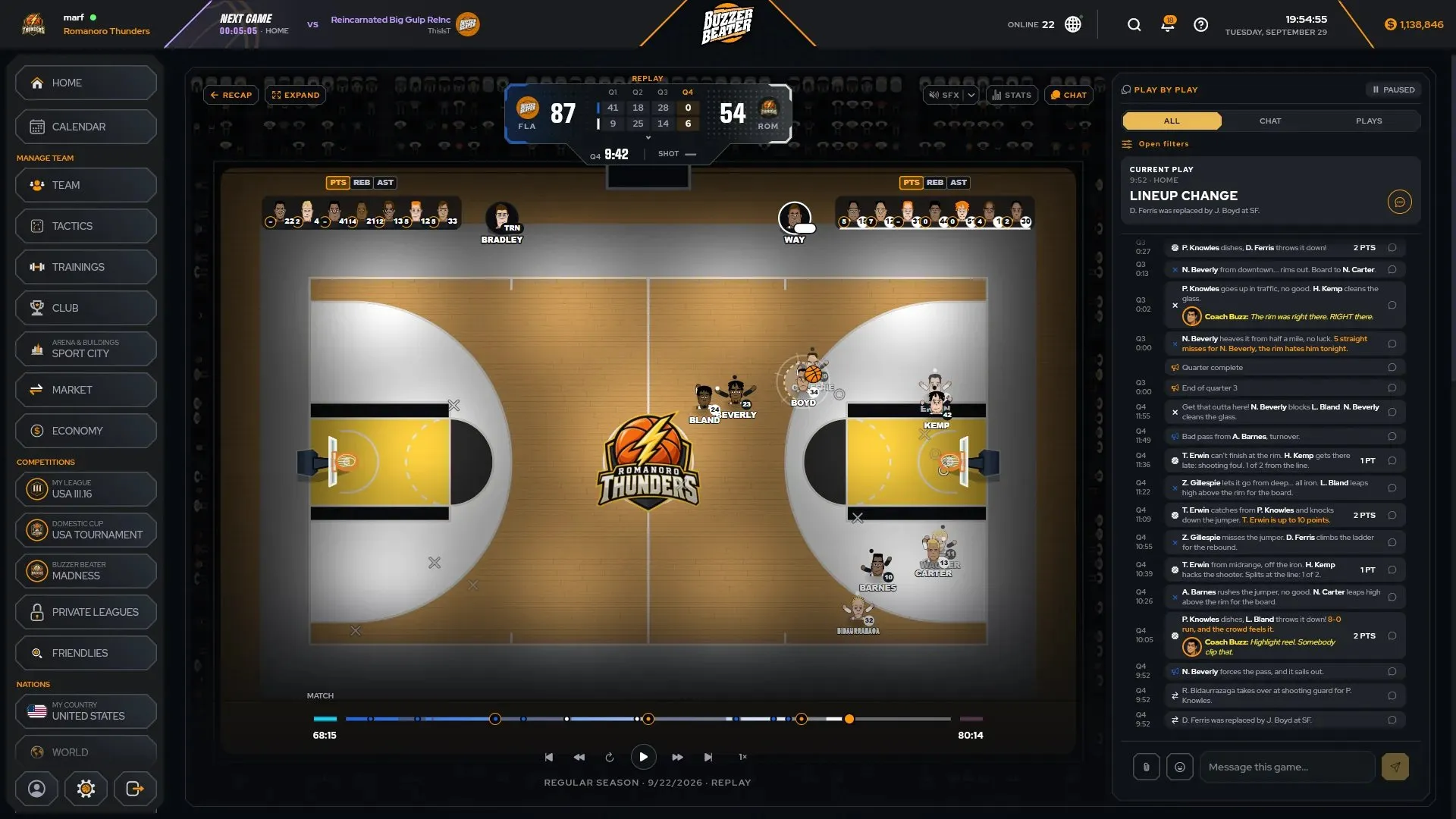
The new match viewer: cartoon players move on a 2D court following each engine action, the scoreboard keeps quarter splits and team fouls, and the play-by-play on the right mixes commentary with Coach Buzz, the game’s AI assistant. Image: BuzzerBeater (official open-beta page).
The short version
- Play it if you want a long-term online hobby against human managers, with real tactics, a weekly training puzzle and an auction market where every bid is somebody else’s plan.
- Skip it if you want contracts, cap rules and trade negotiations: BuzzerBeater’s front office is an auction house and a bank account, not an NBA cap sheet.
- The 2026 rebuild matters: the old complaint about the interface is largely answered, and the engine you fight against is the same one veterans have studied for years.
- Timing caveat: we reviewed it four days after the migration. Expect bugs, rule adjustments and a pending rework of the salary formulas.
How we researched this review
We did not create an account, so we did not manage a club, set a lineup, train or bid. This is a researched review, and everything below comes from sources we read or pages we captured ourselves:
- Public pages captured on 14 November 2026 with headless Chrome: the new landing page, the world, country and league hubs, team pages and rosters, and complete match pages (tactics, team and matchup ratings, box scores, shot zones, recap, play-by-play) for games of the Italian third division.
- A small statistical sample: we opened the public box scores of 16 games from Italia III.1, season 73 (15 regular-season games and a playoff final, 32 team-games) to compare the engine’s output with real NBA averages from Basketball-Reference. Sixteen games is a small sample; treat the numbers as indicative.
- The complete public game manual (37 sections, readable without login), the official open-beta letter and FAQ, the rules of conduct, the developer API page, the announcements on the legacy site from October and November 2026, and the English text bundle of the new web client for Supporter and Store wording.
- Store listings: App Store (US and UK storefronts) and Google Play, for both the main app and the beta app, including recent and negative reviews.
What we could not do: see Supporter prices (they appear only after login), read the official forum (it now requires login), or watch a replay in the new viewer: during our session the replay screen and some panels returned “The game service is temporarily busy”, as the servers were still catching up after the migration. Where we describe the logged-in experience, we rely on the official screenshots and the manual, and we say so.
The rebuild: what changed in 2026, and what didn’t
The story starts with an admission. In the open-beta letter on the official site, the new owners write: “We know how it looked from the outside: a site that hardly changed, and news that came in drips.” They explain that while they built the new game, members of the previous management kept the old one running. The letter is signed by Marco, CEO of Spicy Sparks, who joined BuzzerBeater as a 14-year-old in January 2009, during season 7, and later won a league undefeated, 22-0, in season 35.
The technical reasons they give are specific. The old game was “a mosaic”: more than 2,000 database procedures holding the rules, more than 30 separate programs passing the baton to each other at set times for training, the economy, transfers, the draft, cups and national teams, and the website on top. “Every change risked breaking something else.” They chose to rebuild: first brick in April 2024, 29 months of work, code that “would fill more than 11,000 printed pages”, and a single system instead of thirty.
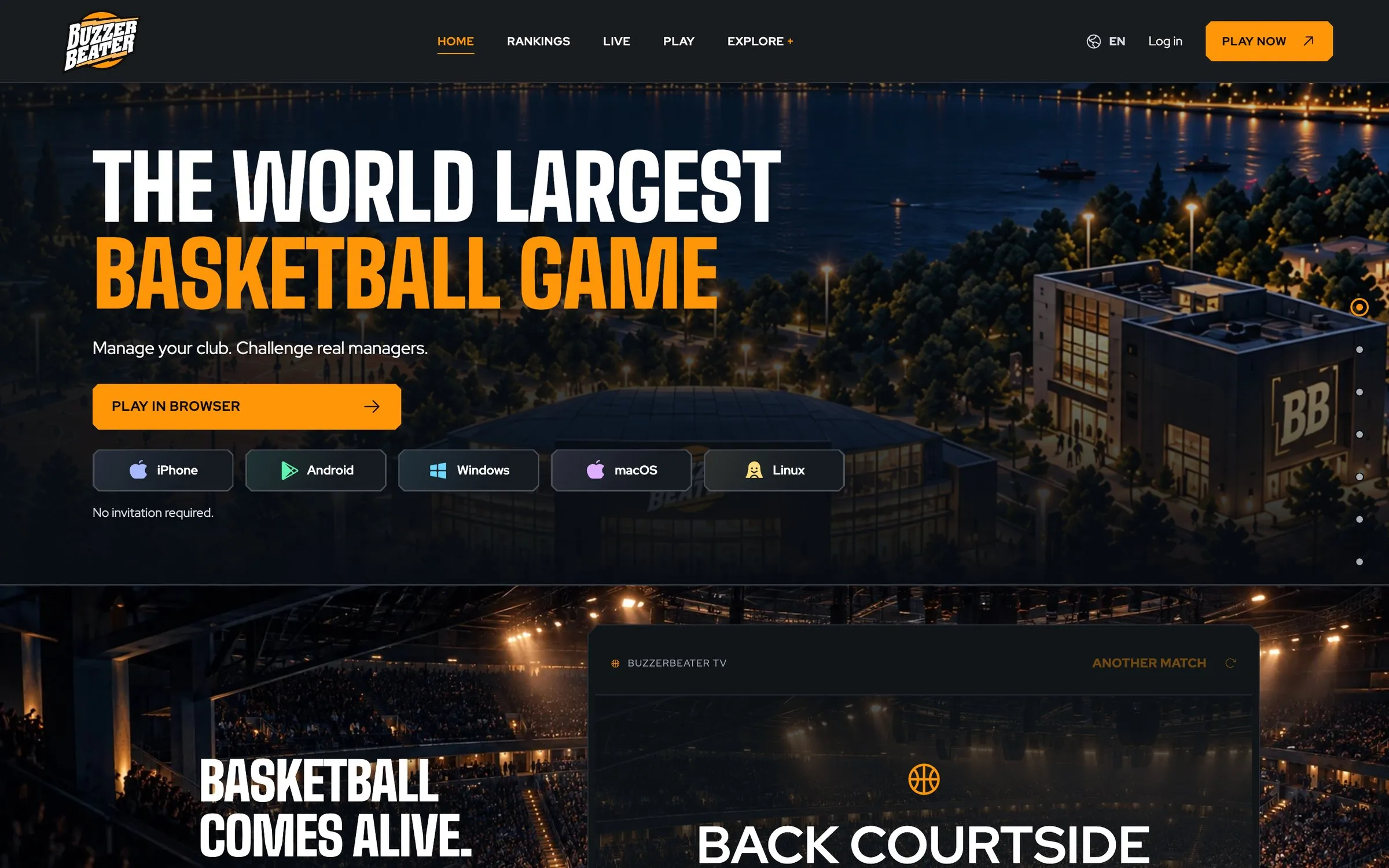 The new public landing page, captured on 14 November 2026. Six ways to play, “No invitation required”, and below the fold an interactive tactics board, a jersey designer and a SportCity preview. The live “BuzzerBeater TV” panel was showing “Back courtside soon” during our visit.
The rule they set themselves: invent nothing
The most important sentence for veterans is about the engine: “We didn’t rewrite it our way. We translated it faithfully from the original code, small quirks included, because you have built years of tactics on that engine.” To prove it, the team keeps a set of reference games; whenever someone touches the engine, the computer replays them and checks that they end “exactly as before, play by play”. The FAQ repeats it: “Your tactics work the way you know them.” When the code and the screens disagreed, they followed what players could actually do in the game; when even the code wasn’t clear, they asked the original developers.
That choice is conservative, and it is the right one. A management game whose community has been reverse-engineering its engine for twenty years cannot afford a new engine with a new meta. The trade-off is that the engine’s age, which we discuss below, comes along too.
What is actually new
The official page shows before-and-after screenshots of five screens, and they are worth looking at closely:
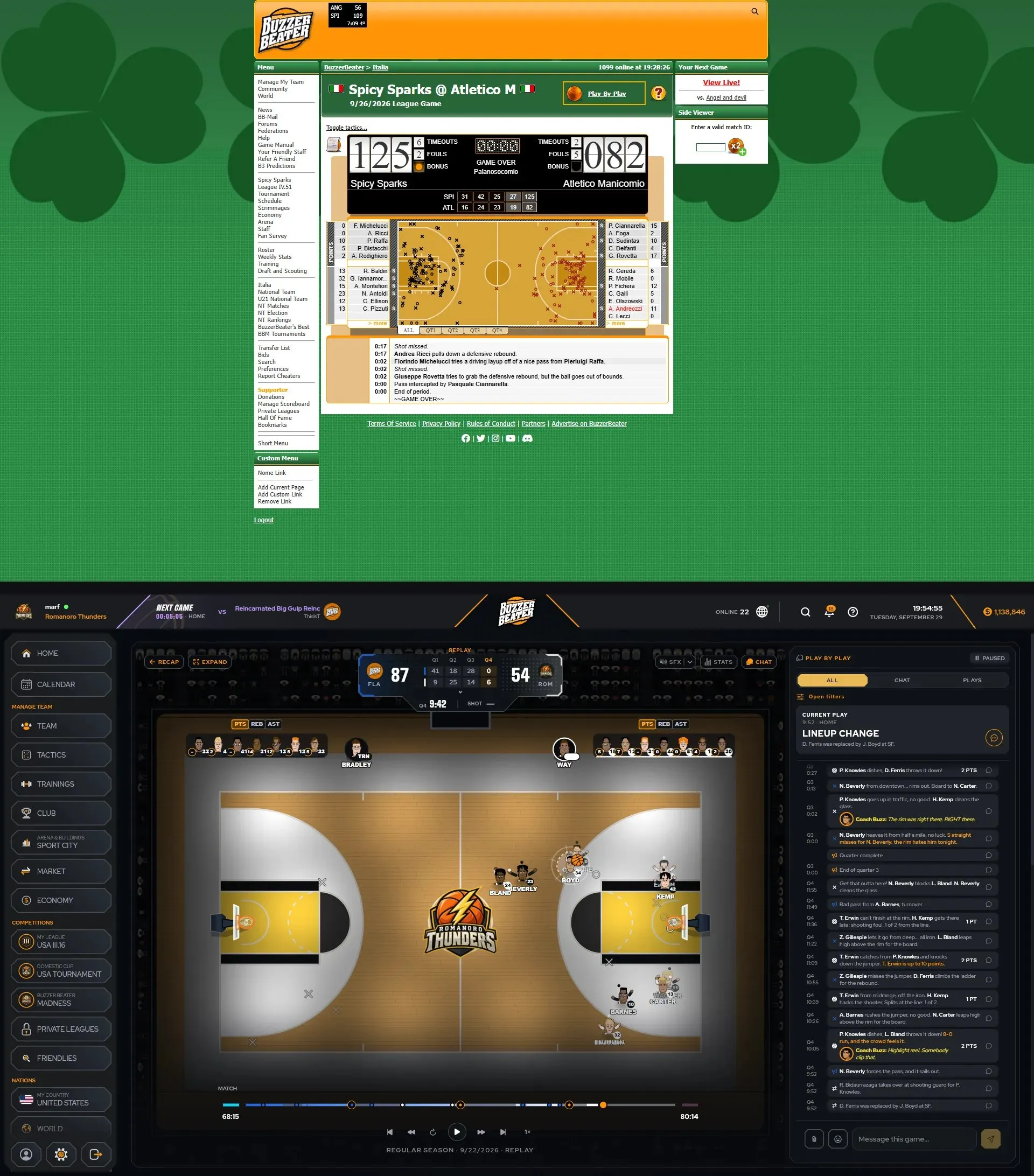 Before (top): a fixed-width page, a shot chart with Xs and dots, a scrolling text box. Today (bottom): players move on a full court, a timeline lets you scrub back and forth through the game, the play-by-play has filters and its own chat tab. Image: BuzzerBeater (official open-beta page).
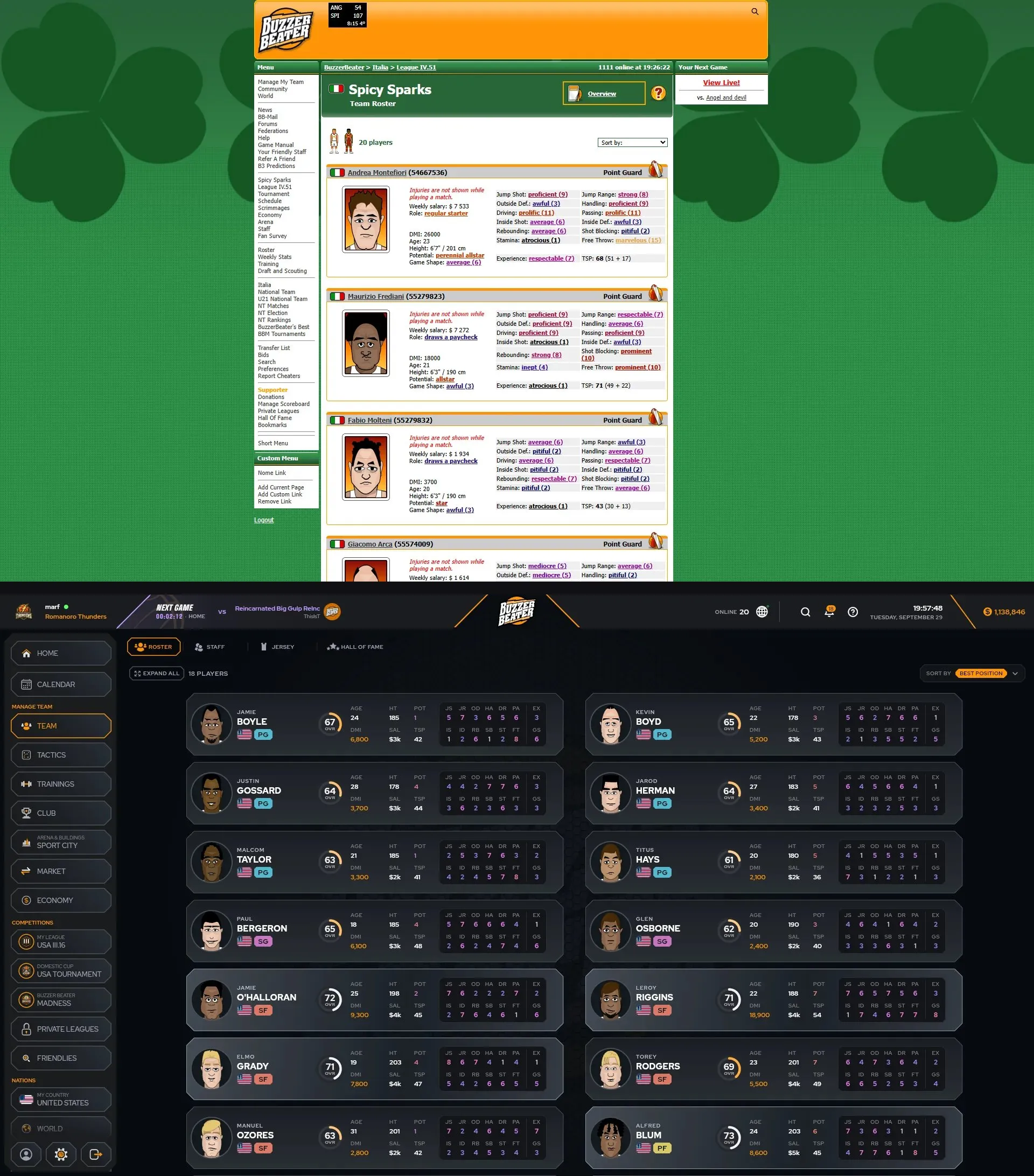 The roster before and today. The old page showed three players per screen with skills spelled out (“proficient (9)”); the new one fits fourteen players with age, height, potential, DMI, salary, OVR and all twelve skills as numbers. Image: BuzzerBeater (official open-beta page).
- Match viewer: rewritten from scratch. “Players move on the court following every action of the engine”, with score, stats and play-by-play at hand, and you can scroll back and forth.
- Tactics: lineup and tactics now sit on one screen, “with your players where they will play”, instead of a long form of drop-down menus.
- Training: the screen shows the drill, what it improves, which positions train it and how fast each grows.
- Standings: table, schedule, playoff bracket and league stats in one place for every competition.
- Phone: the old game needed the separate BuzzerBeater Mobile app; the new site is responsive and works in a phone browser “without zooming”. Beta apps for iPhone (TestFlight) and Android (Google Play) installed alongside the old app during the beta, and desktop builds exist for Windows, macOS and Linux (version 2.0.1).
- Three interface levels: Rookie (essentials, fewer numbers), Veteran (standard) and All-Star (every figure, skills on compact cards). You pick one at the start and can switch in Settings.
- The Classic layout and the classic player portraits remain one click away in Settings, for those who miss the old look.
- Coach Buzz, an AI assistant coach who walks new managers through the first days, comments on events at the club and answers questions “from this manual and from your own club”. He “never changes anything himself: he tells you where to click”, and you can send him home in Settings.
How the switch happened
The timeline, reconstructed from the official pages and the announcements on the legacy site:
| Date (2026 unless noted) | What happened |
|---|---|
| April 2024 | Work on the new game starts |
| 21 September | Closed beta with 121 veterans; 22 updates and 234 bug fixes followed “within a few days” |
| Late September | Open beta: a separate universe, everyone a Supporter, 2-week first season, then 4-week seasons from 6 October |
| 4 October | “Season 74 Update”: most of the previous off-season’s economy changes are reverted after community backlash |
| 21 October | BuzzerBeater Beta app updated on Google Play |
| 4 November | 11,000 invitation emails sent to players of the current game |
| 10 November, 10:00 UTC | The old site goes offline; migration of the whole world begins |
| 11 November | Season start delayed to Saturday 21 November; auctions postponed one week; fix for new clubs placed too deep in the pyramid |
| 11 November | Store opens two additional clubs per manager |
| 12 November | Promotion-bonus error on 31 clubs explained and clawed back |
| 13 November | New salary-floor rule for additional teams takes effect |
The migration did not go smoothly, and the staff said so: “We expected the migration to go smoothly, we load-tested it many times, but a lot of issues arose in the actual, final migration.” The database was “working at 100%” while the game server caught up; the season start moved to 21 November, training to Friday 20, the economy update to 22 November. We saw the consequences on 14 November: some panels said statistics were “still being calculated”, the replay screen would not load, and the landing page’s announcement feed returned an error.
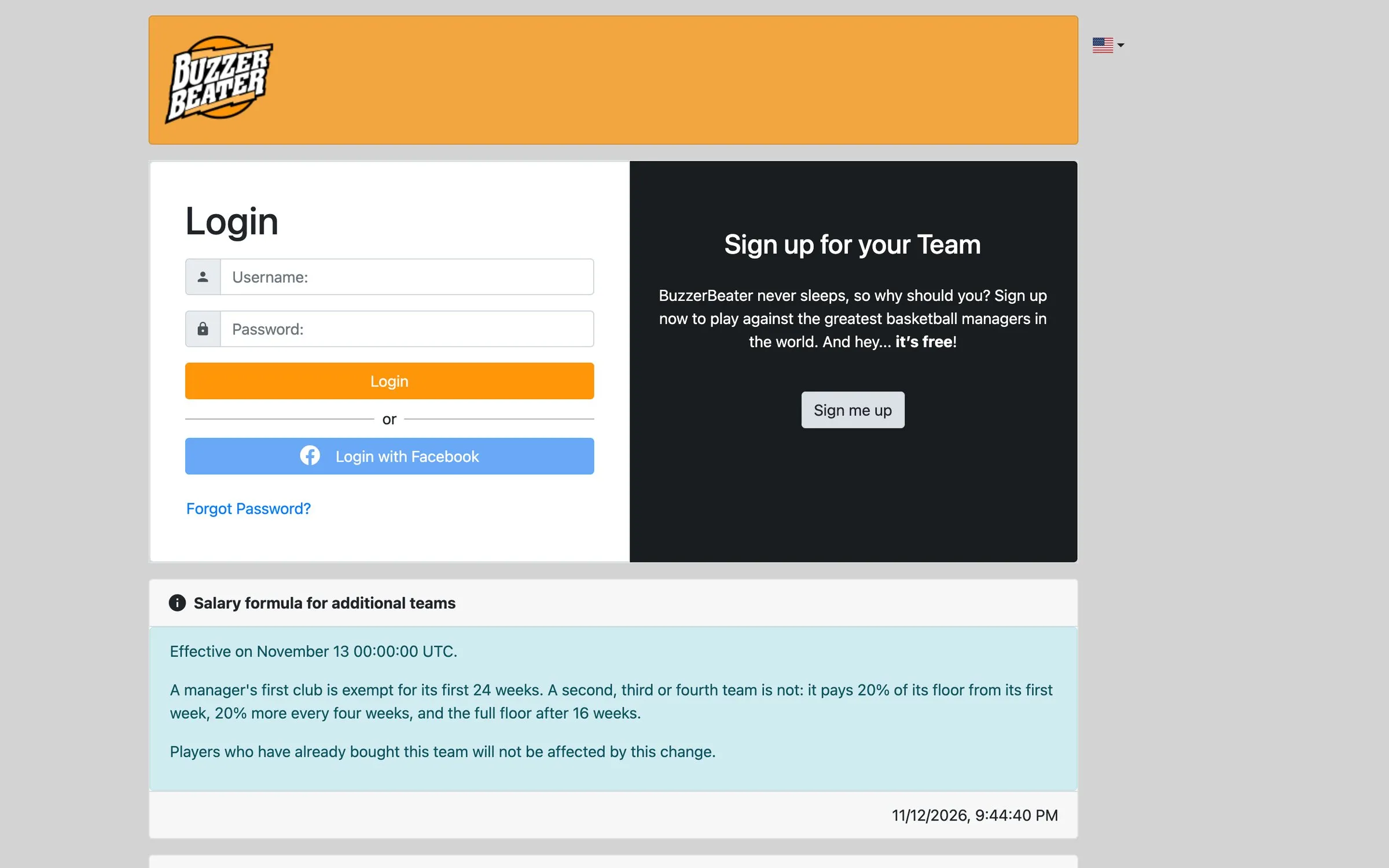 The legacy site (legacy.buzzerbeater.com) in its classic style (orange header, grey page), captured on 14 November 2026. It now serves as a noticeboard: the latest post sets the salary floor for second, third and fourth teams.
A season, step by step
BuzzerBeater runs on a real calendar, and the season is the unit of everything. In the classic game a season lasts 14 weeks (the beta page compares its 4-week test seasons to “the usual 14”). The manual and the public calendar for Italia III.1 describe the loop:
- The night the season turns. There is no break between seasons. Trophies are handed out, the MVP vote is counted, the draft runs (three rounds, worst record first), clubs move up and down, prizes are paid. Every player turns a year older, injuries are cleared, Game Shape is reset and salaries are recalculated from current ratings. The new schedule is created and the first league round is played that same evening.
- The regular season: 22 games. Your league has 16 teams in two conferences of eight. You play every team in your conference twice and every team in the other conference once: 14 plus 8. The season that starts on 21 November ends its regular season on 6 February 2027, so the league plays two rounds a week. Every round puts one game on television; televised league games give players double experience.
- The weekly rhythm around it. The national cup plays one round a week (Thursdays in the current calendar, starting 26 November). BuzzerBeater’s Best plays on Wednesdays. Private leagues play on Friday evenings in a standard season. Training runs once a week, the economy update once a week, plus a daily update. A club not involved in a cup round can book one scrimmage a week. Tactics and ticket prices lock 15 minutes before tip-off (two minutes for a scrimmage).
- The All-Star break. Reporters pick an All-Star team per conference (two players per position) and the game is played after a three-point contest. For the current season the break runs 3 to 8 January, with the game on 6 January.
- Playoffs and play-downs. The top four of each conference make the playoffs: one-game quarter-finals in each conference (1 vs 4, 2 vs 3), one-game semifinals, then a best-of-three final. The champion goes up, along with the clubs with the best records where places are free. At the bottom, the 8th of each conference drops automatically, and places 5 to 7 play best-of-three play-downs. In the current calendar the quarter-finals start on 9 February and the final’s third game is on 21 February.
- Postseason economics. Clubs with nothing left to play pay no wages for two weeks; play-down clubs pay half, then nothing. The manual suggests using that window to sell players you won’t need and to give youngsters scrimmage minutes.
Then it turns again. The promise of the design is that every week has a decision (training, a lineup, a bid, a ticket price) and every season has a stake: promotion, survival, a cup run, a call-up.
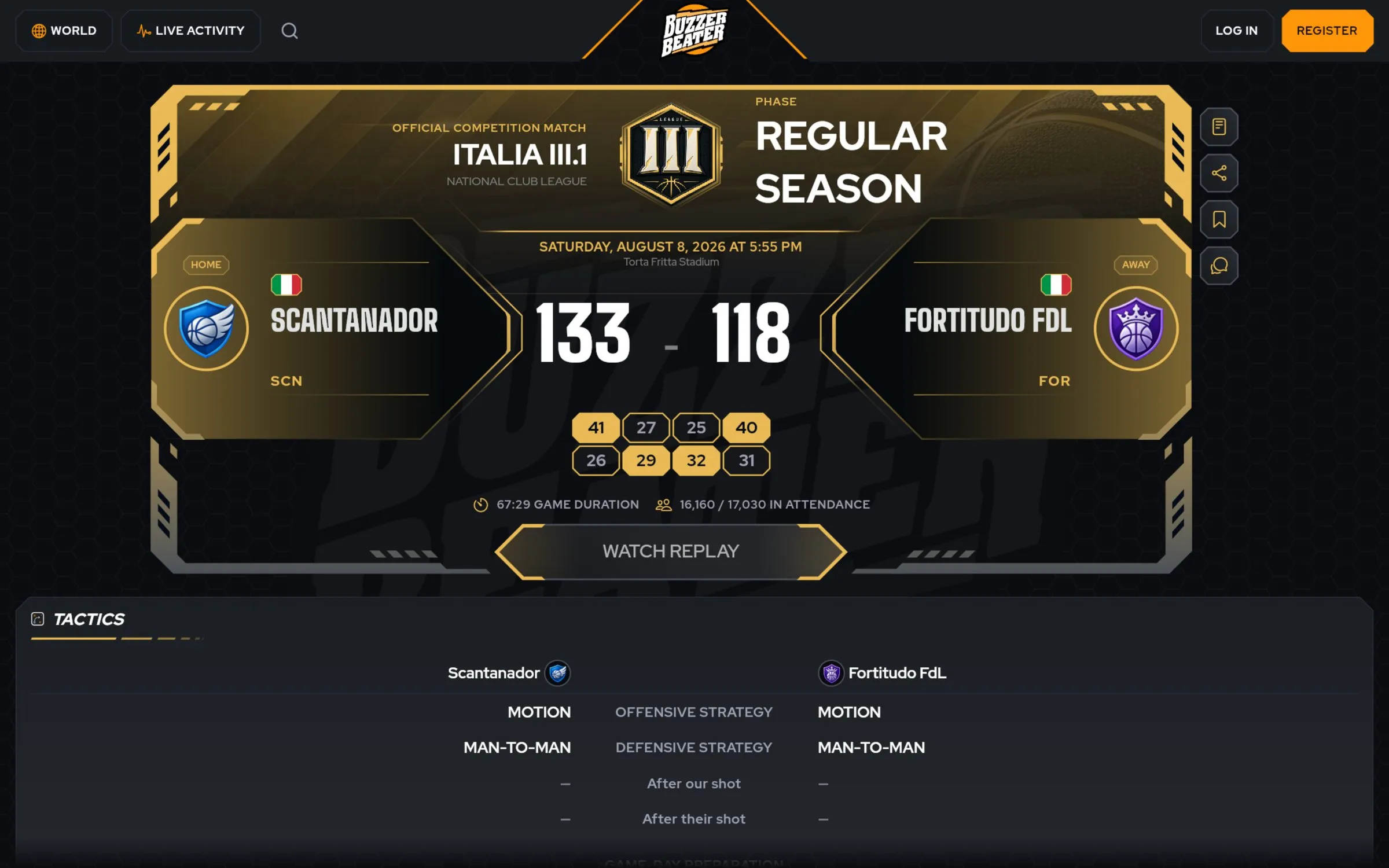 A public match page from the Italian third division, season 73, captured without logging in. Quarter splits, the arena (16,160 of 17,030 seats sold), game duration and a “Watch replay” button.
The match engine: possessions, matchups and a slightly old-fashioned shot chart
BuzzerBeater simulates games possession by possession, and it is upfront about how. The manual’s “Game Engine” chapter describes a half-court model in which a team gets “a series of opportunities to score”. The kind and quality of each look depend on the offense being run and on the matchups between attackers and defenders. Then the player decides whether to shoot, depending on the shot clock, his experience, the score, the quality of shots the team has seen recently, and whether “that rookie shooting guard of yours thinks he knows better than the coach does”. The adjustments, the manual says, take up “over 10,000 lines of code”.
Three ideas matter in practice:
- Pace and focus. Every offense is a combination of pace (faster, slower, normal) and focus (inside, outside, normal). Focus improves the looks you get in one area and worsens the other, and the manual warns that “in general the marginal gain you get is outweighed by the loss”: you focus only where you really have an edge.
- The coach adjusts, but badly. During the game your coach reacts: more inside shots if they are falling, more post double-teams if the opponent is scoring inside. But “any time that the coach makes a change away from the tactics you started out with, it will be less effective”. The game is decided by what you submit before tip-off.
- Usage pressure. A great player who is the only option on a bad team “will draw more coverage, and therefore his shooting percentage will go down”, while a bad player shoots mostly when wide open.
What you can see
The new match page is a small analytics suite, and most of it is public. On the game we captured we could see both teams’ offensive and defensive strategies, team ratings in six areas (outside scoring, inside scoring, perimeter defense, inside defense, rebounding, offensive flow) on BuzzerBeater’s word scale, and matchup ratings by position. A matchup rating is “the number of points that players at a given position would have scored, on average, if they were to take 100 shots”.
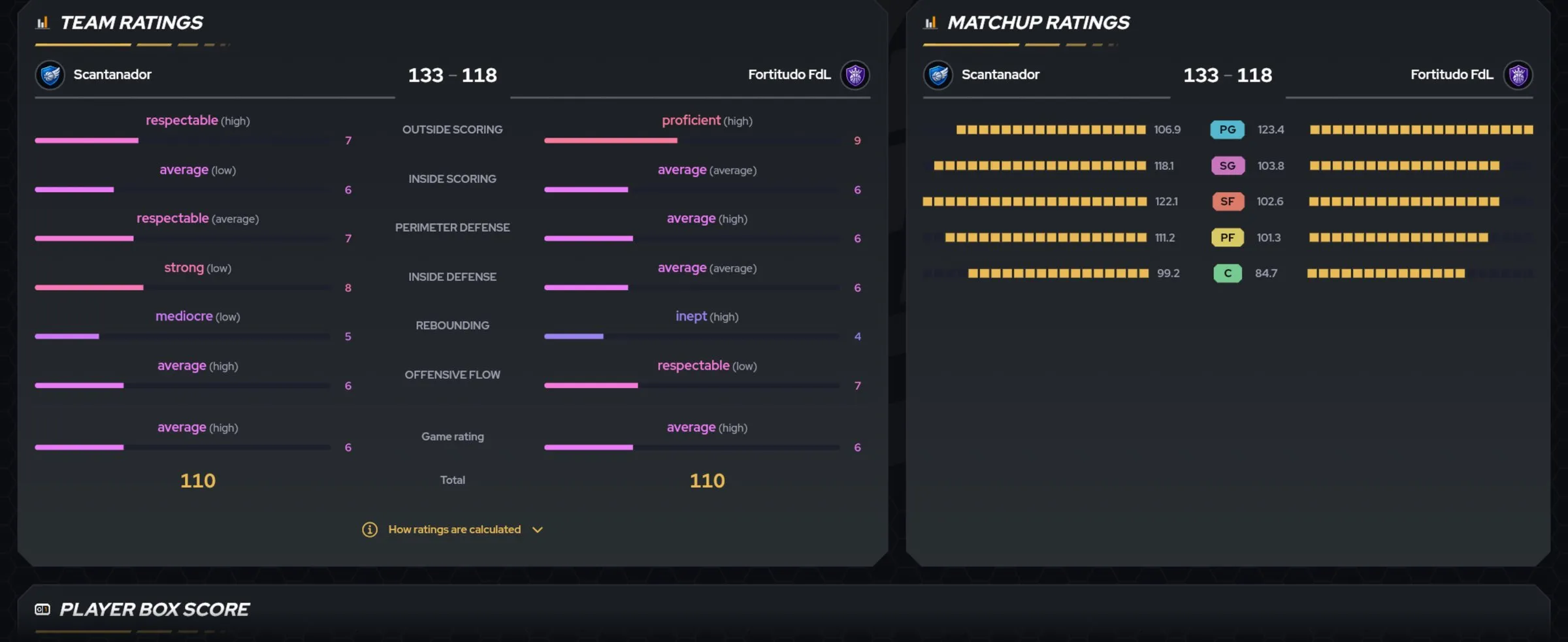 Team ratings (left) and matchup ratings (right). Both teams rated 110 in total, yet Scantanador won by 15. The matchup panel shows where: its shooting guard and small forward found looks worth 118.1 and 122.1 points per 100 shots against 103.8 and 102.6 for Fortitudo, while Fortitudo’s point guard had the best matchup on the floor (123.4).
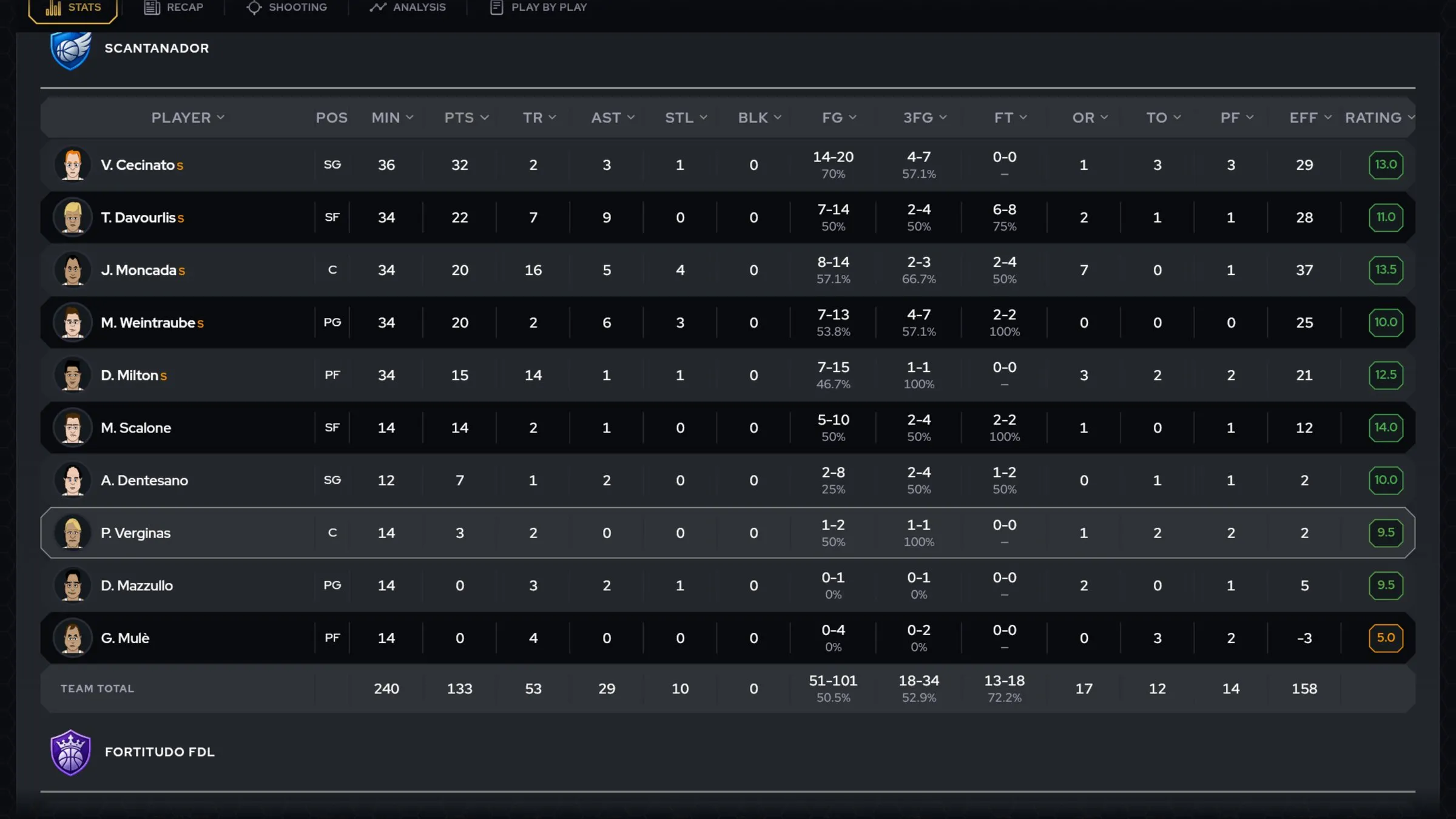 The box score: minutes, points, rebounds, assists, steals, blocks, field goals, threes, free throws, offensive rebounds, turnovers, fouls, efficiency and a per-game rating. Note the rotation: five starters at 34–36 minutes, five reserves at 12–14, exactly what a depth chart produces.
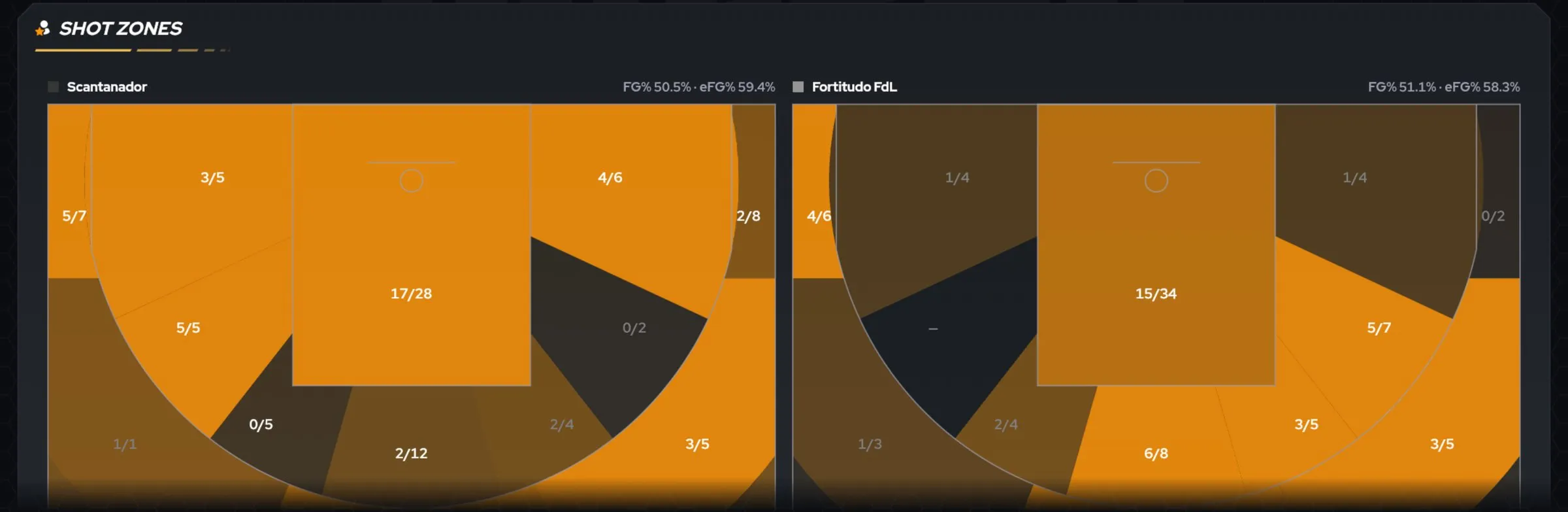 Shot zones by area, with FG% and eFG% per team (59.4% eFG for Scantanador). Even in this high-scoring game the paint dominates: 17 of 28 and 15 of 34 at the rim, with corner and wing threes a secondary diet.
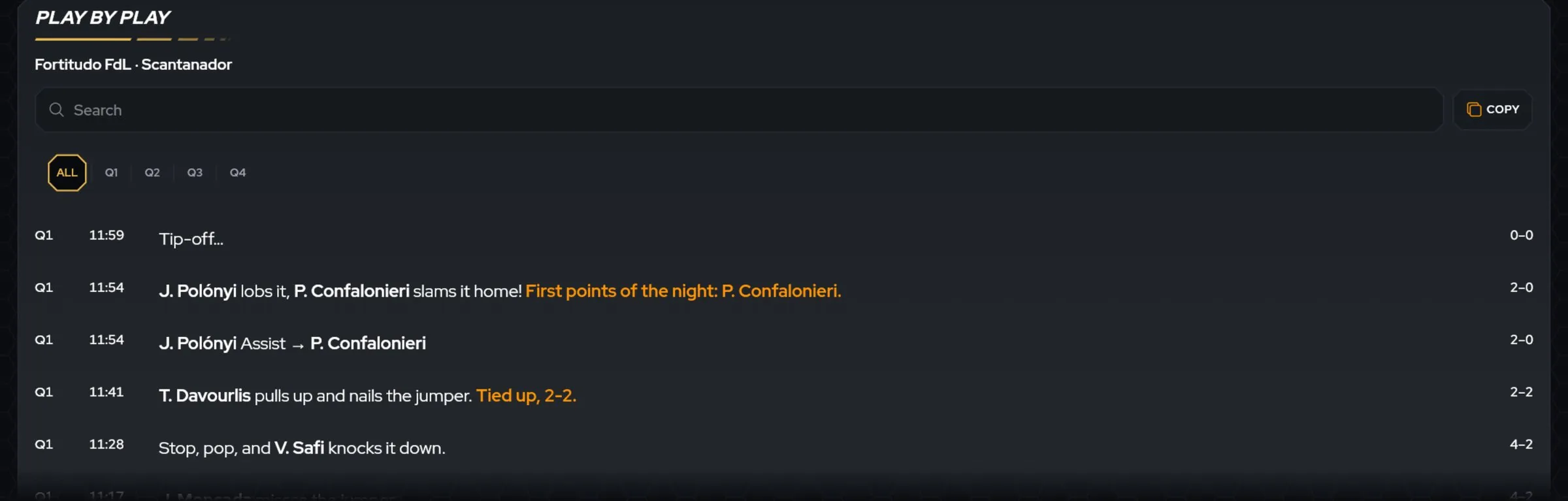 The play-by-play, with search, quarter filters and a copy button. The commentary is short and specific (“J. Polónyi lobs it, P. Confalonieri slams it home!”), and the engine logs assists, second chances and ties as separate events.
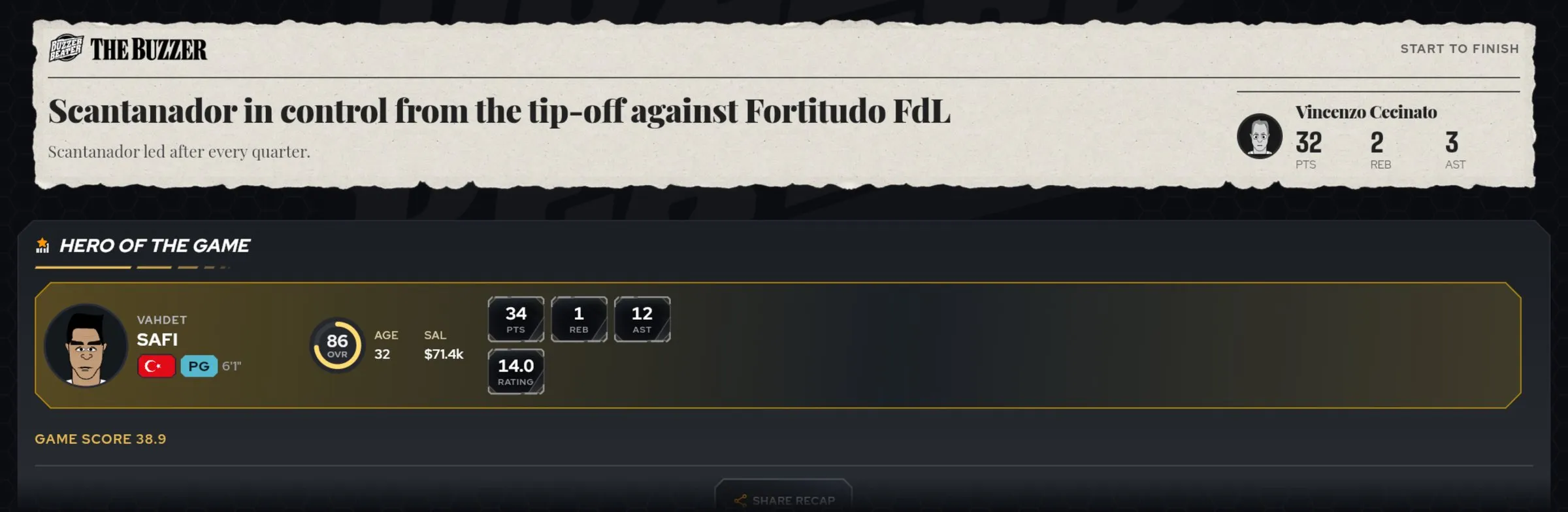 The Recap tab turns the box score into a front page (“Scantanador in control from the tip-off against Fortitudo FdL”) and names a Hero of the Game. Here it picked the losing point guard, Vahdet Safi: 34 points and 12 assists.
Our observation about access is worth flagging. For years the community scouting site BuzzerShark has explained that play-by-play, defensive switches and shot maps require a Supporter subscription on BuzzerBeater. On the new public match pages we captured logged out, play-by-play and shot zones were visible. We could not check whether logged-in non-Supporters see the same, or whether this will change.
Is it realistic?
We took 16 public box scores from Italia III.1, season 73, and averaged them per team-game. Then we compared them with NBA league averages from Basketball-Reference:
| Per team, per game | BuzzerBeater (16 games, Italia III.1, S73) | NBA 2009-10 | NBA 2025-26 |
|---|---|---|---|
| Points | 105.6 | 100.4 | 115.6 |
| Field goal attempts | 92.4 | 81.7 | 89.1 |
| Field goal % | 44.3 | 46.1 | 47.1 |
| 3-point attempts | 22.6 | 18.1 | 37.0 |
| 3-point % | 36.9 | 35.5 | 36.0 |
| Free throw attempts | 21.4 | 24.5 | 23.5 |
| Offensive rebounds | 11.9 | 11.0 | 11.4 |
| Assists | 23.1 | 21.2 | 26.7 |
| Steals | 5.9 | 7.2 | 8.4 |
| Turnovers | 10.8 | 14.2 | 14.5 |
| Personal fouls | 16.2 | 20.9 | 19.9 |
The picture is coherent basketball with an older shape. Shooting splits and offensive rebounding are in a believable range. But three-point volume sits between the late-2000s NBA and today’s, and the engine produces fewer turnovers, steals and fouls than any modern NBA season. Games play out over 48 minutes in 12-minute quarters, and the manual says team fouls “follow the NBA rules”.
That is the cost of the “invent nothing” rule. It protects twenty years of tactical knowledge, and we think it was the right call for the migration. But the engine has not been modernised, and the staff have shown they will adjust it: a planned nerf of the 3-2 zone was announced for season 74, then withdrawn after feedback. Engine changes in BuzzerBeater are community politics, not patches.
What you can’t do
You cannot intervene. The manual is explicit that the game engine “takes no requests once the game starts, so the real work happens before tip-off.” You can watch live with running commentary, chat in the game’s own room, and replay it afterwards. If you want to call a timeout, play Hoop Land.
Coaching and tactics: the best reason to play
This is where BuzzerBeater earns its reputation, and the rebuild makes it easier to use.
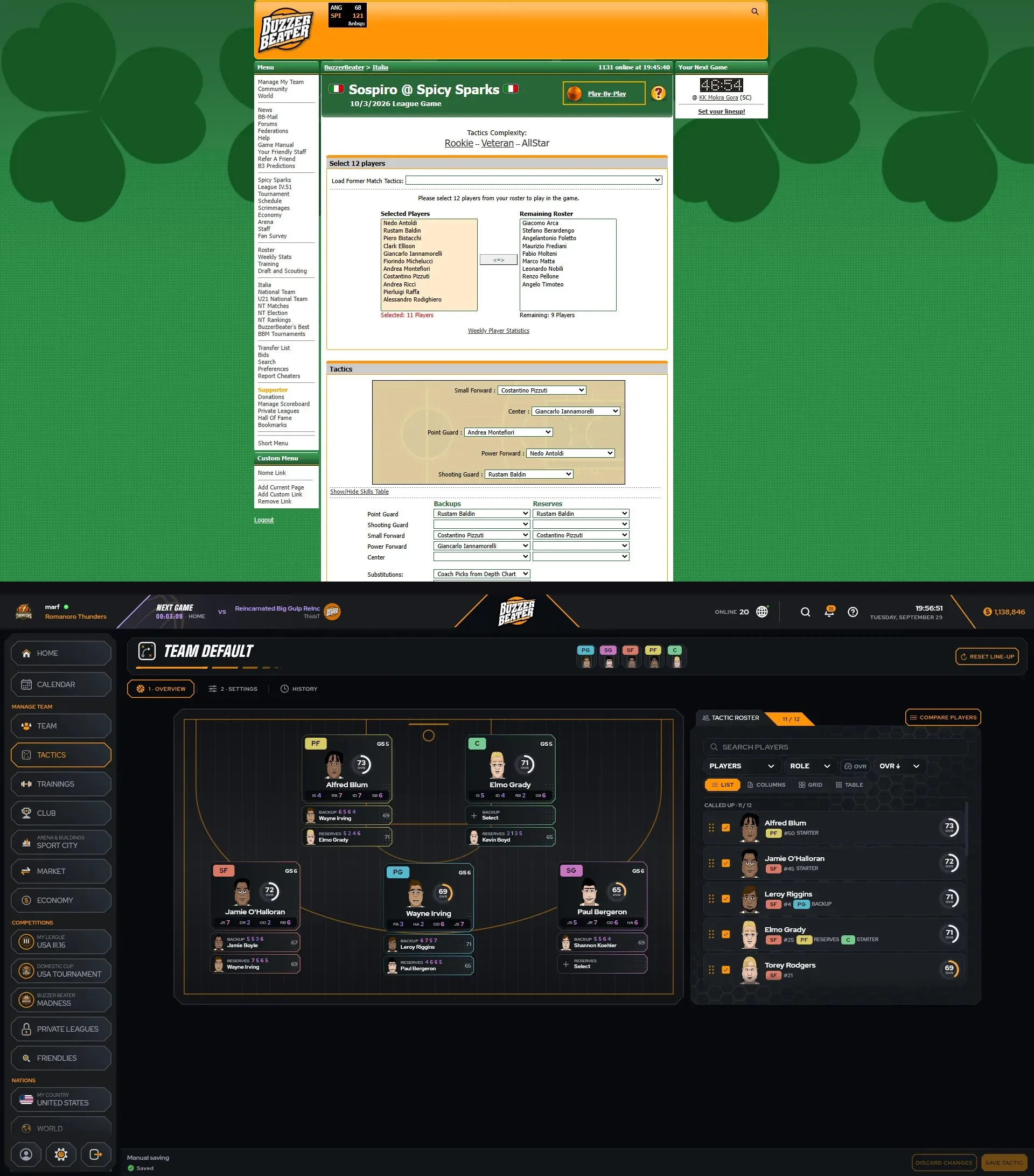 The tactics editor before and today. The old form (top) listed 12 dressed players, starters by drop-down and backups and reserves below. The new editor (bottom) puts starters, backups and reserves on a court diagram, with a searchable roster panel and a “Compare players” button. Image: BuzzerBeater (official open-beta page).
Offenses (10)
| Offense | Focus | Pace |
|---|---|---|
| Base Offense | Normal | Normal |
| Push the Ball | Normal | Increased |
| Patient | Normal | Somewhat decreased |
| Look Inside | Inside | Slightly increased |
| Low Post | Inside | Somewhat decreased |
| Motion | Outside / mid-range | Normal |
| Run and Gun | Outside | Increased |
| Princeton | Outside and inside (fewer long twos) | Decreased |
| Inside Isolation | Balanced, best inside scorer | Normal |
| Outside Isolation | Balanced, best outside scorer | Normal |
Defenses (7)
Man-to-man; 2-3 zone (inside defense and rebounding at the cost of a lot of perimeter defense, somewhat slow); 3-2 zone (perimeter over interior, slow); 1-3-1 zone (dramatically more perimeter defense, weaker inside and on the boards); Full Court Press (more turnovers forced, at a cost in stamina, defense and rebounding, very high pace); and two box-and-ones that shadow the opponent’s best inside or outside scorer. The manual’s advice is a good summary of the design: “Every defense is a trade.”
The other levers
- Game-day preparation. You can predict the opponent’s offense along two dimensions, focus and pace. Predict right and you gain “a sizeable edge”; misread completely and your players are unprepared. A near miss costs less than a complete misread, and leaving it empty costs nothing. This is a scouting mechanic disguised as a tactic, and it rewards reading the other manager’s recent games.
- Enthusiasm. Your team has a baseline enthusiasm that drifts back to 5. Crunch Time makes them try harder today and costs a week or two of recovery; Take It Easy banks energy for later. The biggest games (playoffs, play-downs, cup semifinals and final) only offer Playoff Normal or Playoff Crunch Time. Managing this across a season, cup included, is the closest BuzzerBeater gets to a strategic layer.
- Depth chart and substitutions. A starter, backup and reserve per position, and four substitution patterns: Follow depth chart, Coach decides, Coach picks positions, Depth chart until 4th. A “Rest the starters” option benches the starters on big leads (more than 30 points late in Q3, 20 in Q4, 15 in the last two minutes).
- Exhaustion. Players aged 27 or older who play most of a game without enough rest can become exhausted in the fourth quarter. Thirty seconds on the bench in the first three quarters does not count as rest.
One design detail deserves attention. In the new tactic editor, the Veteran view offers five offenses and five defenses, and enthusiasm options appear only in the All-Star view; Rookie and Veteran views play every game at Normal. It is a sensible way to protect newcomers. But a new manager who never switches to All-Star is playing with fewer tools than the veteran next door, and the game should say so more loudly.
What’s missing compared with the genre’s best
No per-player instructions (shot selection, defensive assignments beyond the box-and-one), no minutes targets, no playbook or play-calling, no timeouts, nothing during the game. Offline sims like Draft Day Sports give you more knobs. What BuzzerBeater gives you instead is an opponent who also has knobs, and that changes the value of every one of them.
Training and players: the slow, satisfying core
If tactics win games, training wins seasons. BuzzerBeater players have twelve skills: Jump Shot, Jump Range, Outside Defense, Handling, Driving, Passing, Inside Shot, Inside Defense, Rebounding, Shot Blocking, Stamina and Free Throw. Each runs on a 20-step word scale from “atrocious” (1) to “legendary” (20). On top come Experience, Game Shape, potential (a 12-step scale from “Announcer” to “All-Time Great”) and chemistry.
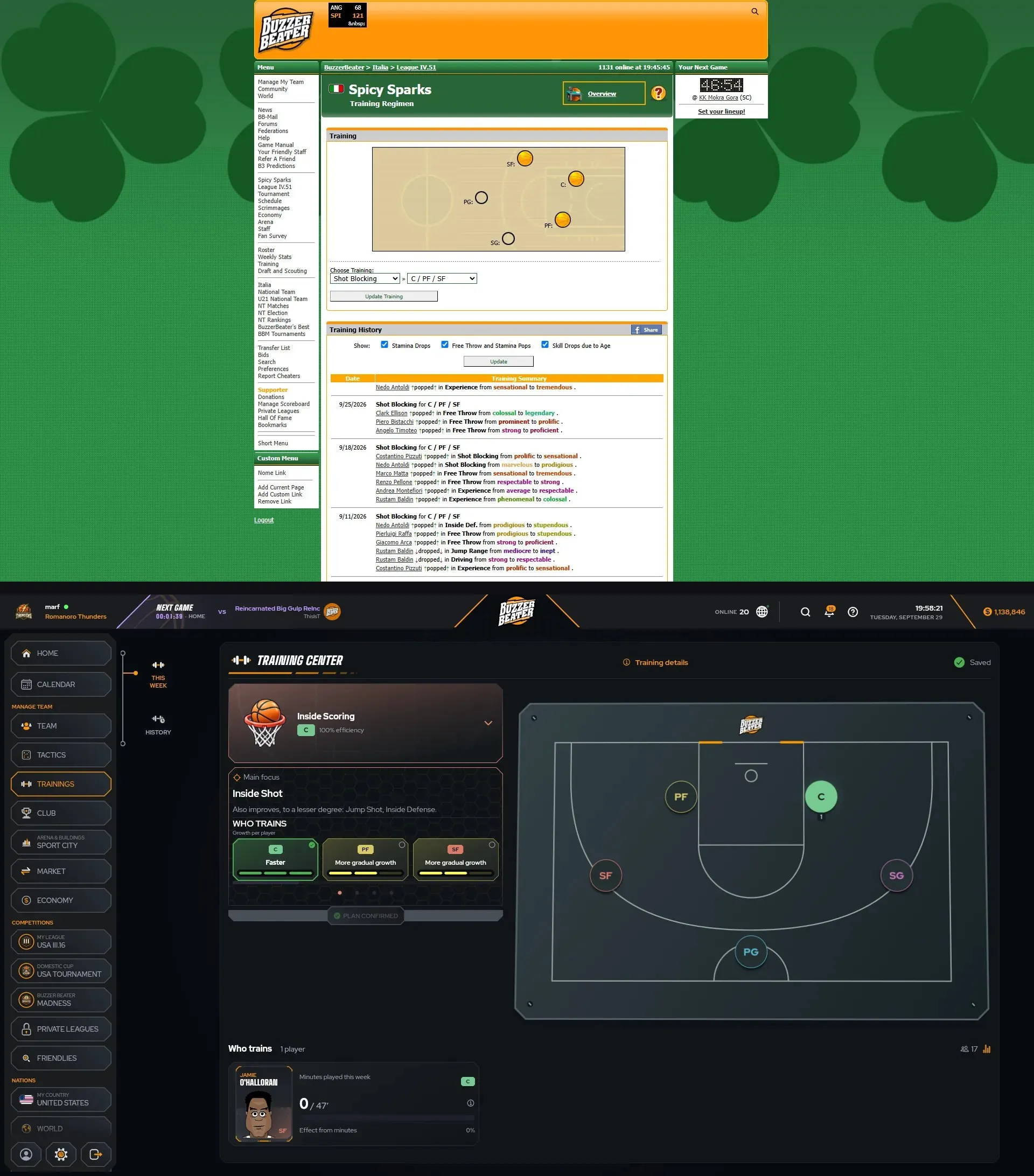 Training before and today. The old page (top) shows the weekly drill and a history of “pops”, single-step skill increases. The new Training Center (bottom) explains the drill (Inside Shot, which also improves Jump Shot and Inside Defense “to a lesser degree”), which positions train fastest, and each trainee’s minutes this week (0 of 47). Image: BuzzerBeater (official open-beta page).
How training works, from the manual:
- One training type per week, aimed at positions. Train one or two key players and they improve fast; train three or more positions and the effect is reduced. Each drill is built for certain positions.
- Minutes are part of training. Full effect needs weekly court time: 48 minutes for ages 20 to 26, 45 for 18 and 19, 40 for 27 and older (with a one-minute buffer). League, cup, playoff games and scrimmages count; BuzzerBeater’s Best, Madness, private leagues, the All-Star Game and national-team games do not. Your depth chart is therefore a training plan.
- Team Training, Free Throws and Stamina train the whole roster regardless of minutes.
- Potential is a soft cap: players who reach it still improve, but much more slowly. Younger players improve faster, taller and shorter players train faster in different areas, and better players improve faster in related skills.
- Cross-training spreads roughly 10% of a typical player’s primary-skill gains into other skills, more for one-dimensional players.
- Game Shape drops if a player plays too little or too much, and changes build up over weeks. In a three-game week you should rotate.
- Chemistry goes from 0% on arrival to 100% after a full season. A settled player’s offensive skills are up to 5% better than a new signing’s in club games. Drafted players and a club’s original squad start fully settled.
The manual also describes the strategy veterans use: train more players than you need in one area and sell the extras on the market. Training is not only how you build a team, it is how you make money.
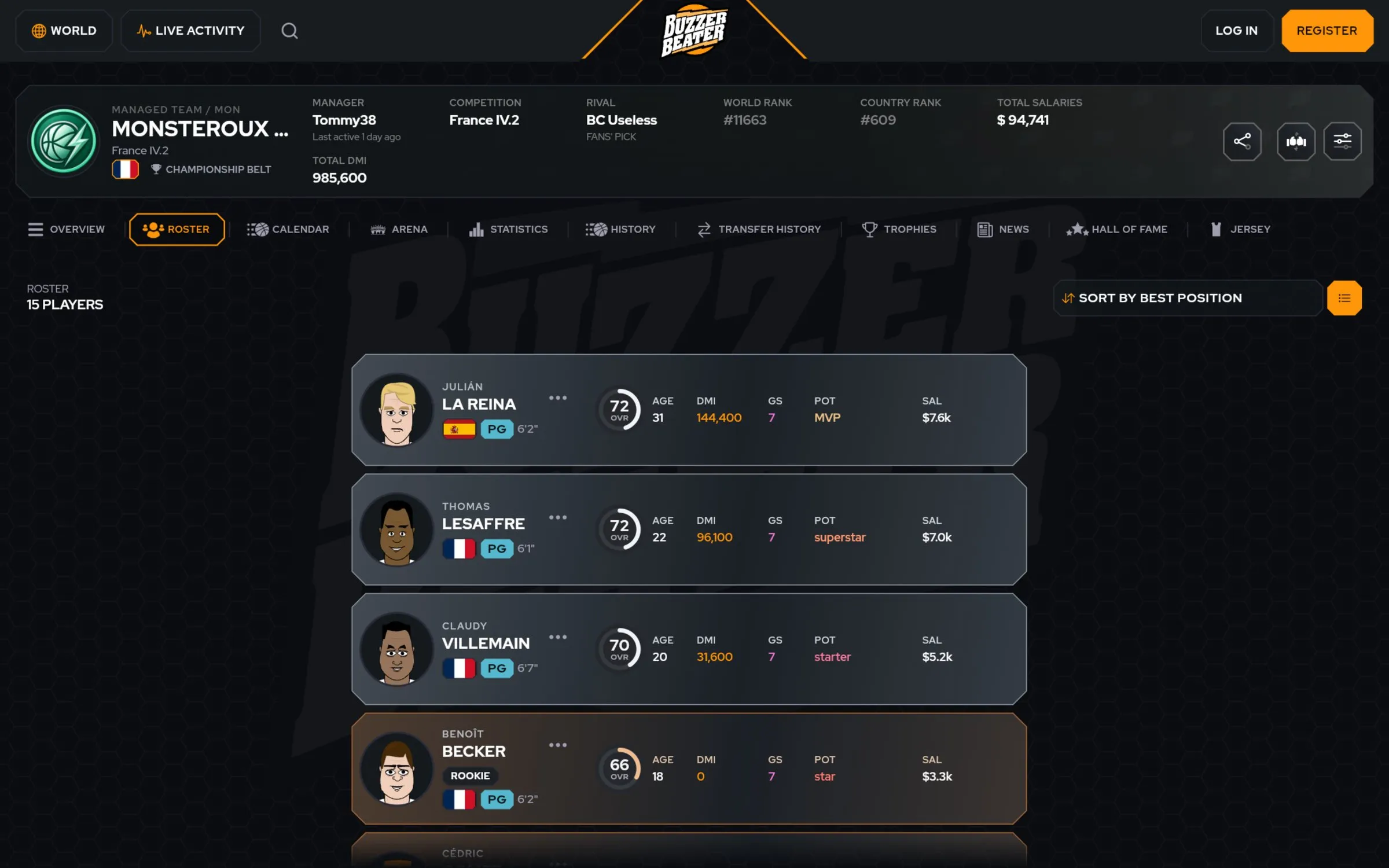 What a rival sees: the public roster of a French fourth-division club shows OVR, age, DMI, Game Shape, potential (“MVP”, “superstar”, “starter”) and weekly salary, but not the twelve skills. Those stay private unless the player is listed for sale.
That last point is BuzzerBeater’s version of scouting fog. You never see another club’s skills unless the player hits the transfer list. You read box scores and game logs instead, and the manual itself calls DMI and best position “very rough” guides.
The draft
Every offseason each league drafts a class of 48 players over three rounds, worst regular-season record first, with no lottery. Forfeits cost you places in the order. Scouting is a points economy: you set a weekly budget of up to 6 points (charged to your expenses), and points carry over between seasons.
- Unscouted prospects come only with a rough ranking.
- Scouting a player once (1 point) gives a box score from one of his games and a better read on his current skills.
- An interview (2 more points) reveals current skills, potential, height and age (18 or 19).
- Seven one-off options cost 10 points each: five drills that reveal two skills for the whole class, a Scouting Combine for ages and heights of all 48, and a Group Demonstration that scouts every 1- or 2-ball prospect.
- Your draft order only counts once you press Submit Ranking.
It is a well-designed little game in itself, and the manual is honest that unscouted estimates are “fairly inaccurate”.
The front office: an auction house, a bank and a building site
Here BuzzerBeater is a different genre from Basketball GM. There is no salary cap, no contract, no negotiation and no trade screen. Salaries are set by the game and recalculated from ratings when the season turns. The front office is three things: the transfer market, the economy, and your arena and staff.
The transfer market
- A first-price auction. Whatever you bid is what you pay. Bids cannot be retracted, and the money is locked while you lead. You can also set an auto-bid, a private ceiling up to which the game raises your bid for you.
- Anti-sniping. Every bid extends the auction so that three minutes must pass without a new bid.
- Listings run three days, up to seven for Supporters, and cannot be withdrawn once confirmed.
- Selling costs money. Agent fees and taxes depend on how long you have owned the player and on how many sales you made in the past 14 weeks. You cannot list a player you have owned for less than four days.
- Search. You filter by up to four skills (eight for Supporters), plus age, height, salary, potential, Game Shape, experience, position, nationality and injuries. You can save five searches.
- Firing. A fired player earning at least $2,500 a week becomes a free agent on the list at ten times his salary (capped at $500,000); cheaper players just leave. Unsold free agents retire.
The integrity layer is serious. Bidding above market to move money between friends gets both teams fined or banned; suspicious sales can be held for 24 hours and cancelled; the rules ask sellers to report overbids themselves. It works because the market is the game’s only economy between humans.
Money
The economy updates weekly. Income comes from tickets (four seat tiers, with price ranges from $5 to $20 for bleachers up to $400 to $1,600 for luxury boxes), merchandise (better when you win, with domestic and self-drafted players, and with national-team call-ups), a TV contract shared by the league, cup prizes and season prizes. Costs are player salaries, staff salaries, scouting, construction, SportCity maintenance and purchases.
Several rules shape strategy:
- A salary floor tied to TV money. A manager’s first club is exempt for 24 weeks; since 13 November, second to fourth teams pay 20% of their floor from week one, rising every four weeks.
- A hoarding tax of 10% a week on cash above $25 million, to punish passive managers.
- Debt costs 5% a week. End four weekly updates in a row below −$500,000 and the club goes bankrupt: the squad is replaced, and the books restart.
- Promotion bonuses are the biggest payments most clubs ever receive: $1,500,000 for promotion into Division I down to $225,000 for the lower divisions. Champions also get a prize ($400,000 in Division I, half for the runner-up).
- Loyalty pays. Players who stay three full seasons add a merchandise loyalty bonus (15%, up to 75% after seven), plus a small career bonus for honours.
The economy is also the most contested part of the game in 2026. During the season 73 off-season, the staff announced new salary formulas, a lower hoarding-tax threshold (15 million), a nerf to the 3-2 zone and other changes. On 4 October they reverted most of it: “we rushed their implementation and did not give managers enough time to prepare. We take responsibility for that.” They promised a data-driven review of the economy and the salary formulas after the official launch, with “a group of experienced and knowledgeable BuzzerBeater managers”. Anyone starting now should expect the salary rules to change within a few seasons.
Arena, staff and SportCity
- Arena. You expand by seat tier and set prices per tier. A new club in the new game starts with 6,104 seats (5,438 bleachers, 550 lower tier, 110 courtside, six luxury boxes). Expansions take time, and the manual warns that the estimates are optimistic. The new attendance screen plots price against seats filled for every home game.
- Staff. Three essential roles (Doctor, Trainer, PR Manager) and three secondary ones (Youth Trainer, Sports Psychologist, Nutritionist), each on seven levels from “minimal” to “world-renowned”, with specialties such as taping injuries, career extension or crowd involvement. You hire them at auction on the Staff Market, against other managers. Firing costs a week of salary.
- SportCity. Five buildings, each with three levels: Gym (more cross-training), Training Court (free throws during the season), Health & Recovery Center (faster healing), TV & Radio Station (fan mood and season tickets) and Merchandise Store. The manual calls even level one “luxury”, not for fresh teams.
There is real depth here, but it is the depth of a club owner, not of an NBA general manager. You never decide whether to give a 30-year-old a fifth year, never fit a trade under the cap, never decline a team option. If those decisions are why you play basketball management games, BuzzerBeater will feel shallow in exactly the place Basketball GM is deep.
World and longevity: a planet of leagues
BuzzerBeater’s world is its strongest argument after the humans in it.
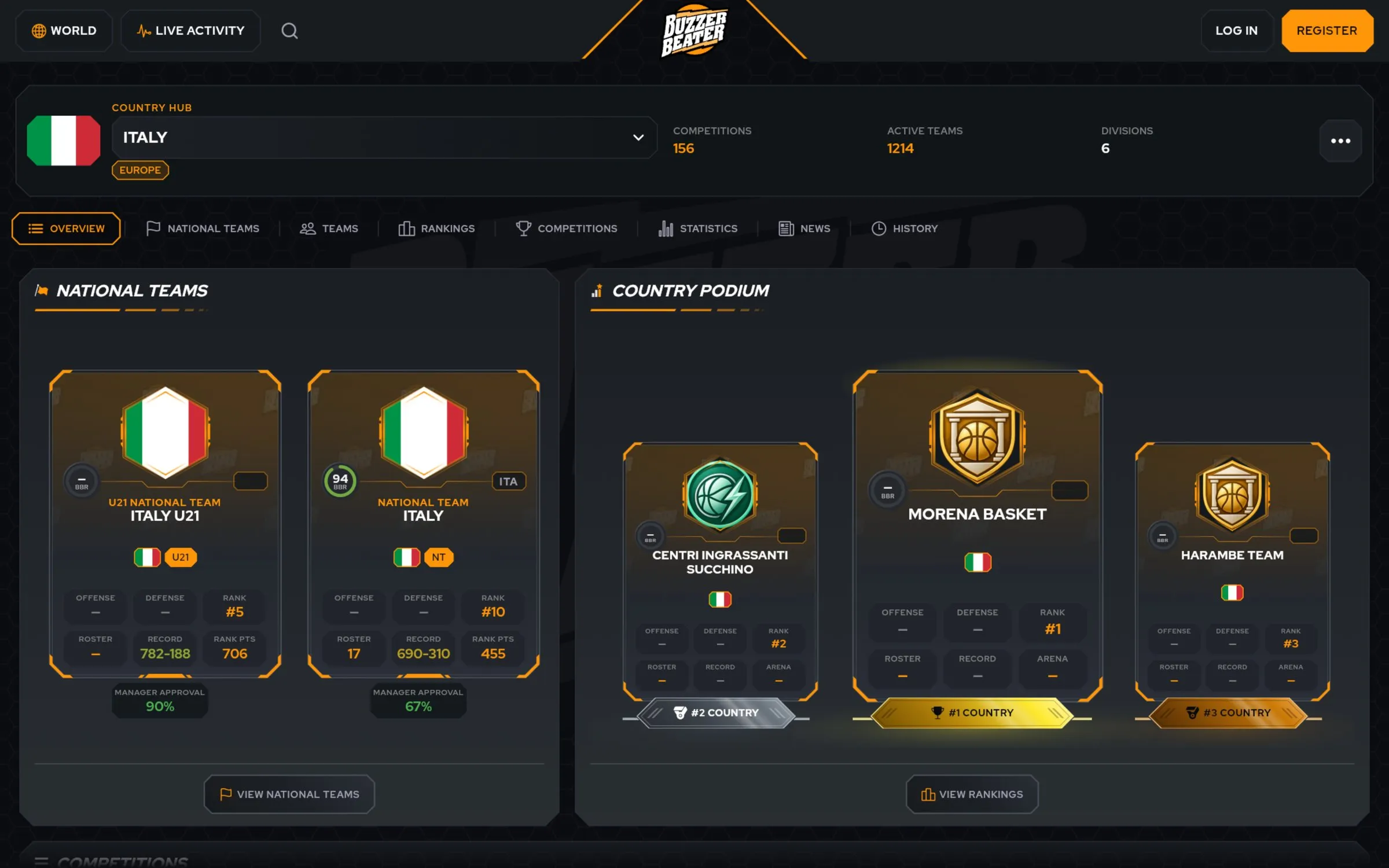 The public Italy hub: 156 competitions, 1,214 active teams, 6 division levels. The senior team ranks #10 in the world, the U21 #5, and 90% of Italian managers approve of the U21 coach they elected.
| Competition | Who plays | Format |
|---|---|---|
| National league | Every club, in leagues of 16 (two conferences) stacked from Division I down | 22 games, top-4 playoffs, best-of-three final, play-downs for 5th–7th, automatic drop for 8th |
| National Tournament (cup) | Every managed club with a league place, plus bots to fill the bracket | Single elimination, one round a week, cash per win, no ticket revenue |
| BuzzerBeater’s Best (B3) | 128 clubs: each country’s cup winner and Division I champion, the previous Madness top-tier winner, past B3 champions still ranked in the top 500 | Seven Swiss-system qualifier games, then a 64-team knockout; neutral courts on Wednesdays; $50,000 per qualifier win up to $500,000 for the final |
| BuzzerBeater Madness | The other clubs, in tiers | Season-long; the top-tier winner earns a place in the next B3 |
| National teams | Senior and U21 teams of each country | Continental championships in one season, World Championships (16 teams) the next; managers elected by the country’s users |
| Private leagues | 4 to 16 clubs invited by a Supporter | Own schedule and playoffs; no money, no training, no trophies |
| All-Star Game | Two players per position per conference | Three-point contest plus game, no effect on the league |
Across the world, the legacy site counted 14,852 managed teams in 103 countries when we read it. The world page’s competition hub shows the season counter at 73. History is everywhere: team histories, trophies and flags, a Hall of Fame, retired jersey numbers, past MVP votes, a season picker on every league.
The Utopia country is a clever piece of design: a country created for second teams of Supporters from anywhere, with its own cup, draft and B3 places, played on UTC−8 game times “for the proactive managers”. Your two clubs can never buy players the other owns or has owned, to stop one team feeding the other.
The national teams are a social game of their own. Elections last a week: four days of candidacies and votes, a cut to the top five, three more days to decide. Only users of that country with accounts at least four weeks old can vote. The elected manager serves a two-season term, calls up players from clubs around the world, and answers to them in the national team chat.
There is no editor and no modding, which is normal for a shared online world. But there is now a public API (v1): OAuth sign-in, read-only access, quotas per manager, and a principle the developers state plainly: “The API never plays for anyone.” It replaces the old XML “bbapi” that community tools were built on. Tools such as BuzzerShark (unofficial) use it for scouting reports, training planners and salary projections; after the move, BuzzerShark noted that logins could fail while it waited for staff approval on the new platform.
On longevity, few games can argue with a season counter of 73 and managers who have run the same club for more than a decade. The new owners say their goal was a game “built to last another twenty years and, above all, easy to improve”.
Interface, platforms and performance
The rebuild is a genuine upgrade. On a 1440-pixel desktop window, the new site uses the full width; the old one centred a narrow column in the middle of the screen. Every team page now has tabs for overview, roster, calendar, arena, statistics, history, transfer history, trophies, news, hall of fame and jersey. The calendar shows every event in your own time zone and can follow other teams’ games. The manual is searchable and linked from a “?” on every screen.
| Platform | How | Notes |
|---|---|---|
| Browser (desktop and mobile) | play.buzzerbeater.com | Responsive; the official page says it works in a phone browser “without zooming” |
| iPhone / iPad | App Store, “BuzzerBeater Mobile” | Requires iOS 15.1+; version 2.0.1 (November 2026); seller Spicy Sparks LLC; 4.4 stars from 19 ratings (US) |
| Android | Google Play, “BuzzerBeater” | 10K+ downloads, 4.4 stars from fewer than 100 reviews, updated 12 November 2026; listing marked “Contains ads” |
| Android beta | Google Play, “BuzzerBeater Beta” | 100+ downloads, updated 21 October 2026, installs alongside the main app |
| Windows / macOS / Linux | Desktop installers 2.0.1 | Windows 10+ (46 MB), macOS 12+ (89 MB), Linux AppImage (119 MB) |
Languages: the official page says the new BuzzerBeater speaks 34 languages; the site’s language menu lists 54 options, regional variants and a joke “Bostonian” included. The App Store lists English and 45 more.
Accounts and saves: everything lives on the server, so your club is the same on every device. There is no offline play.
Performance: the new client is a heavy single-page app. Pages loaded in a few seconds on our connection, but on 14 November several data calls returned errors (“The game service had a problem”, “temporarily busy”), the replay viewer did not load, and team calendars appeared empty. We attribute this to the post-migration catch-up the staff described, and we will retest.
Monetization, line by line
BuzzerBeater is free to play, and the new client says it “always will be”. Money buys Supporter status and extra clubs. Prices are not shown on any public page: the client says they are “in euro and include VAT where it applies”, and you see them in the Store after logging in. We could not verify the amounts.
| Product | Price | What it buys |
|---|---|---|
| Free account | €0 | The whole game: one club, tactics, training, market, cup, B3, national-team voting |
| Supporter · One Month | Shown after login (euro) | “The whole supporter feature set, month by month. Cancel whenever.” |
| Supporter · Six Months | Shown after login (euro) | Same features, six-month term |
| Supporter · One Year | Shown after login (euro) | “The cheapest way to stay a supporter permanently. Renews yearly.” |
| Second-team option (one year) | Shown after login (euro) | A second club in Utopia or another country; requires active Supporter for as long as the second team exists |
| Additional clubs (third and fourth) | Shown after login (euro) | Since 11 November 2026: up to two more clubs, each in a different country, which cannot vote in national-team elections; salary floor phased in over 16 weeks |
| Gift | Same prices | Supporter can be bought for another manager |
| Free Supporter | €0 | The client text mentions a month for inviting an active friend, Supporter for reaching the B3 group stage and a year for winning B3, plus months of Supporter as prediction prizes (another string in the same bundle says some of these routes were not yet wired up in that build) |
| Ads | — | The Google Play listing is marked “Contains ads”; we did not see ads on the public pages we captured |
What Supporter unlocks, from the manual and the client text: market searches on eight skills instead of four; auctions up to seven days instead of three; the full bid history of every sale (non-Supporters see the last two bids); game logs and training history; creating and joining private leagues; automatic scrimmage booking and up to 15 invitations; keeping your club if you are inactive for more than six weeks; a court background; more daily questions to Coach Buzz; up to five federations instead of one; a badge.
Is it pay-to-win? The official line is clear: “Supporter never makes your team stronger. It buys information and convenience — not faster training, not better draft picks, not a thumb on the scale during a match.” Training, the engine and the draft are indeed untouched. But information is power in a market of humans. Full bid histories tell you what players actually sell for, deeper search finds bargains faster, and longer auctions attract more bidders when you sell. We call it pay-for-advantage, not pay-to-win: a free manager can win a league, and many do, but a Supporter makes fewer blind decisions. The new additional clubs don’t make one club stronger, and the rules forbid your clubs from feeding each other, but they do sell presence: more clubs, more markets, more chances at B3. We would like the prices on a public page before anyone pays.
Update history and roadmap
| When | Version / event | What changed |
|---|---|---|
| 2006 | Launch | BuzzerBeater goes online (“born in 2006, before the iPhone existed”) |
| January 2009 | Season 7 | The current CEO signs up as a 14-year-old player |
| October 2023 – July 2024 | BuzzerBeater Mobile 1.10.5 – 1.10.19 | Regular iOS releases; the app is credited to Digital Field Theory LLP (copyright 2023) |
| Not dated publicly | Acquisition | Spicy Sparks acquires BuzzerBeater; previous management keeps the old game running |
| April 2024 | Rebuild starts | “We laid the first brick of the new BuzzerBeater” |
| 27 December 2025 | iOS 1.11.6 | Mobile update for the old game |
| April 2026 | iOS 1.11.12 – 1.11.13 | Last updates of the old mobile app line |
| Season 73 off-season (2026) | Economy changes | New salary formulas, hoarding-tax threshold cut to 15M, 3-2 zone nerf, SB training including some IS, reduced “elastic effect” |
| 21 September 2026 | Closed beta | 121 veterans; 22 updates and 234 bugs fixed |
| Late September 2026 | Open beta | Separate universe, everyone Supporter, short seasons |
| 4 October 2026 | Season 74 Update | Back to season-72 salary formulas; hoarding threshold not cut; 3-2 zone nerf dropped; SB/IS training and elastic-effect change kept |
| 10 November 2026 | Migration | Old site offline at 10:00 UTC; the world moves to the new platform |
| 11–13 November 2026 | Post-launch fixes | Season start moved to 21 November; new clubs no longer placed alone with bots; promotion-bonus clawback; additional clubs in the Store; salary floor for extra teams |
| November 2026 | Apps 2.0.0 – 2.0.1 | New iOS, Android and desktop builds for the new game |
Roadmap: the staff have promised to publish a roadmap “shortly after the new website moves out of beta and launches as the official version”, and to review the whole economy, salary formulas included, using fresh aggregate data and community feedback. The open-beta letter also names a new salary formula as “our priority as soon as we reach a stable version”, and the long-term ambition: “thousands upon thousands of managers online”.
What players say
BuzzerBeater’s reputation is old and mostly warm, with a recurring thread of frustration about change and communication.
Positive clusters:
- The community and the pacing. On Google Play (April 2024), a reviewer writes: “No pay to win! Really been hooked on it for years”, adding that they love following games live and the two league games per week. On the US App Store (July 2024): “Good game, great community.”
- Usability of the mobile app. Another App Store review (January 2024): “Awesome app for basketball fans, intuitive ui makes navigating easy”.
- Specialist rankings. OnlineSportManagers.com, a directory of online sports managers, shows a user rating of 58.72% from 2,222 votes, but also lists BuzzerBeater as its basketball game of the year for 2011, 2015, 2016 and 2017.
- Nostalgia as a market. When a rival indie game launched in June 2026, its devlog opened with: “If you ever managed a club in Charazay or BuzzerBeater and never found anything to replace them — this is for you.”
- The beta testers, quoted by the developers themselves (so not independent): Edo, a closed-beta tester, said the first opinion many had formed of the new owners “wasn’t true”.
Negative clusters:
- Information in the app. Google Play (February 2024): “It has the potential, yet right now it’s disappointing”, asking to see player attributes while choosing the lineup.
- Accessibility. Google Play (December 2025): with dark mode on, “I can’t see a good portion of the text.”
- Account problems. A US App Store review (September 2025) describes being unable to sign in, password resets failing, and losing a team as a result.
- The 2026 economy changes. The staff’s own apology on 4 October is the best evidence of how badly they landed: “We are sorry for letting you down.”
- The redesign itself. The official open-beta forum thread is now behind a login. Search-engine excerpts of it show veterans asking for a way to keep the old interface and others praising the new visuals; the developers’ answer was the Classic layout toggle. We could not read the thread in full, so we do not quote it.
Store ratings (checked 14 November 2026): App Store US 4.4 from 19 ratings; App Store UK 2 ratings; Google Play 4.4 stars from fewer than 100 reviews, 10K+ downloads; BuzzerBeater Beta on Google Play 100+ downloads.
Known issues and bugs
- Migration load (10–14 November 2026): “The database is working at 100%”, the game server catching up; season start delayed to 21 November, auctions postponed a week. Source: staff announcement, 11 November.
- Promotion-bonus error: 31 clubs in 28 countries wrongly received $300,000 to $750,000 while staff fixed new clubs “placed too deep in the pyramid, often alone with bots”. The money is being taken back, partly from arena work already paid for. Source: staff announcement, 12 November.
- Service errors during our capture: “The game service had a problem” on a team calendar, “temporarily busy” on the replay viewer, failed announcement and release-note feeds on the landing page, and “statistics are still being calculated” on country pages.
- Third-party tools: BuzzerShark warned that logins could fail while it waited for staff approval on the new platform.
- Old mobile app: dark-mode text visibility (Google Play, December 2025) and sign-in failures (App Store, September 2025).
- Economy in flux: salary formulas and the wider economy are officially under review; the salary-floor rule for additional teams changed on 13 November.
Tips for your first season
- Set every lineup early. Tactics lock 15 minutes before tip-off, and the defaults “are not a plan”. Put at least three starters in the depth chart, or the coach may redo the lineup.
- Pick your trainees, then build minutes around them. 48 minutes a week for ages 20–26, 45 for 18–19, 40 for 27+. Use Follow depth chart so the coach doesn’t eat your training minutes.
- Book a scrimmage every week you can. It is an extra game of training and experience; bookings close from Wednesday 17:00 to Saturday 03:00 UTC.
- Treat Crunch Time as a loan. It costs a week or two of recovery, and the cup draws from the same enthusiasm as the league.
- Bid with Available cash, not your balance. Bids cannot be retracted, debt costs 5% a week, and four updates below −$500,000 mean bankruptcy.
- Don’t sell half the roster. Sale taxes climb with recent sales, and some fans hate seeing their favourites listed.
- Leave SportCity alone at first and expand the arena only when sections sell out.
- Don’t fire essential staff to save money. A fired Doctor, Trainer or PR Manager is replaced by someone of minimal skill, plus a week of severance.
- Read skills, not DMI. The manual calls DMI and best position very rough guides.
- Save part of any promotion bonus. The division above has stronger opponents and a higher salary floor.
- Never “help” a friend with a generous bid. Both teams can be fined or banned.
- Switch the tactic editor to All-Star once you are comfortable: it is the only view with all ten offenses, seven defenses and enthusiasm settings.
Against the alternatives
| BuzzerBeater | Basketball GM | Hoop Land | Draft Day Sports: Pro Basketball 27 | Swish & Dunk | |
|---|---|---|---|---|---|
| Opponents | Humans, shared world | AI | AI | AI | Humans, shared world |
| Engine | Possession sim, 2D viewer | Possession sim, text | Playable arcade engine plus sim | Text sim with 2D view | Possession sim, 2D |
| Platforms | Browser, iOS, Android, Windows, macOS, Linux | Browser, Android | iOS, Android, Windows, macOS | Windows | Browser, iOS, Android |
| Price model | Free + Supporter / extra clubs | Free + ad-free tier | Free + Premium Edition | $39.99 yearly edition | Free |
| Contracts and trades | No (auction market) | Deep (soft cap, tax, two-team trades) | Simple contracts, basic trades | Deep (real 2025-26 cap, aprons, protected picks) | See review |
| Tactics | 10 offenses, 7 defenses, game plan | Playing time only | Live play calls, thin playbook | See review | See review |
| Our score | 7.9 | 9.0 | 7.8 | 8.2 | 6.9 |
- Basketball GM is the opposite philosophy: an NBA-style front office (soft cap, luxury tax, Bird rights, trades) with almost no coaching, played alone in minutes. If cap sheets excite you, start there.
- Hoop Land lets you play the games you manage. Lighter management, far more immediate.
- Draft Day Sports: Pro Basketball is the paid Windows text sim with deep cap rules and game-day presentation, single-player only.
- Pro Basketball Manager offers licensed leagues and a 3D match engine, also single-player.
- Swish & Dunk is the closest in concept, a persistent online world against human managers, with a much smaller and younger community (disclosure: developed by our founder).
Nothing else in basketball offers BuzzerBeater’s combination of a human market, elected national teams and a twenty-year history.
Our take
BuzzerBeater is the best argument for slow games. It turns a week into a decision cycle (who trains, who plays, what you bid, what you charge for a courtside seat) and a season into a story that other people remember too. The moment you realise the manager across the conference changed his defense because of your last three games, offline sims start to feel like playing chess against a wall.
The 2026 rebuild is the most important thing to happen to the game in years, and on the evidence we could gather, it was done with respect. Keeping the engine bit-for-bit, offering the Classic layout, publishing a real manual and a real API, apologising in public when an economy change went wrong: these are the decisions of people who play the game. The new screens fix the problem that kept newcomers away, and the public match pages are a pleasure to read.
The score reflects what is still unfinished. The front office has no contracts and no trades, and it never had them. The engine shoots like the NBA of fifteen years ago, by design. The migration week was rough, the economy is officially under review, and monetization is expanding (extra clubs for sale) at the same moment trust is being rebuilt. None of that breaks the game. All of it is worth watching.
Our wish list:
- Publish Supporter and club prices on a public page.
- Make the new announcements and release-notes feeds reliable, and keep a dated changelog.
- Give newcomers human leagues from day one (the November fix is a start) and make the All-Star view’s extra tactics visible to Rookie and Veteran users.
- Once the economy is stable, consider a light contract layer: player-requested raises, loyalty discounts, or even simple player-for-player trades between humans under GM review.
- Publish active-manager numbers each season, so the community can see whether the rebuild is working.
Who should skip it: anyone who wants to sim a decade in an afternoon, anyone who needs real NBA teams, and anyone who would rather negotiate a contract than win an auction. Everyone else: there has never been a better moment to start a BuzzerBeater club.
Sources
Official
- BuzzerBeater landing page
- The new BuzzerBeater: open-beta letter, before/after screenshots and beta FAQ
- General FAQ
- Rules of conduct
- Developers: BuzzerBeater Public API v1
- Legacy site announcements (October–November 2026)
- Game manual: Welcome, Your first week, The season, Rookie mistakes, Game engine, Tactics, Training, Ratings, Draft, Transfer list, Economy, Arena, Staff, Standings, Domestic cup, BuzzerBeater’s Best, National teams, Utopia league, Private leagues, Scrimmages, Coach Buzz
Public game pages (captured 14 November 2026)
- World hub, Italy country hub, Italia III.1 league
- Match page: Scantanador vs Fortitudo FdL, Italia III.1, season 73
- Team roster: Monsteroux foxies
Stores
- App Store (US): BuzzerBeater Mobile and App Store (UK)
- Google Play: BuzzerBeater and BuzzerBeater Beta
- Google Play: developer page of Spicy Sparks
Press and specialist sites
- OnlineSportManagers.com: Buzzer Beater game profile and ratings
- BasketVibe open-beta devlog (June 2026)
Community
Data
Analysis by category
Match engine
Weight 20%7.5A possession-based engine with matchup ratings, team ratings, shot zones and full play-by-play. In 16 public Italia III.1 games we sampled, teams averaged 105.6 points, 22.6 three-point attempts and 10.8 turnovers: believable basketball, but closer to the 2009-10 NBA than to today’s three-point league.
Coaching & tactics
Weight 11%8.5Ten offenses and seven defenses (two zones plus a 1-3-1, press and two box-and-ones), four substitution patterns, a depth chart, game-day preparation that rewards predicting the opponent’s focus and pace, and Crunch Time or Take It Easy. Missing: individual player instructions and any in-game intervention.
Players & development
Weight 16%8.0Twelve skills on a 20-step scale, potential as a soft cap, age and height curves, cross-training, Game Shape and a chemistry bonus of up to 5% on offense. Draft scouting is a points economy with real fog. Skills of other clubs’ players stay hidden unless they are listed.
Front office & salary cap
Weight 13%7.0A first-price auction market with auto-bids, sale taxes that punish flipping, weekly finances, ticket pricing by seat tier, six staff roles and five SportCity buildings. There are no contracts: salaries are set by the game from ratings, and there is no negotiation or trade screen.
League & world
Weight 9%8.5Leagues of 16 in two conferences stacked in divisions across 100+ countries, promotion and relegation with play-downs, a national cup, the 128-team BuzzerBeater’s Best, BuzzerBeater Madness, an All-Star Game, elected senior and U21 national teams, private leagues and the Utopia country for second teams.
Interface & UX
Weight 9%7.0The rebuilt site is a big leap: responsive, three interface levels, a Classic layout toggle, apps for iPhone, Android, Windows, macOS and Linux. During our capture, though, the replay viewer and several panels returned ‘service busy’ errors as the servers caught up after the migration.
Longevity
Weight 6%9.0Built to last: the world is in season 73, many managers have run the same club for over a decade, and the new platform was explicitly designed ‘to last another twenty years’. Every season adds history, trophies and hall-of-fame entries.
Business model
Weight 6%7.5The core game is free. Supporter (one month, six months or a year, priced in euro after login) adds information and convenience, a second team and private leagues; third and fourth clubs went on sale in November 2026. The developer says Supporter never makes a team stronger, but information is an edge.
Multiplayer ecosystem
Weight 9%8.514,852 managed teams in 103 countries and 530 users online on the legacy page we read, 1,214 active teams in Italy alone, elected national-team managers, volunteer GameMasters, chat rooms in every league and game. The migration and economy changes in 2026 tested that trust, and the staff publicly apologised.
Weighted average of the criteria: 7.9
Features
Game type
- Genre
- Online manager
- You play as
- General manager, Head coach
- Players & teams
- Fictional
- League structure
- International
Match engine
- Simulation model
- Possession by possession
- Match view
- 2D, Text play-by-play, Box score
- Watch matches live
- Yes
- In-game decisions (timeouts, subs)
- No
- Match replay
- Yes
- Advanced stats (PER, TS%, +/-)
- Yes
- Shot charts
- Yes
- Fatigue
- Yes
- Fouls & foul trouble
- Yes
- Home-court advantage
- Yes
Coaching & tactics
- Offensive systems
- 10
- Defensive systems
- 7
- Zone defense
- Yes
- Full-court press
- Yes
- Playbook / play editor
- No
- Rotations & minutes
- Yes
- Individual player instructions
- No
- Opponent game plan
- Yes
- Team training
- Yes
- Staff (assistants, scouts, medical)
- Yes
Players
- Ratings per player
- 12
- Progression & aging
- Yes
- Team chemistry
- Yes
- Injuries
- Yes
- Player cards / collection
- No
- Retirements & Hall of Fame
- Yes
Roster building
- Draft
- Yes
- Draft lottery
- No
- Draft combine / workouts
- Yes
- Scouting (hidden ratings)
- Yes
- Contract negotiation
- No
- Transfer market
- Live auctions
Front office & economy
- Salary rules
- Club budget (European style)
- Club finances
- Yes
- Ticket pricing
- Yes
- Merchandising
- Yes
- Arena & facilities upgrades
- Yes
- Fan satisfaction & attendance
- Yes
League & world
- Promotion & relegation
- Yes
- Domestic cups
- Yes
- National teams
- Yes
- All-Star game
- Yes
- Season awards
- Yes
- League history & records
- Yes
- News feed & media
- Yes
- In-game editor
- No
- Mods / roster import
- No
Online & multiplayer
- Multiplayer type
- Persistent online world, Private leagues with friends
- Match schedule
- Several games per week
- Market shared with other players
- Yes
- AI runs inactive teams
- Yes
- Friendlies vs other players
- Yes
- Global leaderboards
- Yes
- Chat & forums
- Yes
- Alliances / federations
- Yes
Platforms & tech
- Playable offline
- No
- Cloud save
- Yes
- Cross-platform progress
- Yes
- Account required
- Yes
- Languages
- 34
- Tutorial / onboarding
- Yes
Monetization
- How it makes money
- Optional subscription, Premium currency, Ads
Frequently asked questions
Is BuzzerBeater free?
- Yes, BuzzerBeater is free to play, with optional in-app purchases.
On which platforms can you play BuzzerBeater?
- BuzzerBeater is available on browser, iOS, Android, Windows, macOS, and Linux.
Is BuzzerBeater multiplayer?
- Yes, BuzzerBeater is an online multiplayer game: you compete against other human managers.
Does BuzzerBeater have real players and teams?
- No, BuzzerBeater uses fictional players and teams.
Does BuzzerBeater have a salary cap?
- Not a salary cap: BuzzerBeater uses a club budget, European style.
Can you play BuzzerBeater offline?
- No, BuzzerBeater requires an internet connection.
Who develops BuzzerBeater?
- BuzzerBeater is developed by Spicy Sparks.
Is BuzzerBeater worth playing?
- Still the deepest online basketball manager, now on a rebuilt site that looks modern and works on a phone. Tactics, training and a human transfer market remain superb. The November 2026 migration was bumpy, there are no contracts or trades, and Supporter sells real information. Worth starting now. (7.9/10)
What are the best alternatives to BuzzerBeater?
- The best alternatives to BuzzerBeater are Swish & Dunk (6.9/10), Astonishing Basketball Manager (6.7/10), and Hoop Land (7.8/10).