Draft Day Sports: Pro Basketball 27
The PC franchise sim that learned the second apron. Wolverine’s fictional league still has the deepest cap sheet you can buy, and now a training camp too.
Score
The verdict
The most complete paid NBA-style franchise sim on PC: real 2025-26 cap figures, aprons, Bird rights, protected picks, archetypes and a training camp that gives development a plan. The 2D game still has to convince, it is Windows-only and $39.99 a year is a real ask. The free demo settles it.
The good
- A modern cap sheet that uses the NBA’s real 2025-26 figures: cap, tax line, first and second aprons
- Trades with protected picks, swap conditions and up to five years of future picks
- New training camp: team focus, four intensity levels, individual plans, position groups
- Players with archetypes, personality types and named relationships, not just an overall
- Scouting as a budget: points spent per region, from star rankings to deep dives
- Fully editable fictional universe, with a College Basketball link and community mods
The bad
- Windows only; Mac needs compatibility software and Steam Deck is unsupported
- $39.99 on Steam, up from $29.99 for PB26, for a yearly edition
- No real teams or players out of the box: realism depends on community mods
- The 2D view has been criticised for static positioning and basic rules errors (in PB26)
- English only, no UI scaling option we could find, and long-standing small bugs
Who it’s for
- GMs who read cap tables for fun and want the 2023 CBA aprons in a game
- Players who want to coach as well as build: strategies, matchups, training camp
- Long-dynasty players who like to edit, mod and replay history
Who should skip it
- Mac, Steam Deck, mobile or console players
- Anyone who needs real NBA names without installing mods
- Players who want a polished, broadcast-quality game view
Wolverine Studios turned twenty this year, and its Draft Day Sports: Pro Basketball series has long been the answer to one question: what if the NBA’s front office were the whole game? No stick skills, no shot meter, no licence. Just a league that behaves like the NBA, a cap sheet that behaves like the collective bargaining agreement, and the ability to rebuild a franchise one decision at a time. Pro Basketball 27, released on October 20, 2026, is the latest yearly edition, and it is the most ambitious in a while.
The pitch this year is development. A new training camp turns player growth from a ratings update you wait for into a plan you write. Around it sit a reworked engine, new offensive styles, an updated interface and a new mode, Unbeaten, which asks whether you can build an 82-0 team from a historical season. The core is still the cap, and in 2026 that means aprons. The official screenshots show that PB27 uses the NBA’s exact 2025-26 cap, first apron and second apron figures to the dollar. That tells you who this game is made for.
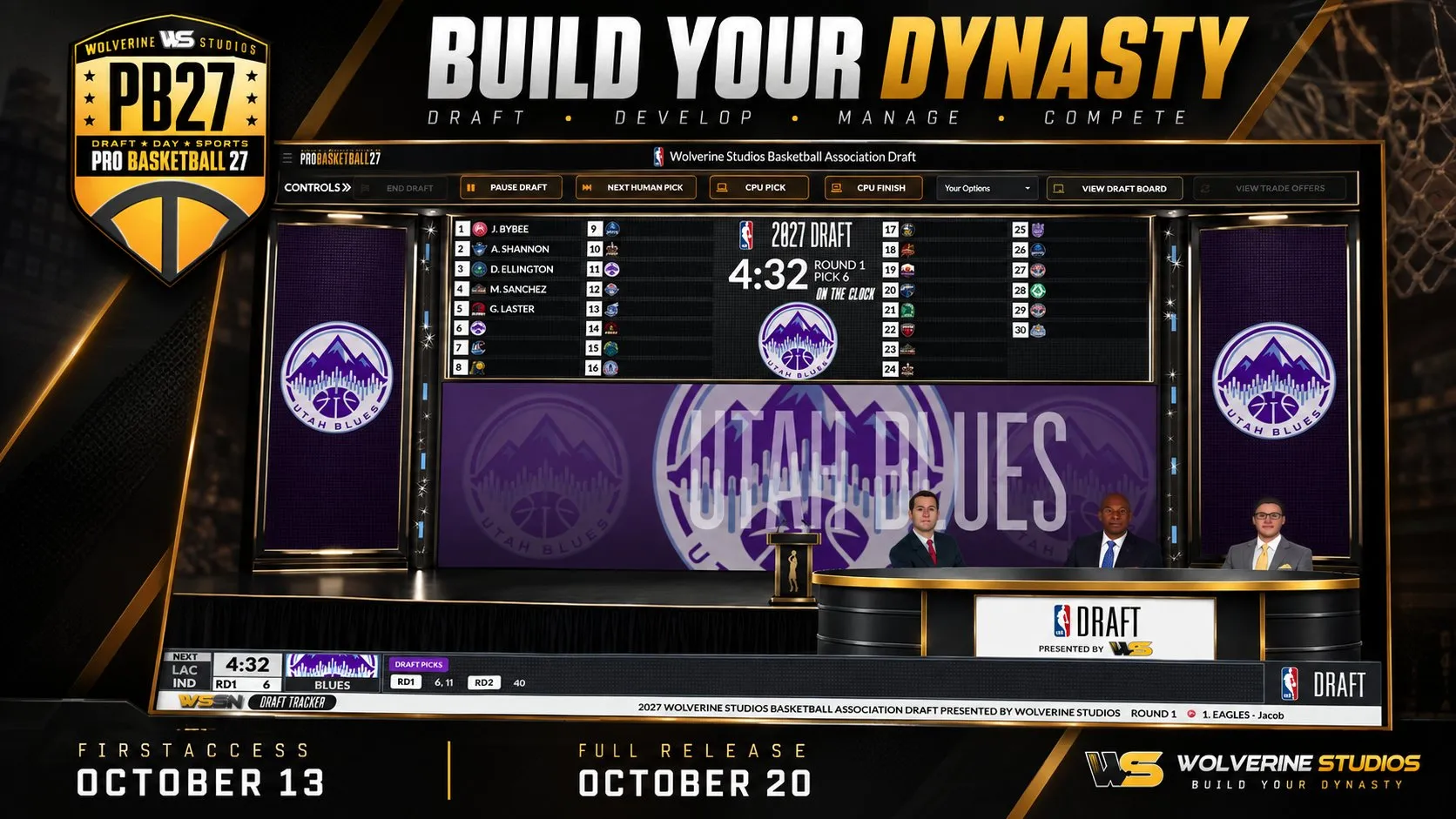
The PB27 announcement art puts the draft, not a game, at the centre: the studio knows its audience lives in the offseason. FirstAccess began on October 13, the full release on October 20. Image: Wolverine Studios.
The short version
- Play it if you want a single-player NBA-style front office with today’s apron rules, real coaching tools and a world you can edit to the last jersey.
- Try the demo first if you care about how games look on the court: the 2D engine is the part that has drawn the most criticism.
- Skip it if you play on Mac, Steam Deck or mobile, need real NBA names without mods, or want European leagues.
- Price check: $39.99 on Steam, a yearly edition, no microtransactions, and a seven-day free demo.
How we researched this review
We did not play Pro Basketball 27, and we will not pretend otherwise. There is no browser version, and the free demo requires downloading and installing a Windows program, which our review rules don’t allow. So everything here comes from sources we read in full, and every image is official.
What we read: the Steam store page and its five patch notes (versions 16.0 to 16.4, October 21 to November 12, 2026); the official product page, FAQ, support, demo, community, about and online-league pages on wolverinestudios.com; Wolverine’s three PB27 blog posts and its two 2026 studio posts; Operation Sports’ launch article; every user review and discussion thread on Steam for PB27, plus those for PB26 and PB2025; GM Games’ coverage of PB25 and PB26; and full reviews of earlier editions from GM Games, Operation Sports and Gaming Trend, to understand what the series has always done and what it has struggled with. For the cap, we checked the game’s numbers against the NBA’s published 2025-26 figures.
What we could not do: test the engine, the trade AI or long-term stability. We also tried to read the official Draft Day Sports forums, where much of the community’s detailed feedback lives, but the forum blocked our read-only requests, and we did not try to get around that. We found no public online manual; the game points to an in-game help menu. Where a feature dates from an earlier edition, we say so. The scores rate the systems Wolverine has documented and shown, weighted by what players report.
A season, step by step
1. Build the world. A new league starts with one choice. Global Control means you are hired only as GM, but can control every team decision. Local Control means you are hired as GM or as GM and head coach, and control only what your job covers. Then come the rules: a 1-100 or 1-10 rating scale; randomised potentials and non-skill traits; “dynamic ratings”, which show ratings as the current perception of a player and introduce a recency bias; a salary cap ($154,647,000 by default); a full or limited financial model; four lottery formats; an injury factor from 0% to 100%; an In-Season Tournament for 30-team leagues; high school and foreign draft entry; trade restrictions; a fantasy-draft start; auto-save; random owner characteristics; and a checkbox to link the league with Draft Day Sports: College Basketball.
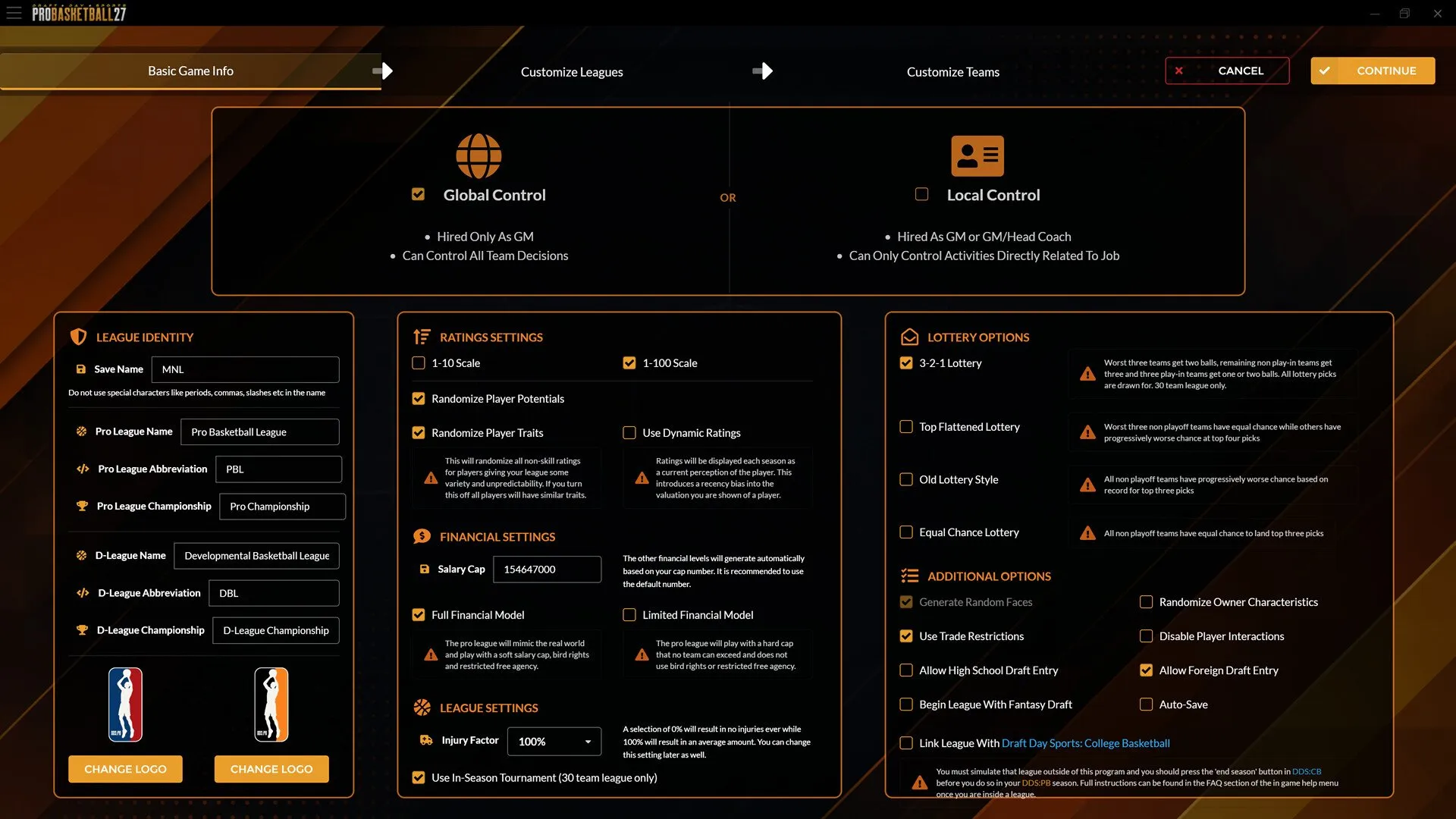 League setup is where PB27 decides what kind of game you’re playing. The financial model is the big switch: the full model mimics the NBA, the limited one is a hard cap with no Bird rights. The College Basketball link requires simulating that league in the other game first. Image: Wolverine Studios / Steam store page.
2. Training camp. Before the season, you set a team focus and intensity, write individual development plans, assign position-group work and, if you want, have play-style conversations with players. The camp ends with a report (more below).
3. Fund your scouting. Scouting points are allocated per region and per task before the season. The game says it plainly: “Allocations are locked once the regular season begins.”
4. The regular season. You play or simulate day by day from a dashboard that tracks standings, injuries, news and morale. You can watch games in the 2D view or simulate past them. Development is now evaluated five times during the season. Previous editions also staged the In-Season Tournament pool drawing and added press conferences (since PB23) and breaking-news cut scenes for trades, injuries and signings (since PB25). The Steam page for PB2025 lists those presentations; we found no sign in PB27’s material that they were removed.
5. The draft lottery and draft. The lottery and the draft are staged events. Draft night has a clock, a stage, analysts at a desk commenting on picks, and controls to pause, sim to your next pick or let the CPU finish.
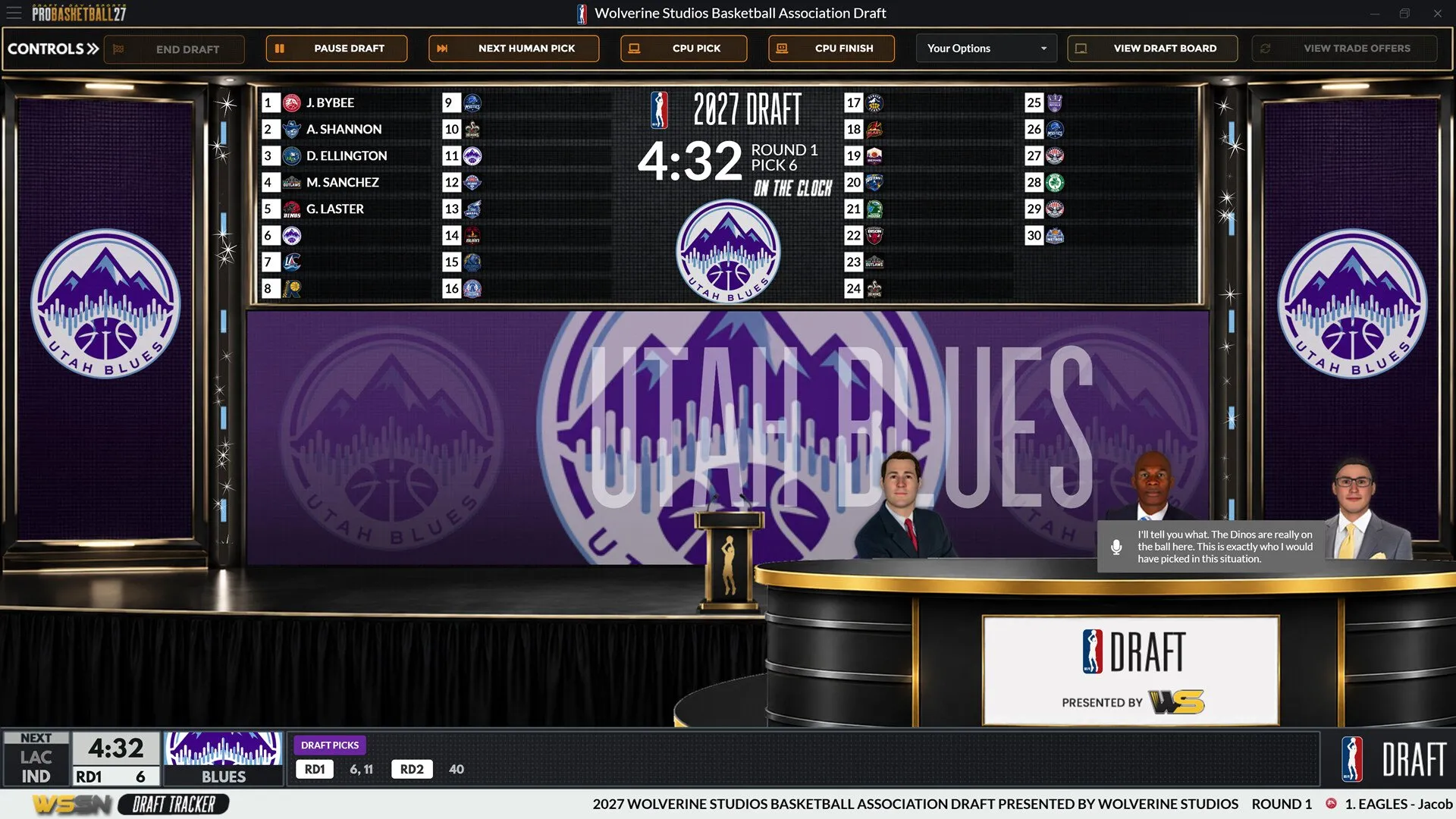 Draft night as television: 4:32 on the clock for the Utah Blues at pick 6, five players already gone, and an analyst bubble praising a rival’s pick. Controls at the top let you pause, jump to your next pick or let the CPU finish. Image: Wolverine Studios / Steam store page.
6. The offseason. Re-signings, free agency and trades, all under the cap and aprons. The PB22 review on GM Games described free-agency meetings and a Shop-A-Player tool that gives feedback while you work the market.
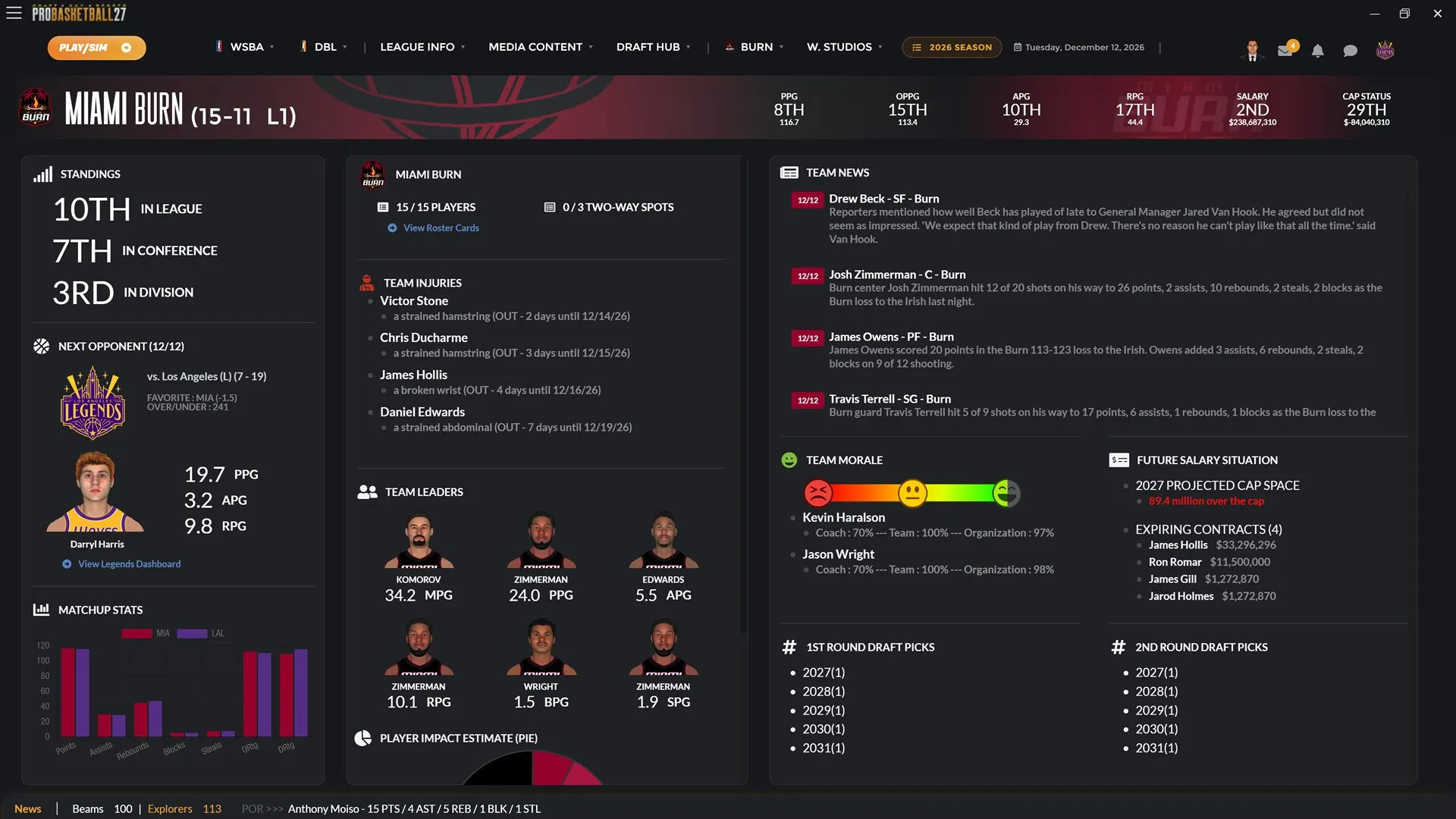 The Miami Burn dashboard is a cap crisis on one screen. A $238.7 million payroll, second-highest in the league, is about $30.9 million over the real second apron. Next year they are already projected $89.4 million over the cap, yet they own all their picks. Image: Wolverine Studios / Steam store page.
That dashboard is the best argument for the 2026 interface redesign. The next opponent comes with a betting line (Miami −1.5, over/under 241). Injuries have return dates (Daniel Edwards, strained abdominal, out until 12/19/26). The news feed reads like short wire reports, one with a quote from the GM. The morale meter names each unhappy player and splits his satisfaction across coach, team and organisation (Kevin Haralson: coach 70%, team 100%, organisation 97%). It all invites decisions rather than hiding them three menus deep.
The match engine: the open question
How it works. Games are calculated by the engine and shown on a 2D court, or simulated straight through. The 2D view shows box scores for the five players on the floor on each side, energy percentages under each name, a player spotlight (“#2 – PG Reginald Cokley, 5 points / 1-4 3P”), a text feed, team fouls and timeouts, and buttons to play, stop, skip and open options. When PB25 launched, GM Games also described a text-based Gamecast view alongside the 2D game.
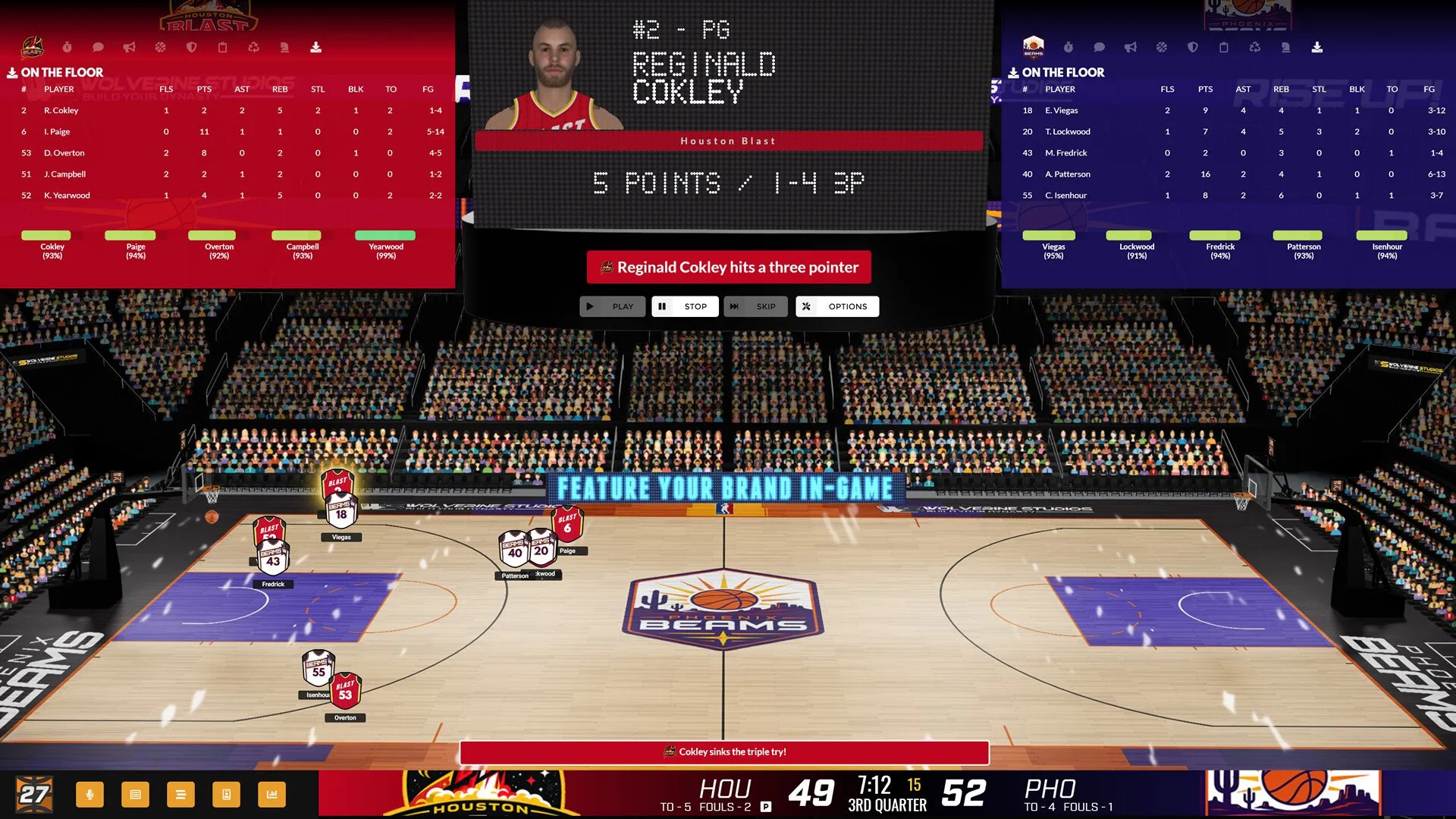 The 2D view with jersey tokens: Houston 49, Phoenix 52, 7:12 left in the third. The bars under each name (93%, 94%, 99%) are live energy, so fatigue is visible during the game. Image: Wolverine Studios / Steam store page.
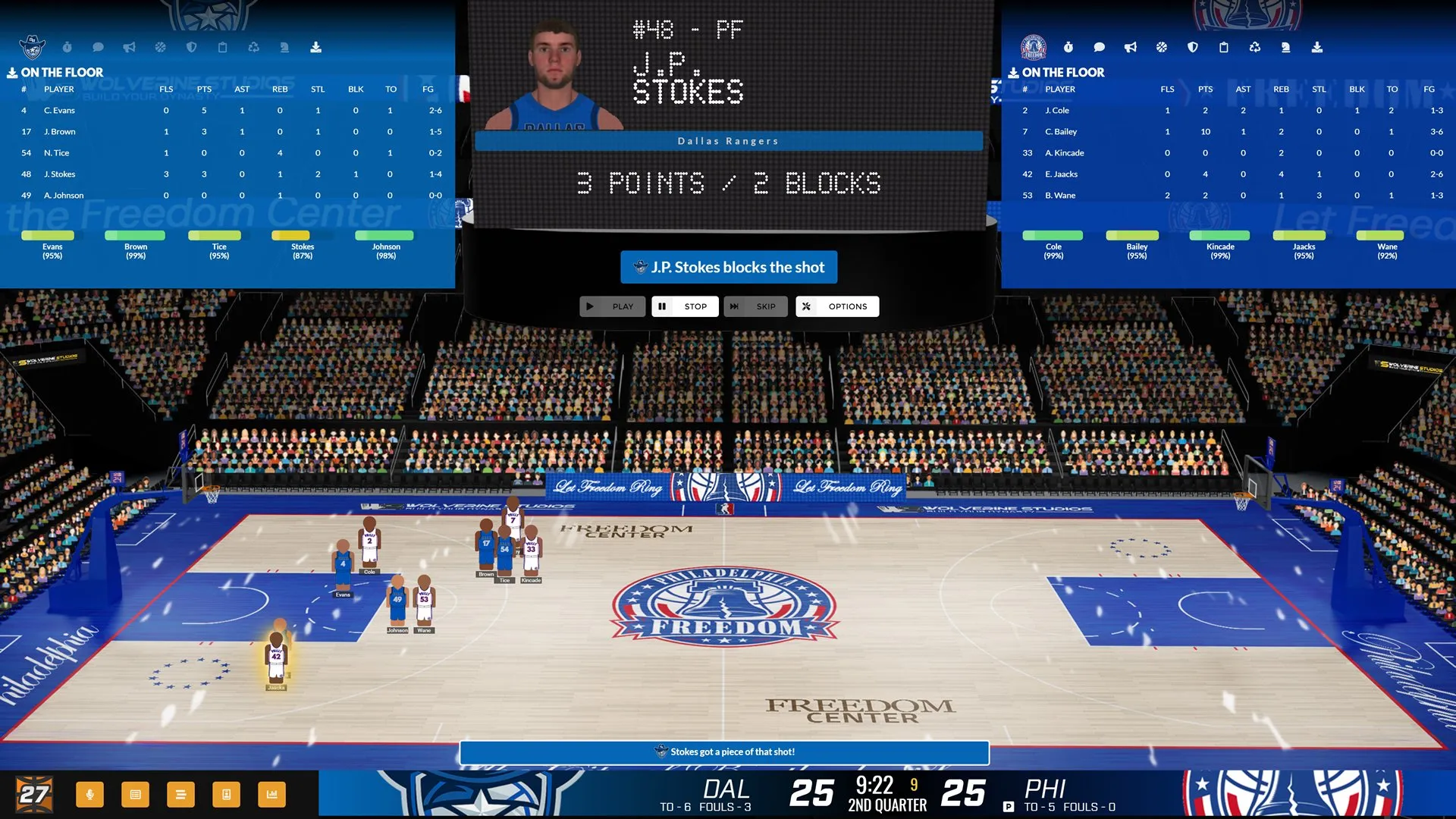 A second official screenshot shows human figures instead of jersey tokens: Dallas 25, Philadelphia 25. Note the shape on the floor: most of the ten players are bunched on one side of the court after a block. Image: Wolverine Studios.
What Wolverine claims. The PB27 reveal says improving “what happens once the ball is tipped” was “one of our biggest priorities”. The product page promises “smarter AI, more realistic player movement, authentic statistics”. Operation Sports’ launch article repeats the improved engine, smarter AI, more realistic movement and updated 2D visuals. None of these sources include numbers: no league averages, no pace, no three-point rates, no comparison with real seasons.
What you can change live. PB26 added new controls on the game-day screen for strategy adjustments and substitutions, according to its launch coverage. PB27’s patch 16.2 fixed “matchup settings on gamescreen”, which confirms that defensive matchups can be set during a game. Patch 16.4 fixed roster and stats popups that didn’t open during gameplay.
The history of the presentation. The 2D view has evolved slowly. Operation Sports’ PB2023 review (November 2022) called the move to “2-D sprites that move in logical ways” the most significant improvement that year. It also asked for a system where each sprite moves according to its attributes. GM Games’ PB23 review (March 2023) noted: “Out are just jerseys; in are actual players.”
The complaints. The most detailed criticism we found is a negative PB26 Steam review dated January 1, 2026, by a long-time follower of the series. It said season-level stats look realistic. But the 2D game, in that player’s words, showed static positions with no visible pick-and-rolls, traps or help defense, and defenders stuck to their own man. Time seemed to pass inconsistently between events. It also listed rules errors: the shot clock not resetting correctly after a blocked shot, 14-second resets set to 24, no jump balls, fast breaks only after steals, and teams fouling intentionally when trailing by one point. Gaming Trend’s review of PB16, ten years earlier, praised the same thing the PB26 critic conceded: “The simulations are really tight and realistic.”
Our read. The series has a reputation for believable season-level output and an unconvincing game view. PB27’s claims point straight at that weakness, which is encouraging. Until someone publishes league-wide numbers or the community confirms the rules fixes, we can’t rate the engine above good. It is the biggest unknown in this review.
Coaching and tactics
Draft Day Sports has always let you coach, and that sets it apart from most GM games. PB27 adds new offensive styles. The strategy screen is the most impressive official screenshot we saw.
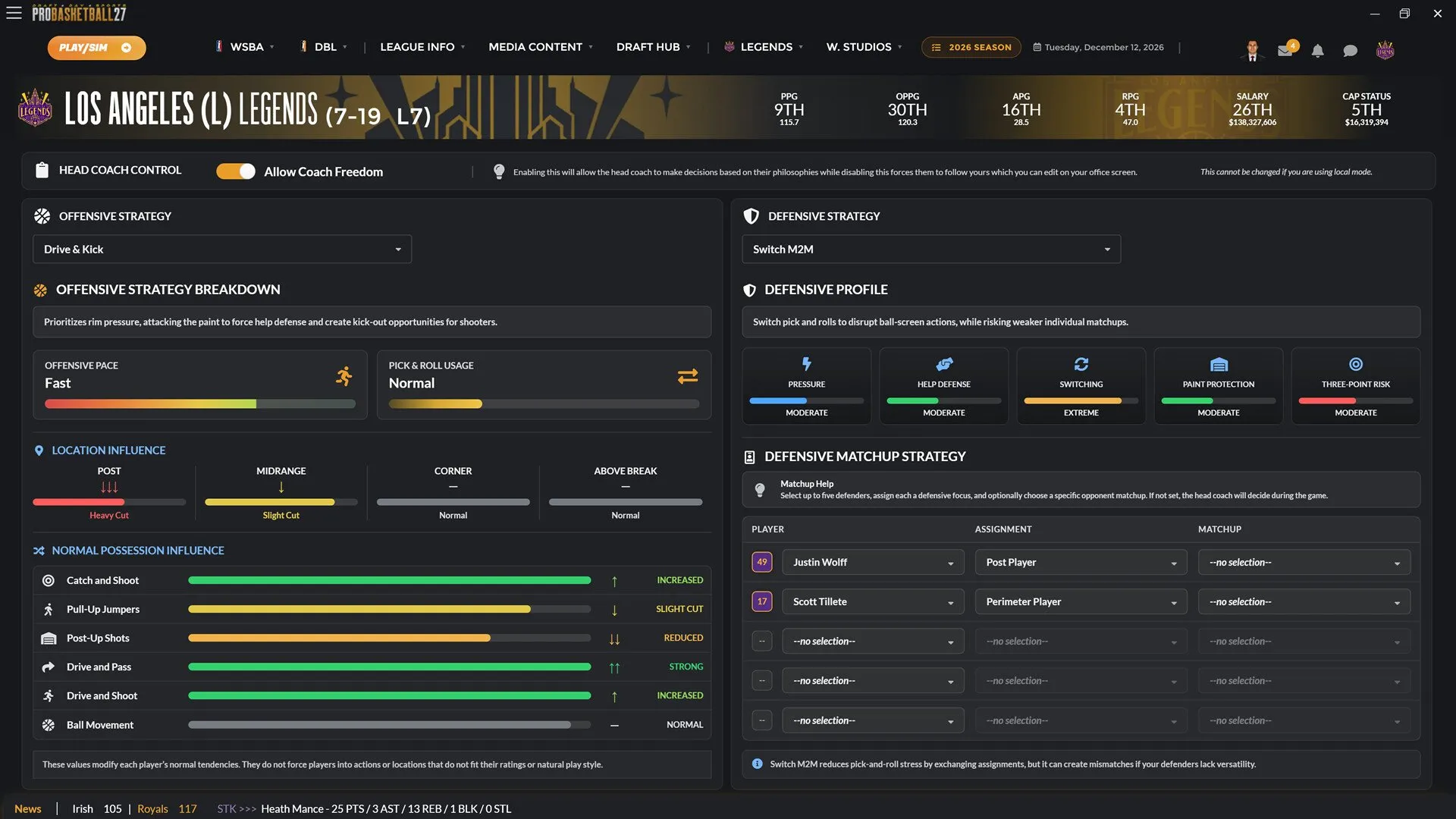 A 7-19 team running a fast Drive & Kick offense with a “heavy cut” on post shots, and a Switch M2M defense rated “extreme” on switching. The footnote is the key design rule: strategy modifies tendencies, it doesn’t force players into actions that don’t fit their ratings. Image: Wolverine Studios / Steam store page.
Offense.
- A named strategy. Drive & Kick “prioritizes rim pressure, attacking the paint to force help defense and create kick-out opportunities for shooters.”
- Offensive pace (Fast in the screenshot) and pick-and-roll usage (Normal).
- Location influence for post, midrange, corner and above the break, from “heavy cut” to increased.
- Possession influence for catch and shoot, pull-up jumpers, post-up shots, drive and pass, drive and shoot, and ball movement.
Defense.
- A named scheme. Switch M2M “switch[es] pick and rolls to disrupt ball-screen actions, while risking weaker individual matchups.”
- A defensive profile of pressure, help defense, switching, paint protection and three-point risk.
- Up to five defenders with an assignment (post player, perimeter player) and, optionally, a specific opponent. If you leave them empty, the head coach decides during the game.
Who decides. “Allow Coach Freedom” lets your head coach make decisions based on his own philosophy; turning it off forces him to follow yours. The screen notes that this “cannot be changed if you are using local mode”, where you only control your own job.
Rotations and training. Rotations are set by you, and the product page promises adjustments “throughout the season as injuries, performance, and expectations change”. Training camp (next section) adds a tactical dimension: “standard tactical improvement” is one of the listed effects of Normal intensity.
What is missing, or unverified. We could not find a list of all offensive and defensive strategies in PB27, so we can’t tell you how many there are, and we don’t know whether zone defenses exist in this edition. PB23 listed four defensive options (Straight, Switch, Attack and Passive); the PB27 name “Switch M2M” suggests the man-to-man schemes have been reorganised. Compared with the genre’s most tactical games, we saw no play-calling, no named set plays and no shot charts. Strategy is a set of tendencies, not a playbook. For a GM game, that is a lot. For a coaching sim, it would be the start.
Players and ratings
PB26 introduced archetypes, and PB27 builds the whole player card around them. The official screenshot of Josh Carter shows what the game wants you to read.
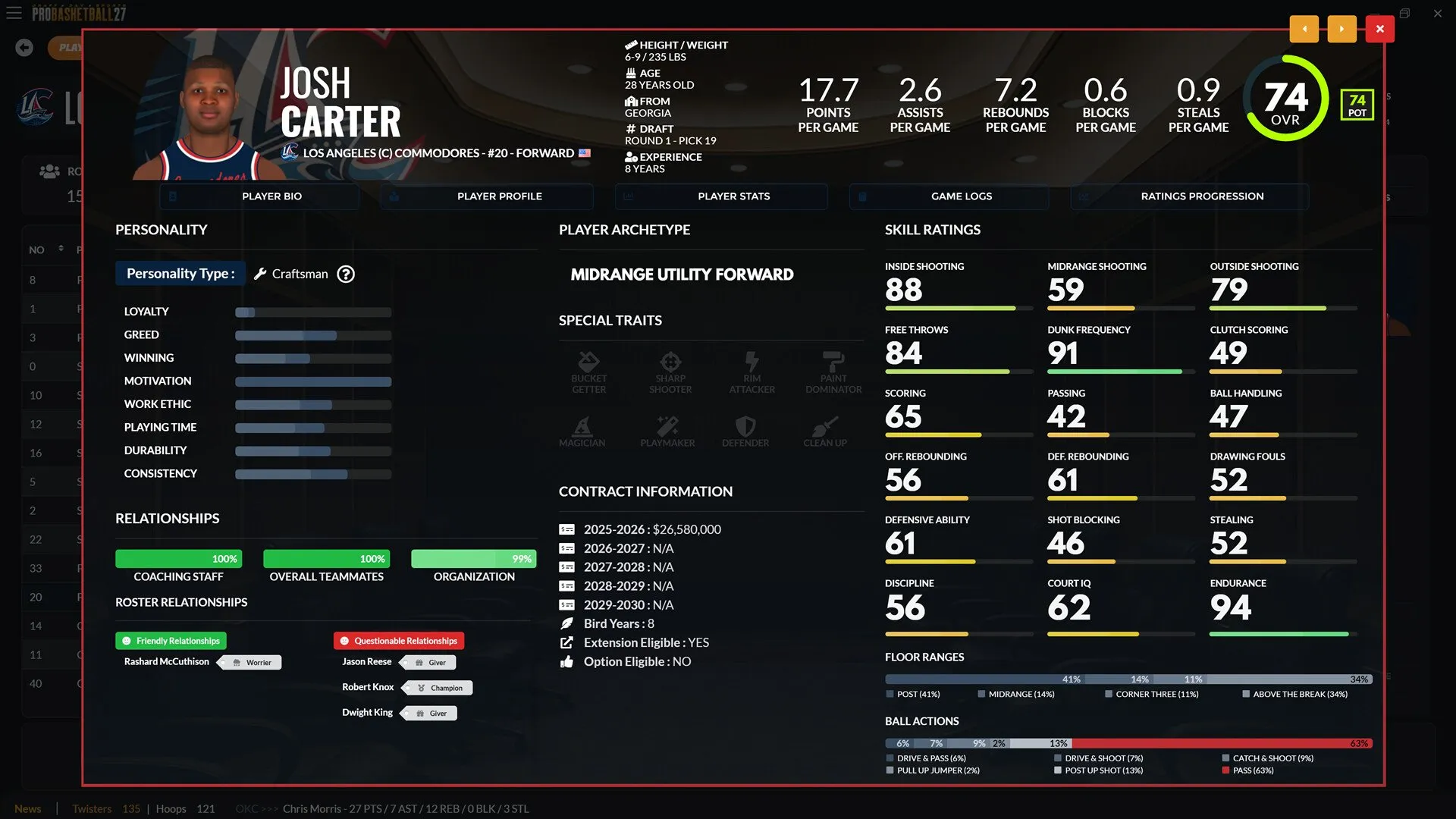 Josh Carter is a 74-overall “Midrange Utility Forward” whose floor ranges say otherwise: 41% of his shots in the post, 34% above the break, only 14% midrange. A “Craftsman” with 100% relationships, eight Bird years and extension eligibility: the card tells you to re-sign him. Image: Wolverine Studios / Steam store page.
- Eighteen skill ratings: inside shooting, midrange shooting, outside shooting, free throws, dunk frequency, clutch scoring, scoring, passing, ball handling, offensive rebounding, defensive rebounding, drawing fouls, defensive ability, shot blocking, stealing, discipline, court IQ and endurance. Plus overall and potential, shown as a ring and a badge.
- Archetypes and traits. The archetype (“Midrange Utility Forward”) gives a role. Eight special traits light up when earned: Bucket Getter, Sharp Shooter, Rim Attacker, Paint Dominator, Magician, Playmaker, Defender and Clean Up. Since PB26, rookies are generated in specific archetype molds.
- Floor ranges and ball actions. Where a player shoots from (post, midrange, corner three, above the break) and what he does with the ball (drive and pass, drive and shoot, catch and shoot, pull-up jumper, post-up shot, pass).
- Personality. A type (“Craftsman”) and eight bars: loyalty, greed, winning, motivation, work ethic, playing time, durability and consistency. Personality types arrived in PB22; GM Games’ PB23 review complained that their effects weren’t explained.
- Relationships. Satisfaction with the coaching staff, teammates and organisation in percentages, plus named friendly and “questionable” relationships with teammates, each tagged with their own type (Worrier, Giver, Champion).
- Injuries. Specific diagnoses with day counts and return dates on the dashboard, and a league-wide injury factor.
Development. This is PB27’s headline feature.
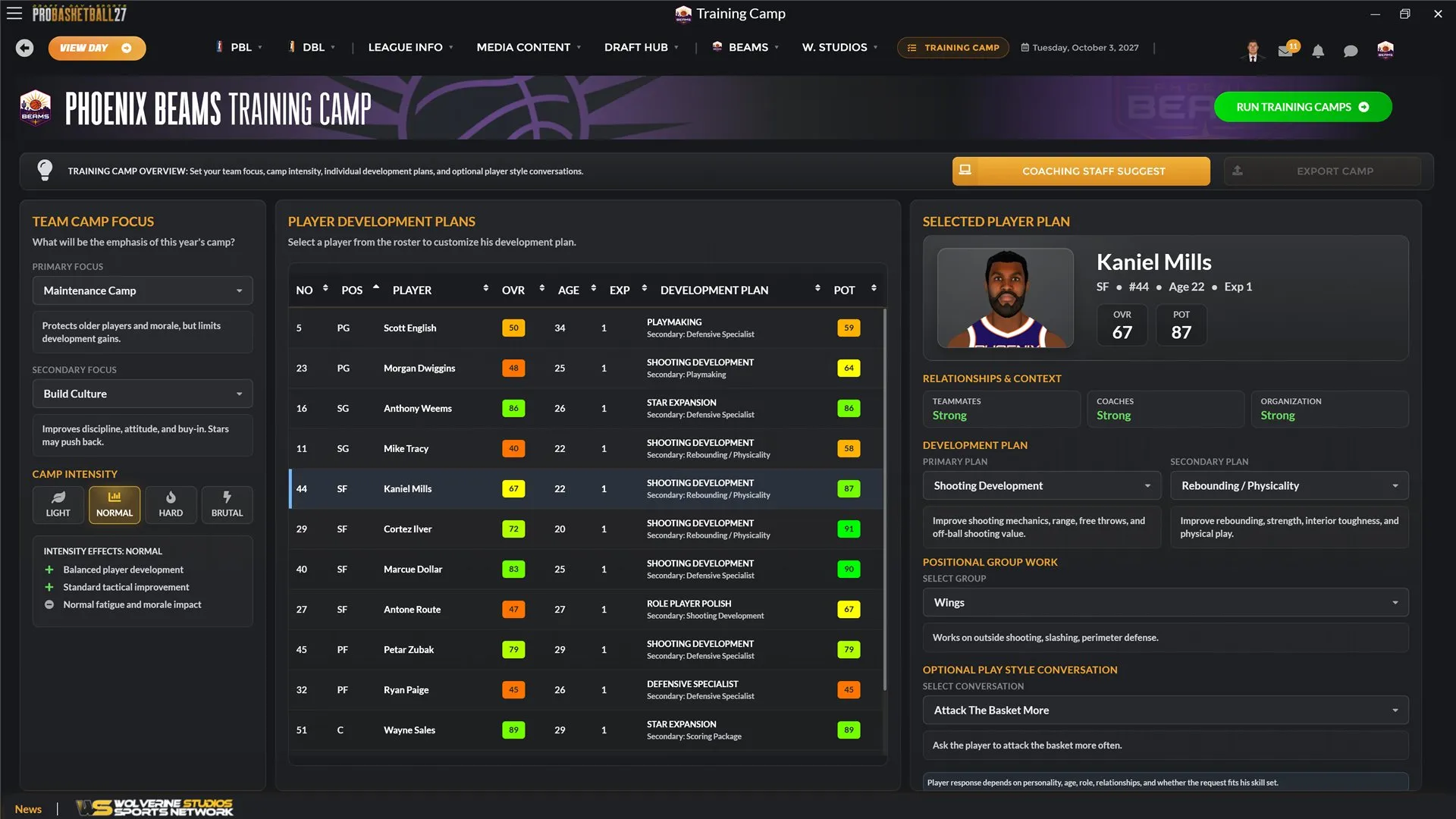 Phoenix opts for a Maintenance Camp plus Build Culture at Normal intensity, which protects veterans but limits gains. 22-year-old Kaniel Mills (67 overall, 87 potential) gets Shooting Development, Rebounding/Physicality, Wings group work and a request to attack the basket more. Image: Wolverine Studios.
- Team focus. A primary and a secondary focus. Maintenance Camp “protects older players and morale, but limits development gains.” Build Culture “improves discipline, attitude, and buy-in. Stars may push back.”
- Intensity. Light, Normal, Hard or Brutal. Harder camps trade physical and mental wear for more improvement. Wolverine’s stated principle: “there shouldn’t be one correct training camp setup for every team.”
- Individual plans. Primary and secondary plans, such as shooting development, playmaking, defensive specialist, rebounding and physicality, star expansion, role player polish or a scoring package.
- Position groups. Extra emphasis for a group, such as wings: “outside shooting, slashing, perimeter defense.”
- Play-style conversations. You can ask a player to change how he plays, but “You can ask. That doesn’t mean the player has to agree.” His answer depends on personality, age, role, relationships and whether the request fits his skills.
- Staff suggestions. The coaching staff can fill in all of it, and an “Export Camp” button sits next to it.
- In-season development. Now evaluated five times a season instead of twice, with the underlying progression adjusted so players don’t “race toward their potential”.
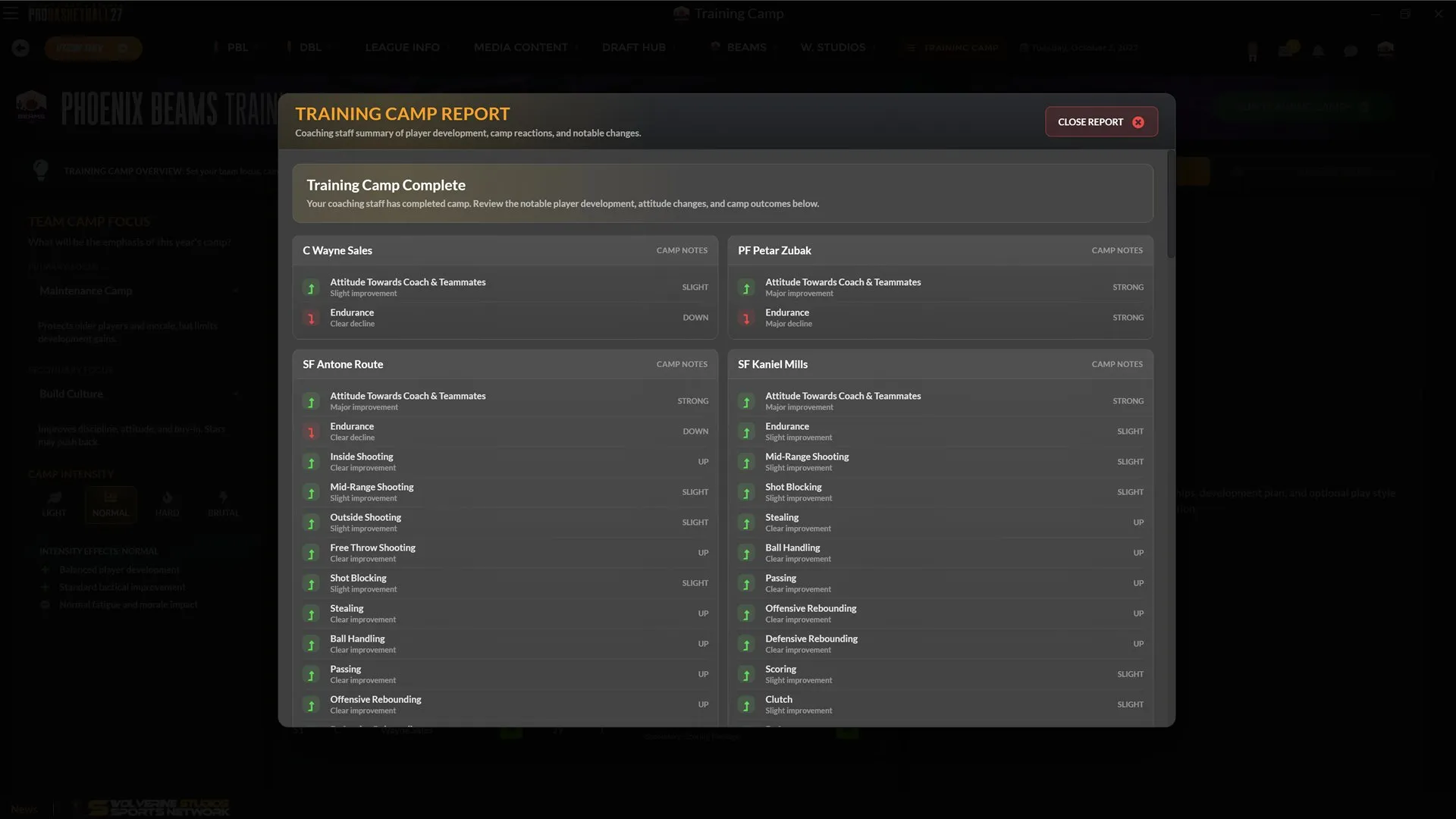 The camp report shows the trade-offs at work. Petar Zubak’s attitude improves “strong” while his endurance drops “strong”; Kaniel Mills gains in ten areas. Changes are described in steps, not exact numbers. Image: Wolverine Studios.
We like that the report uses words (“slight”, “clear”, “strong”) instead of decimals. It preserves some uncertainty, the way a real coaching staff would report. It also means you can’t measure exactly what a Brutal camp is worth, which will drive the min-maxers on the forums to their spreadsheets.
Scouting. Before the season you spend scouting points on tasks in U.S. college regions and international regions. In the official screenshot the Los Angeles Legends have allocated 180 of 242 points.
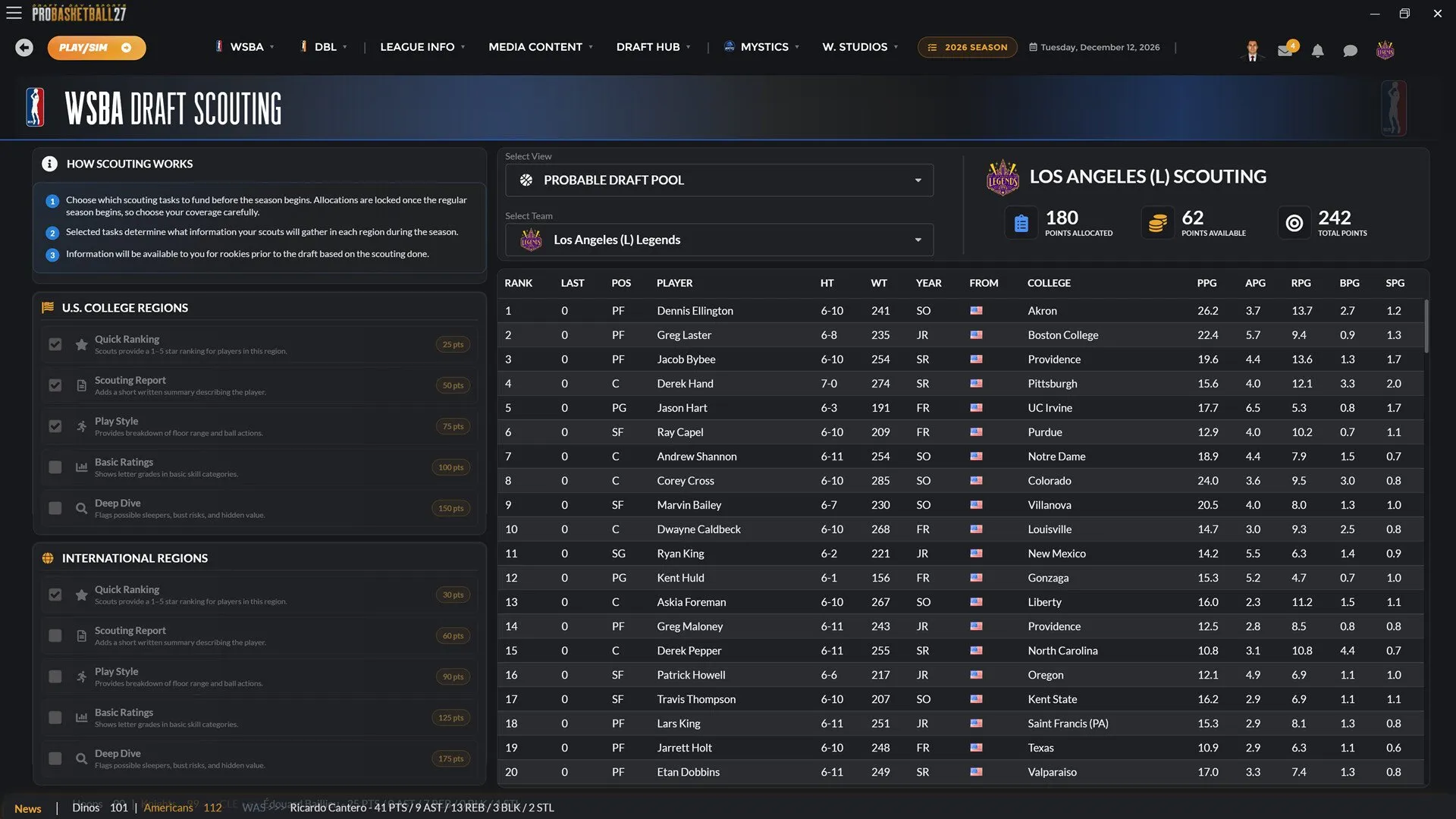 Scouting as an economy: each region offers five tasks of rising cost. You can’t afford a deep dive everywhere, so you decide where your fog lifts. The probable draft pool is sorted by rank with college stats. Image: Wolverine Studios / Steam store page.
| Scouting task | U.S. college regions | International regions | What it reveals |
|---|---|---|---|
| Quick Ranking | 25 points | 30 points | A 1-5 star ranking for players in the region |
| Scouting Report | 50 | 60 | A short written summary |
| Play Style | 75 | 90 | Floor ranges and ball actions |
| Basic Ratings | 100 | 125 | Letter grades in basic skill categories |
| Deep Dive | 150 | 175 | Sleepers, bust risks and hidden value |
This is one of the smartest systems in the game. Scouting is not a slider that makes numbers more accurate; it is a budget that buys specific information. The cost rises with depth and with distance, and the lock at the start of the regular season forces a plan.
The front office
This is where the series has always been strongest, and PB27 is closer to the real league than ever. The clearest evidence is in the numbers.
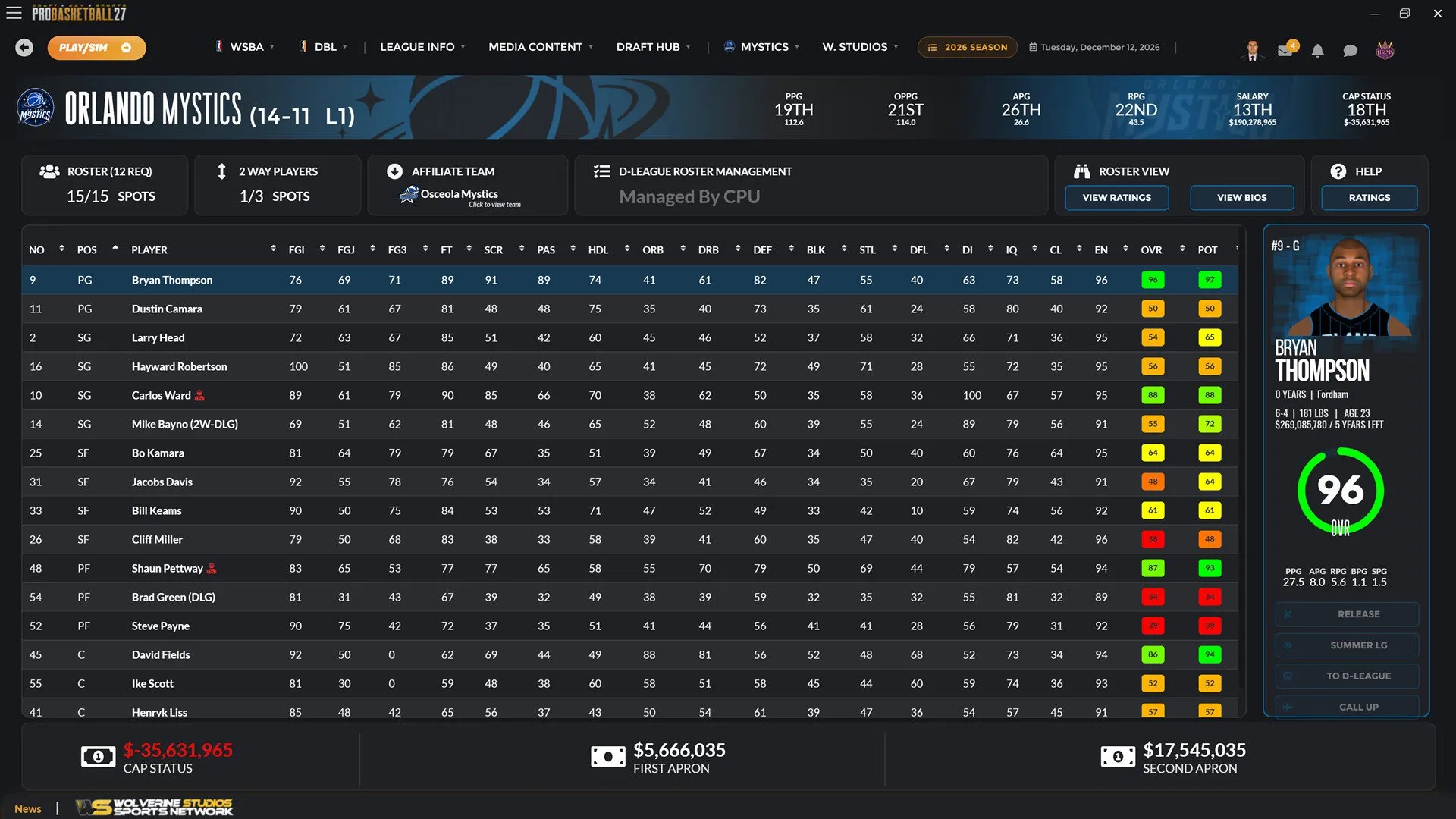 Orlando’s $190.3 million payroll leaves them $35.6 million over the cap, $5.7 million under the first apron and $17.5 million under the second. Those thresholds match the NBA’s real 2025-26 figures to the dollar. Image: Wolverine Studios / Steam store page.
| 2025-26 threshold | NBA (official figure) | Implied by PB27’s screenshots |
|---|---|---|
| Salary cap | $154,647,000 | $154,647,000 (default in league setup; Legends and Coyotes cap status) |
| First apron | $195,945,000 | $195,945,000 (Orlando: $190,278,965 payroll + $5,666,035 room) |
| Second apron | $207,824,000 | $207,824,000 (Orlando: $190,278,965 + $17,545,035) |
| Luxury tax line | $187,895,000 | Luxury tax confirmed by Wolverine; line not visible in the screenshots |
That is not an approximation of the CBA; it is the CBA’s arithmetic. The cap model in detail:
- Full financial model. Per the setup screen, it “will mimic the real world and play with a soft salary cap, bird rights and restricted free agency.” Luxury tax and both aprons are confirmed by Wolverine and Operation Sports. Since PB25, aprons have placed limits on what teams above them can do. PB26 improved the contract and apron logic.
- Limited financial model. A hard cap “that no team can exceed”, with no Bird rights and no restricted free agency. Patch 16.2 hid apron and Bird information in this mode, and 16.3 restored the “room to cap” figure on the contracts page.
- Contracts. Year-by-year salary, Bird years, extension eligibility and option eligibility on every player card. The roster requires 12 players and allows 15, plus three two-way slots and a D-League affiliate, whose roster management can be left to the CPU. We found no documentation on rookie scale or maximum contracts in PB27, so we leave them out.
- Trades. Since PB25, picks can be protected, swap conditions can be attached and up to five years of future picks can be traded. The dashboard lists every first and second-round pick through 2031. Patch 16.2 adjusted the trade value of draft picks three days after release. The new-league screen has a “Use Trade Restrictions” option.
- Draft lottery. Four formats: the NBA’s 3-2-1 lottery, a top-flattened lottery, the old style, and equal chance.
- Owners. Each owner has a willingness to spend, a desire to win, a patience level and a desire for superstars, and these can be randomised.
Trade AI quality. We can only report what others say. Wolverine promised smarter trade behaviour and more realistic draft pick valuation in PB26. A PB26 player with 404.6 hours wrote that “the new ai trade logic is amazing”. Another praised “AI logic and game-simulation” as “pretty spot on”. On the other side, PB26 had a reported contract bug: a two-way player who becomes a restricted free agent with a sub-$100,000 qualifying offer can no longer be offered any legal contract, because his minimum exceeds his maximum. That one comes from a single Steam thread with no reply, so treat it as a report, not a confirmed bug. The early pick-value patch in PB27 shows this area is still being tuned.
World and longevity
The league. Pro Basketball does not have an NBA licence. The official FAQ says it uses “a fictional game universe rather than officially licensed teams.” The default league in the screenshots is the Wolverine Studios Basketball Association, with a developmental league (DBL) and teams like the Utah Blues, Minnesota Coyotes and Philadelphia Freedom. Every name is editable: the screenshots also show leagues called PBL and WSBL.
Mods. Operation Sports’ launch article says fan-made mods add real NBA teams, players, logos and graphics, and links one on the official forums. Wolverine says plainly that it “does not officially distribute or support those files.” A PB26 reviewer pointed new players to real team and face packs on the official message board.
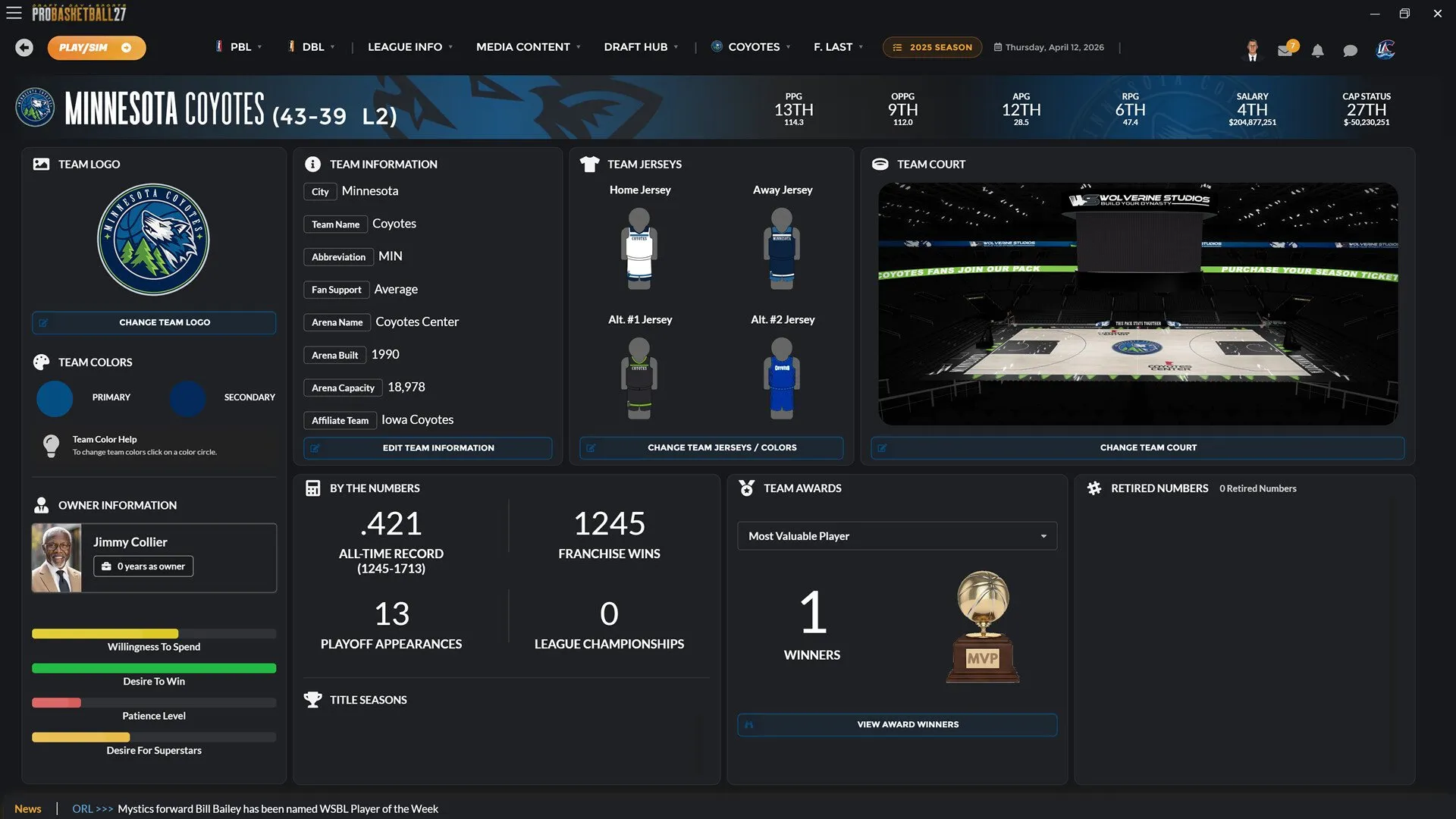 The Coyotes’ team page doubles as an editor (logo, colours, four jerseys, court, arena data) and a history book: a .421 all-time record, 13 playoff appearances, no titles. Owner Jimmy Collier wants to win but has little patience. Image: Wolverine Studios / Steam store page.
History and modes.
- Historical play. It is still here: patch 16.1 updated it on launch day. GM Games’ PB2018 and PB22 reviews describe historical leagues going back to 1976.
- Unbeaten. The new mode is built on historical play. You choose a historical season and a team, build a roster by swapping players from other teams in that season, then play 82 games to see if you can go 82-0.
- Other modes. A fantasy-draft start, the In-Season Tournament and commissioner tools. PB23 also added a daily fantasy game.
- Universe mode. Since PB26, it lets you control multiple teams and create players, teams and logos from scratch.
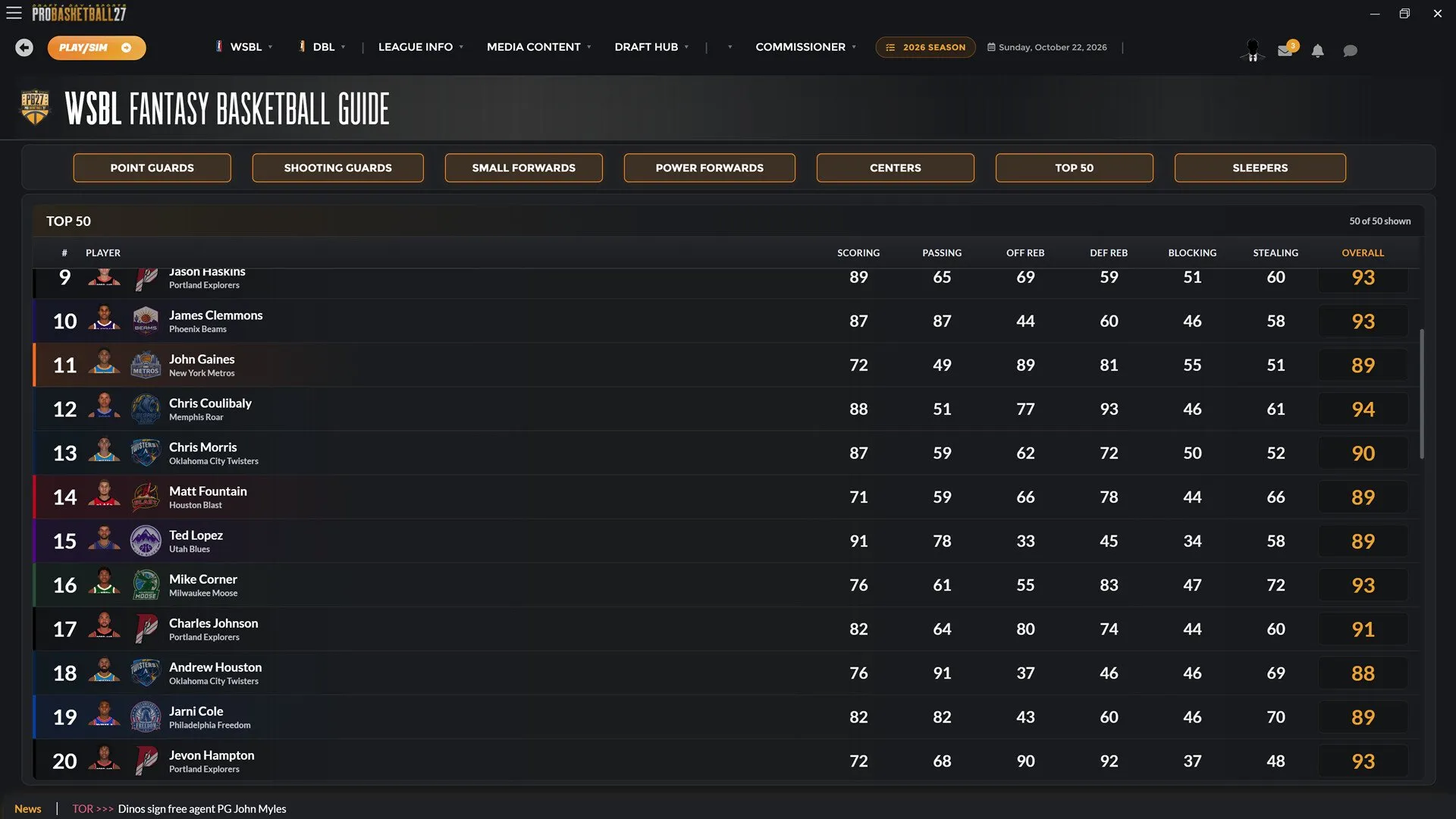 The commissioner view, with a Fantasy Basketball Guide ranking the league’s top 50 by position, plus a Sleepers tab. Five players in this excerpt are rated 93 or higher. Image: Wolverine Studios / Steam store page.
College link. Since PB25, a linked DDS: College Basketball league can supply draft classes, and the PB25 coverage says you can follow college stats, standings and rosters. The setup screen warns that you have to simulate the college league in that game and press “end season” there before doing it in Pro Basketball. Wolverine is also moving College Basketball’s release from March Madness to the start of the college season, “much closer” to Pro Basketball’s.
Online. On Steam, PB27 is single-player. But the series has always supported online leagues run by the community. In 2026 Wolverine replaced its curated Featured Leagues with an open directory. It currently lists one Pro Basketball league, SIBA (the Simulation Internet Basketball Association: 32 teams, a college league and a development league, recruiting). GM Games rated the online side 8 out of 10 in 2018 and called it “the least-utilized part of the game” in 2021.
Not a world game. In a PB26 Steam thread, a European player asked about modding it into a Football Manager-style game with European leagues. Two experienced players said it is built around the NBA and recommended other games. That matches what we see: one pro league and one development league, no promotion or relegation, and no continental cups.
Longevity. The series ships every year, and each edition is a separate purchase. A long-time customer wrote in a PB26 thread that “bugs remain from version to version”, citing a custom-jersey photo issue he says dates back to at least PB22. On the other hand, Wolverine shipped five patches in PB27’s first three weeks, and a PB26 player called that edition “probably the most stable one”.
Interface, platforms and performance
- Windows only. Windows 10 or 11, 64-bit. Requirements are tiny (128 MB of RAM, 2 GB of storage) except for the display: 1920×1080 is the minimum. Wolverine says Mac players need Windows compatibility software.
- Steam Deck. Not supported. A player has asked about it on Steam for PB26 and again for PB27. A PB26 reply said “It doesn’t even run on it”, which we couldn’t verify.
- Accessibility. On October 24, 2026, a player with an eye condition asked on Steam whether the UI can be enlarged. There was no reply when we checked, and we found no scaling option in the official material.
- Language. English only, per Steam. A Chinese player’s PB2025 review asked for Chinese support.
- Speed. We couldn’t measure simulation speed. One negative PB2025 review called it the slowest game the reviewer had played; a positive one noted that it works well on low-end PCs. GM Games asked for a sim-to-date option in 2018, but we couldn’t confirm whether one exists now.
- Store features. Steam lists Single-player and Family Sharing. It doesn’t list Steam Cloud, so we can’t confirm cloud saves.
- Licences. Copies bought directly from Wolverine use a licence key, which can be deactivated on one computer to move it to another, according to the support page.
The redesign is a real step forward from the screens older reviews describe. GM Games criticised a cluttered lineups screen in PB22 and an underused in-game layout in PB23; Operation Sports said in 2022 that newcomers would struggle to learn what each option does. PB27’s dashboards and strategy screens look like a modern web app by comparison. It is still a dense game, and it won’t teach you basketball economics.
Monetization, line by line
| What | Price | What it buys |
|---|---|---|
| PB27 on Steam (US) | $39.99 | The full game, single-player, Family Sharing |
| PB27 on Steam (EU / UK) | €40.99 / £35.75 | Same |
| PB27 direct from Wolverine | Not shown without opening checkout (we didn’t) | Licence key; demo saves carry over; upgrade discounts for future editions via mailing list |
| Free demo | Free, 7 days, no credit card | The full experience for a week; saves continue if you buy a direct licence |
| FirstAccess (Oct 13–20, 2026) | Pre-order discount (amount not published) | Early access via direct purchase; no complimentary Steam key from 2026 |
| Steam launch discount | Matches the FirstAccess discount, per Wolverine’s policy | At launch on Steam |
| DLC, microtransactions, ads | None | — |
| Community mods (real NBA data) | Free, unofficial | Real teams, players, logos and graphics |
Two details matter. First, Operation Sports reports that demo progress carries over “if you buy a license directly from Wolverine Studios”. If keeping your demo save matters, don’t buy on Steam. Second, Wolverine changed its policy in 2026: FirstAccess buyers no longer get a free Steam key, because, the studio explains, complimentary keys don’t count toward Steam review scores. In exchange, Steam buyers get a launch discount that matches FirstAccess, and direct buyers get upgrade discounts by email.
Fairness verdict. No pay-to-win, no loot boxes, no ads, no energy. Wolverine’s copy says it outright: “No pay-to-win shortcuts.” The only cost question is the annual cycle. Here are the current US Steam prices of recent editions:
| Edition | Steam release | Current Steam price (US) |
|---|---|---|
| Pro Basketball 2022 | December 2, 2021 | $19.99 |
| Pro Basketball 2023 | November 23, 2022 | $24.99 |
| Pro Basketball 2024 | November 10, 2023 | $24.99 |
| Pro Basketball 2025 | October 28, 2024 | $29.99 |
| Pro Basketball 2026 | November 5, 2025 | $29.99 |
| Pro Basketball 27 | October 20, 2026 | $39.99 |
In the US, PB27 costs a third more than PB26 does today; in Europe, the gap is smaller (€40.99 against €38.99). The new edition’s price would be easier to defend if your saves and custom universes carried over. We found no indication that they do.
Update history
| Date | Version | What changed |
|---|---|---|
| 2016–2018 | PB16 to PB2018 | Historical leagues from 1976; engine rebuilt around system and chemistry (2018); two-way contracts, D-League affiliates and a new injury system (2018) |
| Dec 2, 2021 | PB2022 | Personality types; free-agent meetings and Shop-A-Player |
| Nov 23, 2022 | PB2023 | 2D sprites replace jersey tokens; four defensive options; press conferences; daily fantasy; midrange and clutch ratings; custom courts and jerseys |
| Nov 10, 2023 | PB2024 | Steam release (we found no feature coverage) |
| Oct 28, 2024 | PB2025 | Protected picks, swap conditions, five years of future picks; salary aprons; College Basketball draft-class import; breaking-news cut scenes; future-class scouting tracker |
| Nov 5, 2025 | PB2026 | Player archetypes; refreshed UI and morale dashboard; smarter AI for trades, draft and cap; apron logic; game-day controls; Universe mode and editing tools |
| Oct 13, 2026 | PB27 FirstAccess | Pre-release version for direct buyers |
| Oct 20, 2026 | PB27 release | Training camp, development five times a season, new offensive styles, improved engine and 2D, redesigned UI, Unbeaten mode |
| Oct 21, 2026 | 16.0 / 16.1 | Initial roster updates; update to historical play; minor roster update |
| Oct 23, 2026 | 16.2 | Trade value of draft picks adjusted; matchup settings fix on the game screen; token display fix; apron and Bird info hidden in limited financial mode |
| Oct 31, 2026 | 16.3 | Box score UI fix; room to cap restored in limited mode; rookie creation and development on defense adjusted; roster updates |
| Nov 12, 2026 | 16.4 | Roster and stats popups fixed during gameplay; roster display fixed when over 20 players are temporarily signed |
There is no public roadmap. Wolverine’s about page promises to keep improving “simulation depth, artificial intelligence, presentation, interfaces”, and the July 2026 post describes a yearly “2027 lineup” across its four series.
What players say
On Steam, for PB27: four user reviews, all positive, as of November 14, 2026. That is too few for Steam to show a score.
- “The best basketball sim out there, and theyve been going strong for several years now.” (nedalezz, October 25, 6.2 hours)
- “Last one I purchased before 2027 was the 2024 version and I played that for nearly 2000 hours.” (Mezan Irdak, November 7, 45.2 hours)
- “I really like the player development aspect.” (piw, October 23, 76.9 hours, who also praised the tactics, tokens and 2D sim compared with PB26)
- A Chinese-language review (November 11) praised it as a way to relive high school seasons while learning English.
On Steam, for PB26: “Positive”, 91% of 12 reviews.
- “This is the best game in the series and, most importantly, probably the most stable one.” (Tompoller, November 17, 2025)
- “The new ai trade logic is amazing.” (miamisports326, 404.6 hours)
- “Needs to be carefully configured – for historical replays – but once done, excellent!” (mitchum22)
- Negative: “The problems are just too glaring.” (Gameologist, January 1, 2026; the engine critique summarised above)
On Steam, for PB2025: nine reviews, too few for a score. The praise was strong (“Best draft in any bball game I have played”; “Easily the best Basketball sim outside of the microtransaction filled NBA 2K.”). The one negative review, after 2.5 hours, called it the slowest game the reviewer had played.
Press: GM Games gave PB22 a 9.3 and PB23 a 9.4; its 2018 review said “no game does it better” for coaching or running a franchise. Gaming Trend gave PB16 a 75, praising the sim but noting regular crashes at the time. We found no professional review of PB27 yet.
The pattern. A small, loyal audience, many of whom have played for years, that values the depth very highly. The negatives cluster around the 2D presentation, a few long-lived bugs, platform limits and speed.
Known issues and bugs
All of these are sourced. Most are player reports, not confirmed by Wolverine.
- Fixed in PB27 patches: popups not opening during games and roster display above 20 players (16.4); box score UI (16.3); matchup settings on the game screen and a token display issue (16.2).
- Game view and rules (PB26, reported): static positioning, shot clock not resetting correctly after blocks, intentional fouling when down one. We don’t know whether PB27 fixed them.
- Contracts (PB26, reported): a two-way player turned restricted free agent can become impossible to sign legally.
- Career mode (PB26, reported): a player who resigned as a D-League head coach in Local mode got no coaching offers afterwards, only GM interviews.
- Custom teams (since PB22 or earlier, reported): custom jerseys show players shirtless in photos.
- Platforms: no Steam Deck support; no UI zoom.
Tips for your first season
- Start with the demo. Seven days, no credit card. If you plan to keep the save, buy the licence directly from Wolverine, since demo progress carries over for direct licences (Operation Sports).
- Choose Global or Local Control on purpose. Global gives you every lever. Local is the career experience, and Coach Freedom can’t be changed there. If you want to coach, take the GM and head coach job at the start: one PB26 player who left a coaching job couldn’t find another.
- Pick the full financial model if you want the real puzzle (soft cap, Bird rights, aprons). Pick the limited one to learn the game under a simple hard cap.
- Fund scouting before opening night. Allocations lock when the regular season starts. Deep dives in one or two regions may beat quick rankings everywhere.
- Match camp intensity to your roster’s age. Wolverine says there is no single correct setup. Maintenance protects veterans; harder camps help development at a physical and mental cost.
- Ask for play-style changes that fit the player. Players can refuse, and the answer depends on personality, age, role, relationships and skills.
- Let the staff suggest camp settings the first time, then edit only your key players. Wolverine designed the system for exactly that.
- Read the cap status and both aprons on the roster screen before every trade. They use the NBA’s real numbers, so real-world apron logic applies.
- Protect your picks. Trades support protections and swaps, and the AI’s valuation of picks was retuned in patch 16.2.
- Install real-data mods only from the official forums, and expect to configure historical replays carefully.
Against the alternatives
| DDS: Pro Basketball 27 | Basketball GM | Pro Basketball Manager 2027 | Hoop Land | BuzzerBeater | |
|---|---|---|---|---|---|
| Engine and view | 2D court, text feed, box score | Text and box score, possession-based | 3D, possession-based | 2D, playable games | Simulated online matches |
| Platforms | Windows | Browser, Android | Windows, macOS | iOS, Android, Windows, macOS | Browser |
| Price model | $39.99, yearly edition | Free with ads; optional $5/month | $34.99 on Steam, yearly edition | Free franchise mode; paid premium and Steam versions | Free; optional supporter subscription |
| Data | Fictional (mods for real) | Real players, unlicensed | Licensed European leagues | Fictional | Fictional |
| Leagues | NBA-style, historical, college link | NBA-style, historical since 1947 | European and international | NBA-style and college | National league pyramids with promotion and relegation |
| Multiplayer | Community online leagues | No | No | No | Persistent online world |
| Front-office depth | Real-CBA cap with aprons | Soft cap, tax, rookie scale | European budgets and quotas | Light | Auction-based transfer market |
- Basketball GM is the free benchmark, with real players back to 1947 and almost no coaching. PB27 has more coaching, a more modern cap and a game view, for a price.
- Pro Basketball Manager 2027 is the other paid PC sim: European, licensed, 3D, and on Mac too. Pick it for EuroLeague-style clubs, PB27 for the NBA.
- Hoop Land lets you play the games yourself, with a lighter front office.
- BuzzerBeater and Swish & Dunk are online leagues against real managers (disclosure: Swish & Dunk is developed by our founder).
Our take
Pro Basketball 27 is the edition that looks most like the modern NBA front office. The cap and aprons are the real ones, to the dollar. Bird years, option eligibility, two-way slots and protected picks are all there. The new training camp is the kind of feature that changes how you think about a roster. A 22-year-old wing with 87 potential is no longer a lottery ticket. He’s a project with a plan, a position group and a conversation he might turn down. That is a basketball idea, not a spreadsheet idea, and it is why this series still matters after twenty years.
What holds our score at 8.2 is what we couldn’t see, plus the price. The 2D engine is the part of the game that has drawn the sharpest criticism for years, and Wolverine’s promises about it are still promises. At $39.99 a year, Windows-only, English-only and with no real players by default, the demo is the right first step.
Our wish list:
- Publish engine data: league averages, pace and three-point rates, compared with real seasons, the way the best sims do.
- Fix the rules the community keeps reporting, starting with the shot clock and late-game fouling.
- Let saves and custom universes carry over from one edition to the next.
- Add UI scaling and a native Mac or Steam Deck-friendly build.
- Document the strategies: how many systems exist, and whether zone defenses do.
Skip it if you play on Mac or a handheld, want European basketball, or need the game to look like a broadcast. Everyone else: play the seven days, run one training camp and one trade deadline, and you’ll know.
Sources
Official (Wolverine Studios)
- Pro Basketball product page, What’s New and FAQ
- PB27 reveal (September 28, 2026)
- Player development in PB27 (October 1, 2026)
- Build your dynasty in PB27 (October 21, 2026)
- The next generation of Draft Day Sports (July 30, 2026)
- 20 years of building dynasties (May 5, 2026)
- About and team, community, free demo, online leagues directory, support
- PB27 trailer on Wolverine Studios’ YouTube channel
Stores (Steam)
- PB27 store page, PB27 user reviews, PB27 patch notes 16.0–16.4
- PB26 store page, PB26 user reviews (including negative)
- PB2025 store page, PB2025 user reviews
- Store pages of PB2024, PB2023 and PB2022
Press and specialist sites
- Operation Sports: PB27 launches with demo and NBA community mods (October 22, 2026)
- Operation Sports: PB2023 review (November 29, 2022)
- GM Games: PB2025 new features explained (October 19, 2024)
- GM Games: PB26 launch (November 14, 2025)
- GM Games: PB23 review (March 5, 2023), PB22 review (December 20, 2021), PB2018 review (June 6, 2018)
- Gaming Trend: PB16 review (March 22, 2016)
Community
- Steam discussions, PB27: Steam Deck?, UI zoom?
- Steam discussions, PB26: Contract bug for RFA, Have they fixed yet…, Can’t get hired as Head Coach, Steam Deck, modding question
- SIBA online league
Data
Analysis by category
Match engine
Weight 22%7.5Games are simulated on a 2D court with player tokens, live box scores, energy bars and a text feed. Wolverine says PB27 has an improved engine but has published no data, and the most detailed PB26 critique we found described static positioning and errors with the shot clock and late-game fouling. We could not test it.
Coaching & tactics
Weight 12%8.5Offensive strategies with pace, pick-and-roll usage and shot-location sliders; defensive schemes with pressure, help, switching and three-point risk; up to five defensive matchup assignments; a toggle that lets your head coach follow his own philosophy. Rich for a GM game.
Players & development
Weight 18%9.0Eighteen skill ratings, archetypes, special traits, personality types with eight bars, relationships with coaches and teammates, and a new training camp with individual plans and play-style conversations players can refuse. Development is now evaluated five times a season instead of twice.
Front office & salary cap
Weight 14%9.0The deepest cap model in the genre, down to the NBA’s exact 2025-26 cap and apron figures: soft cap, luxury tax, first and second aprons, Bird years, extension and option eligibility, two-way contracts, a D-League affiliate. Trades support protected picks and swap conditions. A limited financial mode turns it into a hard cap.
League & world
Weight 10%8.5A fictional universe you can rebuild from the ground up: league names, logos, jerseys, courts, lottery formats, In-Season Tournament, fantasy draft and commissioner tools. Draft classes can come from DDS: College Basketball; historical play and the new Unbeaten mode cover the past.
Interface & UX
Weight 10%7.5The 2026 redesign gives every team a dashboard with morale, injuries, future cap space and draft picks on one screen. It is still dense, English-only, needs a 1920×1080 display, and players have asked for UI zoom and Steam Deck support.
Longevity
Weight 7%8.0Five patches in the first three weeks, a series that has shipped a new edition every year, and community online leagues. Each edition is a separate purchase, though, and some small bugs have survived several editions.
Business model
Weight 7%7.0$39.99 on Steam, with no microtransactions and a seven-day free demo whose saves carry over if you buy a licence directly from Wolverine. Fair for the depth, steep if you upgrade every year.
Weighted average of the criteria: 8.2
Features
Game type
- Genre
- Management simulation
- You play as
- General manager, Head coach
- Players & teams
- Fictional
- League structure
- NBA-style (draft, playoffs), Historical seasons, Custom leagues
- Rules
- NBA (48 min), Customizable
Match engine
- Match view
- 2D, Text play-by-play, Box score
- Watch matches live
- Yes
- In-game decisions (timeouts, subs)
- Yes
- Instant simulation
- Yes
- Fatigue
- Yes
- Fouls & foul trouble
- Yes
Coaching & tactics
- Rotations & minutes
- Yes
- Opponent game plan
- Yes
- Team training
- Yes
- Individual training plans
- Yes
- Staff (assistants, scouts, medical)
- Yes
Players
- Ratings per player
- 18
- Progression & aging
- Yes
- Personalities & traits
- Yes
- Morale & playing-time demands
- Yes
- Team chemistry
- Yes
- Injuries
- Yes
Roster building
- Draft
- Yes
- Draft lottery
- Yes
- Trading draft picks
- Yes
- Scouting (hidden ratings)
- Yes
- Development league / affiliate
- Yes
- Free agency
- Yes
- Contract negotiation
- Yes
- Transfer market
- None
- Trades
- Advanced (multi-team, future picks)
Front office & economy
- Salary rules
- Soft cap (NBA style)
- Luxury tax
- Yes
- Cap exceptions (Bird rights, MLE)
- Yes
- Player / team options
- Yes
- Club finances
- Yes
League & world
- Domestic cups
- Yes
- Season awards
- Yes
- League history & records
- Yes
- News feed & media
- Yes
- In-game editor
- Yes
- Mods / roster import
- Yes
- Fantasy draft
- Yes
- Commissioner / god mode
- Yes
Platforms & tech
- Languages
- 1
Monetization
- How it makes money
- Nothing: no ads, no purchases
Frequently asked questions
Is Draft Day Sports: Pro Basketball 27 free?
- No, Draft Day Sports: Pro Basketball 27 is a paid game.
On which platforms can you play Draft Day Sports: Pro Basketball 27?
- Draft Day Sports: Pro Basketball 27 is available on Windows.
Is Draft Day Sports: Pro Basketball 27 multiplayer?
- No, Draft Day Sports: Pro Basketball 27 is a single player game: you play against the computer.
Does Draft Day Sports: Pro Basketball 27 have real players and teams?
- No, Draft Day Sports: Pro Basketball 27 uses fictional players and teams. You can also create or import custom leagues and rosters.
Does Draft Day Sports: Pro Basketball 27 have a salary cap?
- Yes, Draft Day Sports: Pro Basketball 27 has a soft salary cap, NBA style: teams can exceed it under specific rules.
Who develops Draft Day Sports: Pro Basketball 27?
- Draft Day Sports: Pro Basketball 27 is developed by Wolverine Studios.
Is Draft Day Sports: Pro Basketball 27 worth playing?
- The most complete paid NBA-style franchise sim on PC: real 2025-26 cap figures, aprons, Bird rights, protected picks, archetypes and a training camp that gives development a plan. The 2D game still has to convince, it is Windows-only and $39.99 a year is a real ask. The free demo settles it. (8.2/10)
What are the best alternatives to Draft Day Sports: Pro Basketball 27?
- The best alternatives to Draft Day Sports: Pro Basketball 27 are Basketball GM (9.0/10), NBA 2K27 – MyNBA (8.2/10), and Hoop Land (7.8/10).