Pro Basketball Manager 2027
Real European licences, a 3D court and a surprisingly deep playbook. The match engine still has to show it can turn all that into believable basketball.
Score
The verdict
The closest thing basketball has to Football Manager: 2,000+ clubs, the licensed Basketball Champions League, national teams, a play designer and a 3D court. The 2027 edition improves scouting and contracts. The engine’s realism is still questioned. A good buy for European hoops fans.
The good
- Officially licensed Basketball Champions League plus 20+ licensed domestic leagues, men’s and women’s
- A huge world: 2,000+ teams in 90 domestic competitions, continental cups and national teams
- Real coaching tools: six defenses, screen and hedge coverage per player, shot permissions, timeouts and a play designer
- European club economics: budgets, buyouts, loans, import quotas, promotion and relegation, sponsors and facilities
- New 2027 contract talks driven by hidden personality traits and short-term goals
- Free data editor, Steam Workshop mods and no microtransactions
The bad
- Engine realism is the series’ recurring complaint: odd shot selection, random-feeling results, rule details such as the 14-second reset
- No NBA, EuroLeague or WNBA licence; the American league uses NBA-style rules with unlicensed names
- A new full-price edition every November, with patches that slow down after a few months
- Scouting and many database actions are slow and one-at-a-time; the UI forgets your layouts
- 3D animations are stiff, and the developer itself says more animations are the next step
Who it’s for
- Fans of European basketball who want to run a real club, from Betclic Élite to the Lithuanian LKL
- Football Manager players looking for the same loop in basketball
- Coaches who want to design plays and change defenses during a game
- Modders who want to build their own leagues with the data editor
Who should skip it
- NBA GMs who need an airtight cap, trade and rookie-contract model
- Players who judge a sim by league-wide statistical realism first
- Anyone who owns the 2026 edition and is not interested in the new contract and scouting systems
There is a version of basketball that most management games ignore. Budgets instead of salary caps. A Tuesday night in Kaunas and a Saturday in Bourg-en-Bresse. Promotion races, relegation clauses, import quotas and a continental cup in midweek. Pro Basketball Manager is the series built for that world, and the 2027 edition, released on Steam on November 12, 2026, is its most ambitious attempt so far: more than 2,000 teams, the officially licensed Basketball Champions League, national teams, a play designer and a 3D court where you can watch your decisions play out.
It is also a series with a credibility problem to solve. Two developers, by their own account, have built a coaching toolkit deeper than most rivals. The question players have asked for years is whether the basketball underneath behaves like basketball.
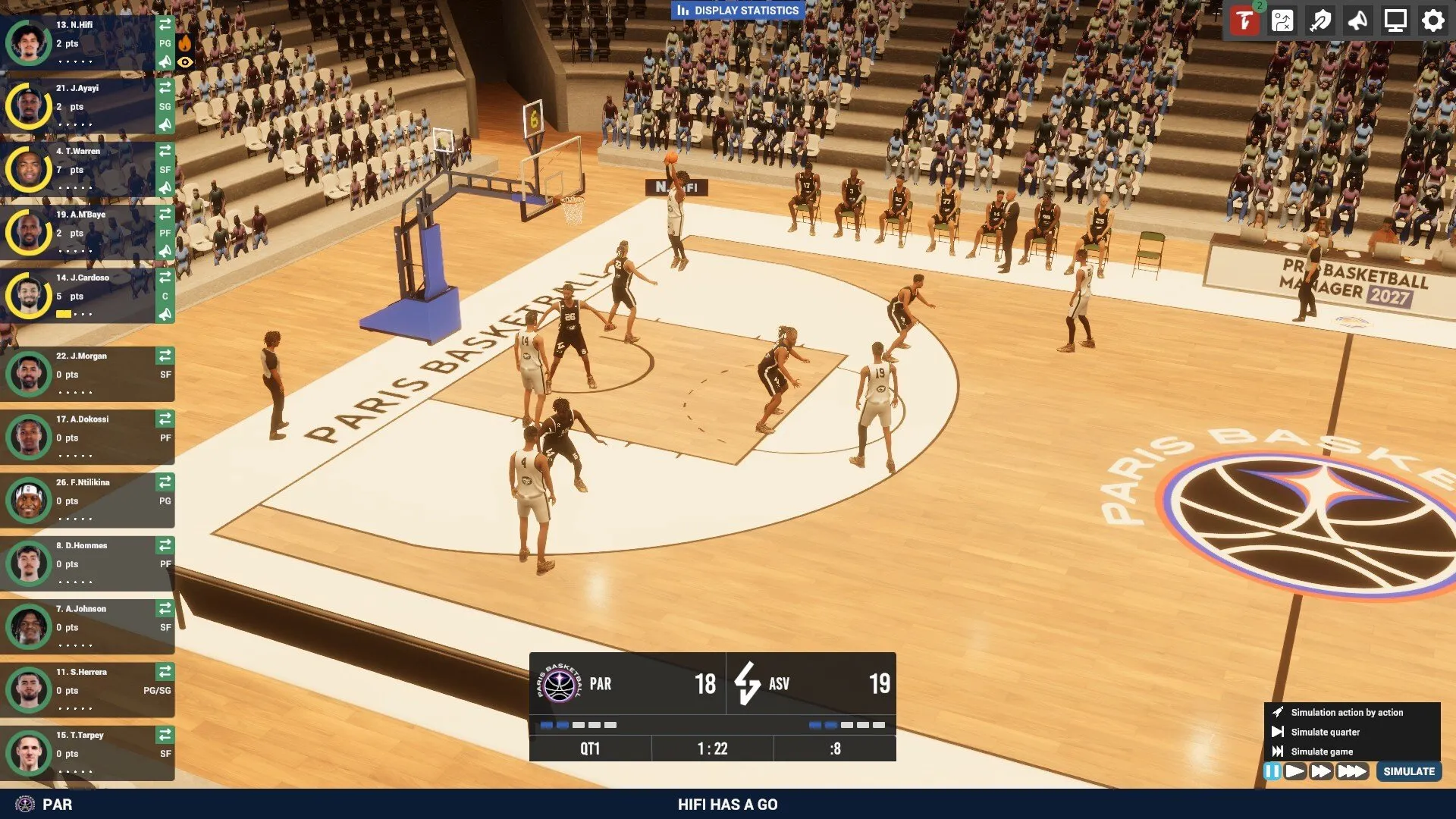
Paris Basketball against ASVEL, first quarter. The left panel shows every player’s points, fatigue ring and fouls; the swap icons are your substitutions. Bottom right: three speeds plus action-by-action, quarter or full-game simulation. Image: Umix Studios / Steam store page.
The short version
- Play it if you want to manage a real European club or national team, and you care about budgets, quotas, promotion and a living multi-league calendar more than about NBA cap mechanics.
- Play it if you like coaching in-game: the defensive options, per-player instructions and custom plays go further than in most basketball management games.
- Wait for a sale if you own the 2026 edition: 2027 adds personalities, better contracts and scouting, and season events, but the core is the same.
- Skip it if league-wide statistical realism is your first test of a sim, or if you only care about the NBA.
How we researched this review
We did not play Pro Basketball Manager 2027. It is a paid game for Windows and macOS with no demo on its Steam page, and our rules forbid purchases, so we could not capture our own footage or run our own seasons. There is no browser version and no public league data to capture.
What we could do was read a lot. Umix Studios publishes an official guide at guide.pro-basketball-manager.com, linked by the developer in the Steam forum as the game’s FAQ. It documents tactics, plays, 3D games, ratings, training, scouting, finances, the draft, settings and the new personality traits in detail. We read every page. We also read the Steam store pages of every edition since Basketball Pro Management 2015, eight years of Steam announcements and patch notes, the developer’s answers in the Steam discussions, the Steam user reviews of the 2025, 2026 and 2027 editions, and press reviews going back to 2014. We studied the official screenshots closely; several come from the 2024 and 2026 editions where 2027 has no equivalent, and the captions say so. Where we compare the engine with real basketball, we use Basketball-Reference data.
What we could not verify: how the game feels over many seasons, whether the 2027 engine fixes are real, and how well the AI uses the tactics it gives you. We say so wherever it matters. There is no testing block on this page because there was no test.
A season, step by step
The guide describes the loop precisely, and it will be familiar to anyone who has played Football Manager.
1. Create the career. You pick a database: the default one maintained by Umix, or a Steam Workshop mod. You create a coach with ten attributes (coaching, negotiation, player management, professionalism, referee management, self control, offensive tactics, defensive tactics, teaching, training). You pick a club, a national team or both. Then you decide which leagues are “playable”: only those get full schedules and active AI recruitment, and the more you add, the slower the simulation. Other career options include men’s and/or women’s competitions, U21 competitions (noticeably slower), the NBA-style draft, the new personality traits and the tutorial.
2. Meet the board. Your first message is a meeting where the board sets an objective for each competition, for example “reach the playoffs” or “finish the season in the black”. Miss it and the board sets them for you. You can raise an objective for a short time after it is set: you get a bigger budget immediately, and less patience if you fail.
3. Build the roster. You set a default roster with positions, minutes and roles, then tactics. Then you look at the budget and the payroll, and go to the market. Most leagues allow buyouts and loans; each has its own transfer windows and import rules. The 2027 negotiations are the new centre of this phase (more below).
4. Preseason. Since 2026 you plan your own friendlies. A big crowd against an established team brings income, but a heavy defeat costs morale. Fitness is the other priority: the guide tells you to use the preseason to get players in shape, because tiredness and poor fitness raise injury risk.
5. The season. Time moves only when you click: next day, until the next game or until a date. Important inbox messages can stop the simulation, and some must be answered before you can continue. On match day you choose to play the game in 3D or simulate it. Every month brings a balance sheet and salary payments. Sponsors check their bonus conditions. In 2027, season events add dilemmas with stated effects: board satisfaction, player morale, fans, sponsors.
6. Jobs and national teams. Your job security is shown on the dashboard, from “Very secure” to “At risk”. The board reviews you during the season and after each competition, after sending warnings. National teams gather only in their competition windows; before each one, a blocking inbox message asks you to confirm a roster.
7. Offseason. In June the American league holds a two-round draft with a lottery. Young players join your youth teams at the start of each season, with quality driven by your Youth Academy, and players who are too old move up a level. The board adjusts next season’s budget depending on the objectives you met. If your contract expires, the board may offer a renewal; if not, you apply for jobs, and your chances depend on your coach attributes and the league’s reputation.
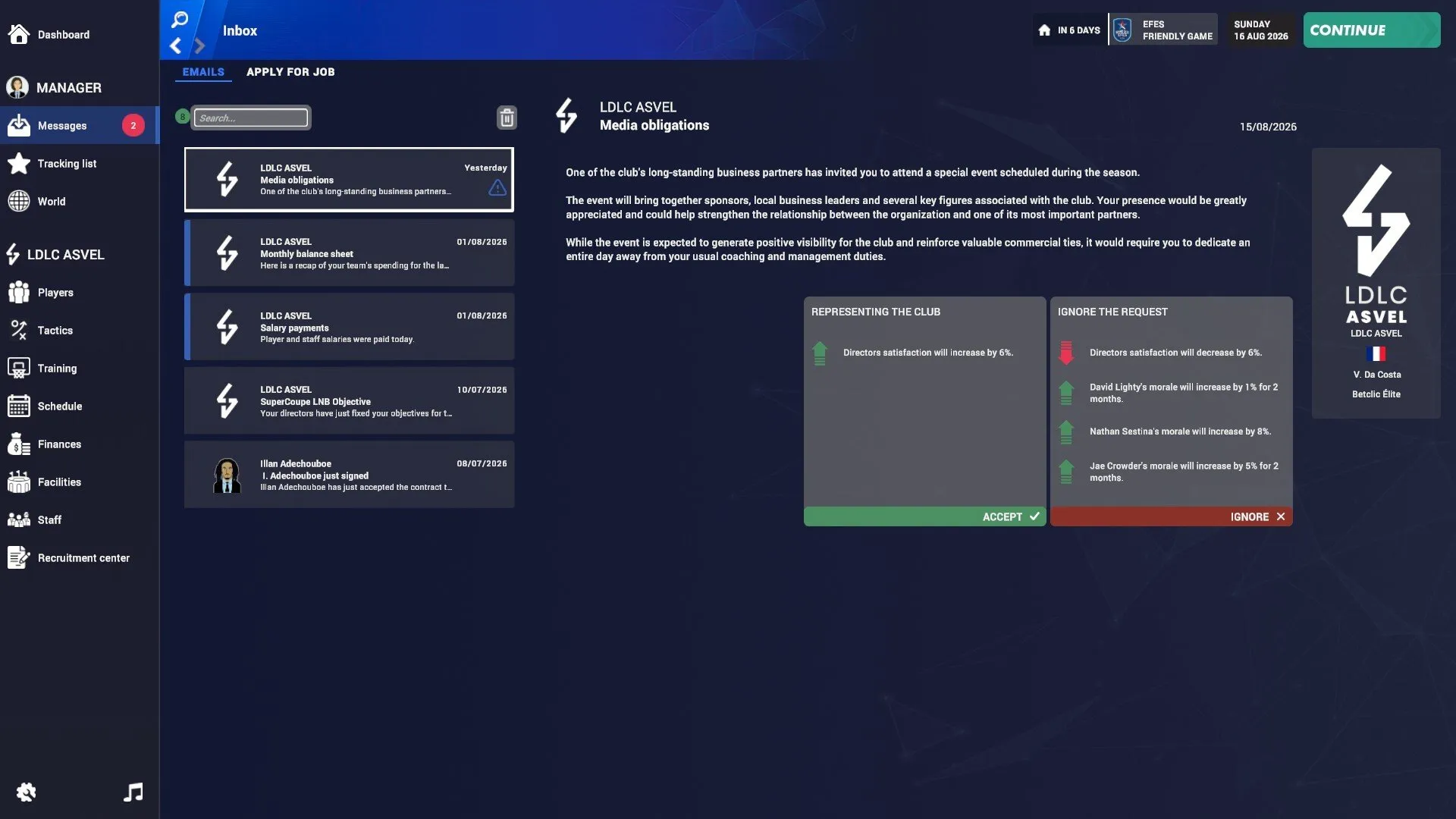 A 2027 season event at ASVEL: attend a sponsor event (+6% board satisfaction) or skip it and boost three players’ morale for up to two months. Every option states its effect in numbers, which makes events easy to read and easy to game. Image: Umix Studios / Steam store page.
The match engine
How results are produced. Pro Basketball Manager simulates games play by play. Watched and simulated games use the same engine, according to the official site, and that has been a deliberate goal: a December 2024 patch to the 2025 edition fixed “the differences between played and simulated games” and simulated games scoring less than watched ones.
What you see. In a watched game you get the 3D arena, the bench panel, a score bug with team fouls and the shot clock, and a play-by-play caption bar. The guide lists the cameras: Coach, TV, Court side, several Stands cameras, and 2D Vertical and 2D Horizontal views. You can play at x1, x2 or x4, pause, or switch to “simulate action by action”, “simulate quarter” or “simulate game”. Panels show a stats comparison, score evolution, top players, both box scores, the play-by-play and other games’ live scores. After the game comes a recap with a shooting chart filtered by quarter, fast-break, second-chance and turnover points.
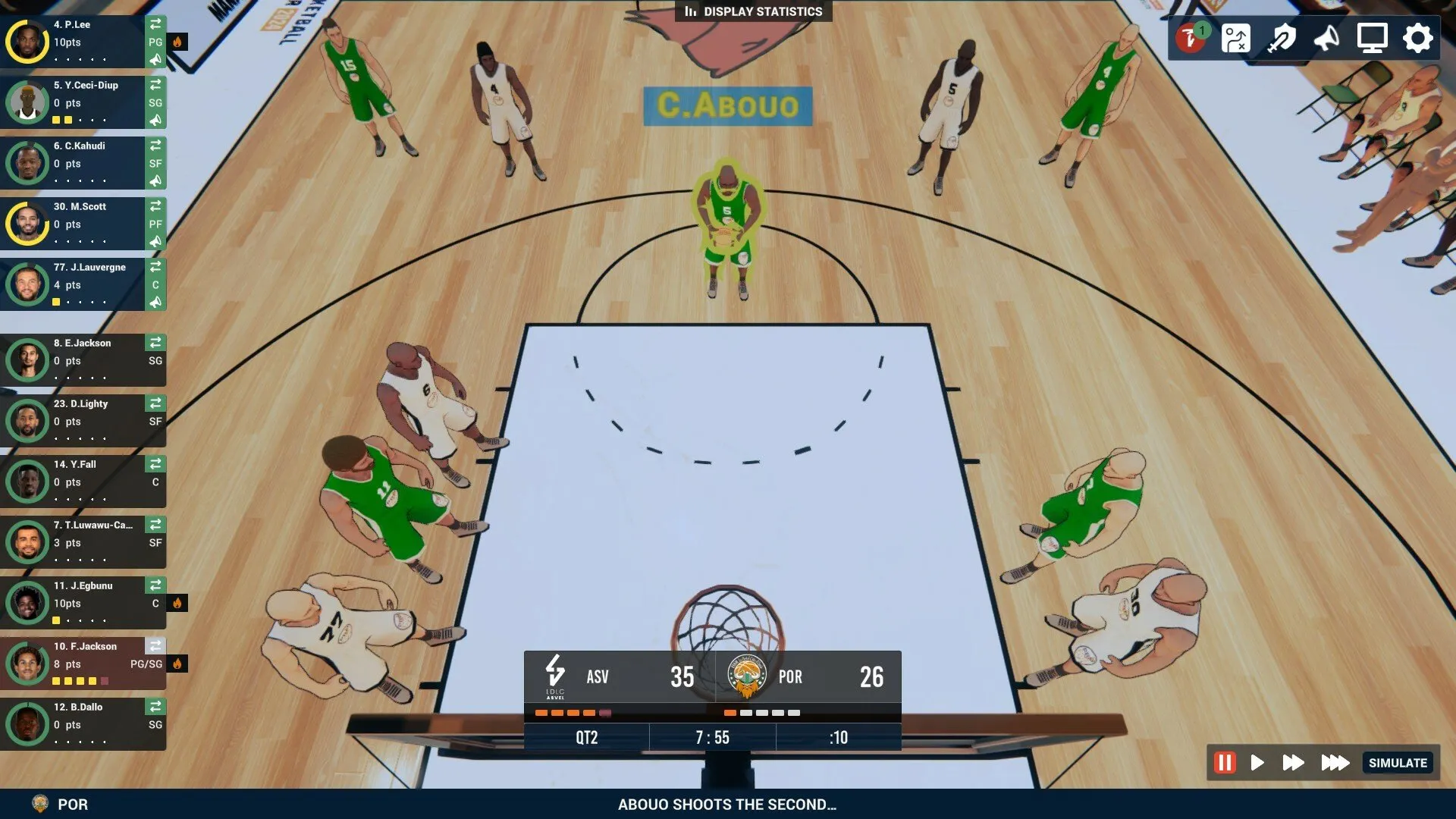 An overhead camera on a free throw in the 2024 edition. Yellow squares under a player’s name track his fouls, and the flame icons mark players who are hot; a 2025 reviewer complained that the “on fire” state can trigger after a single make. Tactics, plays and camera settings sit in the top-right bar. Image: Umix Studios / Steam store page (Pro Basketball Manager 2024).
What you can influence live. More than in most rivals. You can change offensive and defensive tactics at any time, make unlimited substitutions at each stoppage, call a timeout and talk to the team (the speech can help or hurt morale), tell individual players to drive, shoot inside, take a two or a three on the next possession, calm them down or congratulate them, call one of your custom plays, and order a deliberate foul to stop the clock. Your assistants suggest actions: change a match-up, switch defense, sub out a tired or struggling player. If you would rather watch, tactics and substitutions can be handed to the AI, a feature added to the 2023 edition in December 2022.
Difficulty matters on the court. The guide says that on higher difficulty the AI targets weak match-ups more aggressively, exploits strong attackers facing weak defenders and reacts faster to your tactical changes.
Realism evidence. Umix talks about realism in every announcement and has shipped meaningful fixes. The December 2024 “Christmas update” changed shot distribution (point guards shoot less, offensive leaders more), shooting percentages, turnovers, steals, assists and AI rotations that benched stars too often. The February 2026 progression overhaul made older players decline faster and young players develop faster, after Umix “simulated countless seasons”. For 2027, the developer says the engine adds “more physical domination” and ball trajectories with bounces, and promises that “player strengths and team composition are now reflected more accurately”.
What we cannot find is any published league-wide output. So we looked at the one full stat sheet Umix itself publishes for 2027, the recap of a Paris Basketball–Nanterre friendly on the official website, and set it against real EuroLeague averages. One game proves nothing on its own; it is a starting point, not a verdict.
| Per team, per game | Paris (official 2027 recap) | Nanterre (official 2027 recap) | EuroLeague 2024-25 average |
|---|---|---|---|
| Points | 72 | 82 | 83.8 |
| Field goal attempts | 67 | 65 | 62.9 |
| 3-point attempts | 18 | 7 | 26.0 |
| Share of shots from three | 27% | 11% | 41% |
| Points from free throws | 6 | 10 | 14.6 (on 18.8 attempts) |
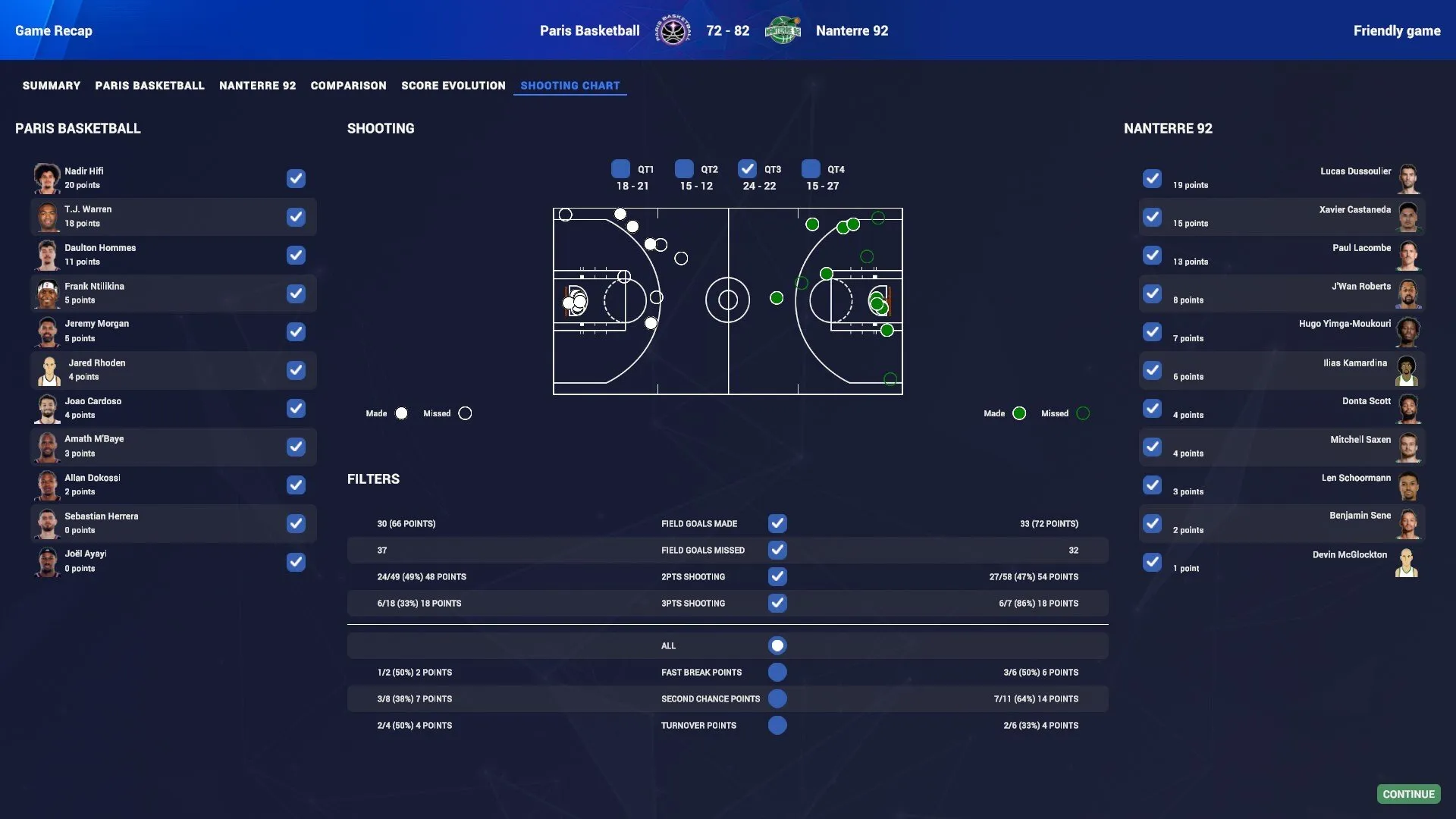 The official recap of a 72-82 friendly. Nanterre made 6 of 7 threes but took only 7 of its 65 shots from deep, and both teams scored very little from the line. The quarter filters and fast-break, second-chance and turnover splits are among the best post-game tools in the genre. Image: Umix Studios / official website.
If those numbers were typical, Pro Basketball Manager would be simulating a game from the early 2000s, with far fewer threes and free throws than modern European basketball. We do not know that they are typical, and it is a friendly. It does line up with what players report, though.
Known engine complaints, all from Steam reviews of the 2026 edition: centers taking too many threes while wings take two a game; results that feel random (“a random number generator with basketball names”); playmakers with high dribbling ratings committing eight turnovers against mediocre opponents; a shot clock resetting to 24 instead of 14 after an offensive rebound (the rule FIBA introduced in 2014 and the NBA adopted in 2018); and AI rotations that ignore the minutes you set. In 2025, one reviewer with 50 hours claimed that when you play games instead of simulating them, “90% of the time you win the match”. On the presentation side, a 2027 forum post complains that players look “stuck in the ground, making robotic movements”. The developer’s reply was candid: “I agree the next step is probably to add a lot of animations!”
Coaching and tactics
This is where our first version of this review was wrong. We had read the tactics complaints and concluded the coaching layer was thin. The official guide shows a toolkit that is, on paper, among the deepest in the genre.
Roster, minutes and roles. For each player you set a position (PG, SG, SF, PF, C, S for the bench, X for excluded) and the minutes you want. The assistant follows them in simulated games, adjusted for fouls, fatigue and injuries. Three roles shape behaviour: up to two Go-to guys take many more shots and get the ball when the shot clock runs down; one 6th Man shoots more than usual off the bench; one Defense specialist focuses on stopping people.
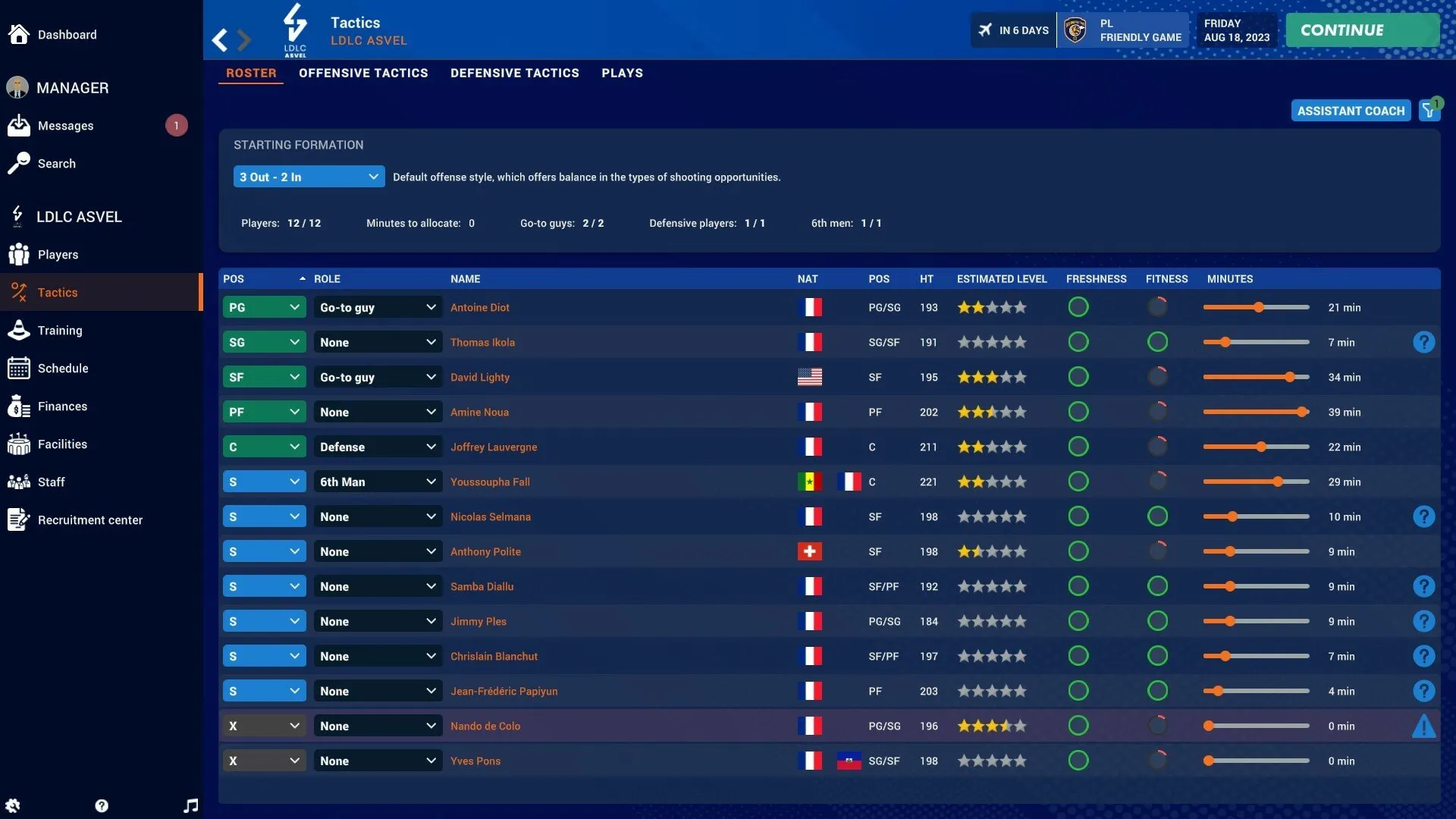 The roster screen in the 2024 edition: 3 Out-2 In, every minute allocated, two go-to guys, one defender, one sixth man. Excluding Nando de Colo (X, 0 minutes) triggers a warning icon. A Chinese-language 2026 review reports that simulated games do not respect these minutes. Image: Umix Studios / Steam store page (Pro Basketball Manager 2024).
Offense. Collective instructions: starting formation (3 Out-2 In or 4 Out-1 In), tempo (patient, neutral, fast), shot distribution (close, balanced, far) and offensive-rebound strategy (limit transitions, neutral, crash the boards). Individual instructions: for each player, avoid, allow or “shoot at will” on mid-range jumpers, threes, shots near the lane and drives.
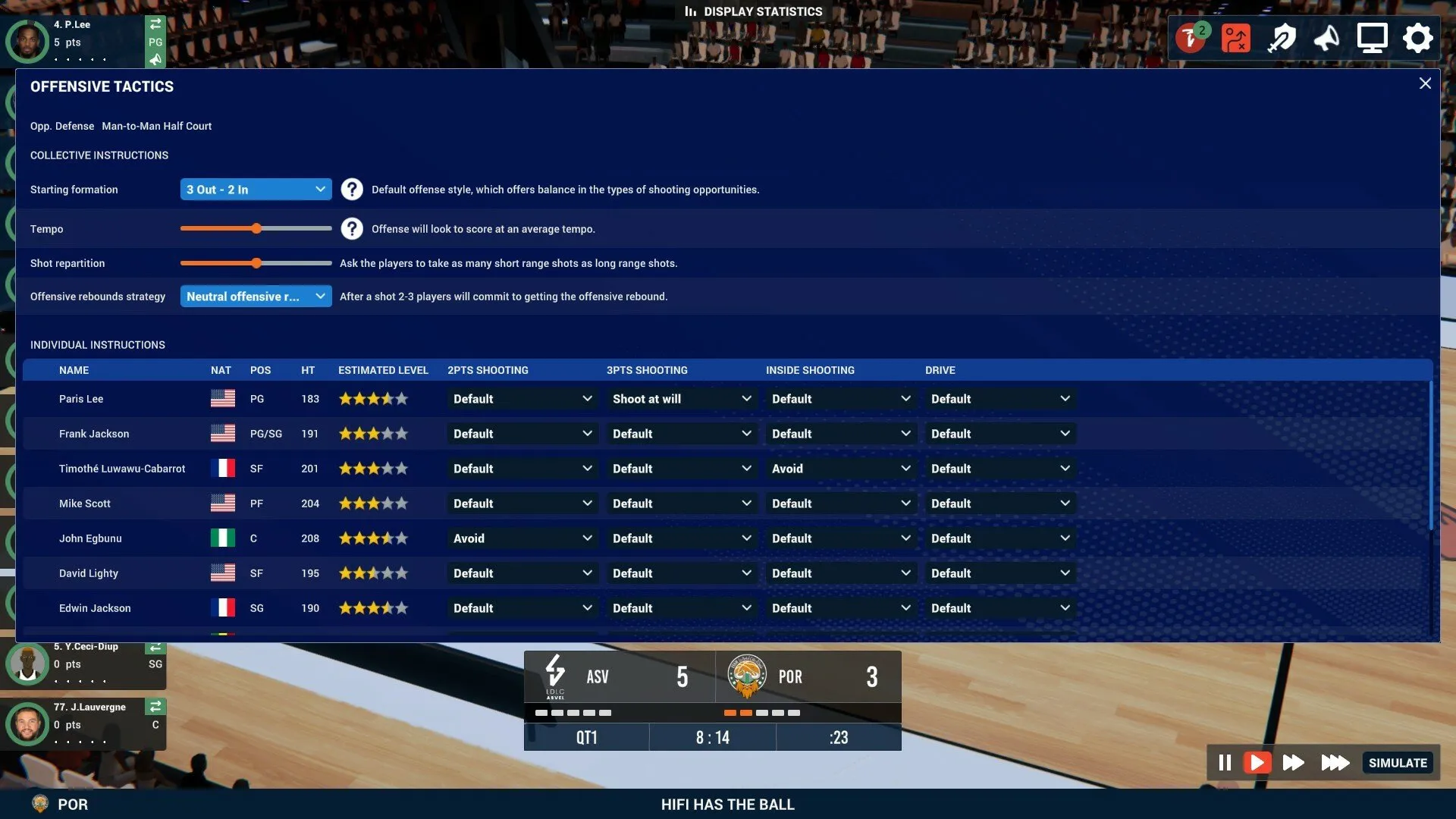 The in-game offensive panel (2024 edition), early in the first quarter. The point guard is set to “shoot at will” from three, the center to “avoid” mid-range twos. The panel also tells you the opponent’s current defense: man-to-man half court. Image: Umix Studios / Steam store page (Pro Basketball Manager 2024).
Defense. Six team defenses: man-to-man half court, man-to-man full court, zone 2-3, zone 3-2, zone 1-3-1 and a full-court zone press. Then, per player: the match-up, on-ball pressure (gap, moderate, tight, smother), off-ball pressure (gap, moderate, tight, deny), on-ball screen coverage (go over, go under, switch all, switch bigs, switch guards), off-ball screen coverage, and hedging (no hedge, soft, hard). Pick-and-roll coverage, switching rules and hedges are things many basketball management games do not model at all.
Plays. The play designer lets you script a possession for all five players. The ball handler can move (at five speeds), pass (chest, overhead, bounce), drive and shoot, shoot or wait; players without the ball can move, set a screen for a named teammate or wait. Each play is tied to a formation and to the defense it is meant to beat, and must end with a shot. In a game you call it from the megaphone menu, filtered by formation, defense, shooter and shot type. The catch is in the guide: a play only runs if it matches the defense the opponent is playing and there is enough time on the shot clock. When you call nothing, the team picks a play by itself.
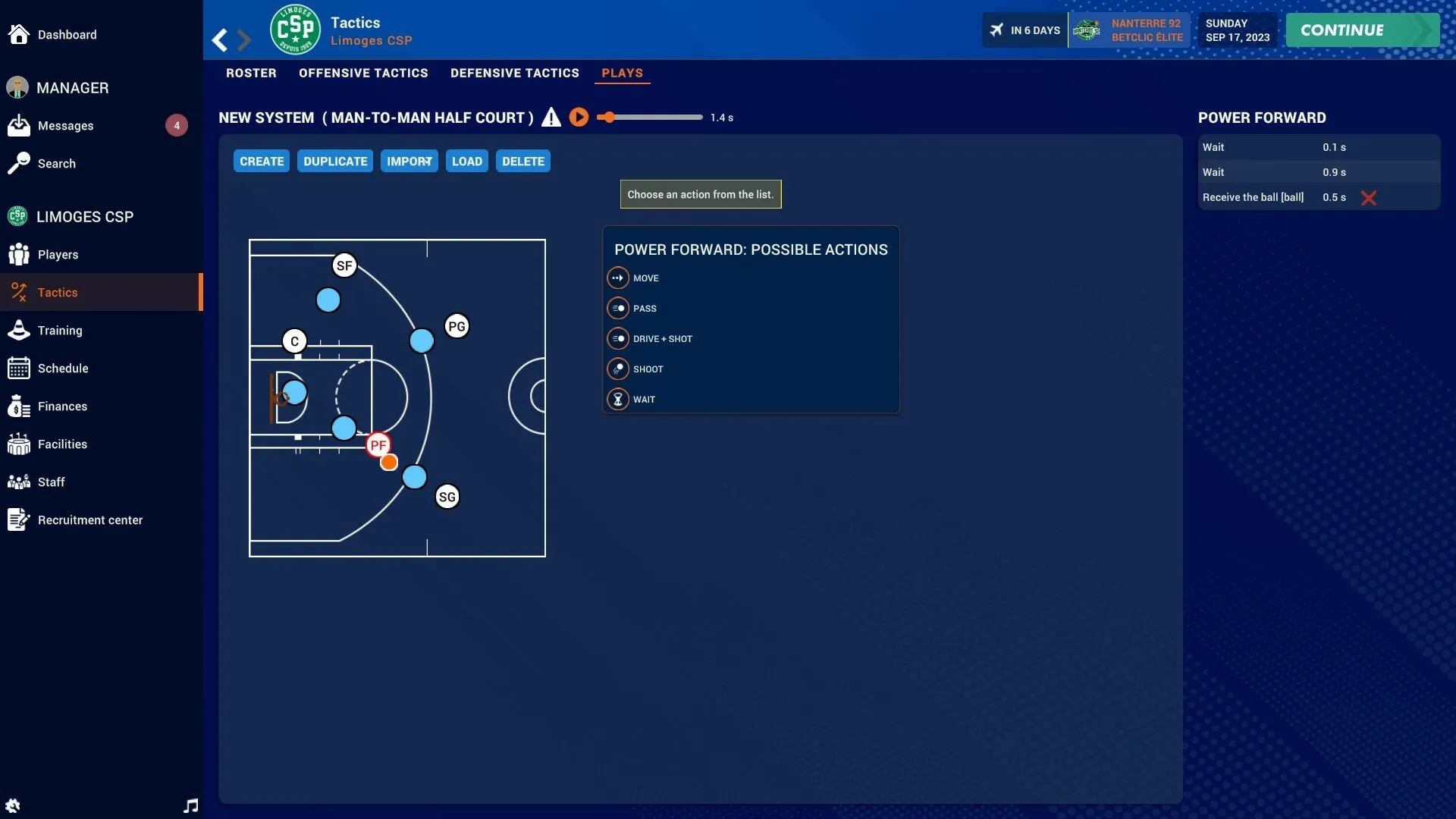 The play creator (2024 edition): a new set against man-to-man half court, with the power forward’s possible actions. The warning icon marks the play as unfinished until a shot is added. Note the Import button. Image: Umix Studios / Steam store page (Pro Basketball Manager 2024).
Training and staff. Up to six hours a day, with separate settings for the day before and after games and for vacations, a split between team and individual work, and five intensity levels. Individual programmes target a profile (playmaker, rebounder, perimeter shooter, inside finisher, mid-range shooter, slasher, perimeter defender, post defender), a single skill, a second position, or rest. Coaches’ Training and Teaching attributes, fitness coaches, physios and facilities all feed progression. Training programmes can be exported and loaded.
What is missing compared with the best. Not much on paper; a lot in practice, according to players. The play designer is labour-intensive: “Game calling creator is buggy and needs a complete overhaul,” wrote a 2026 player, who also asked for simple calls such as pick-and-pop and ball reversal. A 2025 buyer could find no shared playbooks and asked the forum for ready-made plays, getting no answers. There are no pre-built offensive systems in the sense of Draft Day Sports (motion, Princeton, run-and-gun); there is no matchup planner across a playoff series; players asked for separate rotations per competition. And the biggest gap is the one we cannot measure: whether the engine honours your choices. Several negative reviews say it does not.
Players and ratings
Twenty-six ratings in four groups, each described in the official guide:
| Group | Ratings |
|---|---|
| Offense (8) | 3pt shooting, 2pt shooting (mid-range), inside shooting, drive, free throws, dribble, pass, shot creation |
| Defense (6) | frontcourt defense, backcourt defense, steal, offensive rebound, defensive rebound, block |
| Physical (6) | speed, stamina, jump, power, acceleration, explosiveness |
| Mental (6) | collective, self control, positioning, influence, consistency, experience |
Some definitions are worth knowing. Influence lets a player take more shots without upsetting teammates. Experience helps avoid fouls and turnovers and matters more in playoffs, finals and relegation battles. Consistency governs game-to-game regularity. Ratings display out of 20 or 100. The overall can be “position-weighted” (top players reach 90+), an “attribute average” (most players between 30 and 70) or hidden, showing only your staff’s estimate.
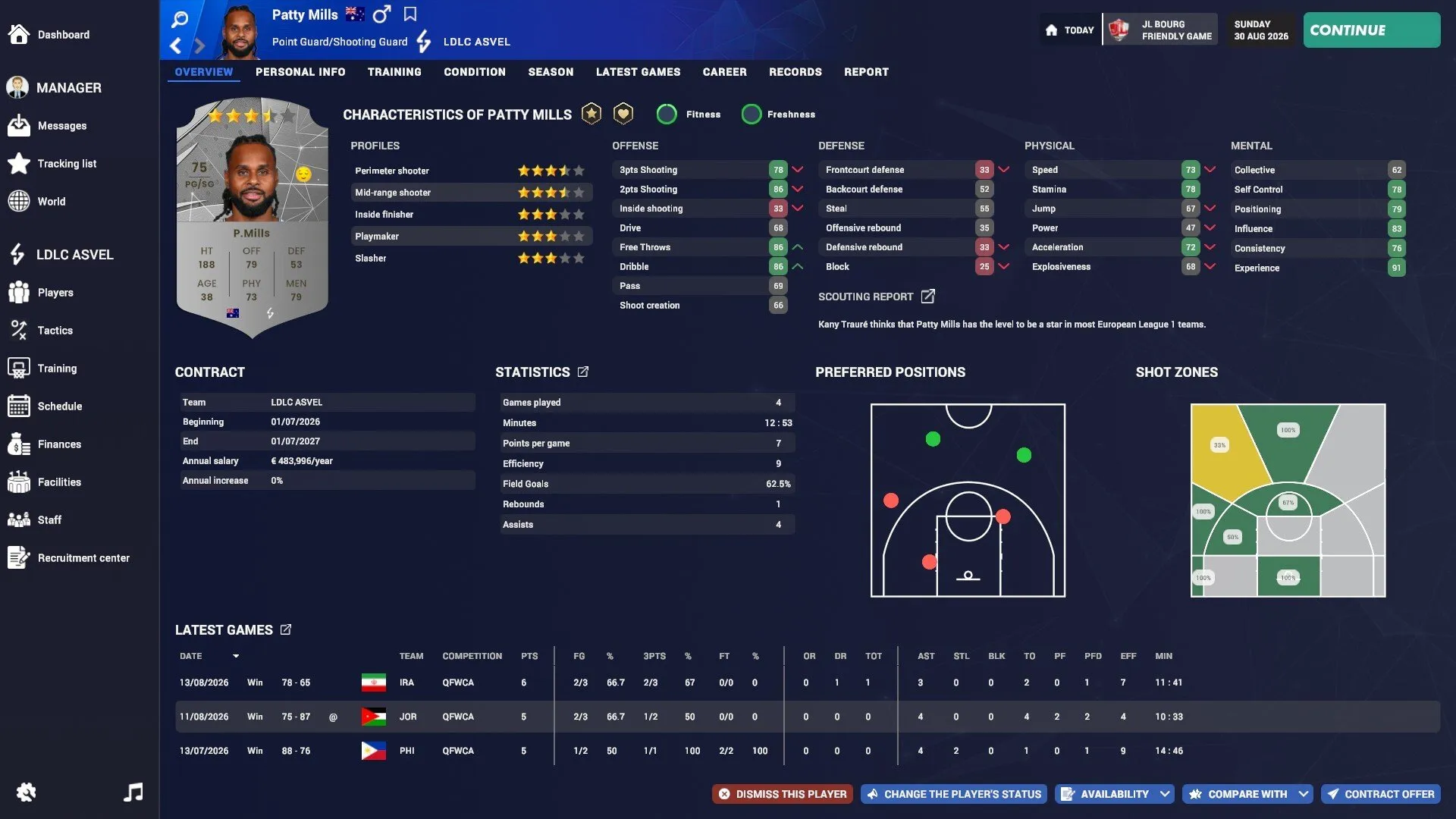 Patty Mills, 38, at ASVEL. Note the profile stars (perimeter shooter and playmaker), the red arrows on his physical ratings signalling decline, and the shot-zone chart. His scouting line already reads like a Football Manager report. Image: Umix Studios / Steam store page.
Potential, progression and aging. Potential caps the level a player can reach. Young players progress much faster; veterans mostly improve their best skills while their physical ratings decline. Training hours and intensity, fitness, work ethic, staff, facilities and playing time (especially against stronger opponents) all count. After February 2026, older players decline faster and youngsters develop faster. A long-term NBA-league player complained in December 2025 that newly generated rookies were far too weak physically for that level.
Scouting fog. Information is incomplete outside your own league. A scouting report gives an estimated level, potential, injury frequency, salary expectations, pros and cons and, in 2027, personality traits and short-term goals. Each report has a reliability; scouting a player again raises it, scouts with a high reputation write better reports faster, and reports age. Missions send a scout to a country or competitions for one to six months, with age, position and budget filters, a monthly report and a travel cost. In 2027 you can scout whole competitions.
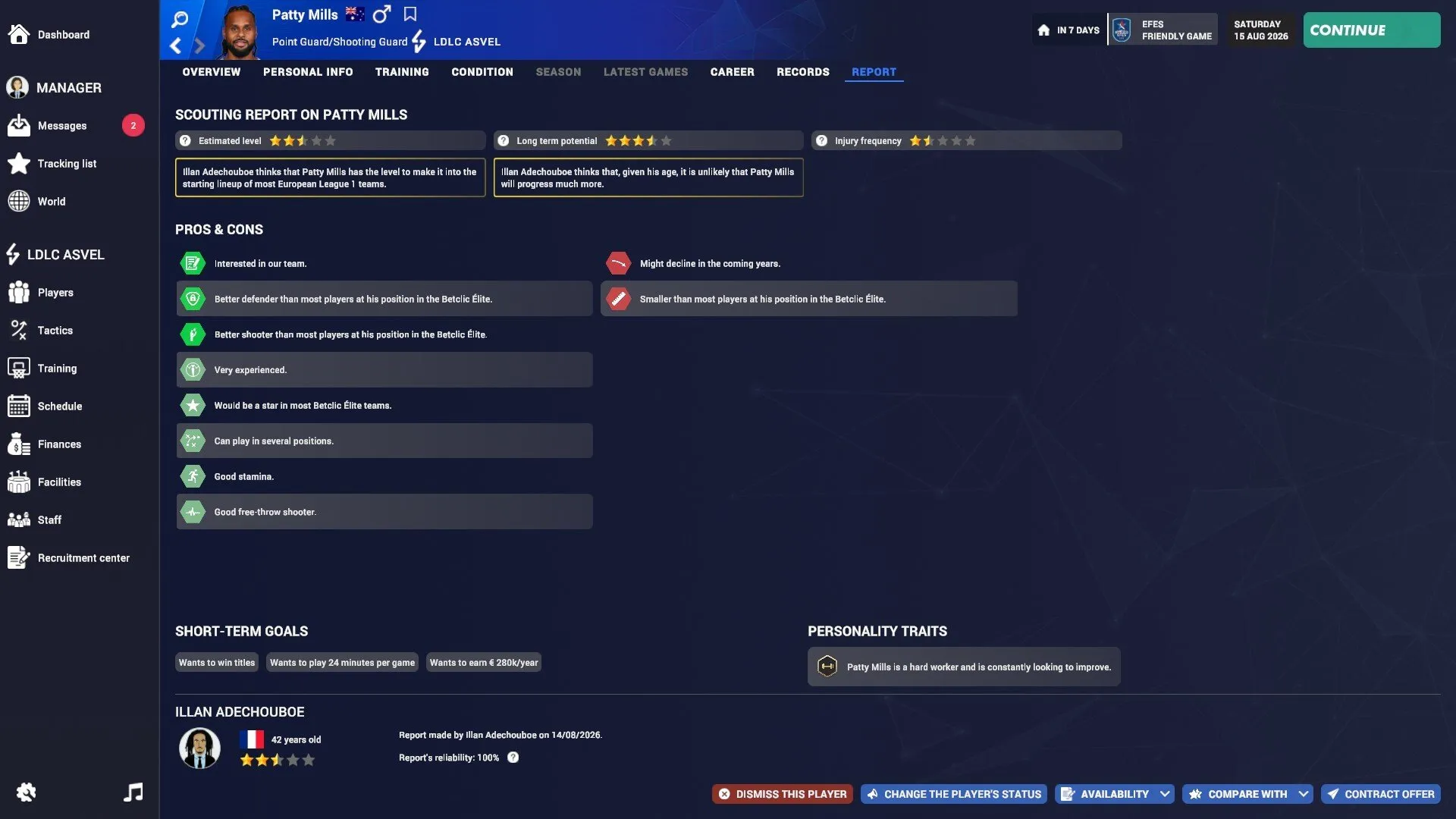 A 2027 scouting report on Mills, 100% reliable because he is on your team. The pros and cons are relative to the Betclic Élite, and the new short-term goals (titles, 24 minutes a game, €280k a year) tell you exactly what a contract has to offer. Image: Umix Studios / Steam store page.
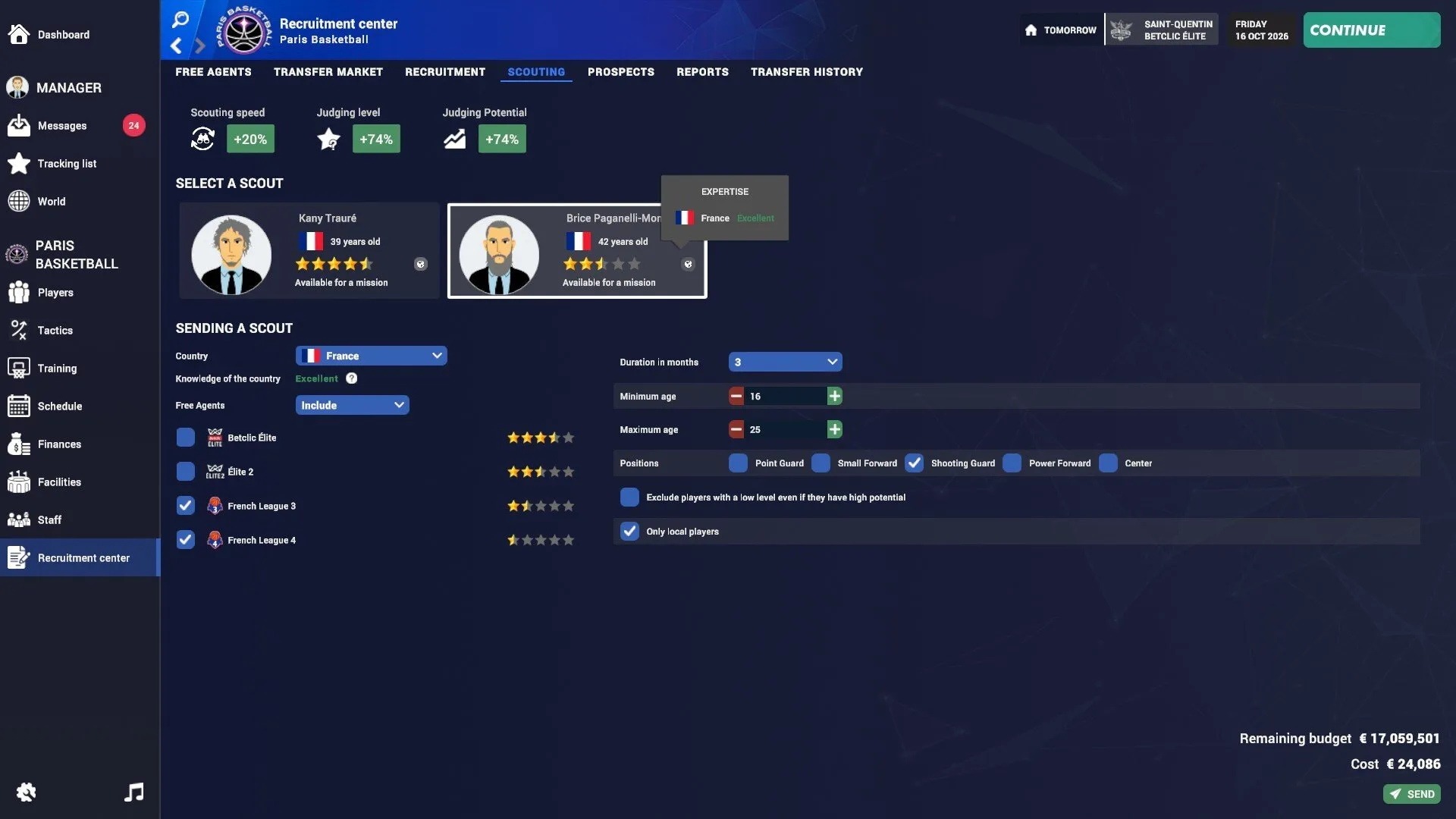 A three-month mission to France’s third and fourth divisions for 16-to-25-year-old shooting guards, local players only, for €24,086. The bonuses at the top (+20% scouting speed, +74% judging of level and potential) come from your staff and facilities; the selected scout’s French expertise is rated Excellent. Image: Umix Studios / Steam store page.
Personality traits (new in 2027). If enabled, every player gets one or two hidden traits: Ambitious, Money-Oriented, Family-Oriented, Adventurous, Hard Worker, Loyal, Leader, Environmentalist or Tech Enthusiast. They shape where a player wants to go, what he asks for and how he reacts, and they generate career goals. A Leader wants minutes and status and may react badly when you sign a rival for his role; a Loyal player renews more easily and negotiates longer; a Tech Enthusiast likes clubs that invest in technology. Some of this is flavour, but the combination with scouting is smart: you have to spend scouting time to know who you are negotiating with.
Morale and chemistry. Since 2026, chemistry gives more weight to leaders, influential players and shared history: players who play together more develop more synergy. The morale screen groups players by influence and shows their feedback. Coaches with good Player Management handle moods better; good Offensive and Defensive Tactics build chemistry faster.
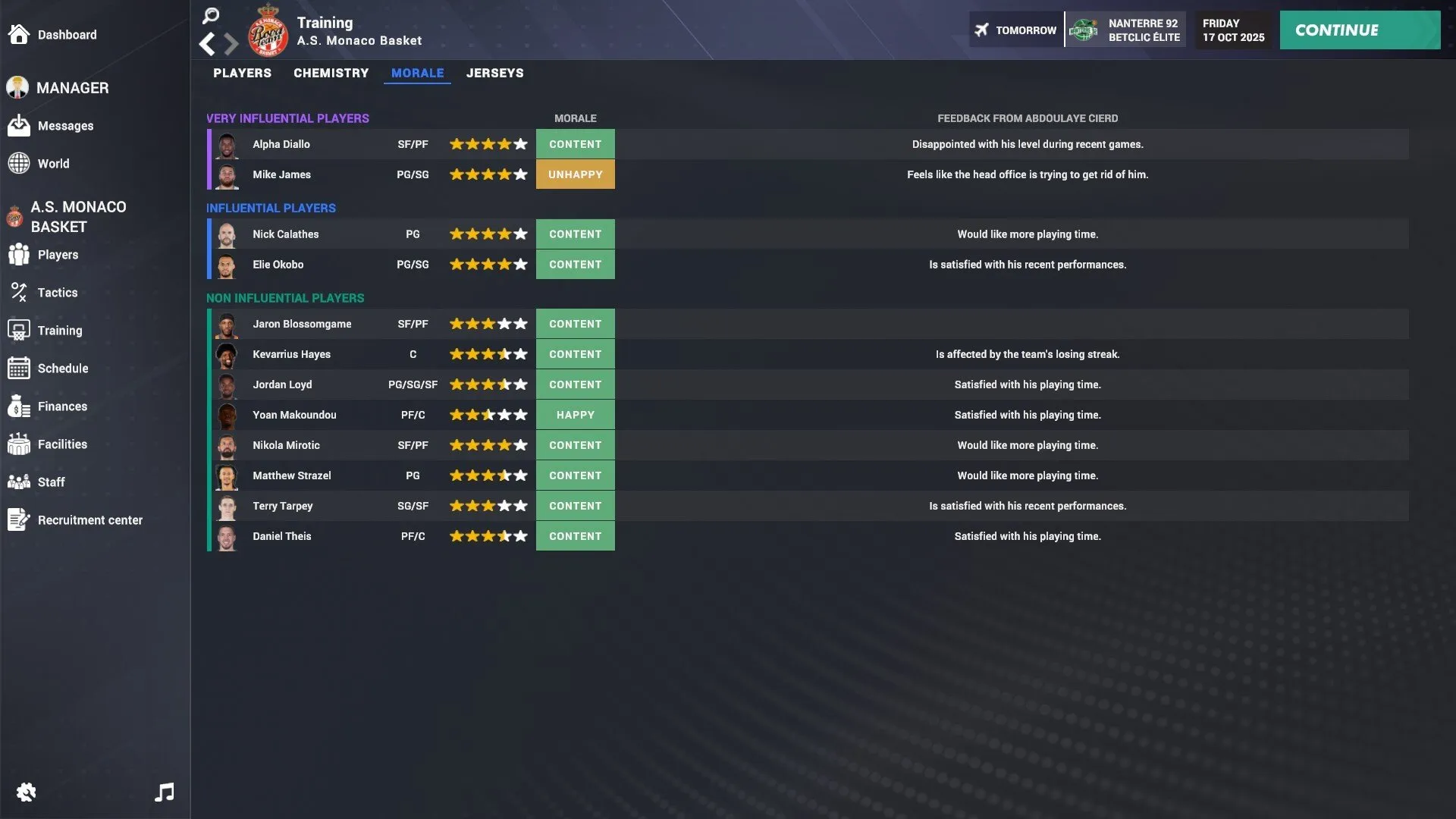 The morale screen of the 2026 edition: Mike James is “unhappy” and thinks the head office wants to get rid of him. Because he sits in the “very influential” group, his mood weighs more on the locker room. Image: Umix Studios / Steam store page (Pro Basketball Manager 2026).
Injuries. Injury risk grows with tiredness, poor fitness, training intensity and hours, and each player’s own injury proneness. Medical staff and the Medical Center reduce injuries and recovery times.
Front office
Pro Basketball Manager runs two economic models side by side, and you need to know which one your league uses.
The European model (most of the world). The board gives you a season budget and a payroll envelope. Income comes from the arena (tickets, shop, refreshments), sponsors, prize money, income-generating buildings, player sales and subsidies. Expenses include salaries, arena and facility upkeep, scouting, recruitment visits, travel, taxes and dismissal fees when you release someone under contract. A negative balance blocks transfer offers, lowers board satisfaction every month and can get you fired “no matter how well you did on the court”. You can buy players out of their contracts and take them on loan. Leagues have their own windows, renewal restrictions and import-player quotas.
The contract. This is the best screen in the game. You set a monthly salary, an end date, a status (from “definitely in starting lineup” down), responsibilities, playing-time promises, a competition victory bonus, a release clause, an annual raise, a car and accommodation, and a relegation release clause. In 2027 the player answers in a chat window, and his traits and goals shape the answer. On higher difficulty players ask for more money, longer deals and specific roles; on lower difficulty, AI clubs pay less attention to traits and goals when making offers. Since 2026, dismissals and transfer exits are negotiated too: a refused exit can leave you with a demotivated player.
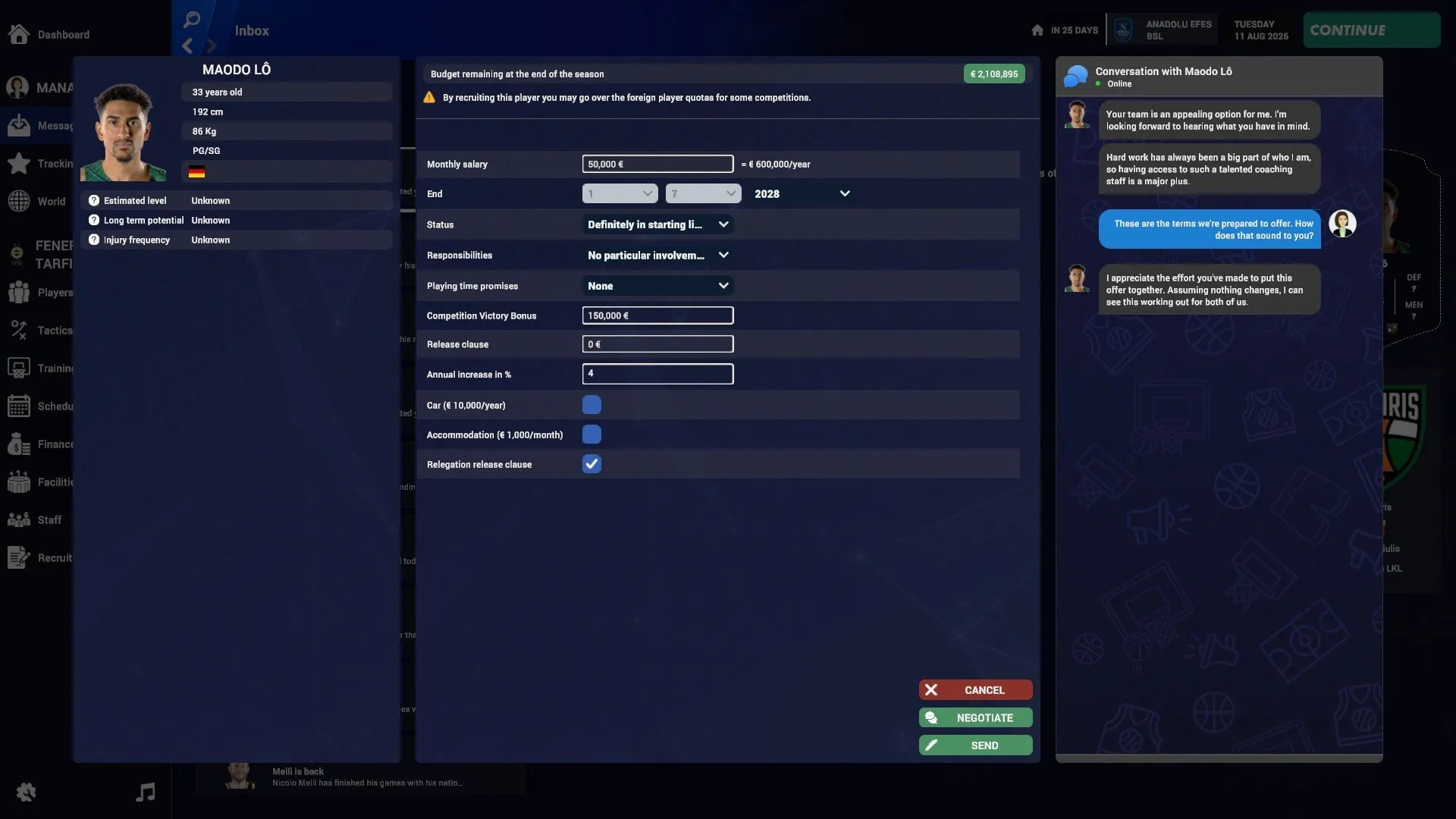 Negotiating with Maodo Lô: €50,000 a month, a starting-lineup promise, a €150,000 title bonus, a relegation clause. His level and potential are still “Unknown”, and the game warns that signing him may break import quotas in some competitions. Image: Umix Studios / Steam store page.
The American model. Umix’s developer told a forum user in October 2026 that there is “a league following the same rules as the NBA”, with Workshop mods adding real NBA names. According to the guide, it uses a salary cap with cap room shown on the finances page, a luxury tax charged at season’s end on payroll above the threshold, free agency in summer, trades of players and picks in the first part of the season, and a two-round draft in June with a lottery. First-round picks sign rookie contracts scaled by draft position; second-round picks sign one-year deals. Pages on cap exceptions and US free agency are still marked “under writing” in the guide. Players who know the NBA report gaps: a Chinese-language December 2025 review lists rookie deals limited to two years without the real 2+2 structure, no 15-man roster limit, salary matching in trades that sometimes blocks equal deals and allows unequal ones, and years of service resetting after a trade so you lose the right to re-sign over the cap. If you want an airtight NBA front office, look at Draft Day Sports or Basketball GM.
Trade AI. The evidence is mixed and dated. In November 2024 a reviewer of the 2025 edition reported trades “that made absolutely no sense for the opposition”. Patch notes since 2022 list repeated fixes to trades, transfers and AI recruitment, including a January 2023 update that made the AI “more aggressive on the transfer market”. We found no recent, detailed evidence either way for 2027.
Board and fans. Board satisfaction matters more than fan satisfaction for your job. Objectives drive both your budget and your survival. Fans react to streaks, margins and rivalries, and can save your job if they stay optimistic.
Sponsors and facilities. Since the 2025 edition you choose three sponsors (main, secondary, minor) from several offers each season, with safer flat deals or riskier ones carrying bonuses tied to goals such as fielding players of the sponsor’s nationality, playing young players or winning 70% of home games. The 3D campus has 13 buildings: arena, offices, museum, youth academy, parking, VIP room, training center, bars, shops, medical center, e-sport center, energy production and public transport. Each upgrade has a price, a build time and a stated effect. You also set ticket prices per stand and shop and refreshment prices, and can ask the local government for funding for arena work.
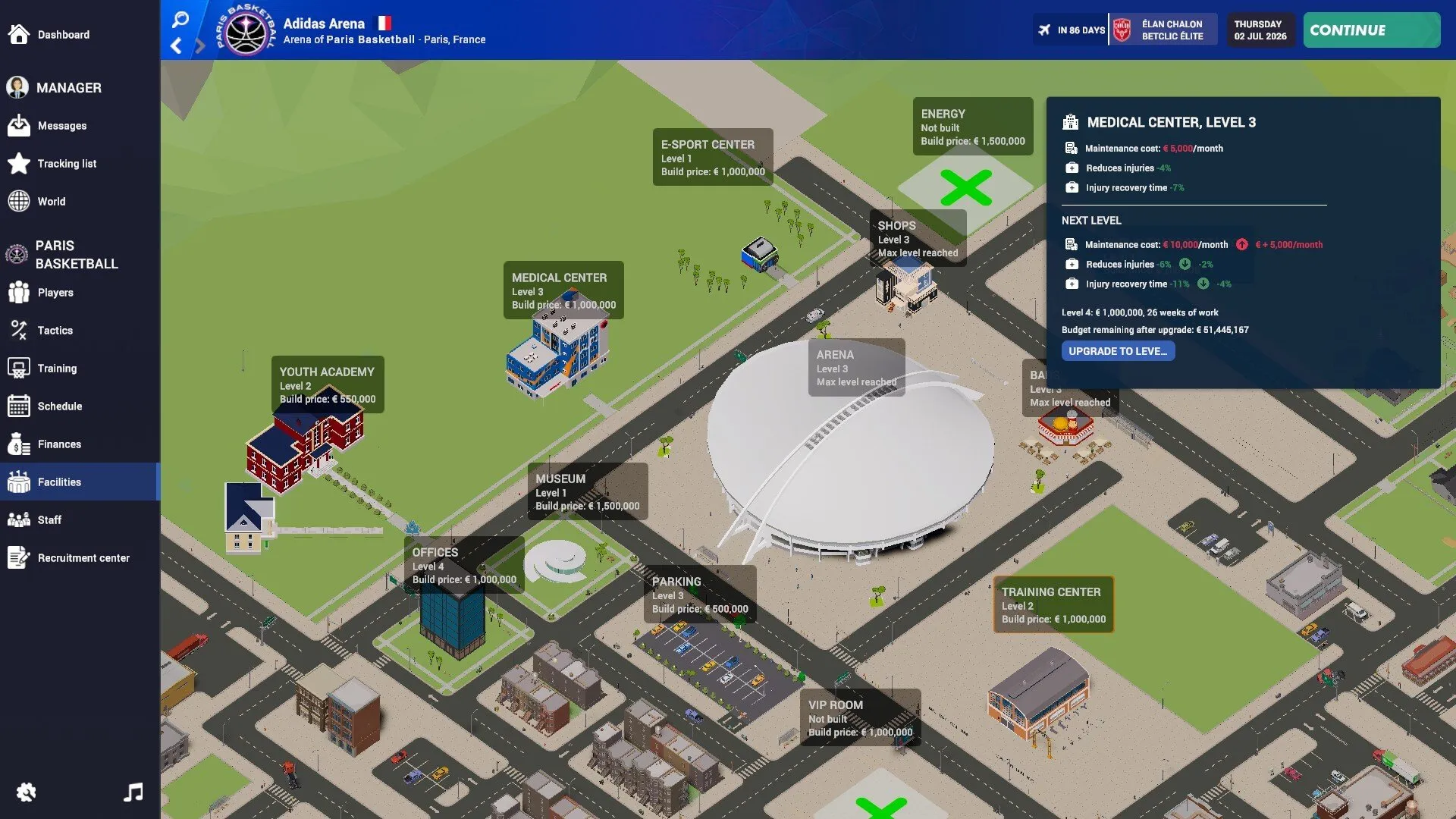 Paris Basketball’s campus. A level-3 medical center costs €5,000 a month and cuts injuries by 4% and recovery time by 7%; level 4 doubles the upkeep to €10,000 for two more points on injuries and four on recovery, and takes €1M and 26 weeks to build. Classic diminishing returns. Image: Umix Studios / Steam store page.
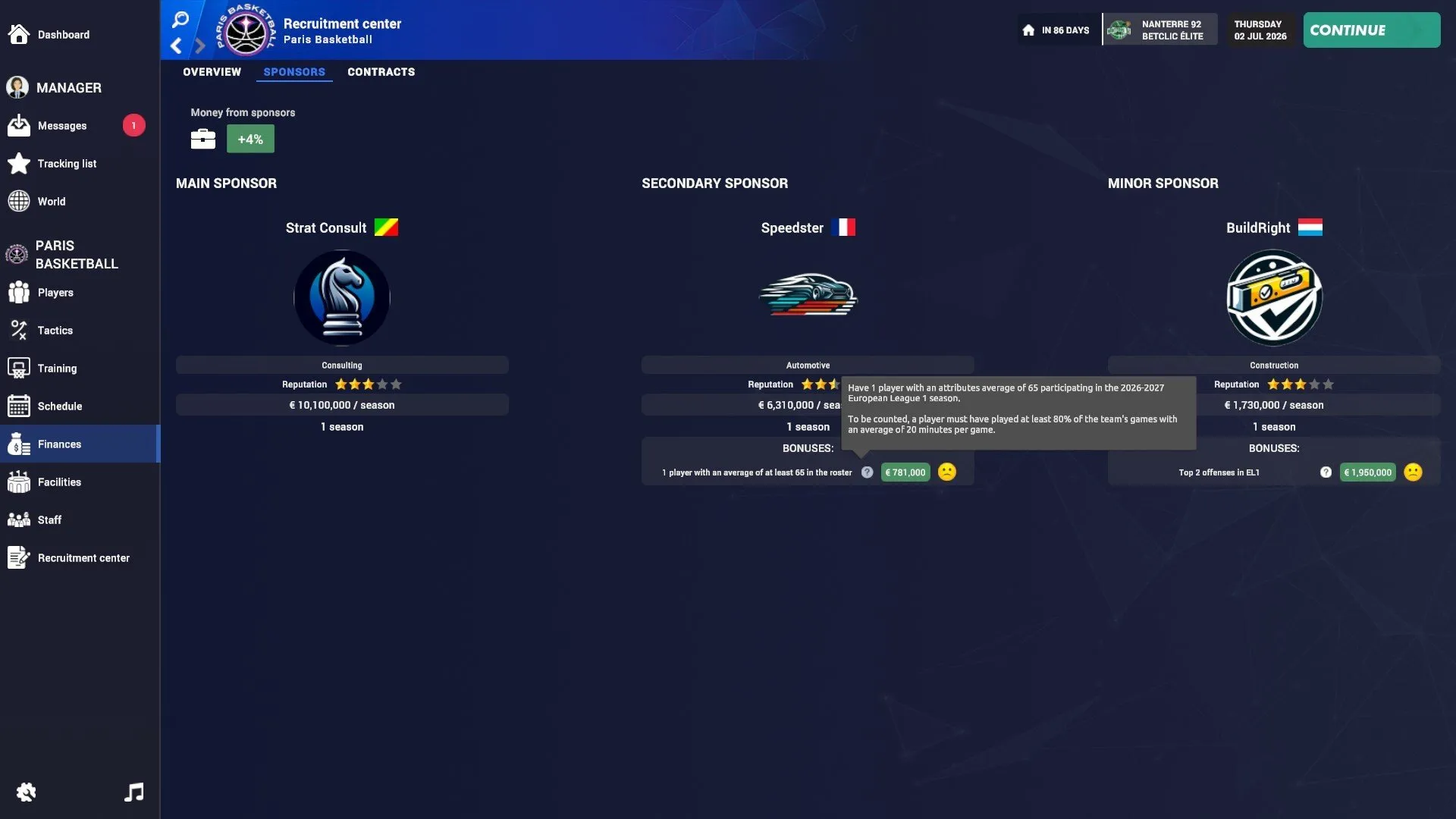 Three sponsors worth €10.1M, €6.31M and €1.73M a season. The tooltip shows a bonus condition: one player with an average attribute of 65 who plays 20 minutes a game in European League 1. Sponsors push roster decisions, which is the point. Image: Umix Studios / official website.
World and longevity
Leagues and licences. The 2026 store page lists 2,000+ teams in 90 domestic competitions, 17 of them women’s, across the Americas, Asia, Europe and Oceania, plus continental competitions (two in the Americas, one in Asia, seven in Europe) and national teams. The Basketball Champions League is officially licensed, with all clubs and players, since 2026, the first continental licence in the series. More than 20 domestic leagues are licensed; the 2026 page names France, Turkey, Lithuania, Belgium/Netherlands, Czech Republic, United Kingdom, Austria, Sweden, Slovakia, Cyprus, New Zealand, Norway, Italy and the women’s Adriatic league, and the 2027 website highlights the Betclic Élite, BSL and Betsson LKL. There is no NBA, EuroLeague or WNBA licence. The developer confirmed the WNBA is not in the game and said unlicensed leagues are usually added by the Workshop community. The EuroLeague’s place is taken by a “European League 1”; a December 2025 patch let European League 2 winners and playoff teams qualify for it, after players complained its participants never changed.
| Structure | What the official sources document |
|---|---|
| Domestic | 90 competitions (17 women’s), promotion and relegation, national cups and supercups |
| Continental | Licensed BCL; European League 1 and 2; other continental cups |
| National teams | Qualifiers, continental championships and World Cup windows; manageable alongside a club |
| Youth | U21, junior, youth and reserve teams; optional simulated U21 competitions |
| American league | NBA-style rules: cap, luxury tax, two-round draft with lottery, rookie contracts |
History and records. Player profiles have records and career tabs; the inbox reports personal records; competitions keep former drafts and trophies. The guide does not document a Hall of Fame or retired numbers, and we found none in the official material.
Editor and modding. The free DataEditor, installed from the Steam Tools section, edits players, teams, competitions, staff, injury types and sponsors. You can create fictional leagues, add photos and logos as PNG files named by ID, and publish to the Steam Workshop from the game. Mods are chosen when you start a career and cannot be changed afterwards. Workshop mods are not supported on the Epic Games Store version, though the DataEditor ships with it. There is no in-game editor; the developer said in November 2026 that it is “not the highest priority”.
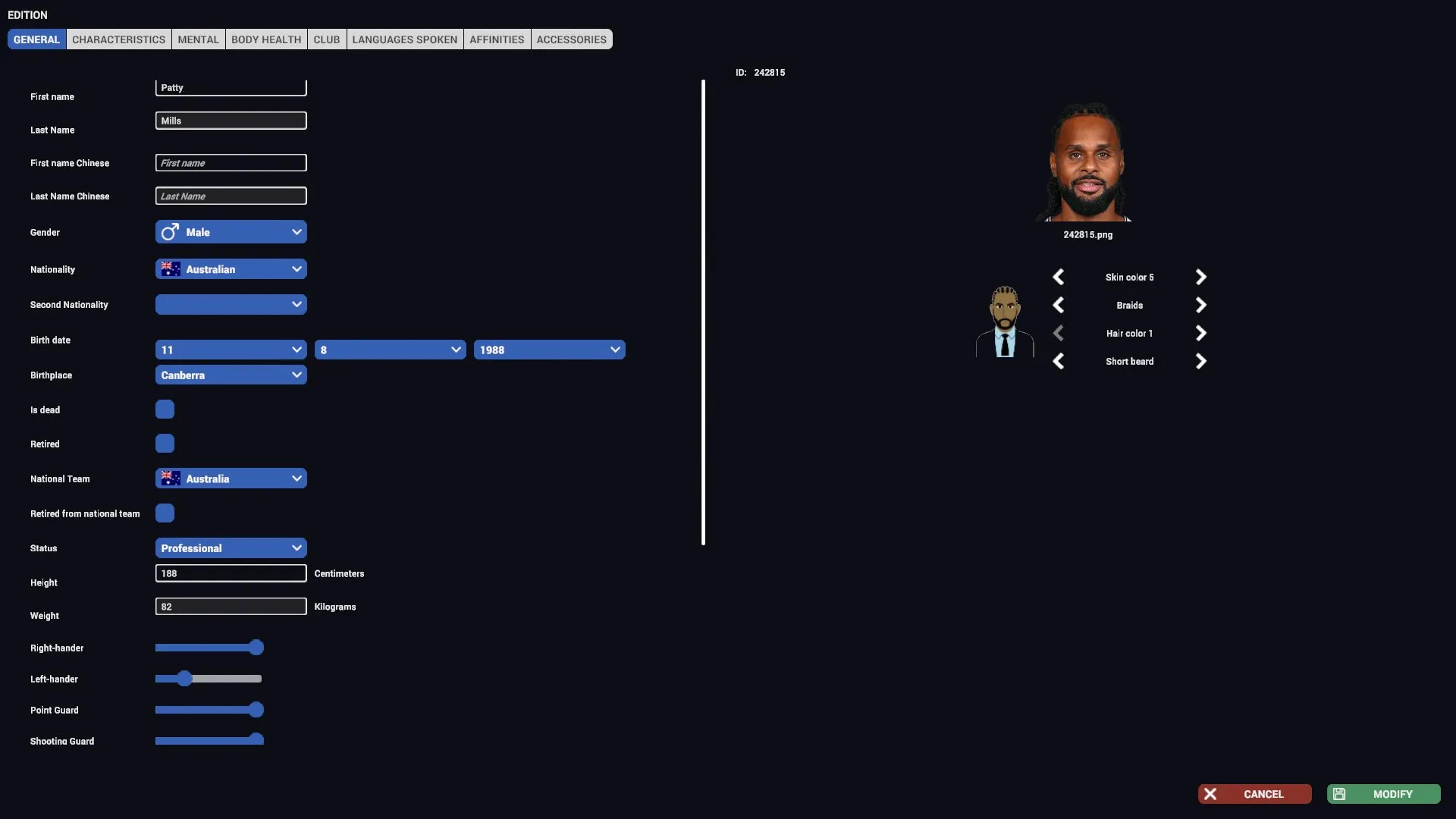 The DataEditor: tabs for characteristics, mental ratings, body health, club, languages, affinities and accessories. Affinities, the relationships between people in the database, have existed since at least the 2016 edition. Image: Umix Studios / official website.
Saves and season limits. Steam Cloud is supported, and a December 2025 patch fixed mods when you switch computers or move between Mac and Windows. Autosave runs every two weeks, every month or every 90 days. Umix does not publish a maximum number of seasons. Patch notes mention fixes for schedules “from season 2037” and contracts starting in 2046, so long careers are possible, and long careers are also where bugs surface.
Interface, platforms and performance
Platforms. Windows 10 or later (8 GB RAM minimum, 16 GB recommended, 10 GB of disk) and macOS Monterey or later on Apple Silicon or Intel (12 GB minimum, 16 GB recommended). The 2027 announcement promises full controller support and Steam Deck compatibility; we found no Steam Deck verification badge to confirm it. The game is sold on Steam, on the Epic Games Store and as a Steam key on the official site. It is single-player, with no online mode.
Navigation. Dashboard, Manager (messages, tracking list, world search), then your club (players, tactics, training, schedule, finances, facilities, staff, recruitment center). The world search has attribute filters and configurable columns. Since 2026, big tables load “up to 20x faster”, Umix says.
Speed. Simulation slows down with every playable league, with U21 competitions and with both men’s and women’s competitions. The 2025 edition cut save times by up to ten times on some laptops, and the 2024 edition improved Mac stability and Windows frame rates in January 2024. For slow 3D games, the guide recommends low quality, a static camera and disabling the crowd.
Accessibility and languages. Three colorblind modes, four text sizes, scroll speed, controller cursor sensitivity, units, currencies and odds formats. Fourteen languages on Steam: English, French, Italian, German, Spanish, Simplified and Traditional Chinese, Greek, Brazilian and European Portuguese, Russian, Czech, Turkish and Polish.
Friction. The interface is where reviews are harshest. “The UI feels mobile game like but it’s an ok simulation game,” wrote a 2027 buyer. A 2025 reviewer called database actions “extremely slow” and complained that scouting works player by player. A December 2025 review asks for remembered layouts, scouting history and a keyboard shortcut for Continue. These are small things that add up over a hundred hours.
Monetization, line by line
| Item | Price (Steam, November 2026) | What you get |
|---|---|---|
| Pro Basketball Manager 2027 | $34.99 / €34.99, 10% off until Nov 26 ($31.49) | The full game, DataEditor, Workshop access |
| Bundle: PBM 2026 + 2027 | €49.18 (24% bundle discount) | Both editions |
| Bundle: Tennis Manager 26 + PBM 2027 | €49.93 (33% bundle discount) | Umix’s two current management games |
| Official site | €34.99 | A Steam key |
| Epic Games Store | listed | Same game; Workshop mods not supported |
| Pro Basketball Manager 2026 | $29.99 | Previous edition, still on sale |
| Older editions | $9.99 (2022) to $24.99 (2025) | Still sold on Steam |
| DLC, microtransactions, ads | none | — |
Fairness verdict. Clean. There is no in-game store, no currency, no loot box and nothing that buys results. The real cost is the yearly cycle: each November brings a new full-price edition, while the previous one gets most of its patches in the first months. A 2025 buyer refunded after the developer said work had moved to the next version; the 2026 edition, to be fair, received content updates until June 2026. Umix has offered loyalty pricing before (a 20% discount on 2024 for 2023 owners) and this year offers a 26+27 bundle.
Update history
| Date | Edition / patch | What changed |
|---|---|---|
| Nov 2014 | Basketball Pro Management 2015 | Fourth edition of the series started in 2012; Umix and Cyanide, published by Nacon |
| Jan 2016 | Pro Basketball Manager 2016 | New name; 70+ competitions, 2D/3D games, set plays and quick plays, data editor |
| Jan 2017 | Pro Basketball Manager 2017 | Umix and Cyanide, published by Nacon; first edition with Steam Workshop support |
| Nov 2021 | Pro Basketball Manager 2022 | Self-published by Umix; macOS version; 160 competitions according to But Why Tho? |
| Dec 2022 | 2023 patch | AI can control tactics and substitutions in 3D games |
| Nov 2023 | Pro Basketball Manager 2024 | Announced as “30 times faster” with 17+ licensed leagues |
| Nov 2023 | 2024 patch | Play editor fixes and reworked player attributes |
| Jan 2024 | 2024 major release | Mac stability, trade and transfer fixes, player comparison |
| Nov 2024 | Pro Basketball Manager 2025 | Dynamic sponsors, 3D facilities management |
| Dec 2024 | 2025 Christmas and simulation updates | Shot distribution, percentages, turnovers, rotations; played vs simulated gap fixed |
| Nov 2025 | Pro Basketball Manager 2026 | Licensed BCL, 3D rebuild, faster UI, chemistry, negotiated exits, preseason planning, draft payouts |
| Dec 2025 | 2026 patch | European League 1 qualification, cross-computer mods |
| Feb 2026 | Season progression overhaul | Faster aging and youth development; SLB Trophy, SLB Cup, SuperCoupe LNB |
| Jun 2026 | New Zealand update | NBL and Tauihi rosters, 550 player photos |
| Nov 12, 2026 | Pro Basketball Manager 2027 | Contract negotiations with personality traits, scouting redesign, season events, controller and Steam Deck support |
| Nov 14, 2026 | First 2027 patch | Contract renewal fixes, board satisfaction, US college years |
Umix has not published a roadmap for 2027. The developer’s forum replies point to more animations as the next major step, and an in-game editor as a possibility but not a priority. Editions 2019 to 2021 are no longer on Steam, which is why the table skips them.
What players say
The numbers. On November 14, 2026, Pro Basketball Manager 2027 had 13 Steam user reviews, 92% positive. The previous editions tell the longer story: 2026 is “Mostly Positive” at 70% of 129 reviews, 2025 “Mixed” at 68% of 169, 2024 “Mixed” at 69% of 155, 2023 “Mostly Positive” at 72% of 149 and 2022 at 73% of 102. The Cyanide-era editions sit much lower: 41% for 2017, 40% for 2016 and 15% for Basketball Pro Management 2015. The trend is clear: a big jump after Umix went independent, then a plateau around 70%.
What people like. The early 2027 reviews are from returning fans. “Great improvements in the scouting department, I still recommend the game,” wrote one on November 12, 2026. Another, on the same day: “I love the new events, negotiations also make the game more realistic and challenging.” A player who started with a Madrid club valued “being able to give instructions and make decisions on the fly” (November 12, 2026). One long positive review comes from a player who received the game for free. For the 2026 edition, a player running a Serie B club on expert difficulty wrote that “every win feels earned” (June 2, 2026), and a 158-hour player called it the best basketball manager available, with a big margin for improvement (July 5, 2026).
What people dislike. The simulation first: “This is not a simulation; it’s a random number generator with basketball names” (April 29, 2026), and “my centers keep shooting 3’s like WHAT!” (February 24, 2026). Then tactics that do not seem to matter: a player says his team plays as it wishes “doesn’t matter what you select” (December 19, 2025). Then the interface and the 3D: “The UI feels mobile game like” (November 12, 2026). And the yearly cycle: a 2025 buyer who refunded after support moved to the next edition (July 15, 2025).
Press. Major outlets do not review the series any more. Smaller sites were consistent over the years: Way Too Many Games called the 2022 edition “basically Football Manager, but with basketball” and gave it 7.5; But Why Tho? also gave it 7.5, but found tactics “incredibly difficult to master”; MKAU Gaming said the 2024 edition “gets the job done” but looks basic. Multiplayer.it gave Basketball Pro Management 2015 a 6.8, and GM Games found Pro Basketball Manager 2016 promising but unpolished, praising its in-game coaching options.
Known issues and bugs
All sourced from patch notes, Steam reviews and discussions. Some may already be fixed in 2027.
- Playoff series cut short. In the 2025 edition, two players reported finals ending at 1-1 or 2-2, with the title awarded to the opponent and remaining games never played (ABA League, November 2024; Turkish league, October 2025).
- Standings recording wins as losses. One 2026 reviewer reported it after 30 hours (July 2026).
- Shot clock. Reset to 24 instead of 14 after an offensive rebound (2026 review, November 2025).
- Minutes ignored. Simulated games not following the minutes set by the user, so prospects get five minutes instead of twenty (2026 review, December 2025).
- NBA-style league gaps. Rookie deals, roster limits, trade salary matching, years of service after a trade, and home court in the playoffs (December 2025).
- Fixed European League 1 participants. Reported in November and December 2025; a qualification system was added on December 30, 2025.
- Competition formats. Winning a cup without entering the next season’s cup, French lower leagues with forfeits due to import rules (fixed December 2025).
- First 2027 patch (November 14, 2026). Fixes for contract renewals, board satisfaction after missed objectives, U21 contracts starting in 2046 and US college years. Some fixes require a new career.
Tips for your first season
- Choose your playable leagues carefully. Only playable leagues have full schedules and active recruitment, and each one slows the simulation. Start with your league, its cup and the continental competitions you can reach. (Official guide: New Career, Settings.)
- Do not miss the board meeting. If you skip it, the board sets the objectives for you. Raise an objective only if you are confident: the budget boost is immediate, the punishment comes in May. (Guide: Search for a New Team.)
- Allocate every minute and use roles deliberately. The roster screen counts minutes left to allocate. Two go-to guys, one sixth man and one defender change who shoots. If a prospect is not getting minutes in simulated games, players report that the sixth-man role is the workaround. (Guide: Tactics; Steam review, December 2025.)
- Build plays for every defense. A custom play only runs if it matches the opponent’s defense and there is time on the shot clock. Duplicate a built-in play and edit it rather than starting from scratch. (Guide: Play Creation.)
- Use the preseason for fitness. Tiredness and poor fitness raise injury risk. Check forecast freshness before games, and do not push intensity so far that players complain. (Guide: Training.)
- Scout before you negotiate. In 2027, traits are hidden until scouted, and reports age. A Leader on your bench or a Family-Oriented import far from home is a problem you can see coming. (Guide: Scouting, Personality Traits.)
- Never let the balance go negative. It blocks transfer offers and erodes the board’s trust every month. (Guide: Finances.)
- Pick sponsors that fit your roster. A bonus for young players or players of a given nationality is free money if you already have them, and a trap if you do not. (Guide: Sponsors.)
- If 3D games stutter, lower graphics quality, use a static camera and disable the crowd. (Guide: Pro Basketball Manager 2027.)
- Mods are per career. Choose the Workshop database you want before you start; you cannot switch later. (Guide: Modding.)
Against the alternatives
| Pro Basketball Manager 2027 | Draft Day Sports: Pro Basketball 27 | Basketball GM | Hoop Land | BuzzerBeater | |
|---|---|---|---|---|---|
| Match view | 3D and 2D cameras, live coaching | 2D, text, box score | Text and box score | Playable 2D | Online, 2D/box score |
| Platforms | Windows, macOS | Windows | Browser, Android | iOS, Android, Windows, macOS | Browser |
| Price model | Paid, yearly | Paid, yearly | Free with ads; $5/month removes them | Free with in-app purchases | Free with optional subscription |
| Data and licences | BCL + 20+ licensed leagues | Fictional, NBA-style | Real-player leagues since 1947, unlicensed | Fictional | Fictional |
| Leagues | Europe-first world + NBA-style league | NBA-style, historical | NBA-style, historical, custom | NBA-style, college | European-style, international |
| Multiplayer | No | No | No | No | Yes, persistent online world |
| Strongest at | Club economy, world, in-game coaching | Cap rules, stats depth | Front office and history | Playing your own games | Long-term competition with people |
Our reviews: Draft Day Sports: Pro Basketball, Basketball GM, Hoop Land, BuzzerBeater and Swish & Dunk (disclosure: developed by our founder).
If the NBA is your world, Draft Day Sports and Basketball GM model its rules more faithfully. If you want to play the games yourself, Hoop Land is the answer. If you want human opponents, BuzzerBeater and Swish & Dunk. Pro Basketball Manager is the only one that combines licensed European competitions, national teams and a 3D court with real-time coaching, and nothing else on our list comes close to its scope.
Our take
Pro Basketball Manager 2027 has an identity, and we like it a lot. Basketball is a global sport, and almost every management game pretends it is played in 30 American cities. This one puts you in Villeurbanne, Vilnius and Istanbul, makes you balance a budget instead of exploiting a cap, and treats a contract as a set of promises instead of a number. The 2027 additions push it the right way: hidden traits, career goals and a negotiation that feels like a conversation.
The surprise of our research was the coaching. Six defenses, pick-and-roll coverage per player, shot permissions, timeouts that can backfire and a play designer: on paper, this is more of a coach’s game than its reputation suggests. That makes the engine question more frustrating, not less. A tactical toolkit is only as good as the simulation that reads it, and the evidence (player reports, and the one stat sheet Umix publishes) still points to an engine that does not always play modern basketball. A two-person studio has fixed a lot in four years, and the reviews show it. It has not yet fixed trust.
Our wish list: publish league-wide averages per competition, so players can see the engine is calibrated; ship ready-made plays and an easy way to share playbooks; enforce the minutes you set in simulated games; implement FIBA rules down to the 14-second reset; add bulk scouting and remembered layouts; and give owners a way to carry their career and mods to next year’s edition.
Who should skip it: NBA purists, players who test a sim with a spreadsheet of league averages, and 2026 owners who are happy with what they have. Everyone else who loves European basketball should try it, ideally on sale, and should start by scouting the Leader on their own bench.
Sources
Official: Umix Studios
- Pro Basketball Manager official site
- Official guide: Main page, Tactics, Play creation, 3D Games, Player attributes, Coach attributes, Personality traits, Training, Scouting, Finances, Draft, Recruitment, Settings, PBM 2027 settings and difficulty, Search for a new team, First steps, New career, Youth teams, National teams, Facilities, Sponsors, Modding, Dataeditor
- Developer blog: Sponsors (July 2024), 3D facilities management (October 2024); YouTube: 3D Facility Management feature reveal
- Steam announcements: 2027 news hub (launch post, release notes November 14, 2026), PBM 2027 announcement (September 2026), Season Progression Overhaul (February 2026), European League 1 format (December 2025), Christmas update (December 2024), Simulation update (December 2024), PBM 2024 major release (January 2024), PBM 2024 announcement (November 2023), Automatic substitutions and tactics (December 2022)
Stores
- Steam store pages: PBM 2027, PBM 2026, PBM 2025, PBM 2024, PBM 2023, PBM 2022, PBM 2017, PBM 2016, Basketball Pro Management 2015
- Steam user reviews: PBM 2027, PBM 2026, PBM 2025
- Epic Games Store listing
Community: Steam discussions
- With the developer: FAQ & Guide, NBA, WNBA and international basketball, Editor, Need better 3D engine, PBM 2026 changelog thread, Focus on basketball depth
- Player reports: NBA-league bugs and minutes (December 2025), Final series ended at 2-2 (October 2025), Help with tactics and plays (November 2025)
Press and specialist sites
- Way Too Many Games: PBM 2022 review, But Why Tho?: PBM 2022 review, MKAU Gaming: PBM 2024 review, GM Games: PBM 2016 review, Multiplayer.it: Basketball Pro Management 2015 review, Gamepressure: series page, Worthplaying: PBM 2016 announcement
Data and rules
Analysis by category
Match engine
Weight 22%6.0One engine produces both watched and simulated games, possession by possession, with a 3D view and 2D cameras. Umix promises more realistic outcomes every year and has shipped real fixes, but players keep reporting odd shot selection and rule gaps. An official 2027 recap shows only 7 threes in 65 shots for one team.
Coaching & tactics
Weight 12%7.5Better than its reputation: two formations, tempo, shot mix and offensive-rebound strategy; per-player shot permissions; six defenses; per-player pressure, screen coverage and hedges; roles, minutes, timeouts and a play designer. Whether the engine honours it all is the open question.
Players & development
Weight 18%7.5Twenty-six documented ratings, hidden potential and injury proneness revealed by scouting reports with a reliability score, training by profile or single skill, chemistry built on influential players and, new in 2027, hidden personality traits that generate career goals.
Front office & salary cap
Weight 14%7.0Most of the world runs on board budgets, buyouts, loans and import quotas; an NBA-style American league adds a salary cap, luxury tax, two-round draft with lottery and rookie contracts. Detailed contract offers and sponsors stand out; cap edge cases and trade matching are reported as buggy.
League & world
Weight 10%8.5The strongest card. 2,000+ teams, 90 domestic competitions including 17 women’s leagues, the licensed Basketball Champions League and 20+ licensed leagues, national teams, U21 teams, promotion and relegation, and a free DataEditor with Steam Workshop sharing.
Interface & UX
Weight 10%6.5Football Manager-style navigation, colorblind modes, text scaling, controller support and 14 languages. But players describe it as mobile-like, scouting must be done player by player, and several database actions are slow.
Longevity
Weight 7%6.0Umix patched 2026 from November to June, including a progression overhaul in February. Long saves still surface bugs (playoff series cut short, rookie generation), and each edition is replaced after a year.
Business model
Weight 7%6.5$34.99 / €34.99 on Steam for Windows and macOS, 10% off until November 26, 2026; also sold on the Epic Games Store, without Workshop mods. No microtransactions or DLC. Fair for the scope, harder to justify every single year.
Weighted average of the criteria: 6.9
Features
Game type
- Genre
- Management simulation
- You play as
- General manager, Head coach
- Players & teams
- Officially licensed
- League structure
- European pyramid, International, NBA-style (draft, playoffs)
Match engine
- Simulation model
- Possession by possession
- Match view
- 3D, 2D, Box score
- Watch matches live
- Yes
- In-game decisions (timeouts, subs)
- Yes
- Instant simulation
- Yes
- Advanced stats (PER, TS%, +/-)
- Yes
- Shot charts
- Yes
- Fatigue
- Yes
- Fouls & foul trouble
- Yes
Coaching & tactics
- Defensive systems
- 6
- Zone defense
- Yes
- Full-court press
- Yes
- Playbook / play editor
- Yes
- Rotations & minutes
- Yes
- Individual player instructions
- Yes
- Team training
- Yes
- Individual training plans
- Yes
- Staff (assistants, scouts, medical)
- Yes
Players
- Ratings per player
- 26
- Hidden potential
- Yes
- Progression & aging
- Yes
- Personalities & traits
- Yes
- Morale & playing-time demands
- Yes
- Team chemistry
- Yes
- Injuries
- Yes
- Retirements & Hall of Fame
- Yes
Roster building
- Draft
- Yes
- Draft lottery
- Yes
- Trading draft picks
- Yes
- Scouting (hidden ratings)
- Yes
- Youth academy
- Yes
- Player loans
- Yes
- Free agency
- Yes
- Contract negotiation
- Yes
- Transfer market
- Club-to-club negotiation
- Trades
- Basic
- Foreign-player / homegrown quotas
- Yes
Front office & economy
- Salary rules
- Club budget (European style)
- Luxury tax
- Yes
- Rookie scale contracts
- Yes
- Club finances
- Yes
- Ticket pricing
- Yes
- Sponsors & TV deals
- Yes
- Merchandising
- Yes
- Arena & facilities upgrades
- Yes
- Owner / board goals
- Yes
- You can be fired
- Yes
- Job offers from other clubs
- Yes
- Fan satisfaction & attendance
- Yes
League & world
- Promotion & relegation
- Yes
- Domestic cups
- Yes
- Continental competitions
- Yes
- National teams
- Yes
- In-game editor
- Yes
- Mods / roster import
- Yes
Platforms & tech
- Cloud save
- Yes
- Languages
- 14
- Tutorial / onboarding
- Yes
Monetization
- How it makes money
- Nothing: no ads, no purchases
Frequently asked questions
Is Pro Basketball Manager 2027 free?
- No, Pro Basketball Manager 2027 is a paid game.
On which platforms can you play Pro Basketball Manager 2027?
- Pro Basketball Manager 2027 is available on Windows and macOS.
Is Pro Basketball Manager 2027 multiplayer?
- No, Pro Basketball Manager 2027 is a single player game: you play against the computer.
Does Pro Basketball Manager 2027 have real players and teams?
- Yes, Pro Basketball Manager 2027 has officially licensed players and teams. You can also create or import custom leagues and rosters.
Does Pro Basketball Manager 2027 have a salary cap?
- Not a salary cap: Pro Basketball Manager 2027 uses a club budget, European style.
Who develops Pro Basketball Manager 2027?
- Pro Basketball Manager 2027 is developed by Umix Studios.
Is Pro Basketball Manager 2027 worth playing?
- The closest thing basketball has to Football Manager: 2,000+ clubs, the licensed Basketball Champions League, national teams, a play designer and a 3D court. The 2027 edition improves scouting and contracts. The engine’s realism is still questioned. A good buy for European hoops fans. (7.0/10)
What are the best alternatives to Pro Basketball Manager 2027?
- The best alternatives to Pro Basketball Manager 2027 are Hoop Land (7.8/10), Basketball Legacy Manager 27 (7.0/10), and Basketball GM (9.0/10).