Basketball GM
A free browser tab that out-thinks most full-price sports games — as long as you came to run a front office, not to coach one.
Score
The verdict
The deepest basketball front-office sim you can play, and it costs nothing. Cap rules, fuzzy scouting, player mood and a history engine back to 1947 are elite. Coaching barely exists and your saves live only in the browser. Still the first one to try.
The good
- Front-office depth that rivals paid sims: soft cap, luxury tax, Bird rights, rookie scale
- Scouting fog: ratings are estimates that sharpen as you spend on scouting
- A mood system with traits that decides who will even talk to you in free agency
- Real-player leagues back to 1947, with era-correct cap, pace and lottery rules
- League stats stayed stable across our ten-season simulation
- Free; the paid tier only removes ads
The bad
- Coaching is a playing-time control: no offensive sets, no defensive schemes
- Live games replay a result that is already decided; you can’t intervene
- Default sim plays like the 2017-18 NBA, not today’s three-point league
- Saves live only in your browser: no cloud sync, real risk of losing a league
- No player or team options, no negotiable extensions; you pick from fixed contract offers
- Trades are limited to two teams
Who it’s for
- GMs who think in cap space, draft capital and aging curves
- History nerds who want to replay any NBA era since 1947
- Anyone who wants the best free basketball GM game and doesn’t mind tables
Who should skip it
- Coaches who want playbooks, matchups and in-game decisions
- Players who switch devices or can’t afford to lose a save
- Anyone who needs graphics to care about a game
Every basketball fan has a trade they would have vetoed and a draft pick they would have made differently. Basketball GM is built for exactly that person. No arenas, no motion capture, no cutscenes: just a league, a cap sheet, a draft board and an engine that turns your decisions into seasons. It runs in a browser tab, it costs nothing, and after more than a decade of near-constant updates it is still the reference point every other basketball management game gets measured against.
It is not the complete basketball fantasy, though. It is the front office fantasy, and the difference matters. You will spend your evenings arguing with yourself about a 29-year-old’s contract, not drawing up a late-game play. If that sounds like heaven, nothing else in the genre is as good. If it sounds like homework, this review will tell you exactly where the game leaves the coach in you hungry.
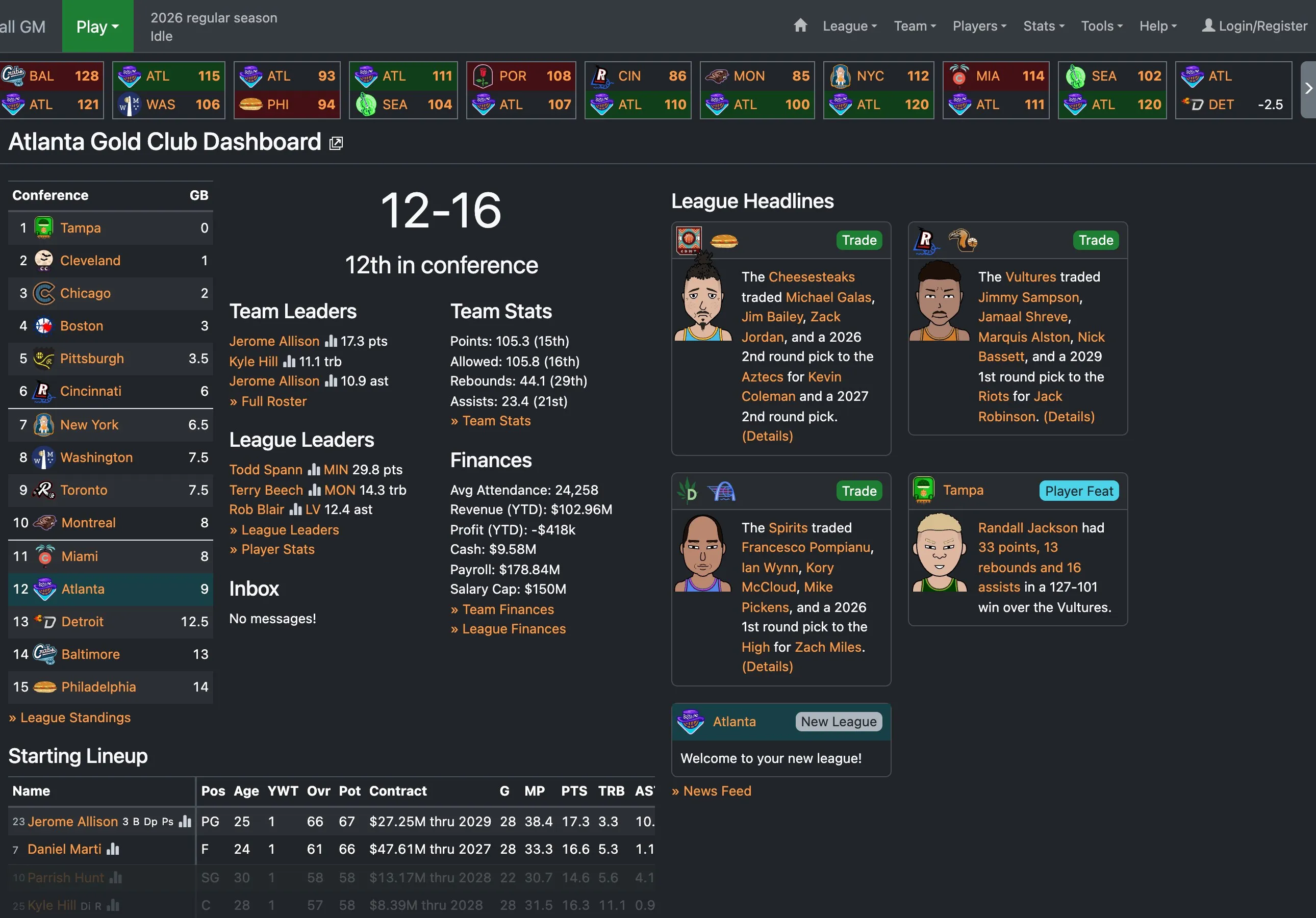
The dashboard of our test league a month into the first season. The number that matters is not the record: it is the payroll, $178.84M against a $150M cap, which tells you this front office was born in trouble.
The short version
- Play it if you think in cap space, draft capital and aging curves. The salary cap, scouting fog and player mood are the best in any free game, and better than most paid ones.
- Play it if you love basketball history. Real-player leagues start in any season from 1947 to 2027, with each era’s cap, pace and lottery rules loaded for you.
- Skip it if you want to coach. There are no plays, no schemes and no in-game decisions; the sideline is a playing-time slider.
- Back up your leagues. Saves live in your browser, not in an account, and the developer himself calls data loss the game’s number one complaint.
How we tested
We played two leagues on version 2026.11.13.0563 (the build number shown in the footer), in desktop Chrome on a Mac, without creating an account.
- A random-players league. The game handed us the Atlanta Gold Club. We managed the first season decision by decision: lineup, trades, draft, re-signings and free agency. Then we used the game’s own Auto Play from that first offseason to the 2036 preseason (nine more full seasons, 2027 to 2035) to stress-test long-term stability. Auto Play also makes your team’s decisions, so we treat those seasons as the AI’s work, not ours.
- A real-players league starting in 1996. We picked the 1995-96 season and the Chicago franchise, watched the opening game live, then simulated the rest of the regular season and the playoffs without touching the roster, to see how close the engine gets to a famous real season. We also read every league setting in both leagues, to report the exact cap rules rather than the manual’s older numbers.
That is eleven simulated seasons in total, one and a bit of them truly hands-on. Everything else comes from the official FAQ, manual, changelog and developer blog, the game’s public source code, the Google Play and Microsoft Store listings, press coverage and community discussion (sources at the end). We did not install the Android app, subscribe to ZenGM Gold or test multi-device play, and we say so wherever it matters. We could not read Reddit threads directly; where we mention them, we rely on their titles and on the developer’s own posts.
A season, step by step
The manual splits every Basketball GM season into seven phases, and the green Play button in the top-left corner always offers only the actions that make sense in the current one. That button is the whole rhythm of the game.
- Preseason. Player development happens here, all at once: ratings change, young players tend to improve and older ones decline. You open the roster page to see who grew over the summer. Rookie contracts are not guaranteed until the regular season starts, so this is the last moment to cut a disappointing draft pick for free.
- Regular season. You choose the pace: one day, one day watched live, one week, one month, until the trade deadline, until the All-Star events, or straight to the playoffs. The default schedule is 82 games, and the trade deadline falls 60% of the way through it.
- All-Star break. An All-Star game, plus a dunk contest and a three-point contest (four and eight players by default), arrive as their own stop in the Play menu.
- Playoffs. The modern default is a play-in tournament and four best-of-seven rounds. Historical leagues load the format of their era: our 1996 league used a best-of-five first round and no play-in.
- Draft lottery. The default for modern leagues is now the NBA’s 2027 “3-2-1” format. All lottery picks are drawn, the three worst teams get fewer chances than the teams just above them, and repeat top picks are restricted.
- Draft. Two rounds, prospects aged 19 to 22 by default, with ratings filtered through your scouts.
- Re-signing, then free agency. You get a window to re-sign your own expiring players, over the cap if necessary. Those you don’t keep hit the open market, where the mood system decides who will even take your call. Then a new preseason begins and the game never ends: as the manual puts it, “There is no real way to ‘win’ at Basketball GM.”
Here is how that loop went for us. The game gave us the Atlanta Gold Club, rated 45 overall and one of the weakest rosters in the league. It also gave us a mess: a $50M-a-year contract running through 2027 for Ronnie Murphy, a 24-year-old guard rated 52, and a payroll above the luxury tax line. The finances page did the math for us: projected penalty, $16.26M.
We finished 37-45, ninth in the conference. We beat Montreal 103-100 in the play-in, then lost in Toronto, 119-114. Then the owner wrote. We had lost $10.4M too.
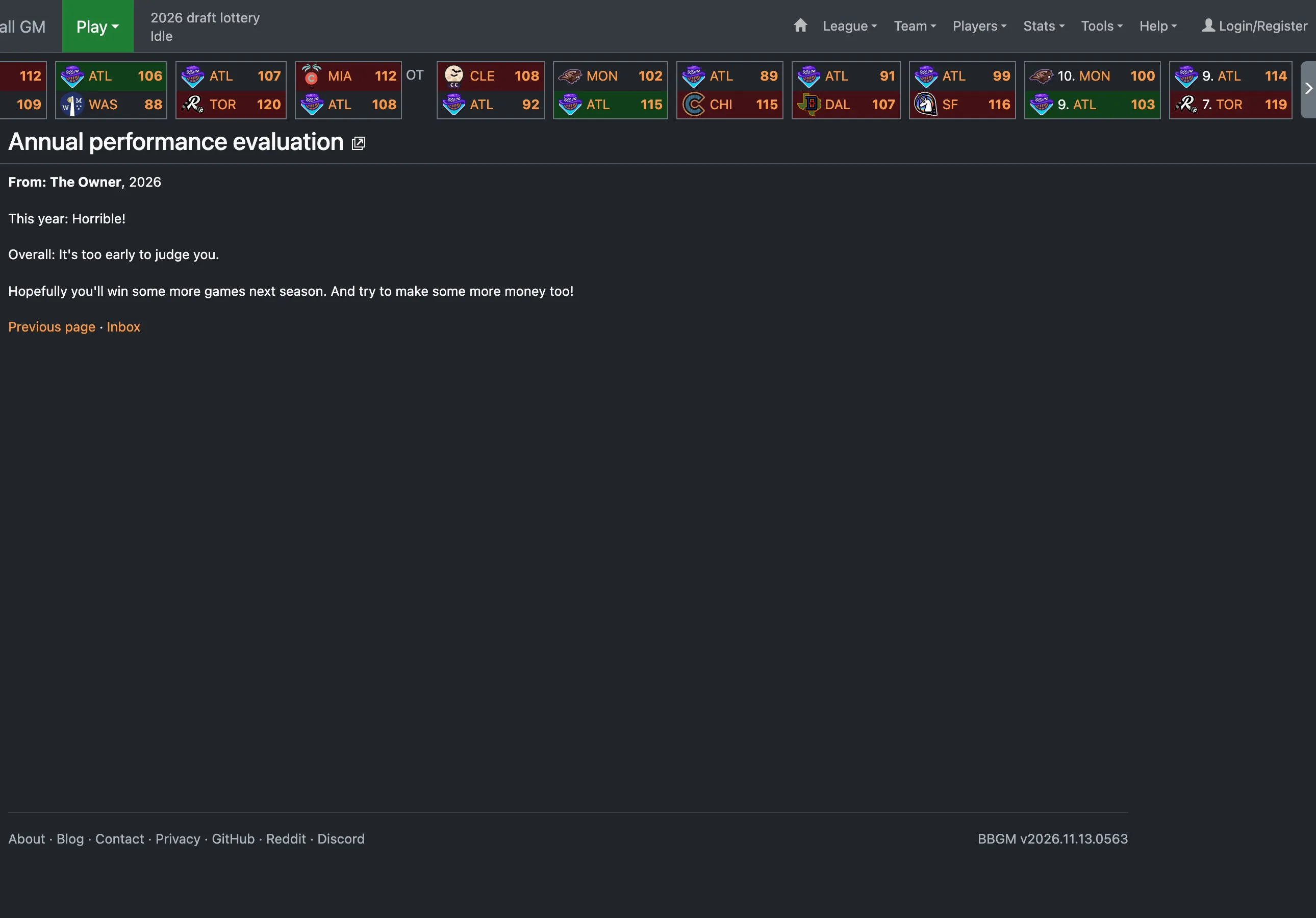 The owner’s annual performance evaluation: “This year: Horrible! Overall: It’s too early to judge you.” Then the real brief: win more games, and make more money too. Keep failing both and you lose the job.
Then the lottery happened. Our 5.4% chance at the top pick turned into the third pick. We took Ledell Jones, a 21-year-old center rated 50 with 68 potential and the Di and R skill tags.
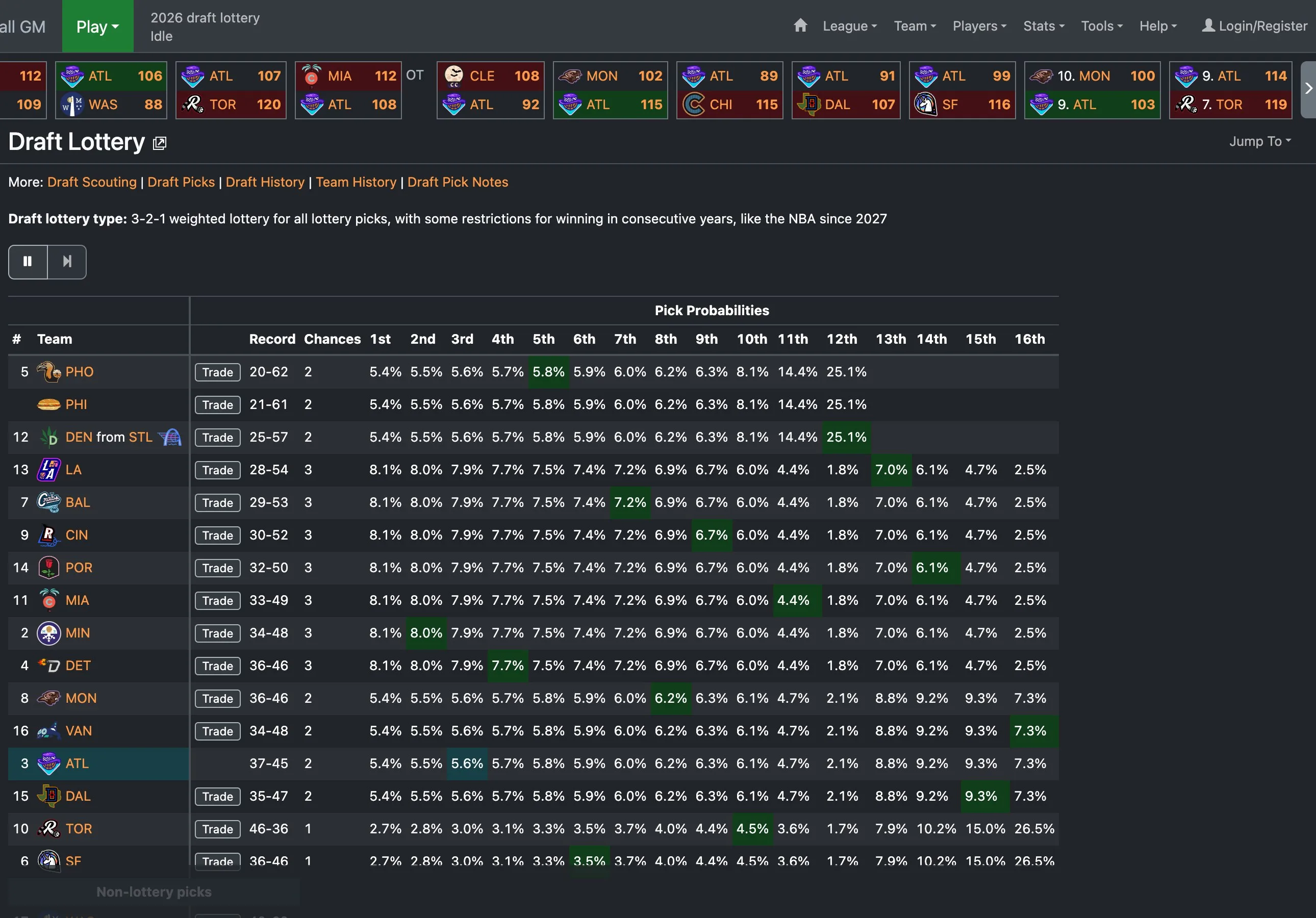 The 2027-style lottery in action. Look at the odds column: the worst teams no longer have the best chance at number one, which is exactly the anti-tanking point of the real NBA proposal.
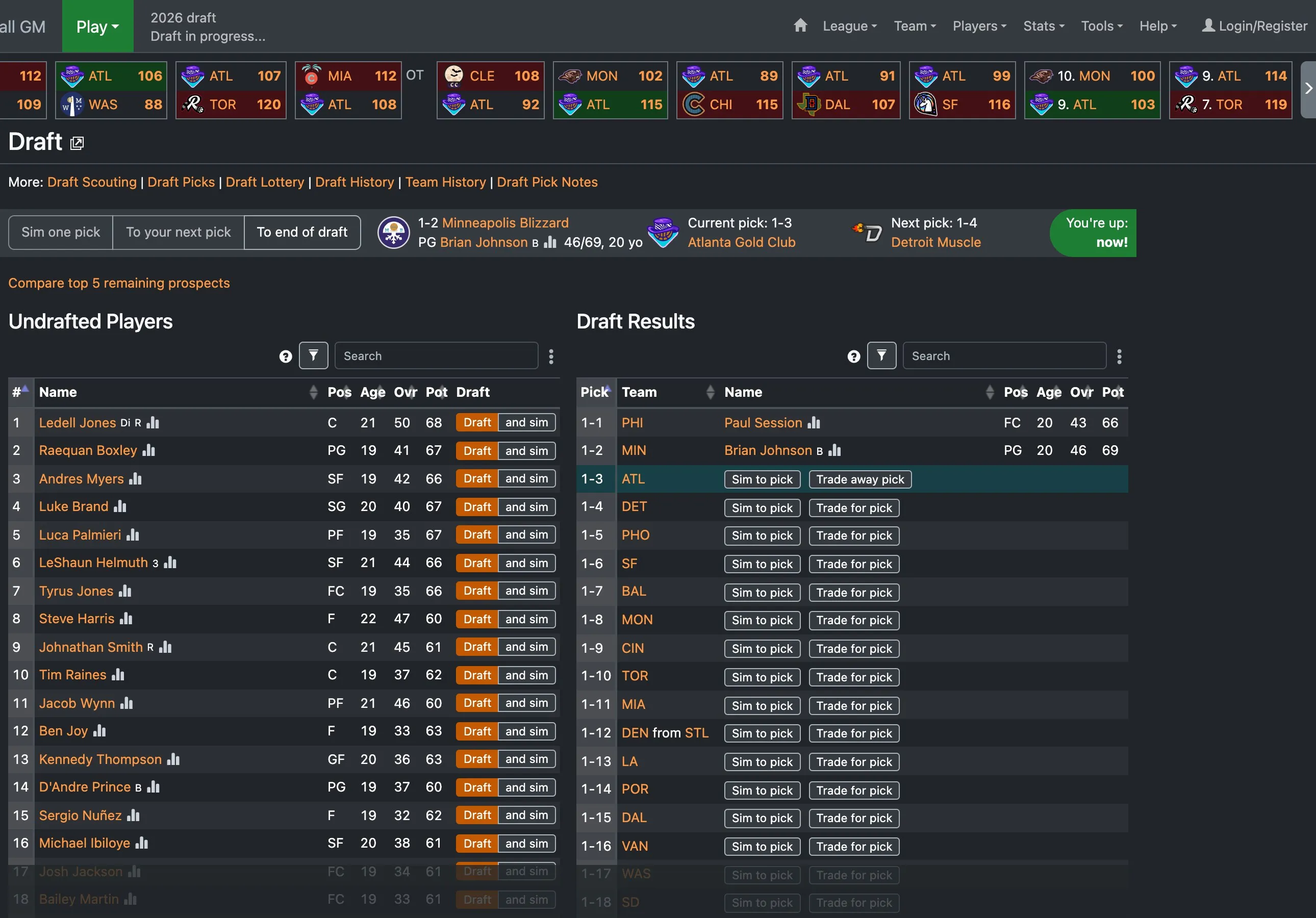 On the clock at number three. Every rating on this board is a scout’s estimate; the two-point gaps between prospects are often smaller than the margin of error.
Free agency was a lesson in the mood system. Three of the four best free agents flatly refused to negotiate with us. A losing team, a small budget and the wrong personality traits mean the market is closed before you make an offer.
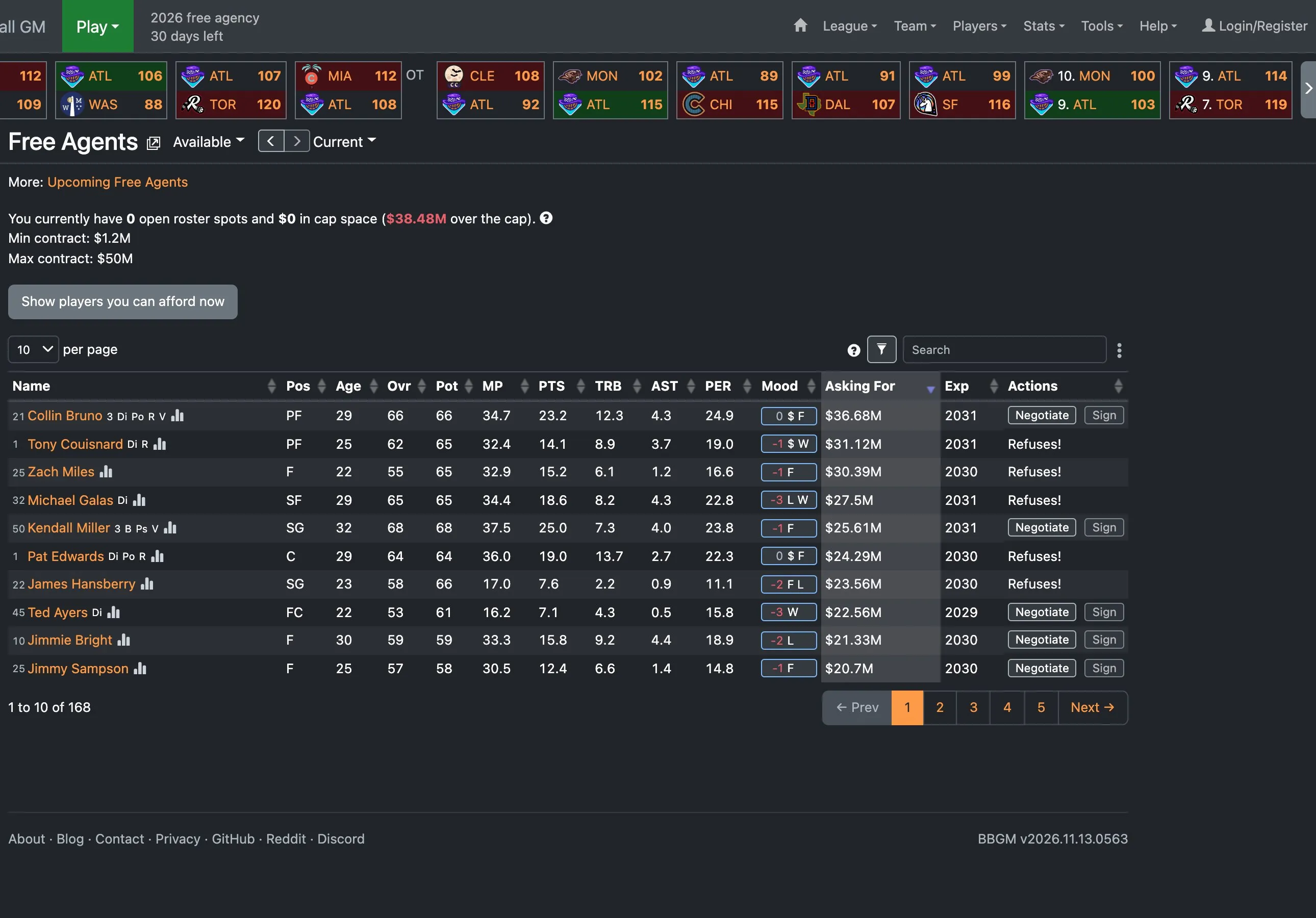 “Refuses!” The mood column and the traits (F, L, $, W) decide who will even talk to a 37-45 team. Cap space is useless if nobody wants your money.
At that point we started Auto Play up to the 2036 preseason, which took about 35 seconds. The AI turned that lottery team into a contender. Across the ten completed seasons, our hand-managed one included, Atlanta went 502-318, reached two Finals and won both, in 2030 and 2033. Ledell Jones, the center we drafted, was Finals MVP in 2030. One lucky lottery ball rebuilt a franchise, which is exactly how it feels when it happens in real life.
The 1996 experiment: history is a starting point, not a script
The second league was our test of the game’s most seductive feature. The real-players screen lets you start in any season back to 1947, at any phase from preseason to after the draft. We picked 1996, the year the Bulls went 72-10.
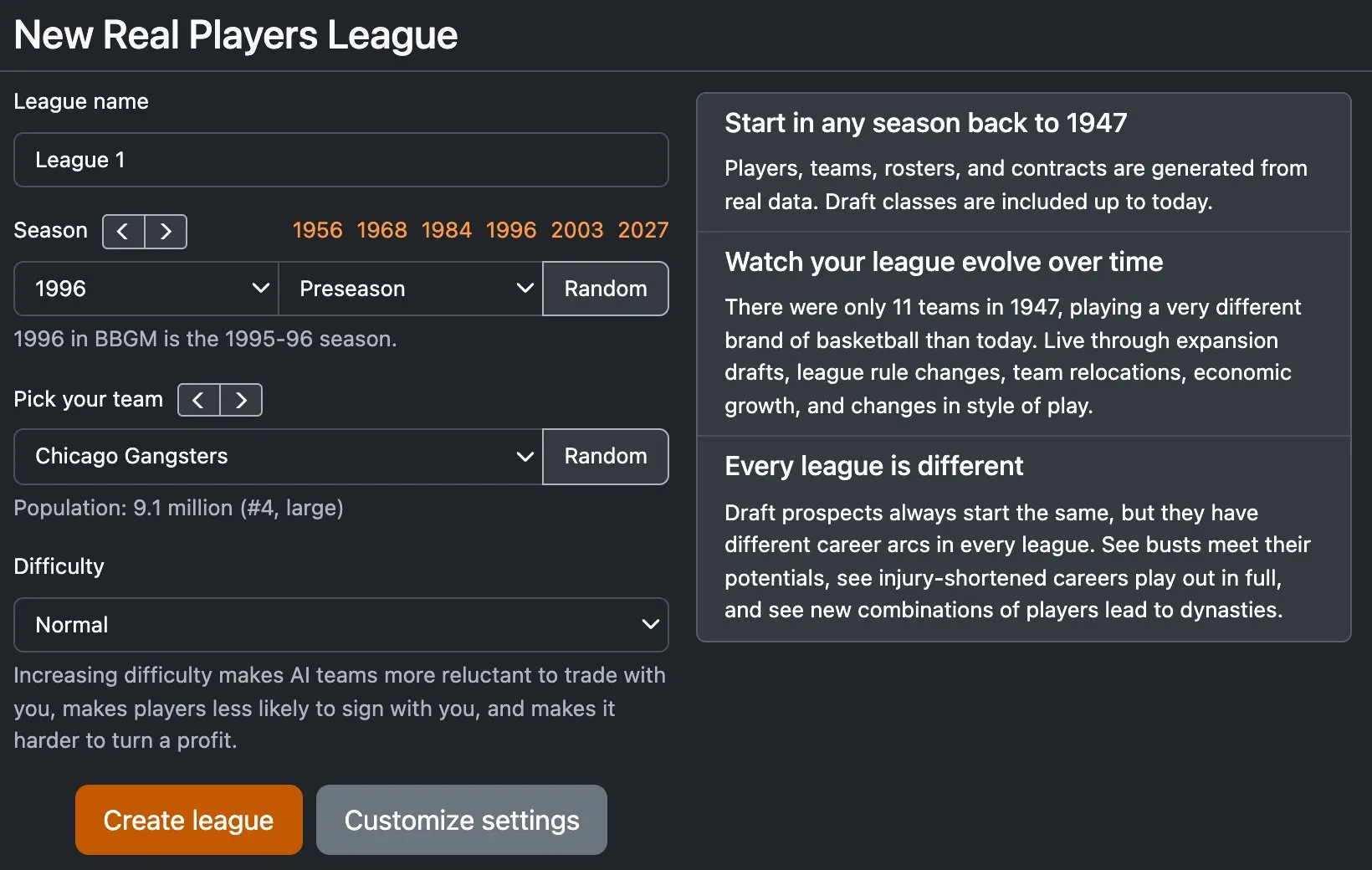 The real-players league screen. “1996 in BBGM is the 1995-96 season,” it notes. Shortcuts jump to six eras, and the season dropdown runs from 2027 back to 1947.
The league took about five seconds to create. Names, ages, draft history, colleges and contracts are real; team names and logos are not. The developer has said from the start that the built-in rosters include no player pictures, team names or logos, so Chicago is the “Gangsters” and Los Angeles has a Lowriders franchise. Michael Jordan arrived at 33 years old, rated 73 overall, on a $3.85M contract expiring in 1996. The salary cap was $23M, and our payroll was $23.2M.
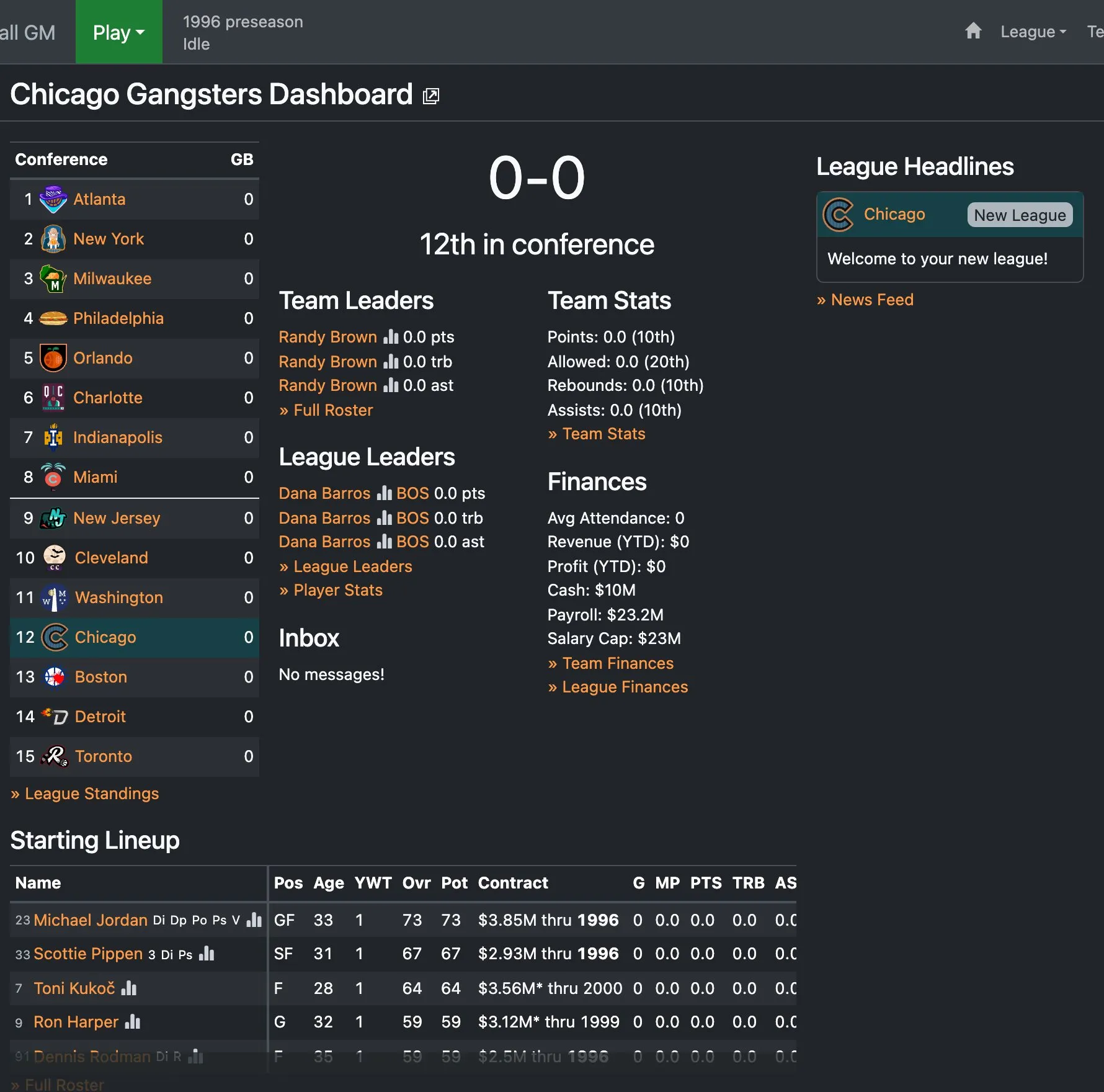 Preseason 1996: Jordan (73), Pippen (67), Kukoč (64), Harper (59) and Rodman (59), with a $23M cap. The asterisks next to Kukoč’s and Harper’s salaries mark the variable contracts added in November 2026.
The settings page showed how much of the era the game had loaded: a $23M soft cap, a $15.35M minimum payroll, a $30.2M tax line with a zero tax rate (no luxury tax yet), a $7.65M maximum contract, the 1994 lottery format, a best-of-five first round and no play-in. The game-simulation section held a pace of 91.8 possessions and a three-point tendency factor of 0.518, an era preset. Basketball-Reference lists the real 1995-96 pace as 91.8 too.
We watched Chicago’s opener live (a win over Sacramento, after Jordan opened with five points and three assists in seven minutes), then simulated the rest. The regular season took about three and a half seconds; the playoffs, under two.
History did not repeat. Chicago went 49-33 and lost in the first round to Cleveland, 3-2. Jordan averaged 27.4 points in 62 games and made the All-League first team, as did Pippen; Rodman made the All-Defensive first team. David Robinson won MVP. The Los Angeles franchise went 58-24 and swept Orlando in the Finals, with Cedric Ceballos as Finals MVP and Magic Johnson as Sixth Man of the Year.
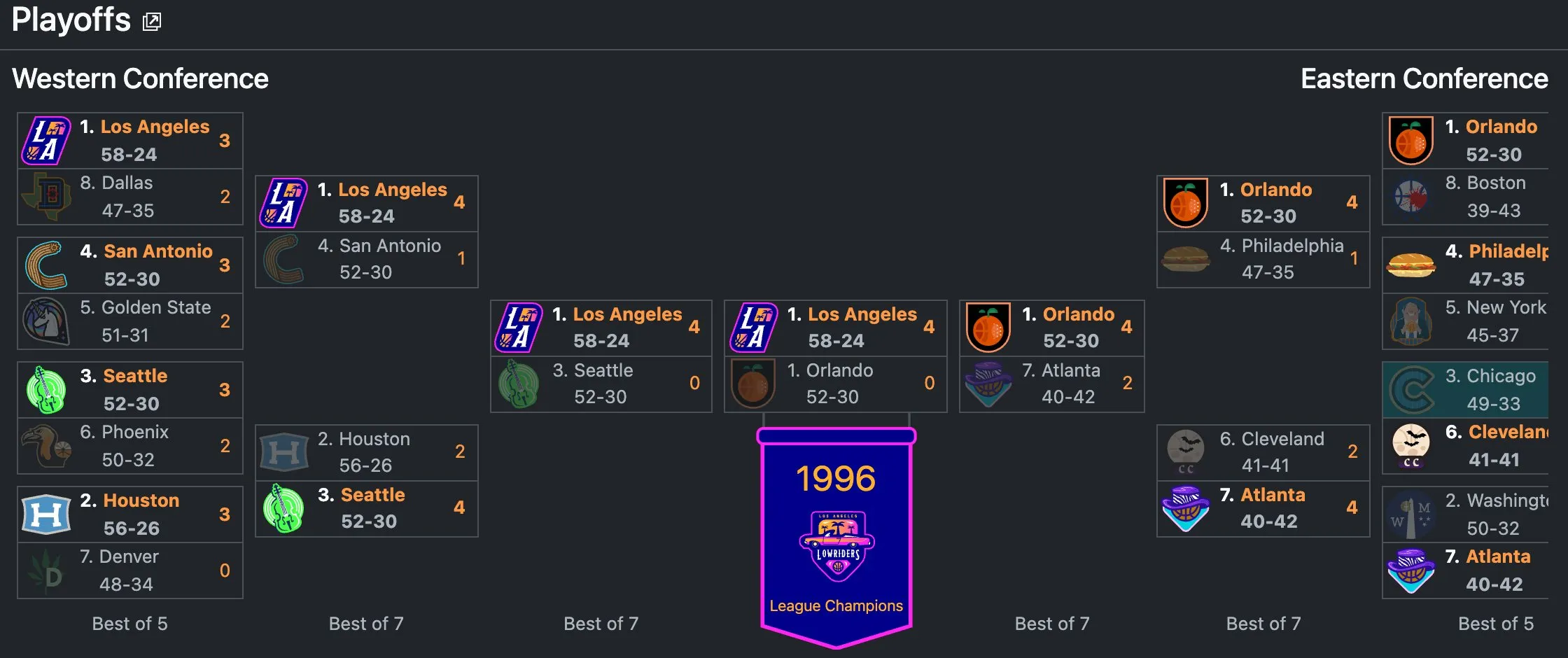 Our 1996 playoffs. Chicago, seeded third, lost a best-of-five to sixth-seeded Cleveland. The real Bulls won the title. Basketball GM gives you the cast, not the ending.
Is that a flaw? We think it is the point, with a caveat. The ratings are derived from real data, and a 33-year-old Jordan ranked 73 is still the best player in that league, but they do not encode the extra wins that made the 1996 Bulls historic. If you want to relive exactly what happened, this is the wrong tool. If you want to know what else could have happened, it is the best one there is. There is also a setting called Real Player Determinism, off by default, that lets real players’ careers follow their actual paths more closely.
The match engine: possession by possession, already decided
Basketball GM simulates every game possession by possession. The source code is public, so you don’t have to guess how. Each possession picks a shooter and a shot type (at the rim, low post, mid-range or three, plus tip-ins and putbacks) from composite ratings built out of the fifteen player ratings. Fatigue drains players as they stay on the floor, home teams get a configurable advantage, and lineups earn offensive, defensive and rebounding synergy when they combine the right skills. Synergy grows with the number of shooters, ball handlers and passers on the floor, and the offense is punished when perimeter skills are missing. In the playoffs the code cuts fatigue and multiplies the weight of synergy by 2.5, so balanced lineups matter more when it counts.
What you see is text and numbers. The live view shows a running box score, a scoreboard by quarter, the four factors (eFG%, TOV%, ORB%, FT/FGA) and a play-by-play feed, with pause, next-play and fast-forward controls and a speed slider. From the daily schedule you can watch any game in the league, not only your own.
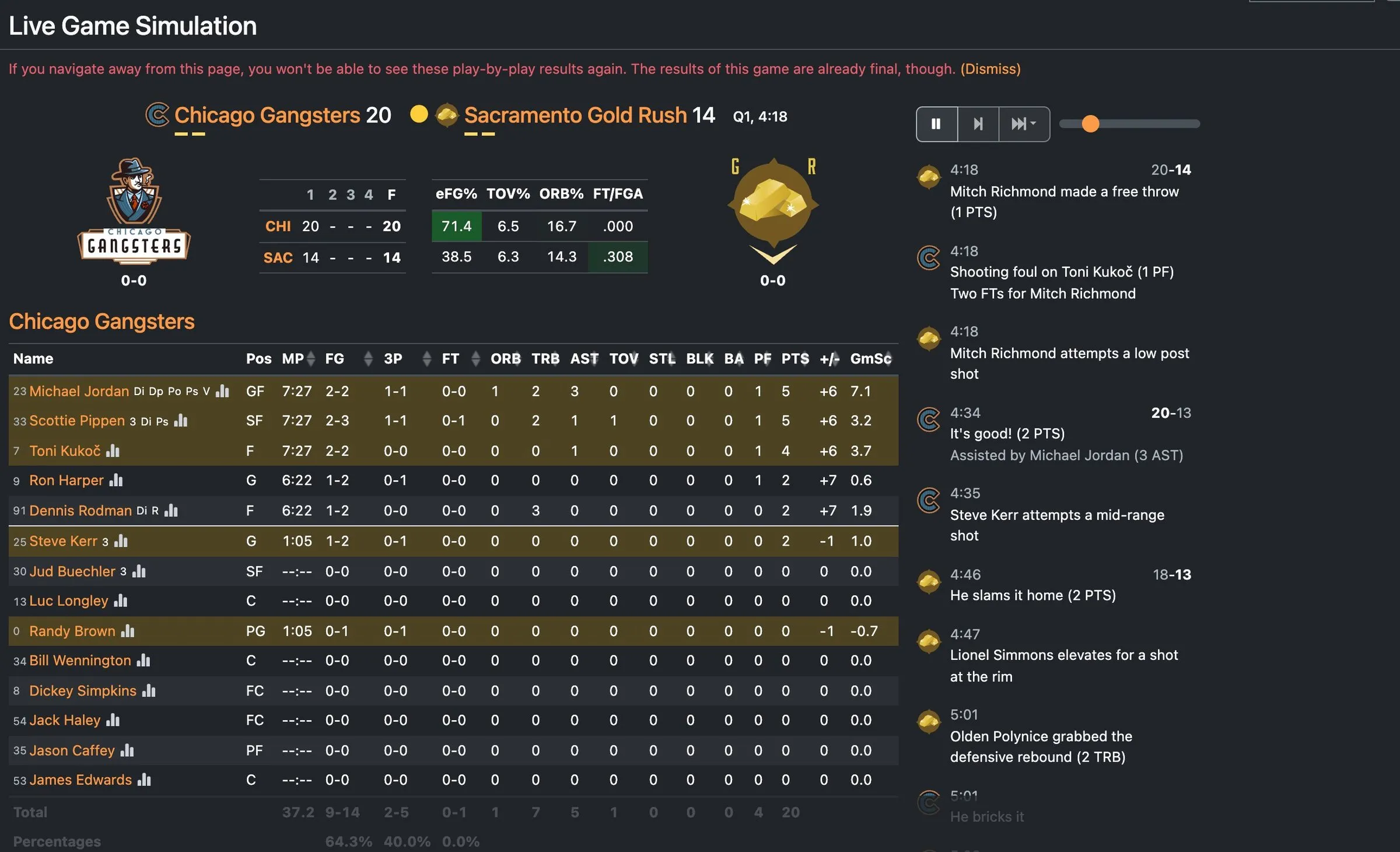 Watching Jordan live. Note the red line at the top: “The results of this game are already final, though.” The play-by-play is a replay with pacing; the playback controls only change its speed.
That red line is the most honest sentence in the game, and the biggest limit of the engine. Watching is a replay, not a coaching session. You cannot call a timeout, change a matchup or sub a player during the game.
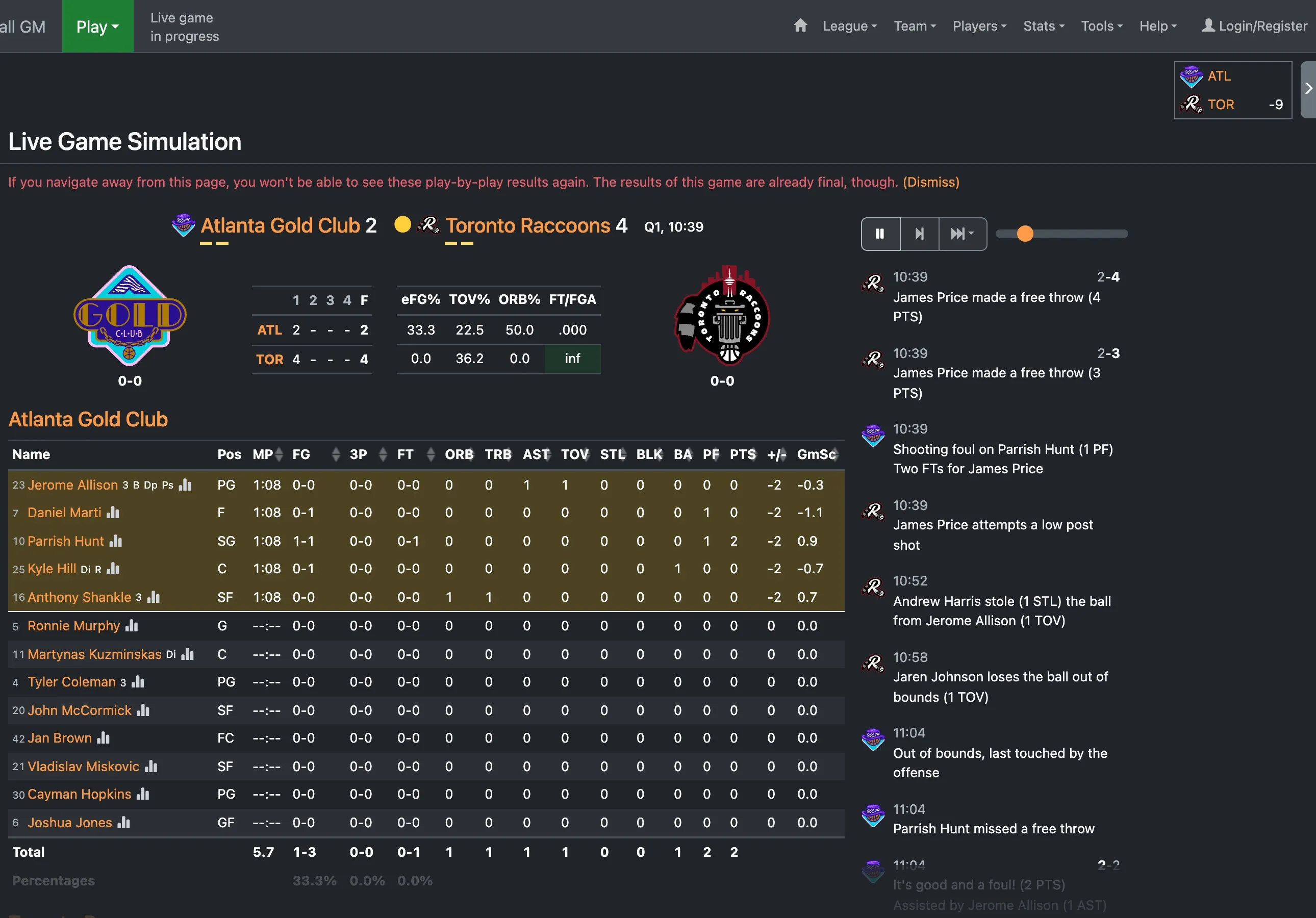 The same view in our random league. The skill tags next to each name (3, B, Dp, Ps, Di, R) are a readable summary of the ratings that also drive synergy.
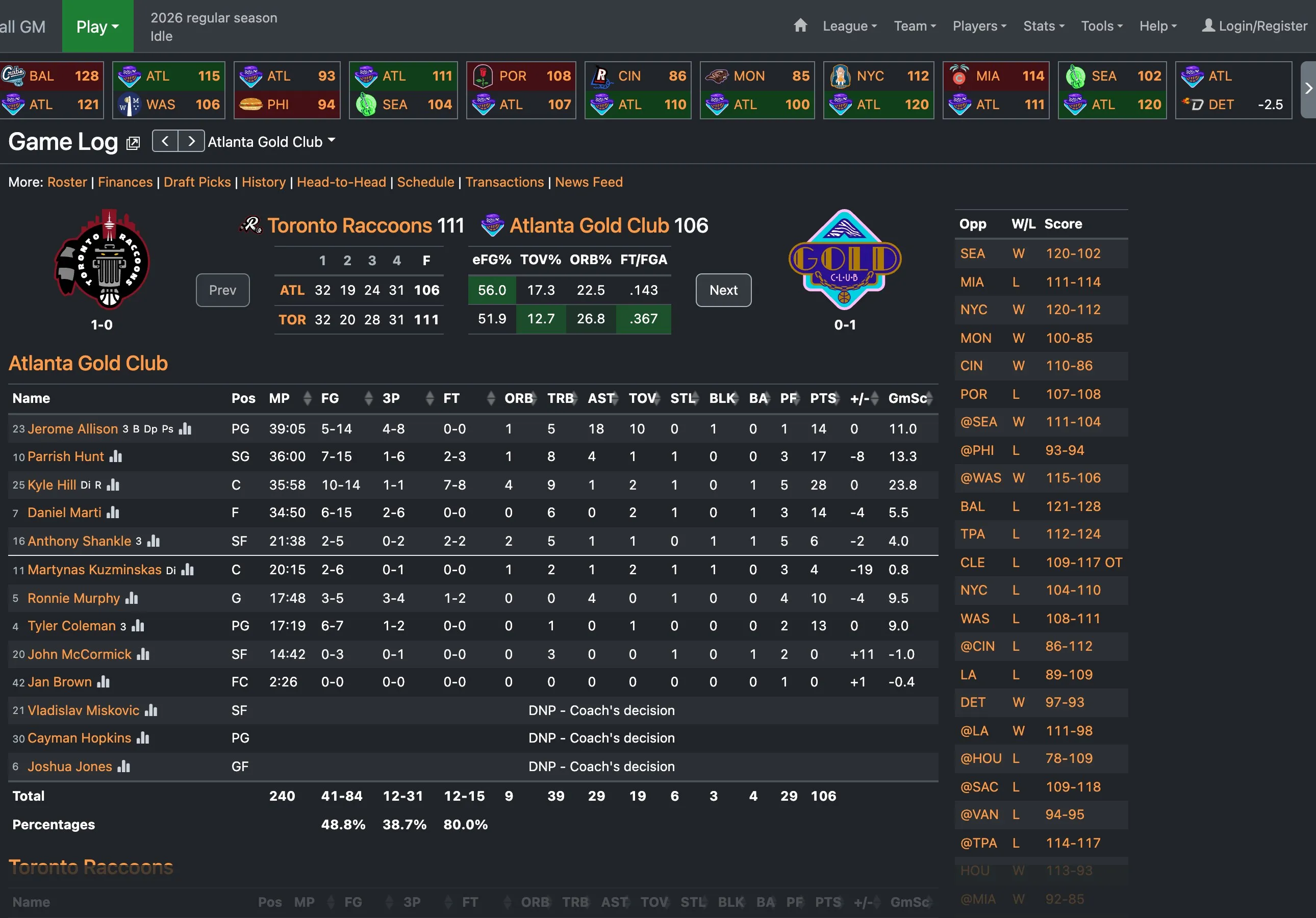 Every game leaves a full box score with four factors and plus-minus. It doesn’t write a recap; the numbers are the story.
The numbers hold up. Across ten seasons of our random league, scoring moved between 104.8 and 106.0 points per game and three-point attempts between 29.4 and 30.3, with no drift. The defaults, though, are tuned to a slightly older game. And in the 1996 league, the era preset got close to the real season on most measures:
| League average per game | BBGM random league (10 seasons) | NBA 2017-18 | NBA 2025-26 | BBGM 1996 league | NBA 1995-96 |
|---|---|---|---|---|---|
| Points | 104.8 – 106.0 | 106.3 | 115.6 | 97.0 | 99.5 |
| 3-point attempts | 29.4 – 30.3 | 29.0 | 37.0 | 15.1 | 16.0 |
| Field goal % | 43.9 – 44.5 | 46.0 | 47.1 | 45.9 | 46.2 |
| Turnovers | 16.1 – 16.4 | 14.3 | 14.5 | 16.1 | 15.8 |
| Offensive rebounds | — | 9.7 | 11.4 | 13.3 | 12.6 |
| Free throw attempts | — | 21.7 | 23.5 | 23.2 | 26.4 |
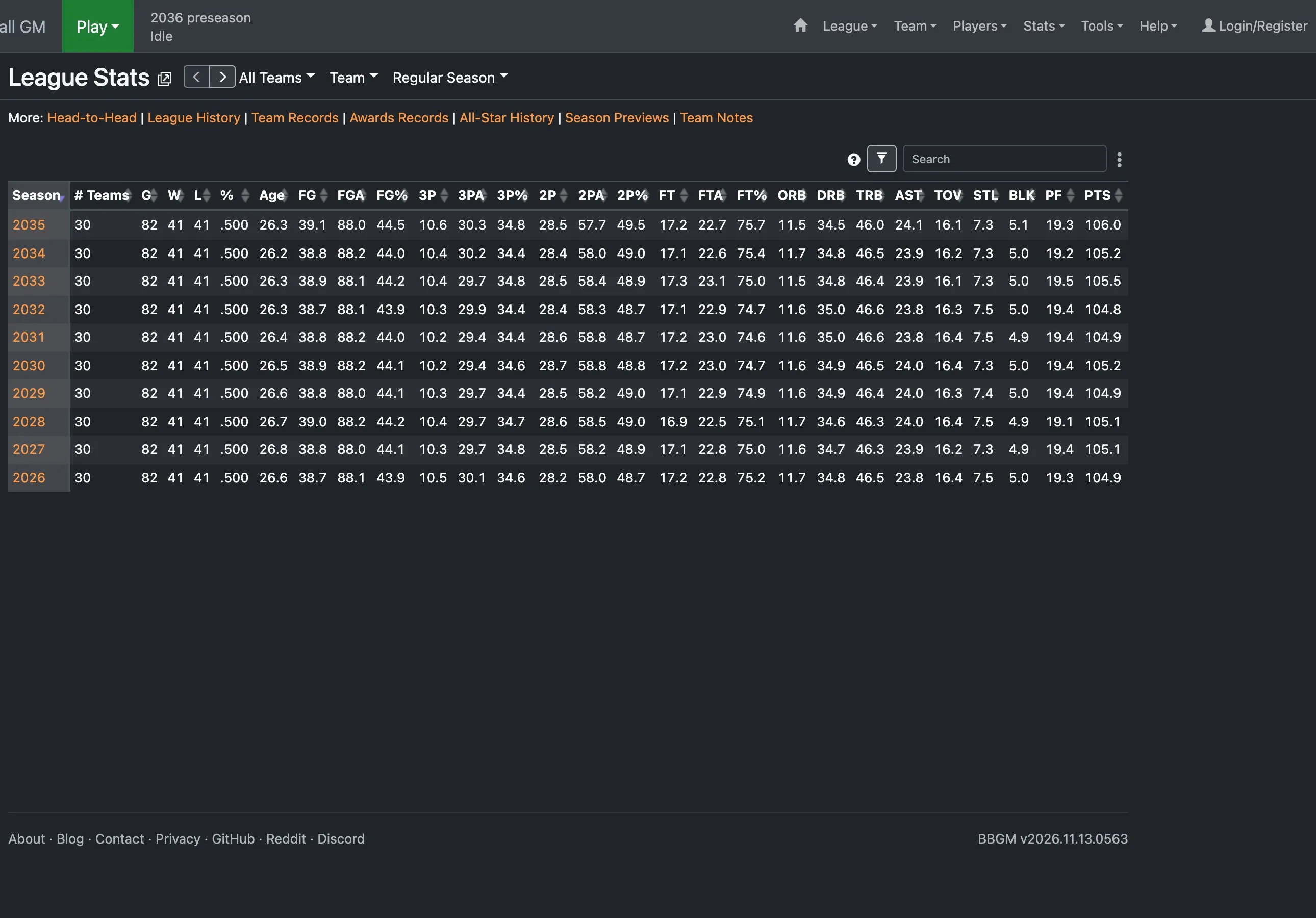 League-wide averages from our random league, 2026 to 2035. Steady as a metronome, and steadily about seven years behind the real NBA.
Two conclusions. First, out of the box Basketball GM plays like the late-2010s NBA: about nine fewer points and seven fewer threes per game than the 2025-26 league, and around two more turnovers. Second, the engine is flexible enough to fix that itself. League Settings expose pace and factors for three-point tendency and accuracy, two-point and free-throw accuracy, blocks, steals, turnovers, offensive rebounds, fouls and assists, plus a menu of presets “based on historical NBA stats”. You can modernize a league in a minute; we just wish the default did.
There are knobs for rules too: quarters and their length, overtime length, a cap on overtime periods, shootouts, foul-out limits, bonus thresholds, the number of players on the court, three-pointers on or off, neutral-site playoff games and an Elam Ending. The engine is also fast. In September 2026 the developer measured ten auto-played seasons dropping from 202 to 109 seconds, and the post is candid that “if any bugs were introduced in this release, they are probably from my code.”
Community complaints about the engine tend to be about realism at the edges: the 2022 GM Games review wrote that “everyone is playing the same style”, which is a fair description of a sim without team tactics. The developer has said he would rather fix ratings and the sim than add a layer of player tendencies, admitting in the FAQ that BBGM is “far from ideal” in those aspects.
Coaching and tactics: the empty chair
If Basketball GM has a hole, it is on the sideline. Here is everything a coach can do, verified on the roster page:
- Starting five and rotation order, by dragging rows. The top five start; the order of the rest sets who comes in first.
- Playing time, per player, in five steps: 0, −, normal, + and ++.
- Auto sort roster and a Keep auto sorted switch, which let the AI handle all of the above.
- Reset playing time, to undo your tinkering.
- Play through injuries, with separate settings for the regular season and the playoffs.
That’s it. There are no offensive sets, no defensive schemes, no zone, no pace and no play-calling. There are no assistant coaches, no training camp, no practice focus and no individual training plans. The only “coaching” lever outside the roster page is the coaching budget on the finances page, which nudges progression: in our league it read +1.49% positive progressions and −1.49% negative ones.
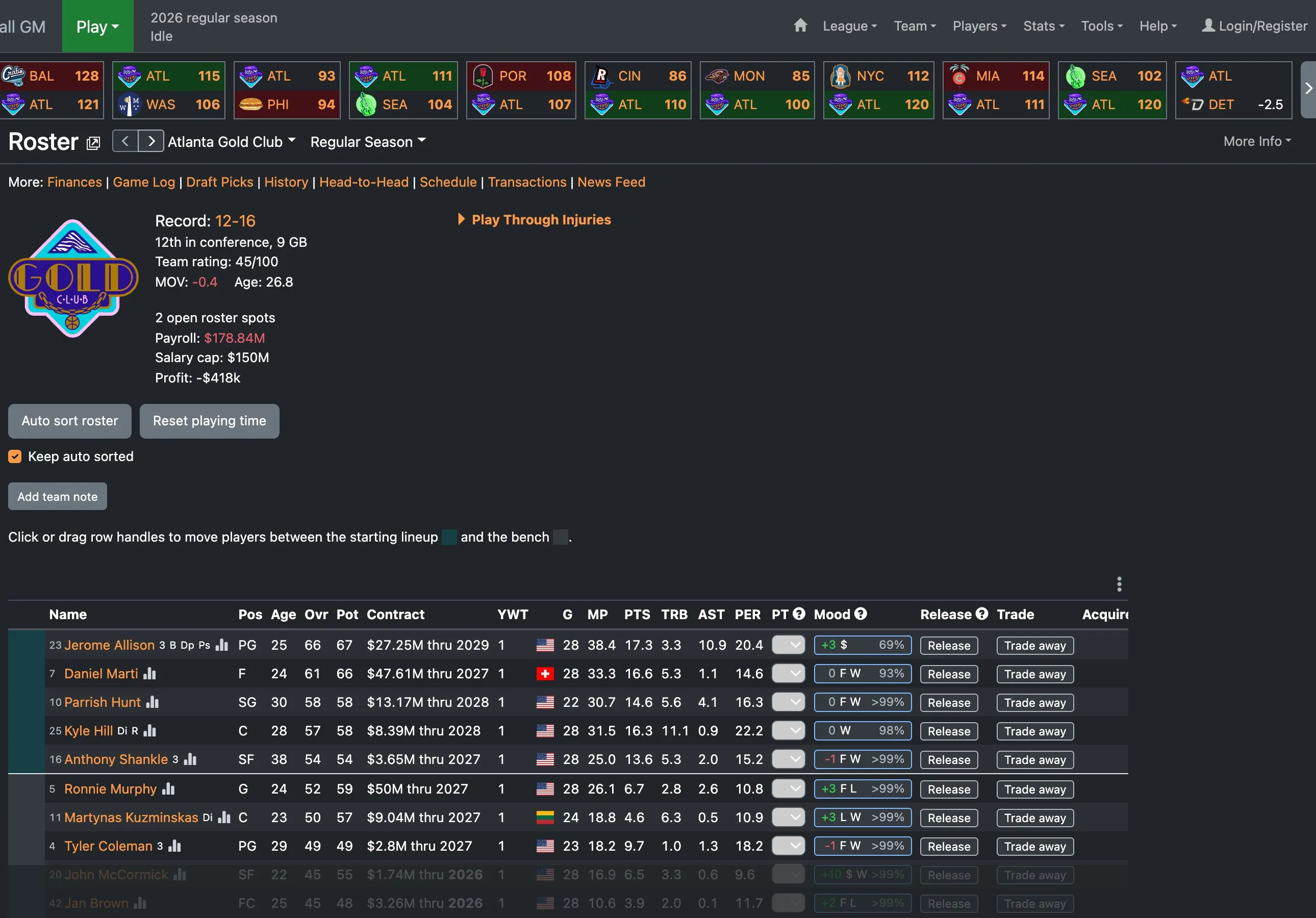 Your whole coaching toolkit fits on this page: drag to reorder, plus a five-step playing-time control per player. The mood and contract columns next to it are a reminder of where the game’s attention really goes.
Compared with the best of the genre, the gap is large. On our site, Swish & Dunk offers fifteen offensive and eight defensive systems, BuzzerBeater ten and seven, and Hoop Land lets you take the ball and play. Basketball GM offers none of that.
It is a deliberate choice, and the developer explains it plainly. He told The F5 in 2025 that he is going for “as little micromanagement as possible”. In the FAQ he adds that coaching strategies are hard to balance, because “you don’t want one coaching strategy to always be the best”. He also doubts that playing time makes young players develop faster. He says he has seen no convincing evidence of it, so minutes have no effect on progression.
We respect the consistency, and we still disagree. A light tactical layer — three or four offensive identities, a couple of defensive ones, an aggression slider — would add the one thing the front office can’t give you: the feeling of outcoaching someone in a playoff series. In 2022, GM Games listed the absence of coaches, offensive and defensive systems and playing styles among the game’s cons. Four years later, that is still true.
Players and ratings: fifteen numbers and a fog
Every player has fifteen ratings on a 0-100 scale, grouped in three blocks:
| Group | Ratings |
|---|---|
| Physical | Height, Strength, Speed, Jumping, Endurance |
| Shooting | Inside, Dunks/Layups, Free Throws, Mid Range (shown as 2Pt), Three Pointers |
| Skill | Offensive IQ, Defensive IQ, Dribbling, Passing, Rebounding |
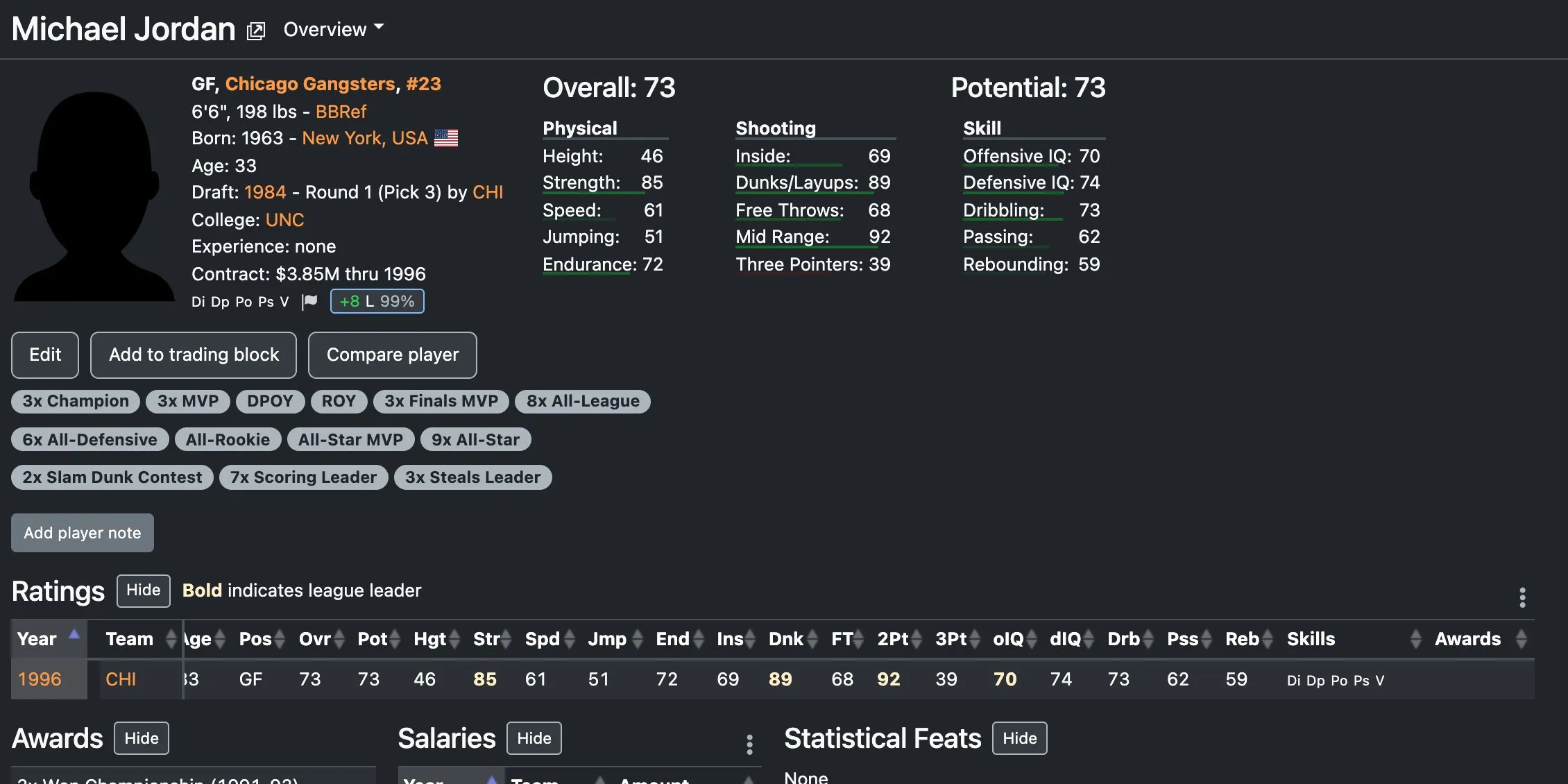 Michael Jordan in 1996: 92 mid-range, 89 dunks/layups, 85 strength, but 39 from three and 46 height. Bold marks a league-best rating. The “+8 L 99%” badge is his mood: loyal and almost certain to re-sign.
The manual says that “the whole scale is used”, so a typical rating is 50, and gives a rough guide to the overall: 85+ is an all-time great, 75+ an MVP candidate, 65+ an All-League candidate, 55+ a starter and 45+ a role player. That is why Jordan reads 73: the developer says in the FAQ that he decided “I might as well try to use all of” the 0-100 range, so 90+ players are rare. The height rating includes wingspan and standing reach, and it is the one the sim actually uses; listed heights in feet and inches are cosmetic.
Potential is a forecast, not a ceiling. The manual is precise: potential “doesn’t actually do anything to influence player development”. It is the 75th percentile of simulated career arcs, so a player should beat it about a quarter of the time. Development depends on current ratings, age and your coaching rank, and it happens once a year, in the preseason.
Scouting is a fog. The ratings you see “are not the real ratings. They are estimates from your scouts.” Raising the scouting budget shrinks the error gradually, averaged over three seasons. In our Atlanta league, a level of 41 meant a ratings error with a standard deviation of 1.77 and a maximum of 4 points. In a draft where prospects are separated by two points, that fog is real. The error shrinks further once a player has been on your team.
Skills are a readout. The little tags (3, A, B, Di, Dp, Po, Ps, R, V) summarize composite ratings. The manual says the tag itself has no effect, and the code confirms that synergy uses the underlying composites on a smooth curve, so a player who barely misses a tag is about as useful as one who barely makes it.
Mood is the hidden economy. Introduced in 2020, the mood system has eight components: market size, facilities (your spending over the past three seasons), team performance, hype, loyalty, trades, playing time and rookie contract. Four all-or-nothing traits change their weight: Fame (big markets, minutes, attention), Loyalty (stays put, dislikes seeing teammates traded), Money (cares less about everything else, least likely to refuse) and Winning (will take fewer minutes and a small market for a contender). Mood affects two things: whether a player will negotiate, and how much he asks for. Players on rookie deals are eager to sign their next contract, which works a bit like restricted free agency.
Injuries were refreshed in July 2026, with default injury types and durations rebuilt from more recent NBA injury reports; durations got longer. The health budget shortens recovery (−2.37% duration at our level), and a setting stops the sim when one of your players is hurt for more than 20 games. There is no team chemistry rating beyond lineup synergy. Players age, retire, enter the Hall of Fame and occasionally turn out to have faked their age.
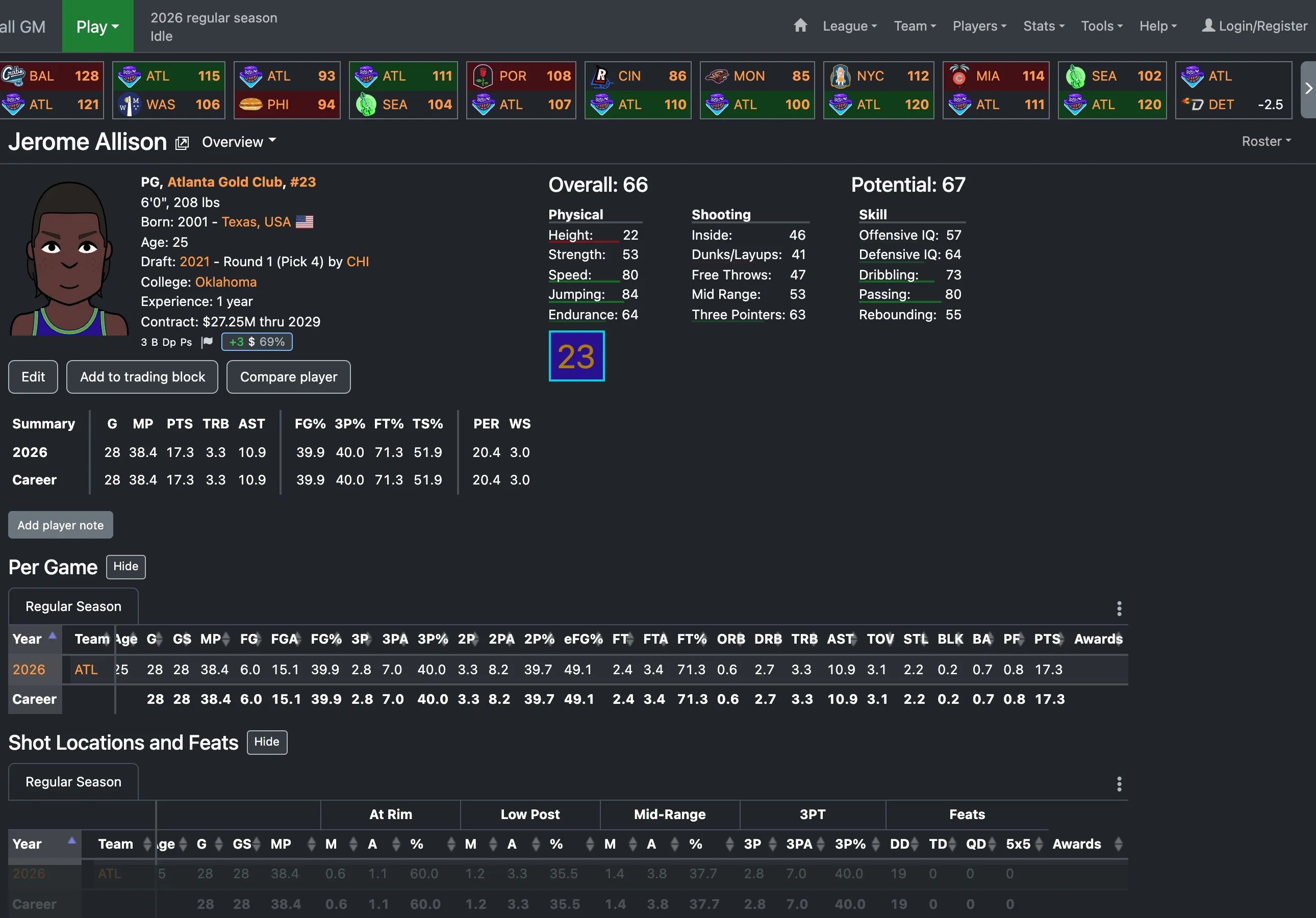 A random-league player profile. Same fifteen ratings, same three groups; the overall weights height and defensive IQ heavily, so tall, smart defenders are worth more than their box scores suggest.
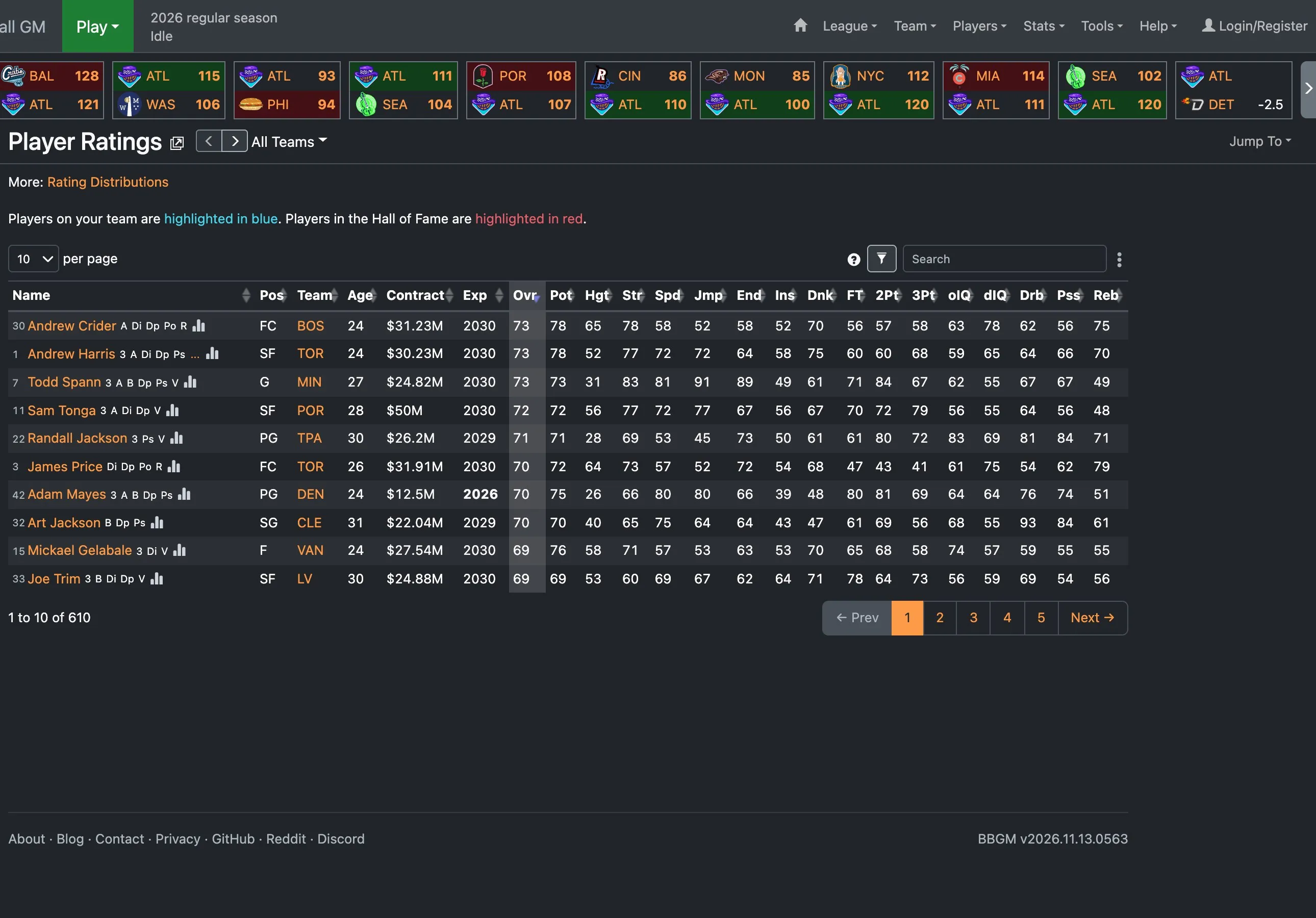 League-wide player ratings, filterable and sortable. Every number on another team’s player is seen through your scouts’ eyes.
The front office is the game
This is where Basketball GM is untouchable. These are the exact defaults we read from our random league’s settings, not the manual, whose figures ($90M cap, $30M max contract) date from an older version:
| Rule | Default (random league) | 1996 real-players league |
|---|---|---|
| Cap type | Soft cap (hard cap, no cap and budget-only also available) | Soft cap |
| Salary cap | $150M | $23M |
| Minimum payroll | $95M (teams below it pay the difference) | $15.35M |
| Luxury tax line | $168M | $30.2M |
| Tax rate | 1.5 × the amount over the line | 0 (no tax in that era) |
| Contract range | $1.2M – $50M, 1 – 5 years | $0.2M – $7.65M, 1 – 5 years |
| Trade salary matching | 125% | 125% |
| Rookie scale | #1 pick earns 25% of the max; only round 1 above the minimum; 3 years (round 1), 2 years (round 2) | Same |
| Roster size | 10 to 15 players | — |
| Draft | 2 rounds, NBA 2027 “3-2-1” lottery | 2 rounds, NBA 1994 lottery |
| Tradable future picks | 4 seasons | 4 seasons |
How the soft cap works, per the manual: over the cap you can still draft, re-sign your own players (“like the Bird exception”) and sign free agents to minimum contracts, but not sign other free agents above the minimum. The tax is assessed on your payroll at the end of the season, so you have until the trade deadline to get under it. The game spells all this out on the re-signing screen.
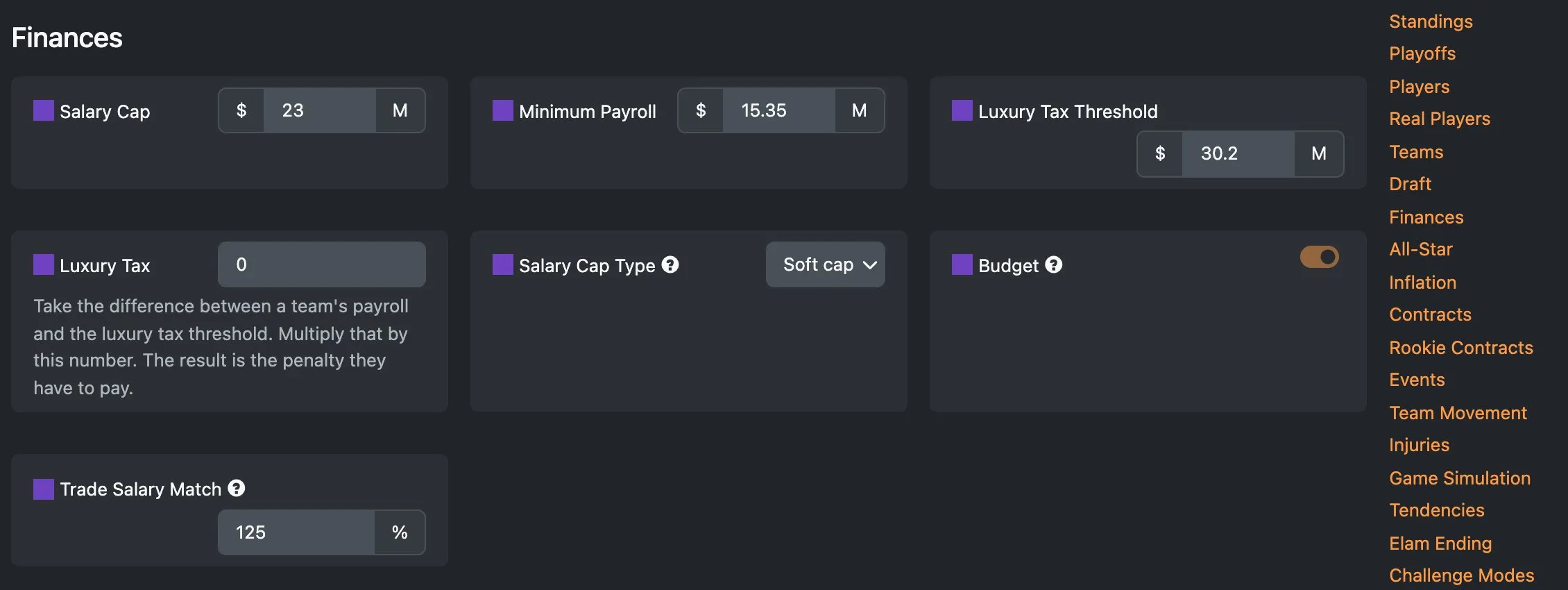 The 1996 league’s finance settings. The purple squares mark God Mode settings: every cap number is editable, and the cap type can switch between hard, soft, none and a budget model.
Contracts are simple on purpose. The FAQ is unusually frank: contracts “pay the same amount every season, they are all fully guaranteed with no player/team options, there are no restricted free agents, special salary cap exceptions are mostly not present”. Rookie deals are the exception, not guaranteed until the regular season. In November 2026 the game gained partial support for contracts that change over time. They appear in real-player leagues (the asterisks in our 1996 screenshots) and can be made in God Mode. Free agents don’t ask for them yet, and you can’t pick them when negotiating.
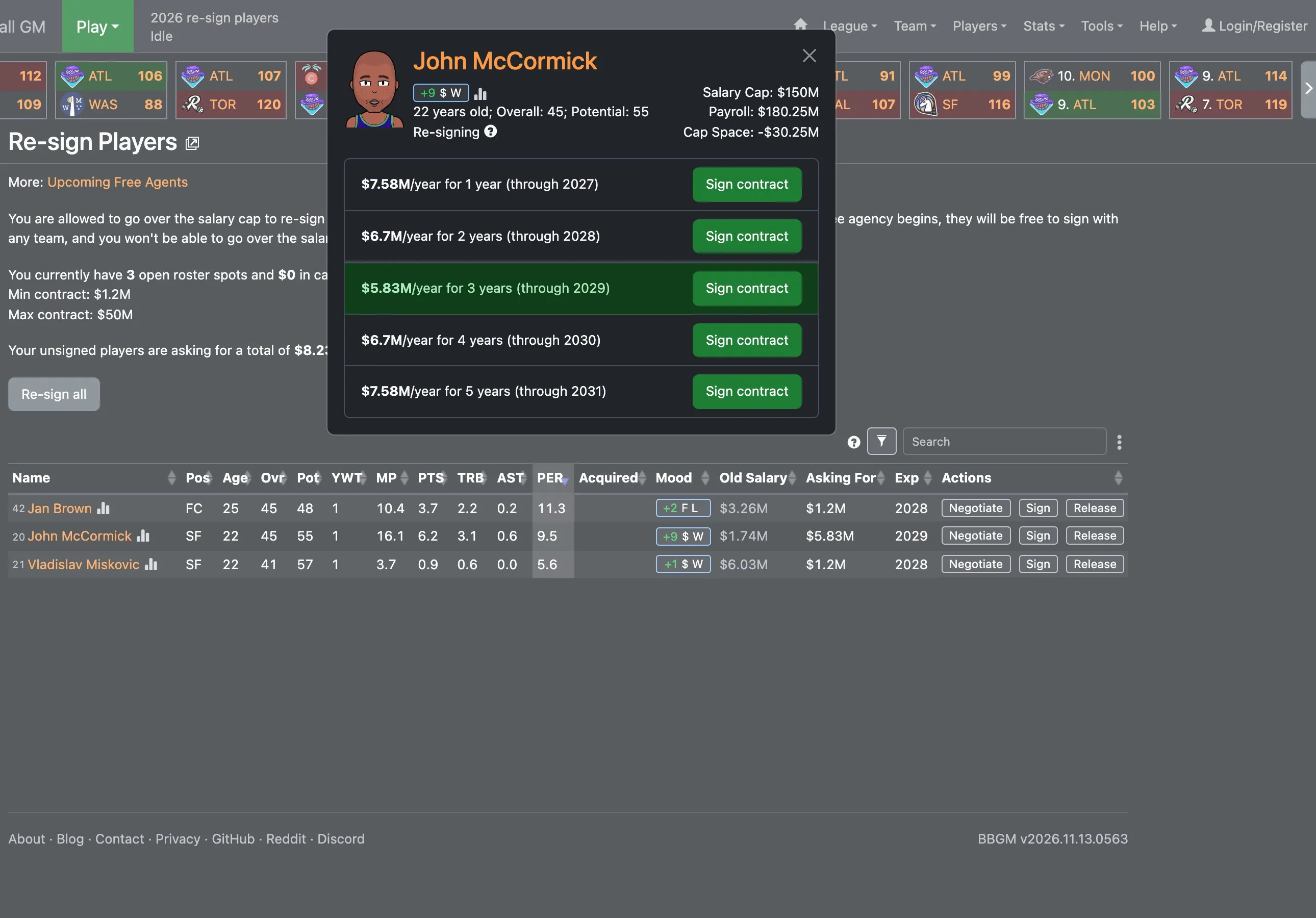 Negotiating with John McCormick: five fixed offers, cheapest at three years ($5.83M), most expensive at one and five ($7.58M). You choose a length; you can’t type a number.
Negotiation is where the simplification shows most. You don’t make offers; you pick from a menu of lengths, each with its price. Stanners at GM Games wrote back in 2020 that “Salary negotiations can be at times very annoying” because you can’t offer a little more. Since February 2025, free-agent asking prices react to market conditions, which makes the menu less arbitrary.
Trades are two-team only, salary-matched at 125% by default, with draft picks tradable four seasons out. The trade screen has a “What would make this deal work?” button that asks the AI to balance a deal, and the trading block lets you shop a player and filter the replies by position, skill, draft picks, prospects or best current players.
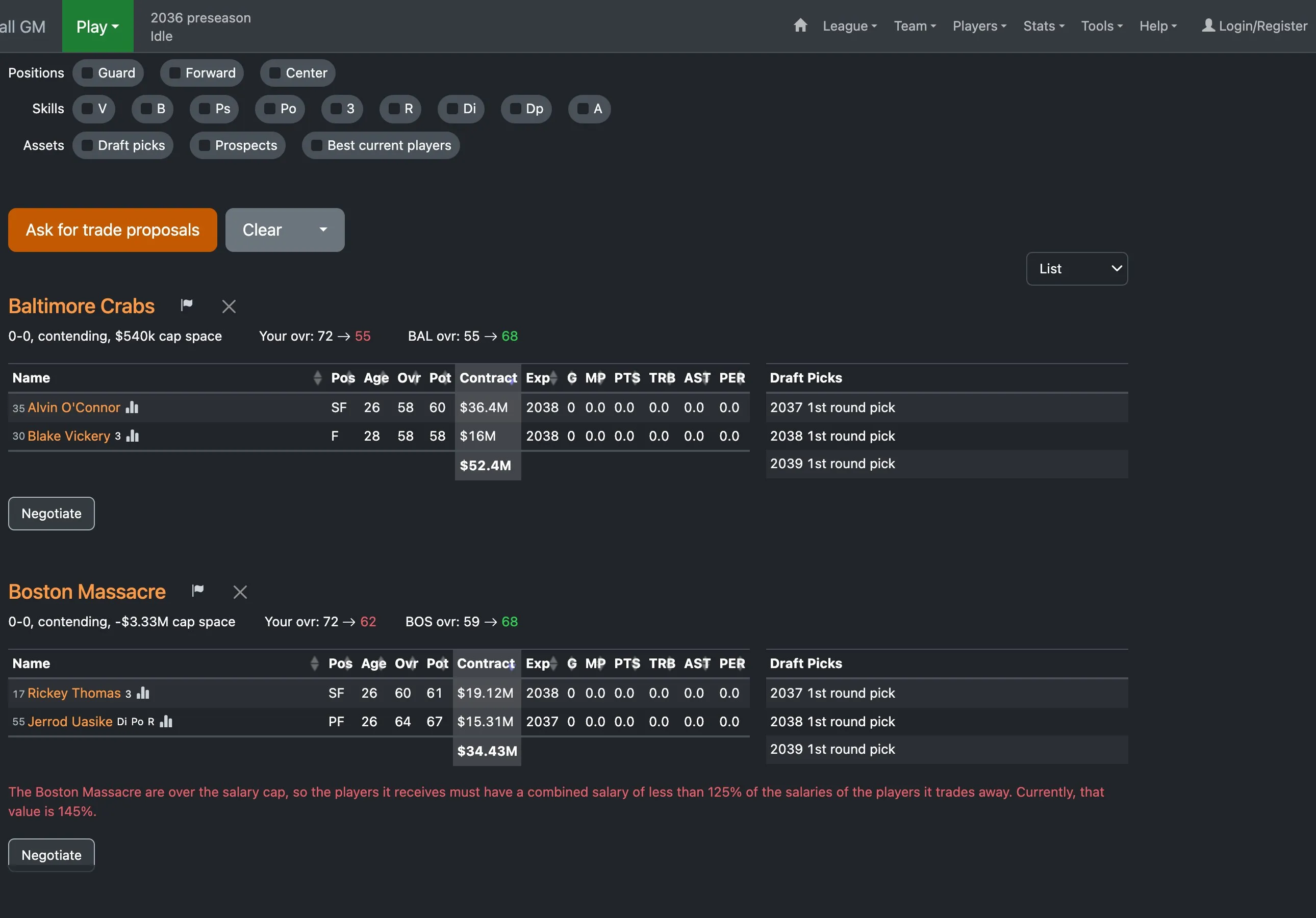 The trading block in 2036: for our 78-overall star, Baltimore and Boston each offered two players and three first-round picks. Contenders offered help now; rebuilders offered picks.
We put the trade AI to work twice. First we shopped Murphy’s $50M deal. Rebuilding Baltimore offered three cheap role players; contending Boston offered $32.6M of Tray Perry plus two role players and a second-round pick; Chicago offered a 2026 first-round pick. Some of those automatic proposals broke the 125% salary-matching rule and needed adjusting. Years later we shopped our star Ben Davis (29 years old, rated 78, $50M through 2039). Baltimore and Boston each offered two players plus three first-round picks.
The valuation feels coherent: age and potential matter, contending and rebuilding teams want different things. The developer is unusually candid that it hasn’t always been so. A 2023 post said “the trade AI remains flawed” and described “an exploit that I think many people have used”. A January 2025 post joked about the trade AI, “which certainly some of you know how to exploit”. And in October 2026 he rebuilt draft pick valuation because “Draft pick trading was always somewhat bad, but it became really bad the past several months”. The fix simulates the rest of the season and applies the actual lottery odds, and he calls it a step towards protected picks, which don’t exist yet.
Finances and the owner. Four budget items (scouting, coaching, health, facilities) are set as levels, and each shows its effect in plain numbers: facilities gave +0.4 player mood and +0.74% ticket demand at our level. You also set ticket prices, with an auto-price option. The owner sends an annual performance evaluation that weighs winning and money, and the store description is blunt: “make the wrong choices and you’ll get fired!” Difficulty (Easy to Insane) makes AI teams tougher traders, players less willing to sign and profits harder to make.
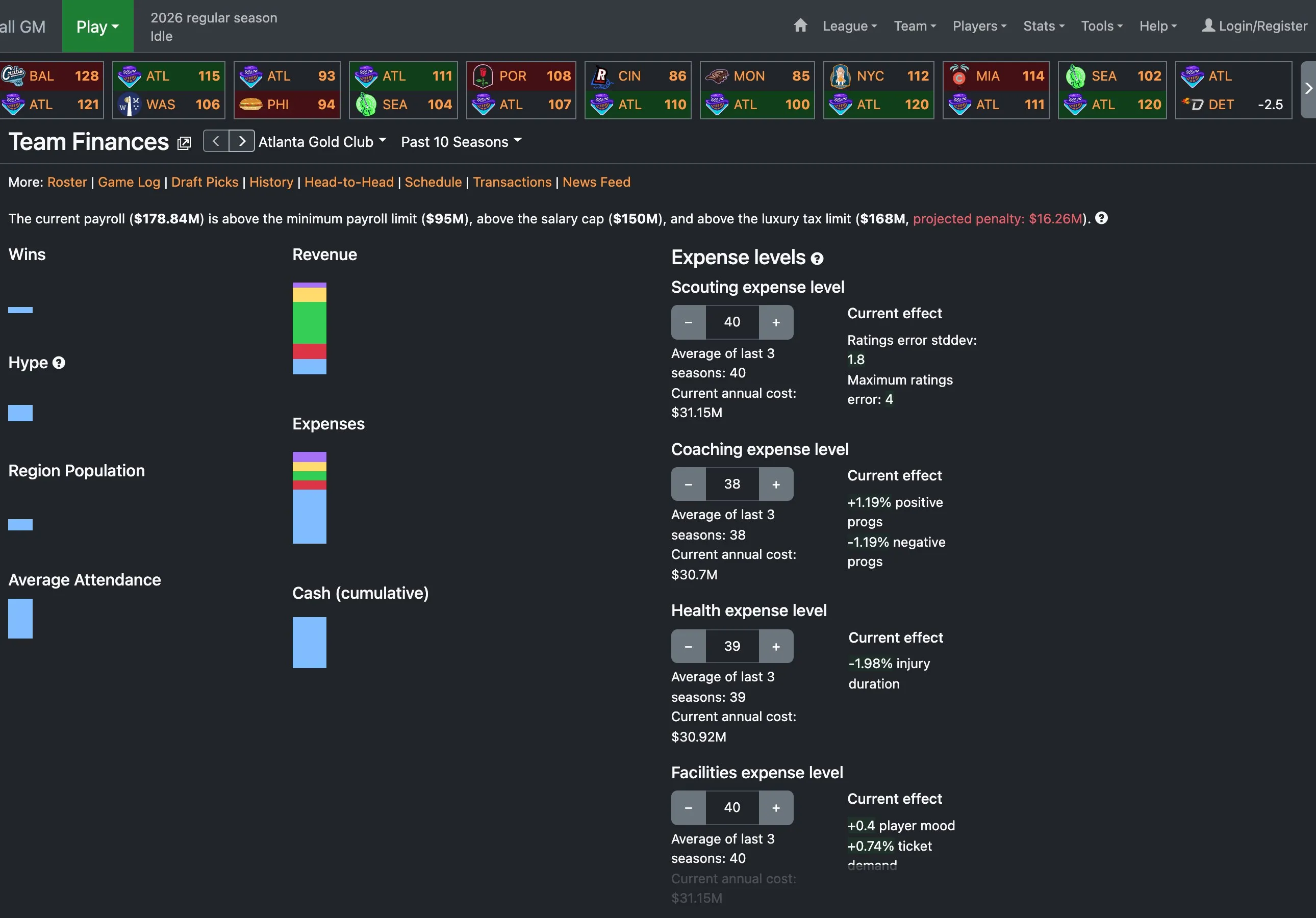 Finances: four budget levels, each with a stated effect (in our first season, coaching: +1.19% positive progression; health: −1.98% injury duration — the figures move as your budget history changes), and a luxury-tax warning. Rare honesty: the game tells you what your money buys.
World and longevity: a league that remembers
Nothing else in the genre gives you this much league to play with.
- League types. Random players, real players from any season since 1947 (with draft classes up to today, so you can watch real prospects arrive), cross-era leagues built from historical teams (since 2023), women’s leagues (since 2023), custom rosters from the community and Import Real Players from any season into any league (since 2025).
- No licences. To stay on the right side of the law there are no NBA logos, team names or photos. Player names and careers are real; franchises are fictional.
- Rules and structure. Many draft lottery formats, including the anti-tanking COLA option added in February 2026 and the NBA 2027 format; play-in tournaments; split or mixed conferences; series lengths per round; expansion drafts; automatic expansion and relocation; a schedule editor and scheduled-events editor; and extremely customizable awards (September 2026).
- History. Every season adds to the league history, Hall of Fame, retired jerseys, statistical feats, award races and team records. Players can have fathers and brothers in the league (2% each by default). Real-players leagues add Seattle and Las Vegas as expansion teams in 2029.
- Challenge modes. No Draft Picks, No Free Agents, No Trades, No Visible Player Ratings, Lose Best Player, fired if you pay the tax, fired if you miss the playoffs, Sisyphus Mode, Thanos Mode, Spectator Mode and Groundhog Day.
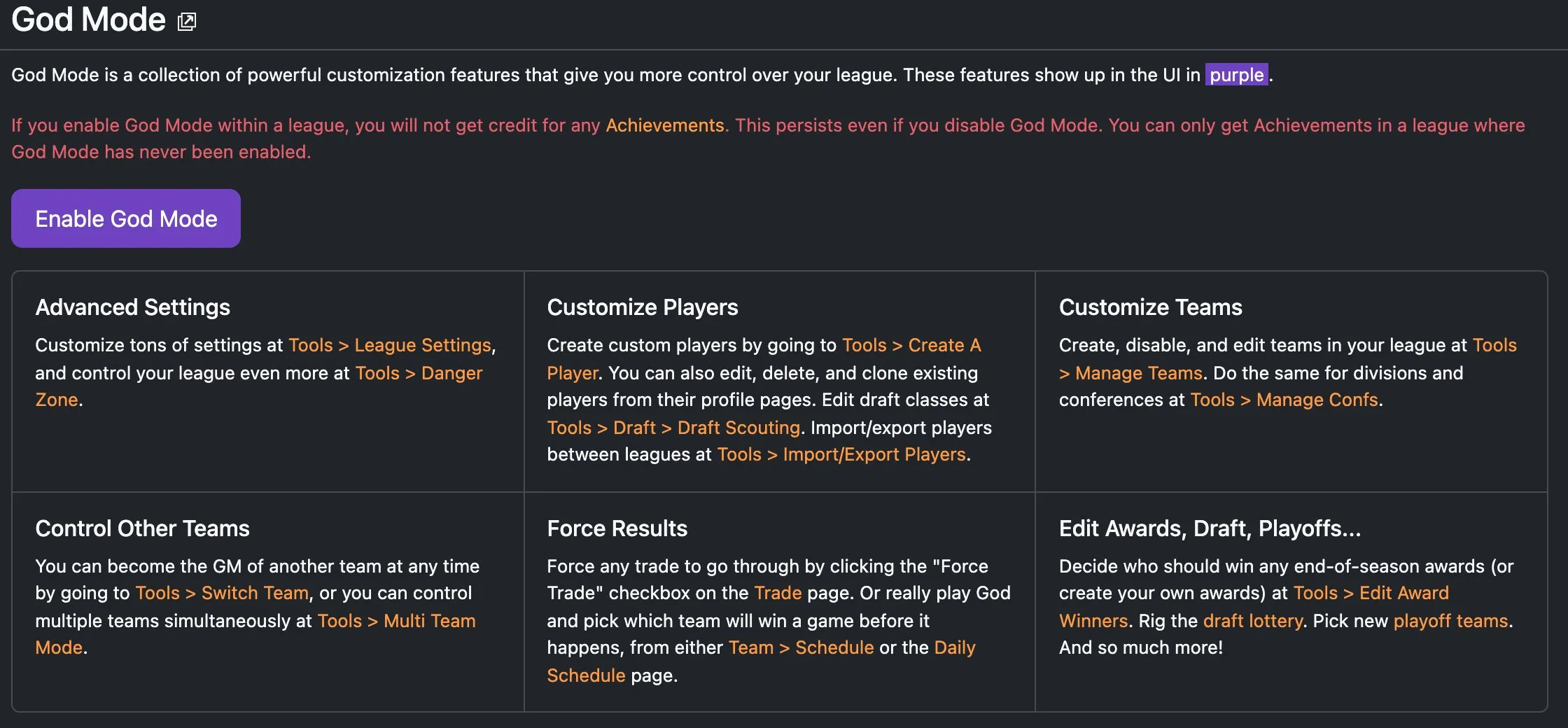 God Mode, one click away. Create and edit players, force trades, rig the lottery, decide awards or take over another team. The warning is real: enable it once and that league stops earning achievements forever.
God Mode lets you edit anything: players, teams, contracts, the draft order, awards and even which team wins a game. Multi Team Mode lets one person run several franchises, which is how “multiplayer” works here. GM Games’ 2022 review complained that multiplayer requires one person to control all teams.
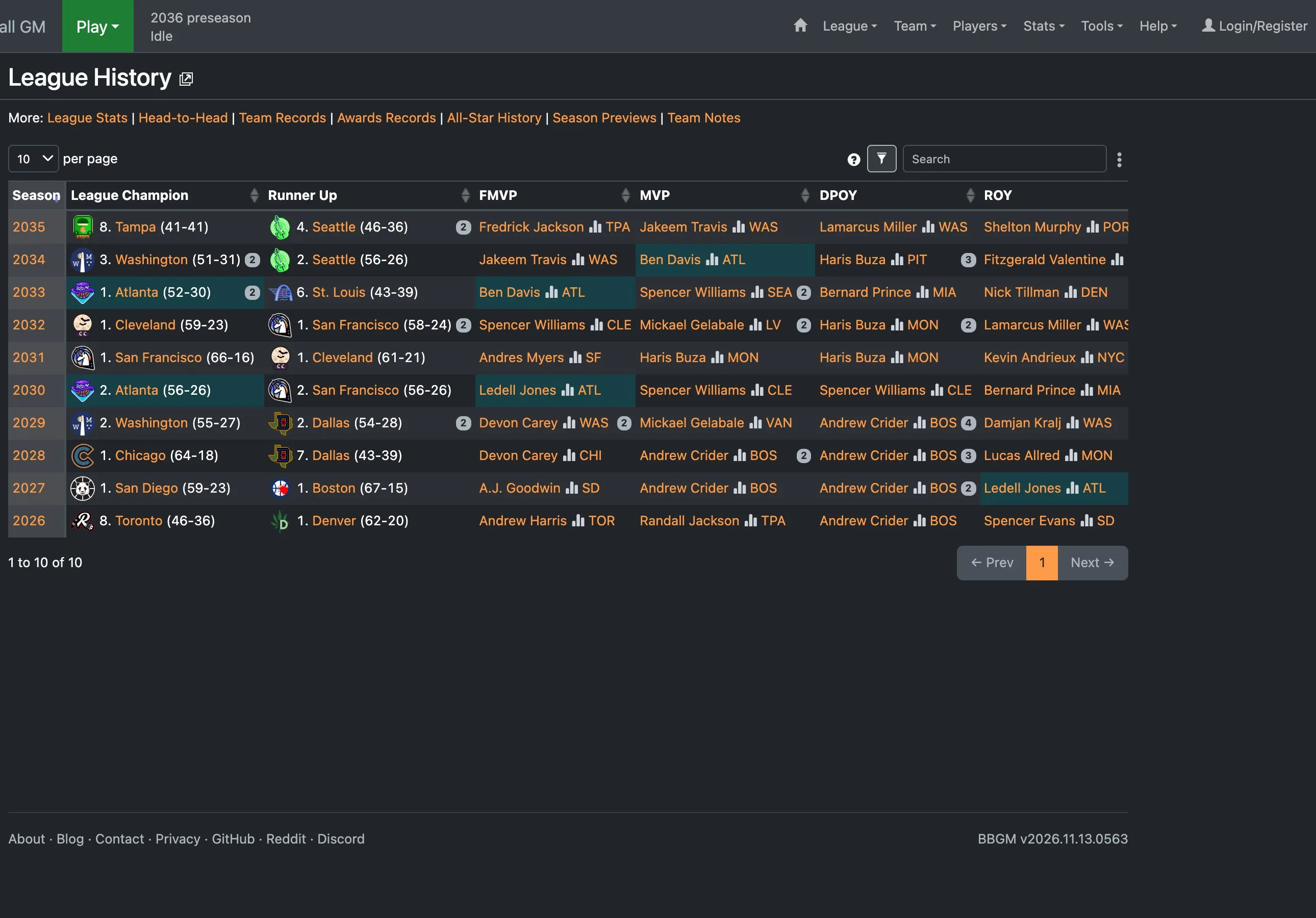 League history after ten seasons in our random league: champions, Finals MVPs and awards pile up into a shared memory.
Longevity. There is no season limit. Our random league ran ten seasons with no slowdown we could feel and no drift in league stats. The developer’s November 2026 post mentions converting a 2,000-season league, so people really do play that long. The 2025 usage report counts 5,025,784 Basketball GM sessions and 20,900,958 seasons simulated in that year alone. Long-term, the real threat to your league is not the engine but the browser storage it lives in.
Interface, platforms and performance
Basketball GM is a web app first. It runs at play.basketball-gm.com in any modern browser and keeps working offline once loaded (the page tells you so). The other ways in are wrappers around the same app:
| Platform | How | What we found |
|---|---|---|
| Browser (desktop/mobile) | play.basketball-gm.com, no install, no account | Tested on desktop Chrome, Mac |
| Android | Google Play app by ZenGM | 4.3 stars, about 1,100 reviews, 100K+ downloads, “Contains ads”, updated Jul 31, 2026 (not installed) |
| Windows | Microsoft Store app, free | Listed by ZenGM, LLC since Nov 2021; about 5 stars from 10 ratings (not installed) |
| iPhone/iPad | No app; the FAQ suggests Safari’s “Add to Home Screen” | Not tested |
The interface is dense and consistent: a left menu with League, Team, Players, Stats and Tools; a top bar with the Play button and the current phase; tables everywhere, all sortable, with advanced stats (PER, BPM, VORP, on/off, plus-minus per 100 possessions), player graphs and a player comparison tool. It is utilitarian. The learning curve is in reading, not in clicking. We found no language option: the interface is in English.
Performance is excellent. Creating the 1996 league took about five seconds, a full regular season about three and a half, and the nine auto-played seasons about 35. There is no cloud save. An optional account stores only achievements, not leagues. To move a league between devices you export it from Tools and import the file elsewhere.
Monetization, line by line
| Item | Price | What it gives you |
|---|---|---|
| Basketball GM (browser) | Free | The full game, unlimited leagues and seasons, with ads |
| Android app (Google Play) | Free | Same game in an app wrapper; listing says “Contains ads” and shows no in-app purchases |
| Windows app (Microsoft Store) | Free | Same game as an installable web app |
| ZenGM Gold | $5 a month | Removes ads in Basketball GM, Football GM, ZenGM Baseball and ZenGM Hockey. Nothing else |
| ZenGM account | Free, optional | Cloud-stored achievements across browsers; required only to subscribe to Gold |
That is the whole store. No virtual currency, no packs, no energy, no loot boxes, no premium features. The account page is defiant about it: “There will never be any ‘freemium’ or ‘pay-to-win’ bullshit here.” Gold gives you “no new features, no new improvements, no new anything” beyond removing ads, so that the free version never becomes “a crippled advertisement for the pay version”. A Play Store reviewer in 2021 called the ads “not intrusive at all”.
Our verdict: this is the fairest business model in the genre. It has one hidden cost. Keeping data on your device rather than a server is what keeps the game free. The FAQ explains it directly: server costs stay “extremely low, which is what allows me to make this game free and unlimited.” You pay with the responsibility for your own backups.
Update history
The full changelog runs back to the first web beta in 2013 and is updated every few days. The highlights:
| Date | Version / change |
|---|---|
| 2008 | First code written, as a desktop game (C#, then Python) |
| Aug 2013 | Web version released to the public via Reddit’s r/nba |
| Sep 2013 | Trading Block and “What would make this deal work?” |
| Nov 2013 | Live play-by-play game simulation |
| Jun–Jul 2014 | Full league import/export; God Mode |
| Mar 2015 | Multi Team Mode |
| May 2017 | Runs in Safari, so iPhone and iPad work |
| Sep 2019 | All-Star Game |
| Nov 2019 | Persistent storage option; new ovr formula; game sim improvements |
| Apr–Jun 2020 | Real-players leagues, extended back to 1947 |
| Sep 2020 | New player mood system with traits |
| Sep 2021 | Play-in tournament, slam dunk and three-point contests |
| Nov 2021 | Windows app in the Microsoft Store |
| Jan 2022 | Settings to disable the salary cap and control rookie contracts |
| Feb–Jun 2023 | Women’s leagues; finances revamped into expense levels; cross-era leagues |
| Jan 2025 | Trading block filters |
| Feb 2025 | Free-agent contracts react to market conditions |
| May 2025 | Import Real Players from any season |
| Feb 2026 | COLA anti-tanking lottery |
| May 2026 | NBA 2027 “3-2-1” lottery, default in real-players leagues from 2027 |
| Jul 2026 | New default injuries from recent NBA data |
| Sep 2026 | Simulation engine about twice as fast; customizable awards |
| Oct 2026 | Draft pick trade value accounts for lottery and playoff odds |
| Nov 2026 | Partial support for contracts that change over time |
There is no public roadmap. The developer says he is “very bad at planning”. Hints in recent posts point to protected picks and better contract data, and the FAQ names college sports as a possible next “big” project, without a date.
What players say
The numbers first. Basketball GM logged 5,025,784 sessions in 2025, up from 4,605,106 in 2024, according to ZenGM’s usage report. The Android app holds 4.3 stars from about 1,100 Google Play reviews with more than 100,000 downloads (checked November 14, 2026). The Windows listing shows about 5 stars from just 10 ratings. Fan site GM Games scored it 8.5 in 2022 and Stanners, there, 8.8 in 2020.
What people love:
- Endless replay. GM Games’ 2022 review was titled “Repetitive doesn’t exist. You can find thousands of ways to play.”
- Customization. A 2021 Play Store review: “Simple, easy to play and very customizable… Hands down the best basketball sim on android.”
- Longevity. Stanners in 2020: “Basketball GM remains one of my favourite games of all time.”
- The developer. Releases arrive every few days, often answering community requests, and the business model wins trust: the store page promises “No virtual currency, no microtransactions, no pay to win.”
What people complain about:
- Trades. Stanners: “The AI can also at times be very stingy when trading draft picks.” A February 2025 r/BasketballGM thread was titled “Trade block needs fixing!!!”, and the developer’s own posts admit to exploits.
- Lost leagues. On Hacker News in June 2024 the developer wrote that “my #1 complaint is data being lost on both Android and iOS”, even with persistent storage.
- No tactics. GM Games, 2022: “I have a really hard time connecting to a game where the appearance is that everyone is playing the same style.”
- Player development feels random. A 2021 Play Store review that otherwise called the game “a masterpiece” noted that teams “that barely invest in coaching develop some insane players while mine decline once they hit 24”.
- Wishes for more context. A November 2026 Play Store review asks for college awards or stats for draft prospects.
The overall picture is consistent over a decade: enormous respect for the depth and the developer, steady frustration with the trade AI, the missing coaching layer and fragile saves.
Known issues and bugs
- Data loss. Leagues live in browser storage. Clearing “cookies and other site data” in Chrome deletes every league, even if you choose “today” only, and iOS is “very aggressive about deleting data from unused web apps” (FAQ). Persistent storage “doesn’t always work”.
- Stuck on an old version. The FAQ has four methods for when the browser keeps serving an old build, up to unregistering the service worker.
- Outdated manual. The manual still quotes a $90M cap, a $100M tax line and a $30M max contract; the game we played used $150M, $168M and $50M.
- Trade AI exploits. Admitted by the developer in 2023 and 2025; draft-pick valuation was “really bad” for several months in 2026 before the October fix.
- Variable contracts are half-built. They show up in real-player data but not in negotiations, and the developer calls the data imperfect.
- Real-player data gaps. Historical rosters include only players with stats, and some prospects appear in the wrong draft class (FAQ).
- Fresh performance code. The September 2026 speed-up came largely from outside pull requests; the developer warned about possible new bugs. We didn’t hit any.
- Auto-proposals that don’t fit. In our test some trading-block offers broke the 125% salary rule and had to be adjusted.
Tips for your first season
- Protect your league before you play. Turn on Persistent Storage in Global Settings and export your league regularly from Tools > Export League (FAQ).
- Read the finances page first. If you are over the tax line, you have until the trade deadline to fix it, because the tax is assessed on your end-of-season payroll (manual).
- Cut busts in the preseason. Rookie contracts are not guaranteed until the regular season; after that every contract is fully guaranteed (manual).
- Re-sign before free agency. You can go over the cap to keep your own players, but not to sign someone else’s (manual).
- Check mood before you clear cap space. In our test three of the four best free agents refused a 37-45 team. Winning, facilities and hype open doors; cap space alone doesn’t (our test, mood blog).
- Don’t bench veterans to “develop” kids. Playing time has no effect on progression (FAQ), and players who lose minutes get unhappy (mood blog).
- Treat potential as a coin weighted 75/25. It is the 75th percentile of simulated careers, not a promise (manual).
- Budget for the long game. Scouting and facilities work on three-season averages, so a one-year splurge does little (manual, mood blog).
- Let the AI do the arithmetic. On the trade screen, “What would make this deal work?” balances a deal; on the trading block, filters target picks, prospects or a position (our test).
- Modernize the sim if it bothers you. The game-simulation settings let you raise pace and three-point tendency to match today’s NBA (our test).
Against the alternatives
| Basketball GM | Hoop Land | Draft Day Sports: Pro Basketball 27 | BuzzerBeater | Swish & Dunk | |
|---|---|---|---|---|---|
| Match view | Text, box score | Playable 2D | 2D, text, box score | 2D, text, box score | 2D, text, box score |
| Platforms | Browser, Android, Windows | iOS, Android, Windows, macOS | Windows | Browser | Browser, iOS, Android |
| Price model | Free (ads; $5/mo removes them) | Free + IAP | Paid | Free + IAP | Free |
| Real players | Yes, unlicensed, since 1947 | No | No | No | No |
| Multiplayer | No (Multi Team Mode only) | No | No | Yes, online leagues | Yes, online leagues |
| Tactics | Minutes and rotation only | Playbook, play the games | In-game intervention | 10 offensive / 7 defensive systems | 15 offensive / 8 defensive systems |
| Front office | Soft cap, tax, rookie scale, 2-team trades | Basic trades | Soft cap, advanced trades | Budget, no cap | Budget, no trades |
| Our score | 9.0 | 7.8 | 8.2 | 8.2 | 6.9 |
- Hoop Land is for people who want to play the games they manage, with a lighter front office (review).
- Draft Day Sports: Pro Basketball 27 is the paid Windows text sim, with stronger game-day presentation, in-game intervention and the most complex cap sheet you can buy (review).
- BuzzerBeater and Swish & Dunk trade single-player speed for online leagues against real managers, with real tactical systems (BuzzerBeater, Swish & Dunk; disclosure: Swish & Dunk is developed by our founder).
- Pro Basketball Manager 2027 brings European licences, a 3D court and a playbook, for a price (review).
None of them matches Basketball GM’s front-office depth for free. Several of them beat it the moment the ball goes up.
Our take
Basketball GM is the purest version of the fantasy that brings most of us to this genre. It does not want you to coach a game; it wants you to build a team, live with the contracts you signed and watch a draft pick become a Finals MVP ten seasons later. On those terms it is the best basketball management game you can play, and the price — zero — is almost beside the point.
The 1996 experiment sums up the game. It handed us Jordan, Pippen and Rodman with the right contracts, the right cap and even the right pace, and then let Cleveland knock them out in five games. A licensed console game would never dare. Basketball GM doesn’t care about your nostalgia; it cares about consequences. That is its genius, and it is why a single season here can feel more like a real front office than a hundred hours elsewhere.
Our wish list, in order:
- A light coaching layer. A handful of offensive and defensive identities and a pace setting, so a playoff series can feel like a chess match.
- Cloud saves, or at least automatic local backups. A ten-year dynasty shouldn’t depend on the mood of a phone’s browser.
- Real negotiation. Let us type a number, add player and team options and negotiate extensions, now that variable contracts exist.
- Modern defaults. Ship the random league with today’s pace and three-point rate, not 2018’s.
- Three-team trades and protected picks. The October 2026 valuation rewrite makes the second one sound close.
Who should skip it: anyone who needs to see the game, play the game or call the play; anyone who switches devices daily and won’t export a file; anyone who wants an officially licensed NBA. Everyone else: export your league, and start drafting.
Sources
Official — ZenGM and Basketball GM
- Basketball GM FAQ · Manual · ZenGM changelog · Source code and licence (GitHub) · Account and ZenGM Gold page
- Developer blog: Development history (2013) · Real players (2020) · Player mood (2020) · AI draft pick valuation (2023) · Trading block filters (2025) · 2025 usage stats · NBA 2027 draft type · Vibecoded games (2026) · Updated default injuries · Twice as fast · Draft pick trade value · Variable contracts
- Game simulation code: GameSim.basketball
Stores
- Basketball GM on Google Play (ratings and reviews checked November 14, 2026)
- Basketball GM on the Microsoft Store
Press and specialist sites
- The F5 — Owen Phillips, July 2025 · Sportico (2025) · Last Word on Gaming (2022) · GM Games review (2022) · GM Games, Stanners review (2020)
Community
- Hacker News thread with the developer (June 2024) · r/BasketballGM · “Trade block needs fixing!!!” (r/BasketballGM, February 2025)
Data
Hands-on
- Our own leagues on Basketball GM v2026.11.13.0563: a random-players league (Atlanta, 2026–2036) and a real-players league (Chicago, 1996). All screenshots are ours.
Analysis by category
Match engine
Weight 22%8.5Possession-by-possession and remarkably stable: over ten simulated seasons league scoring stayed between 104.8 and 106.0 points per game. The defaults resemble the 2017-18 NBA more than 2025-26 (115.6 points, 37.0 3PA). Real-player leagues load era presets: our 1996 season averaged 97.0 points against the real 99.5.
Coaching & tactics
Weight 12%6.0You set starters, rotation order, a five-step playing-time control per player and whether injured players play through pain. That is all: no sets, no schemes, no pace. Lineup synergies exist under the hood, built from skills like shooting, ball handling, passing and rim protection, but you only influence them by building the roster.
Players & development
Weight 18%9.5Fifteen ratings, potential defined as the 75th percentile of simulated careers, displayed ratings fuzzed by your scouting budget, and a mood system that made three of the four best free agents refuse to negotiate with our losing team.
Front office & salary cap
Weight 14%9.0A real soft cap with luxury tax, rookie scale and the right to exceed the cap to re-sign your own players. The trade AI priced our 78-overall star at three first-round picks plus starters. Missing: player and team options, negotiable extensions and multi-team trades; negotiating means choosing among fixed offers.
League & world
Weight 10%10.0Random or real-player leagues back to 1947, cross-era leagues, many draft lottery formats, God Mode, expansion and fantasy drafts, an All-Star weekend with dunk and three-point contests, customizable awards. Nothing in the genre comes close.
Interface & UX
Weight 10%8.0Fast and consistent, every table sortable, advanced stats everywhere (PER, BPM, VORP, on/off). Dense and utilitarian: the learning curve is in reading, not in clicking.
Longevity
Weight 7%9.0Nine seasons auto-played in about 35 seconds on our machine, with no drift in league stats. Long leagues are viable; the real long-term risk is browser storage, not performance.
Business model
Weight 7%9.5Free with ads. ZenGM Gold costs $5 a month and only removes ads; the developer explicitly rules out freemium and pay-to-win.
Weighted average of the criteria: 8.7
Features
Game type
- Genre
- Management simulation
- You play as
- General manager
- Players & teams
- Real (unlicensed)
- League structure
- NBA-style (draft, playoffs), Historical seasons, Custom leagues
- Rules
- NBA (48 min), Customizable
Match engine
- Simulation model
- Possession by possession
- Match view
- Box score, Text play-by-play
- Watch matches live
- Yes
- In-game decisions (timeouts, subs)
- No
- Instant simulation
- Yes
- Match replay
- No
- Advanced stats (PER, TS%, +/-)
- Yes
- Fouls & foul trouble
- Yes
Coaching & tactics
- Offensive systems
- 0
- Defensive systems
- 0
- Zone defense
- No
- Playbook / play editor
- No
- Rotations & minutes
- Yes
- Individual player instructions
- No
- Opponent game plan
- No
- Team training
- No
- Individual training plans
- No
- Staff (assistants, scouts, medical)
- No
Players
- Ratings per player
- 15
- Hidden potential
- Yes
- Progression & aging
- Yes
- Personalities & traits
- Yes
- Morale & playing-time demands
- Yes
- Team chemistry
- No
- Injuries
- Yes
- Player cards / collection
- No
- Retirements & Hall of Fame
- Yes
Roster building
- Draft
- Yes
- Draft lottery
- Yes
- Trading draft picks
- Yes
- Scouting (hidden ratings)
- Yes
- Youth academy
- No
- Development league / affiliate
- No
- Free agency
- Yes
- Contract negotiation
- Yes
- Transfer market
- None
- Trades
- Basic
- Waivers / releases
- Yes
Front office & economy
- Salary rules
- Soft cap (NBA style)
- Luxury tax
- Yes
- Cap exceptions (Bird rights, MLE)
- Yes
- Rookie scale contracts
- Yes
- Player / team options
- No
- Club finances
- Yes
- Ticket pricing
- Yes
- Arena & facilities upgrades
- Yes
- Owner / board goals
- Yes
- You can be fired
- Yes
- Job offers from other clubs
- Yes
- Fan satisfaction & attendance
- Yes
League & world
- Promotion & relegation
- No
- Domestic cups
- No
- National teams
- No
- All-Star game
- Yes
- Season awards
- Yes
- League history & records
- Yes
- News feed & media
- Yes
- In-game editor
- Yes
- Mods / roster import
- Yes
- Fantasy draft
- Yes
- Expansion & relocation
- Yes
- Commissioner / god mode
- Yes
Platforms & tech
- Cloud save
- No
- Cross-platform progress
- No
- Account required
- No
- Data export (CSV / JSON)
- Yes
Monetization
- How it makes money
- Ads, Optional subscription
- Ads can be removed
- Yes
Frequently asked questions
Is Basketball GM free?
- Yes, Basketball GM is free to play, with optional in-app purchases.
On which platforms can you play Basketball GM?
- Basketball GM is available on browser, Android, and Windows.
Is Basketball GM multiplayer?
- No, Basketball GM is a single player game: you play against the computer.
Does Basketball GM have real players and teams?
- Basketball GM includes real players, without an official license. You can also create or import custom leagues and rosters.
Does Basketball GM have a salary cap?
- Yes, Basketball GM has a soft salary cap, NBA style: teams can exceed it under specific rules.
Who develops Basketball GM?
- Basketball GM is developed by ZenGM.
Is Basketball GM worth playing?
- The deepest basketball front-office sim you can play, and it costs nothing. Cap rules, fuzzy scouting, player mood and a history engine back to 1947 are elite. Coaching barely exists and your saves live only in the browser. Still the first one to try. (9.0/10)
What are the best alternatives to Basketball GM?
- The best alternatives to Basketball GM are Hoop Land (7.8/10), Basketball Legacy Manager 27 (7.0/10), and Astonishing Basketball Manager (6.7/10).