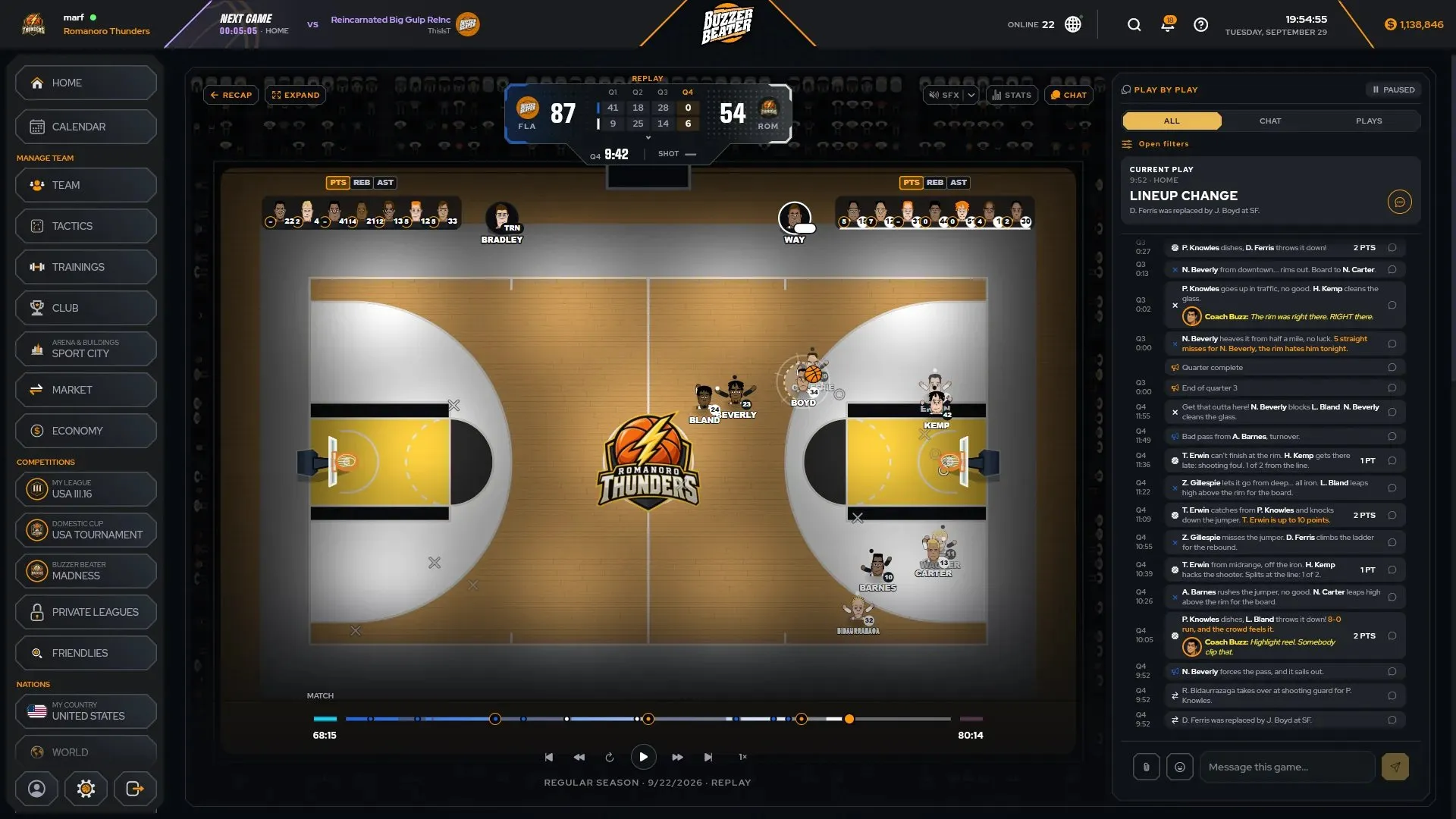
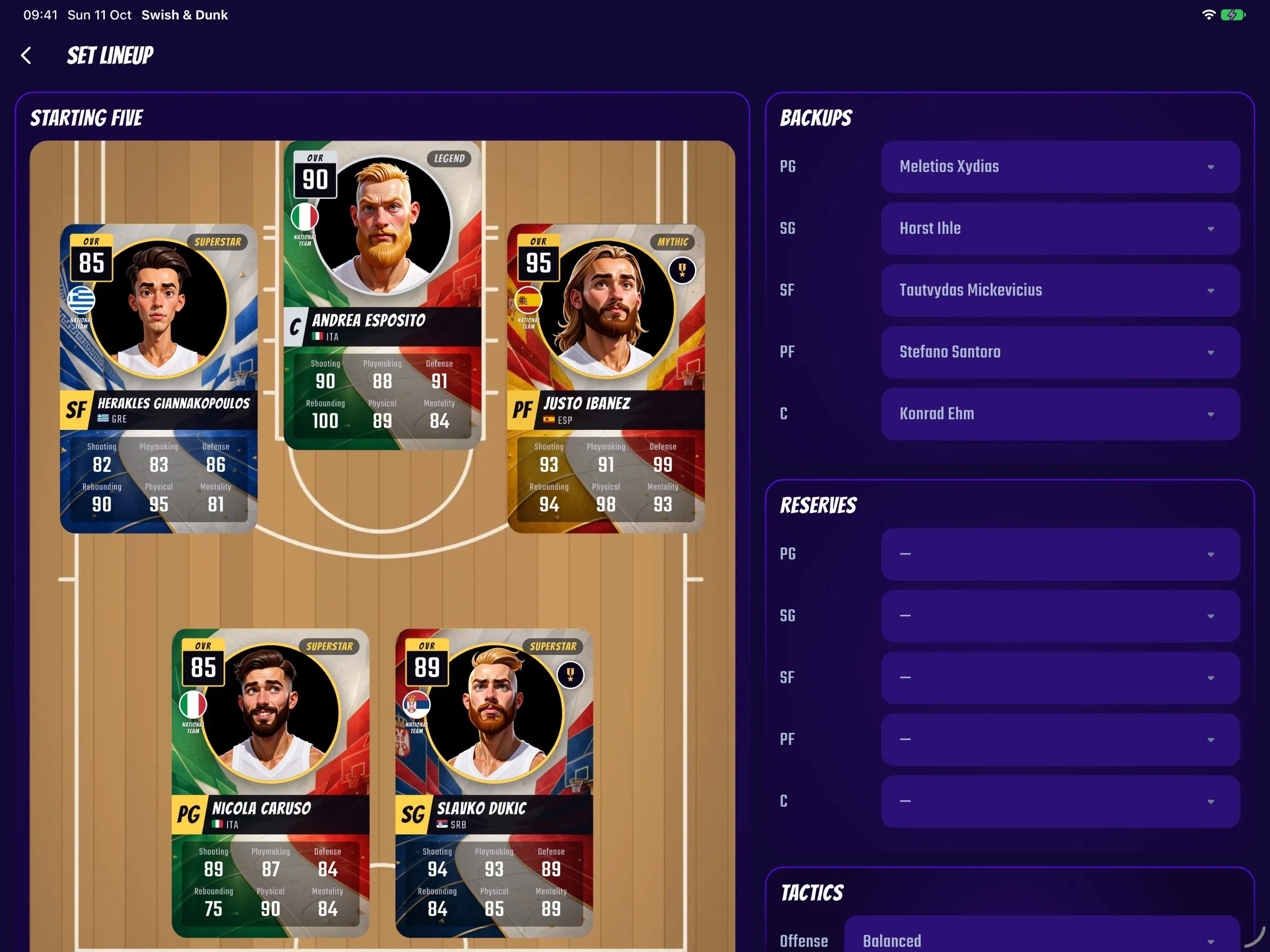
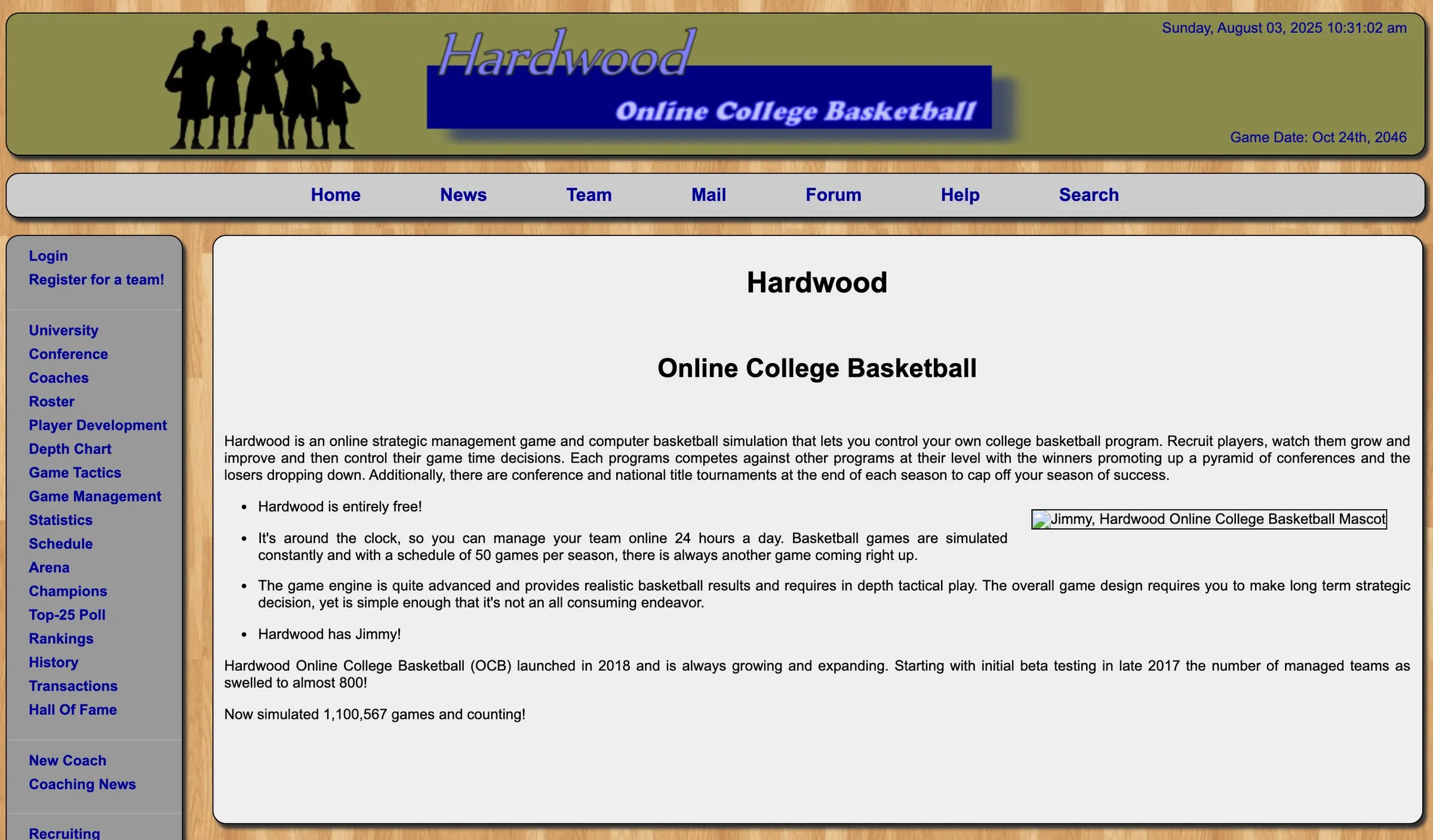
Online Basketball Manager
A young, card-styled online basketball manager with real tactical buttons and twenty languages, still waiting to prove the engine underneath.
Score
The verdict
Manager Factory’s browser and Android manager has the right building blocks: zones and a full-court press, training groups, auctions, divisions with relegation, instant matches. But there is no manual, no visible engine data, a missing terms page and a support record that leans on bans and refunds.
The good
- Four defenses, including 3-2 and 2-3 zones and a full-court press, plus three offenses and three paces
- A team shot-mix bar shows how your offensive choice changes the shot diet before tip-off
- Two training groups with their own focus, plus an auto-assign button for big squads
- Timed auctions with an Autobid button make the shared market a real competition
- Divisions with playoffs and relegation, a Team Cup and instant matches between league days
- Twenty site languages, including Arabic with a proper right-to-left layout and Japanese
- Free to start in a browser; on Google Play no ads are declared
The bad
- No public manual, rules page or engine documentation: you learn every system by playing
- Ratings in the official screenshots don’t share one scale (25, 48, 101 and a 150 ‘OVR’)
- In-app purchase contents aren’t listed anywhere public; Google Play shows only a price per item
- The terms link on the site returns ‘File not found’, and the privacy policy says passwords are MD5-coded
- Store reviews report a market glitch that froze funds and bans for shared or second accounts
- Only eight months old, with a single store version note and no public roadmap
Who it’s for
- Online managers who want zone defenses and a press without a long learning curve
- Players outside the English-speaking world who want a manager in their own language
- Collectors who enjoy card-style players and the hunt for high-potential teenagers
Who should skip it
- Simulation purists who want documented engines, box-score realism and real NBA data
- Anyone who shares a phone or network with a sibling who also plays
- Players who need clear terms and a published price list before they spend
There are, as of November 2026, at least two live basketball games that call themselves “Online Basketball Manager”, and both use the acronym OBM. This review is about the one at onlinebasketballmanager.org, built by the Austrian developer Manager Factory and published on Google Play as Online Basketball Manager. It is a classic online manager in the BuzzerBeater tradition: fictional players from all over the world, a shared transfer market, divisions with promotion and relegation, and a match engine that plays out on a 2D court. What makes it different is the wrapper. Players are glossy trading cards with star ratings, tactics are big friendly buttons, and the whole thing speaks twenty languages.
It is also very young, opaque and, in a few important places, unfinished. There is no manual, no public rules page, no published price list and, on the day we checked, no working terms of service. That combination of a smart tactical layer and a thin layer of trust is what this review is about.
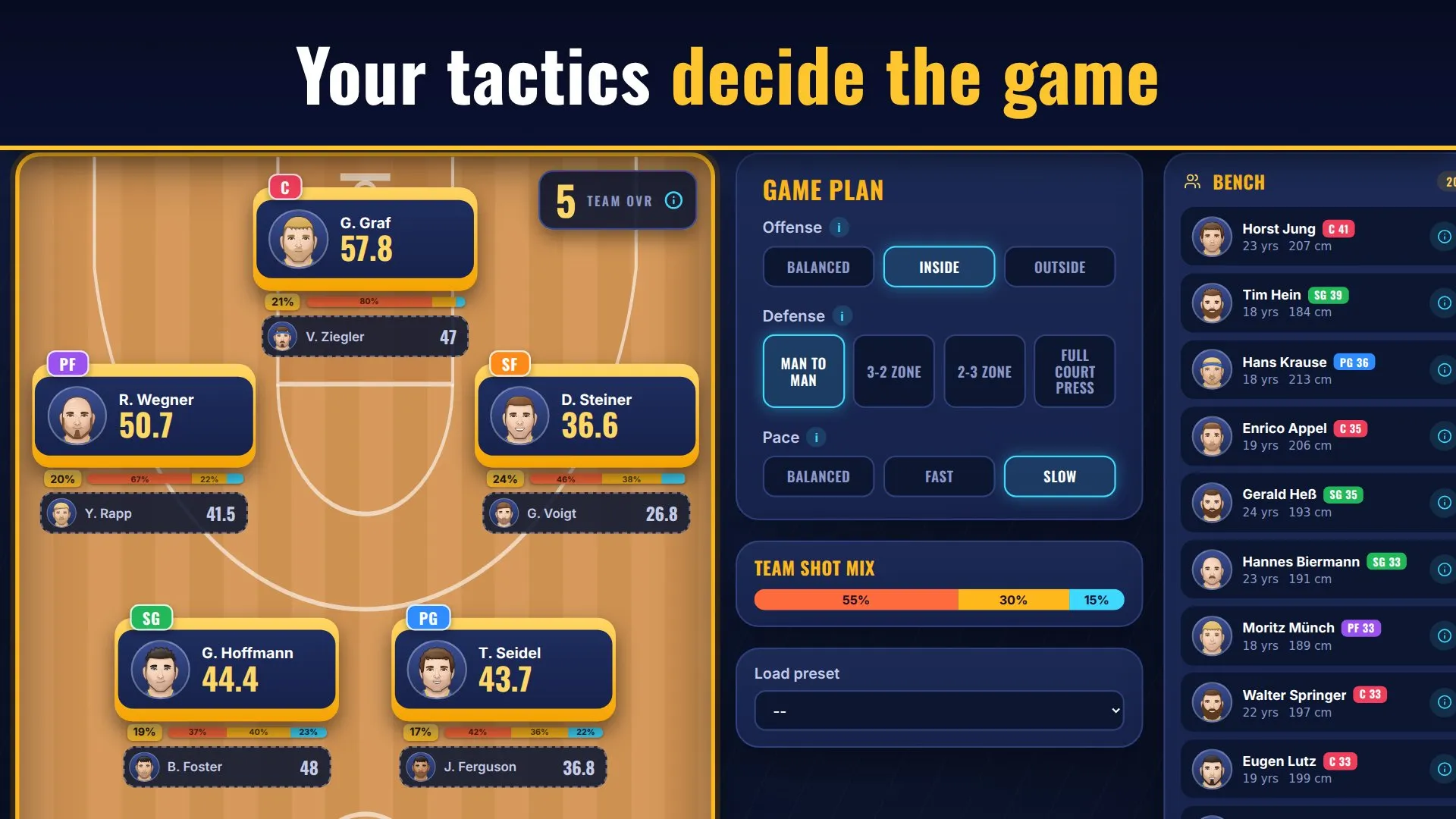
The most informative official image of the game. The “Inside” offense produces a 55/30/15 shot mix, the defense row offers two zones and a full-court press, and every starter has a backup under his card. Note the scale: starters rated 36.6 to 57.8 here, while other official screens show players rated over 100. Image: Manager Factory / Google Play.
The short version
- Play it if you want an online basketball manager with zone defenses and a press that you can learn in an evening, in your own language.
- Play it if you enjoy the card-collector side of management: scouting teenagers with star-rated potential and chasing them in timed auctions.
- Skip it if you need to understand an engine before you trust it. Nothing about how games are calculated is public.
- Skip it if you share a device or household with another player, or if you want published terms and prices before you spend money.
Which “Online Basketball Manager” is this?
Because the name is generic, it is worth being precise. We checked every candidate we could find on 14 November 2026:
| Game | Developer | Platforms | What it is |
|---|---|---|---|
| Online Basketball Manager (this review) | Manager Factory, Matthias Rosenthaler, Austria | Browser, Android | Fictional players, divisions, transfer auctions; Google Play 10K+ downloads |
| OBM: Online Basketball Manager | Alexander Dare (solo developer), playobm.com | Browser, iPhone | Real NBA rosters, 82-game seasons, Draft Battles; App Store app since 1 October 2026 |
| “Online Basketball Manager” on NewRPG | Not stated | Browser | An older text-based listing that mentions arena customization; we found no live link |
| OBM – Online Boxing Manager | onlineboxingmanager.com | Browser | A boxing game that uses the same acronym |
We picked Manager Factory’s game because it is the one actually published as Online Basketball Manager on a major store, with an exact-match domain and by far the largest visible player base: 10,000+ Google Play downloads and about 370 store reviews, against no US App Store ratings at all for playobm’s app. The two games share nothing but the name. If you landed here looking for the NBA-roster game at playobm.com, this is not it.
How we researched this review
We did not play Online Basketball Manager, and we won’t pretend we did. Everything past the landing page sits behind an account, and our rules forbid creating one. The Android app needs installing, which our rules also exclude.
What we could capture ourselves, we did, in desktop Chrome on 14 November 2026:
- the landing page in English, Italian, Arabic and Japanese, plus a phone-width version;
- the sign-up overlay (we opened it to see which fields it asks for, and submitted nothing);
- the public about, privacy and terms pages, the web-app manifest and the sitemap;
- the Google Play listing in the US, Philippine, Nigerian, British and Italian storefronts, including the “About this game” details, the Data safety page and every review the store would display.
On top of that we used the developer’s own material: the eight official Google Play screenshots, the official YouTube trailer and its description, and the store description. Domain registration data came from the public WHOIS of the .org registry. Every in-game image below is an official screenshot, credited as such; the landing-page images are our captures.
What we could not verify: how the match engine works, what in-app purchases buy, contract and salary rules, the draft format, how promotion between divisions works in numbers, and how many managers actually play. Where something is a developer claim rather than something we saw, we say so.
Who makes it
The Google Play listing names the developer as Manager Factory, with Matthias Rosenthaler as the contact, at an address in Klaffer, Upper Austria. The site’s “About us” page gives the same name as “Support and Programming”. The developer email on Google Play uses the domain of a sister game, Online Tennis Manager, which is also published by Manager Factory on Google Play, with 100K+ downloads and a 4.7 rating from 2.73K reviews when we checked. Online Tennis Manager carries both ads and in-app purchases; Online Basketball Manager declares only in-app purchases.
Two Google Play reviews hint at a wider family. One from April 2026 asks the developer to “bring back our online football manager”; another, with 19 people finding it helpful, asks for “a boxing manager game” next. We could not confirm a past football title from Manager Factory, so treat that as player memory, not fact.
The timeline of this particular game is short. The .org domain was registered on 24 March 2026, the Android app was released on 29 March 2026, and the current version is 1.28, dated 12 November 2026. That makes it an eight-month-old game. Its browser version and Android app point at each other: the site’s web-app manifest declares the Google Play app as its related application, so the two are meant to be the same service.
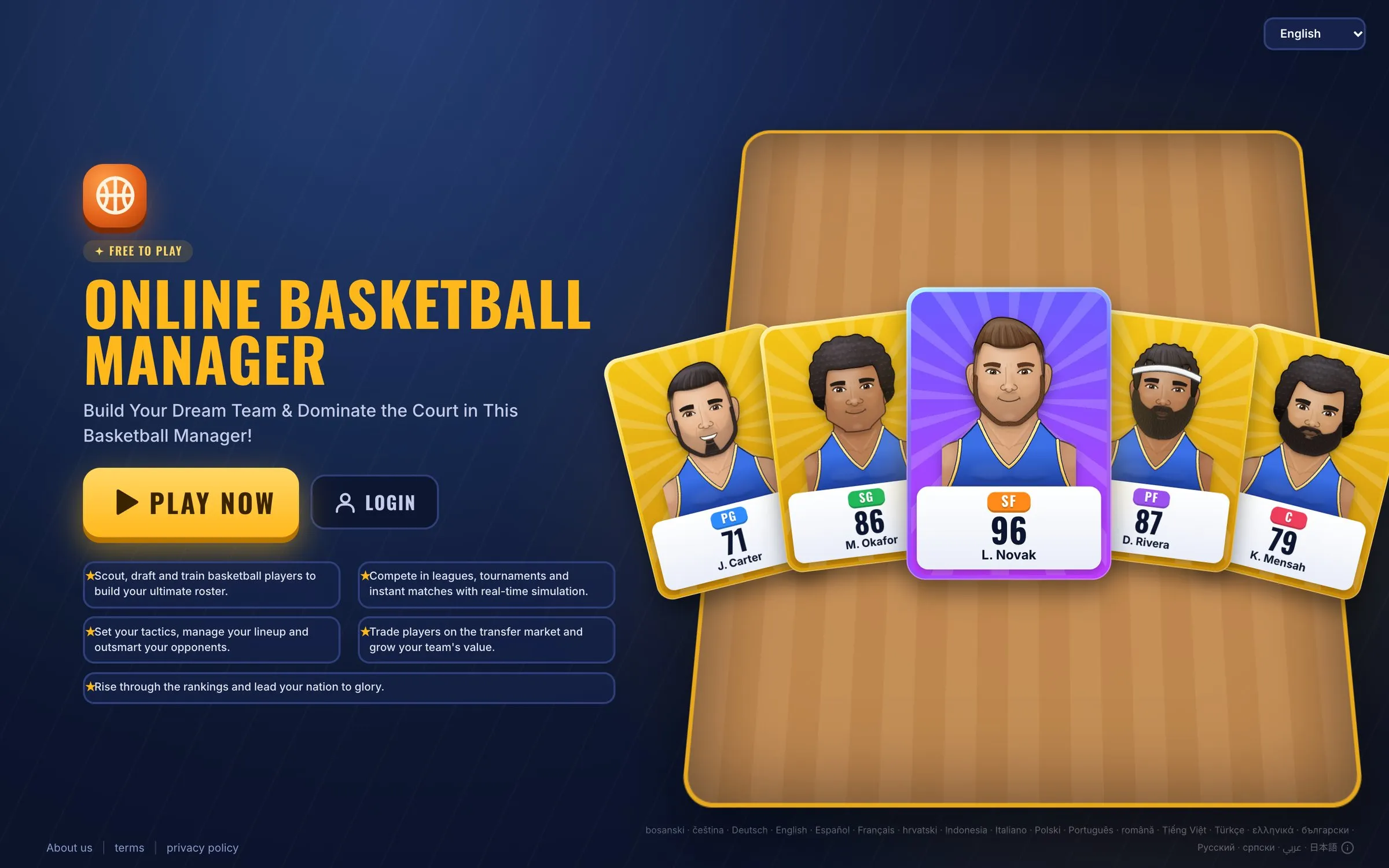 The public landing page, captured by us. The five cards are decorative and change on each visit (we saw a 96-rated SF in one load and a 99 in another). The faces are generated by the site itself rather than drawn by hand. Image: our capture.
A season, step by step
Without a manual, the shape of a season has to be pieced together from the developer’s own descriptions and screenshots. Here is what they establish:
- Create a team and choose a nation. The sign-up overlay asks for a player name and a password, with a nation pre-filled from your location and a “Change Nation” link. The store description says you then receive a squad whose players have skills in shooting, passing, rebounding, defense, speed and basketball IQ.
- Set your starting five and backups. You pick a starter for each of the five positions and a backup behind him. The tactics screen shows a team rating and a shot-share bar under each starter.
- Choose a game plan. Offense, defense and pace, with a preset you can load (more in the coaching section).
- Train. Players go into one of two training groups, each with its own focus, and a counter shows how many training sessions you have left.
- Play league games. The store text describes “a full season of matchdays” in a league system with multiple divisions. The top teams reach the playoffs; the bottom teams are relegated.
- Fill the gaps. Between matchdays you buy and sell on the transfer market, scout for talent, take part in the draft, hire staff and play instant matches, friendlies and the Team Cup.
- Climb. Rankings place you among managers worldwide and within your nation.
How long a season is, when matchdays are played, how many teams share a division, how many go up or down and when the draft happens are not published anywhere we could find. That is a real gap for an online manager: in this genre, the calendar decides whether a game fits your life.
The match engine
Online Basketball Manager is described as a real-time simulation. The official screenshot titled “Outplay real managers in live matches” shows a full 2D court seen from above, players as round portrait markers with position tags, a “+2” bucket animation at the rim and a score bar reading 100-99 with 31 seconds left in the fourth quarter. The landing page promises “instant matches with real-time simulation”. The developer’s YouTube description goes further, promising “Live Tactical Decisions: Change your formation, rotations and strategy while games are being simulated in real time.”
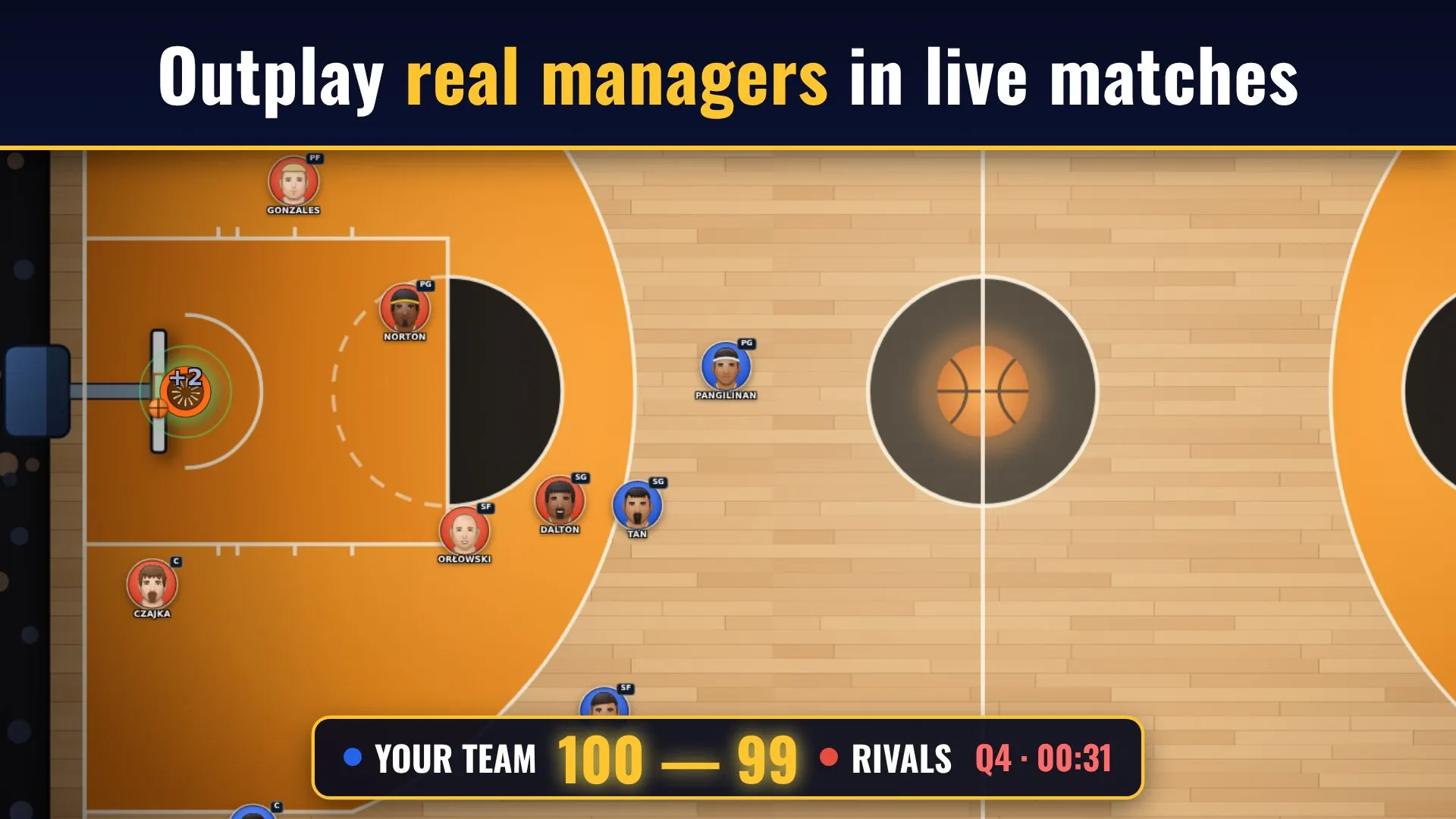 The live 2D view: portrait markers with position tags, a scoring animation at the rim and a clutch-time score bar. It is a marketing image, so the 100-99 finish is chosen, not typical. Image: Manager Factory / Google Play.
That is the extent of what is public. We found no explanation of whether the engine resolves every possession, how ratings feed shots, whether fatigue or fouls exist, or how home court works. The only box-score line in the official screenshots is a player’s league stats against a team called Iron Valley: a 108-47 win in which one shooting guard played all 48 minutes and scored 26 points with 12 assists, 7 steals and 5 turnovers. That is a single, promotional data point, and a 61-point margin with a starter playing every minute is not the kind of thing a realism-focused engine usually produces. It may be an early-season mismatch between a strong human team and a weak computer one. We can’t tell, and that is the problem.
What the screens do show is a reasonably rich stat sheet. The player page tracks points, assists, rebounds, steals, blocks, turnovers, field goals, threes and minutes for every league game, with totals and averages. The store text adds “detailed statistics covering points, assists, rebounds, steals, and blocks for every player across all league matches.” There are no advanced metrics in any screen we saw.
Known engine complaints. We found none in the reviews the store displays, positive or negative, which mostly talk about the market, bans and the game in general. That silence is itself telling: there is not yet a community large or vocal enough to stress-test the engine in public.
Coaching and tactics
This is the strongest part of Online Basketball Manager, and the official tactics screen shows it in detail.
The game plan panel has three rows:
- Offense: Balanced, Inside, Outside.
- Defense: Man to man, 3-2 zone, 2-3 zone, Full court press.
- Pace: Balanced, Fast, Slow.
Each row has an information button, and a Load preset menu suggests you can save combinations and switch between them. Underneath sits a team shot mix bar. With the Inside offense selected, it reads 55%, 30% and 15%: a picture of how your choice reshapes the shot diet before a game is played. That is a genuinely useful piece of design. Most online managers ask you to trust that “inside” means inside; this one shows you the consequence.
Lineups. Each of the five starters has a card with a rating to one decimal place (57.8, 50.7, 44.4 and so on) and a backup beneath him with his own rating. Above each backup is a small bar with percentages, such as 21% next to an 80/… split, which appears to describe that player’s share and type of shots. We are reading those bars from a screenshot, not from documentation, so take the interpretation with care. A team OVR badge sits in the corner.
In-game changes. The developer says you can change formation, rotations and strategy while a game is being simulated. We have not seen it, but it is the claim that sets the game apart from most online managers, where tactics are locked before tip-off. If it works as described, it puts Online Basketball Manager in the small group with TopGM Online that lets you coach live.
What is missing compared with the best of the genre:
- No named systems. BuzzerBeater offers ten offensive and seven defensive systems; Swish & Dunk (disclosure: developed by our founder) has fifteen offenses and eight defenses. Here you get three and four.
- No playbook and no player instructions. TopGM Online lets you draw a play. Nothing here suggests you can tell a specific player to shoot more or guard someone in particular.
- No minutes control. You set a starter and a backup per position; there is no visible minutes target or rotation depth beyond that.
- No matchup tools. There is no indication you can prepare for a specific opponent beyond choosing a preset.
For a game that sells itself on “Your tactics decide the game”, that is a compact toolkit. But it is a well-chosen one. Zone and press defenses are the two tactical levers that matter most in a basketball simulation, and many larger games still don’t have both.
Players and ratings
Players are fictional and international. The official screenshots show flags from Lithuania, Nigeria, Colombia, the United States, the Philippines, Bosnia and Herzegovina, Afghanistan and Egypt, and names written in Latin, Cyrillic and Arabic script. Faces are generated cartoons in the same style throughout.
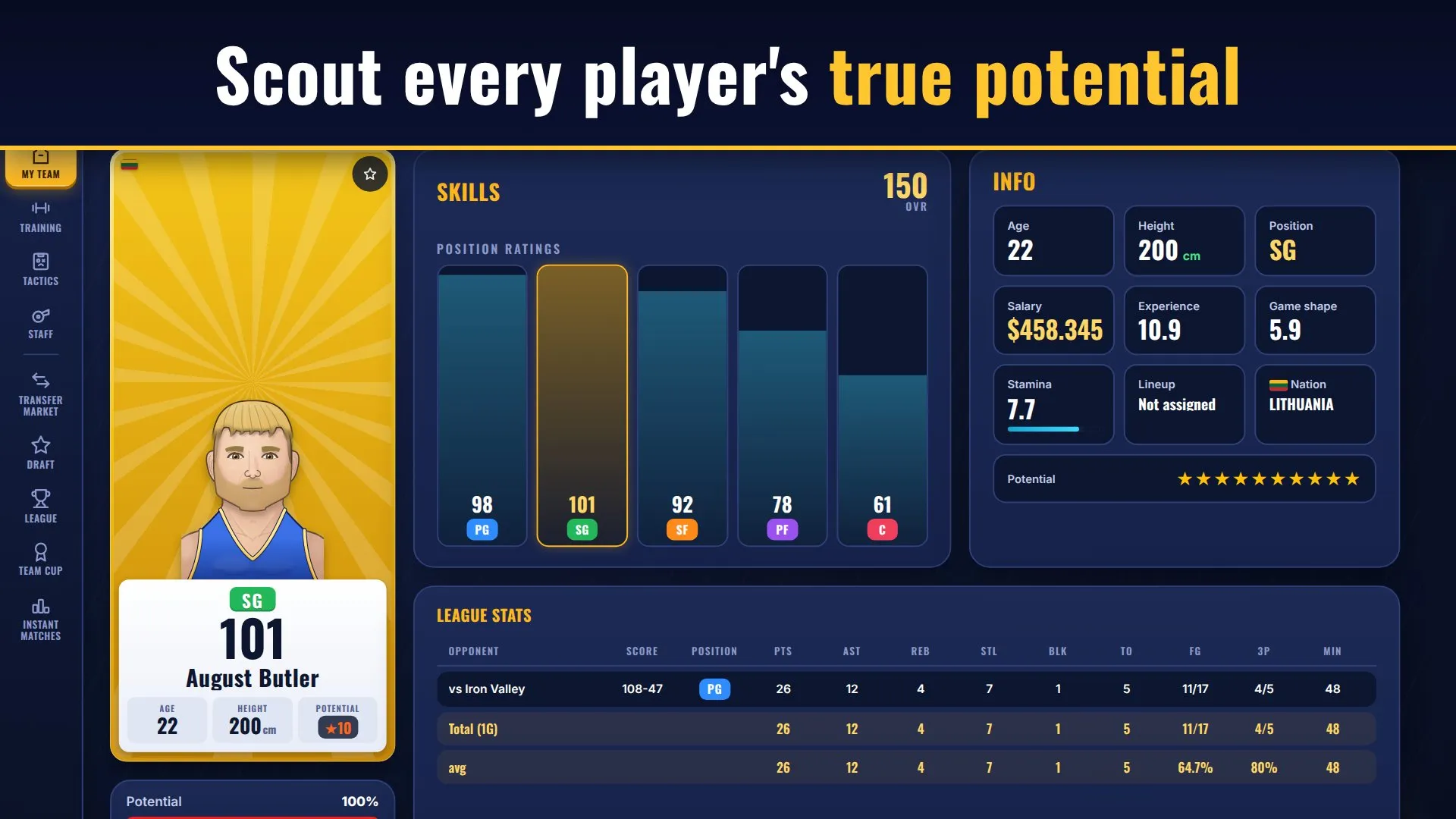 A 22-year-old Lithuanian shooting guard rated 101 on his card, with separate ratings for each position (PG 98, SG 101, SF 92, PF 78, C 61) and a full ten-star potential. The panel above calls him “150 OVR”: the official images don’t agree on one scale. Image: Manager Factory / Google Play.
The player page is where the model is clearest:
- A rating for each position. Our example shooting guard is 98 at point guard, 101 at shooting guard, 92 at small forward, 78 at power forward and 61 at center. That is a sensible way to show positional versatility, and it matters because the lineup screen asks you to fill five positions.
- Physical and condition values. Age, height, stamina (7.7 in the example), game shape (5.9) and experience (10.9).
- Potential as stars. Up to ten stars, also shown as a percentage. The screenshot titled “Scout every player’s true potential” suggests scouting reveals it.
- Contract and nation. A salary ($458.345 in the screenshot, written with a European thousands separator) and a nation.
The scale problem. Across the official images, ratings don’t seem to live on one scale. The training screen lists squad players at 32 to 58; the tactics screen shows starters between 36.6 and 57.8; the “Build a squad of superstars” image shows eight 22-to-24-year-olds rated 84 to 101; the profile above says “101” on the card and “150 OVR” in the skills panel. These may be different views of different teams at different stages, and the 150 may be a sum rather than an overall. Without documentation we can’t say. What we can say is that a new manager will have to work out the scale by trial and error.
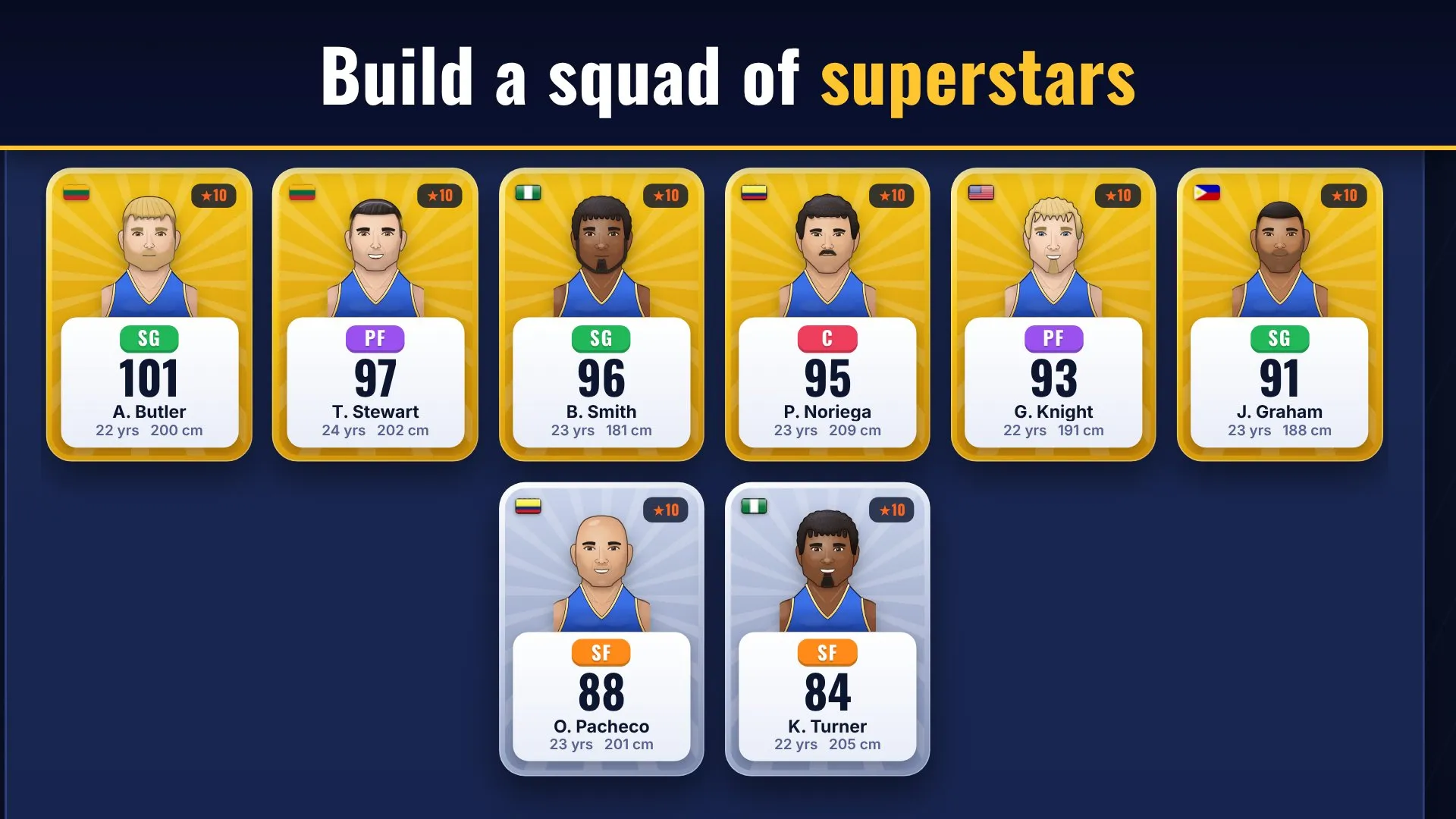 “Build a squad of superstars”: eight cards rated 84 to 101, all aged 22 to 24, all with ten-star potential, from five countries. Gold and silver frames suggest rarity tiers, which the game never explains publicly. Image: Manager Factory / Google Play.
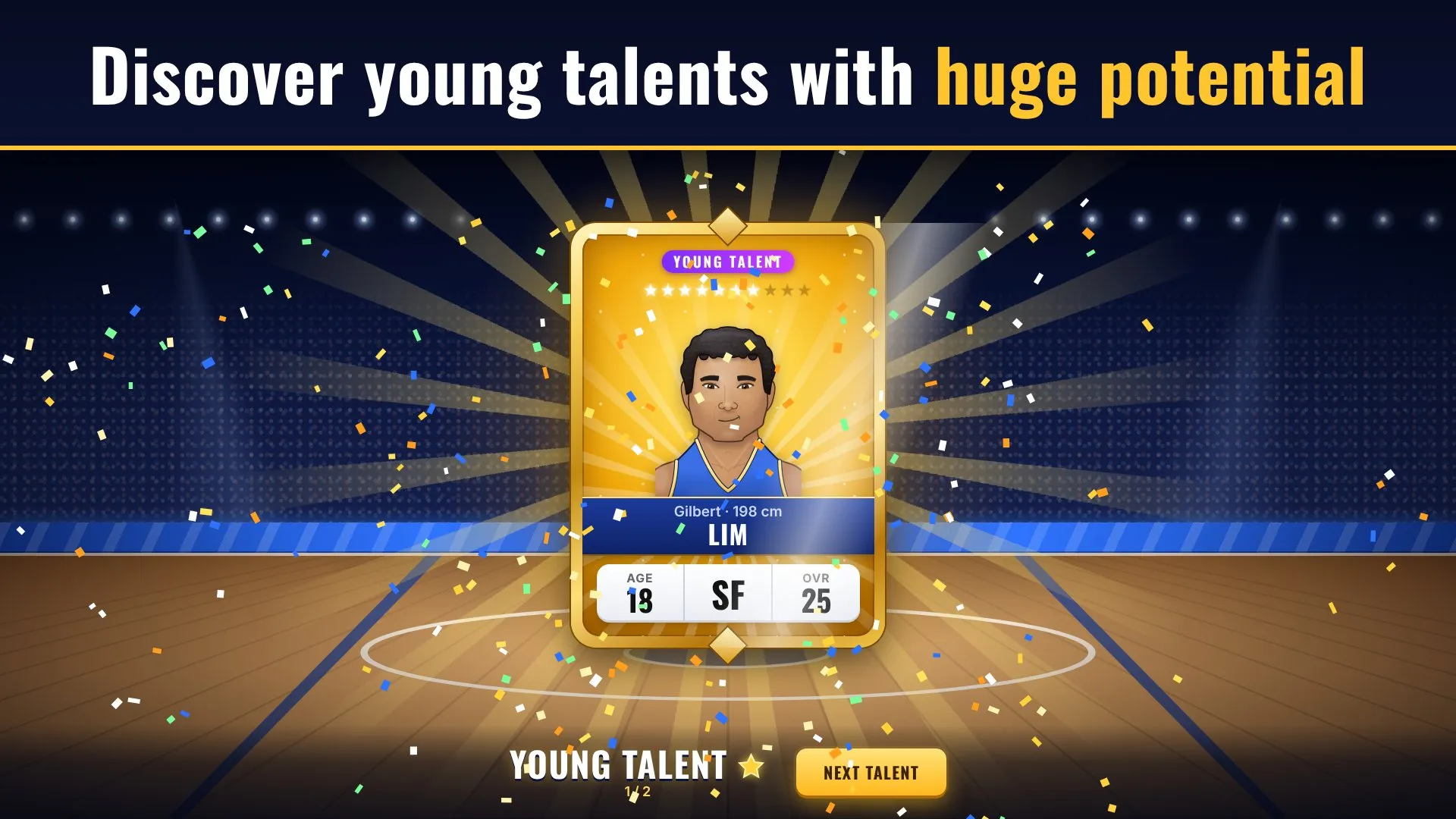 The “young talent” reveal: an 18-year-old small forward rated 25 overall but with seven of ten potential stars. The game sells development as a slow bet on teenagers. Image: Manager Factory / Google Play.
Development. The training screen shows a progress table with each player’s overall, the percentage to his next level and the change over one day, seven days or thirty days. Players go into Group A or Group B, each with a focus chosen from a menu (both are on “Outside Def” in the screenshot), and an Auto assign button sorts the unassigned. A counter reads “8 / 8” available trainings next to a Start Training button, which implies training is a limited, recharging resource. Group sizes in that screenshot are 14 and 13, plus 3 unassigned: a 30-man squad, far bigger than the 12 to 15 players of a real roster. Staff, according to the store text, provide training bonuses.
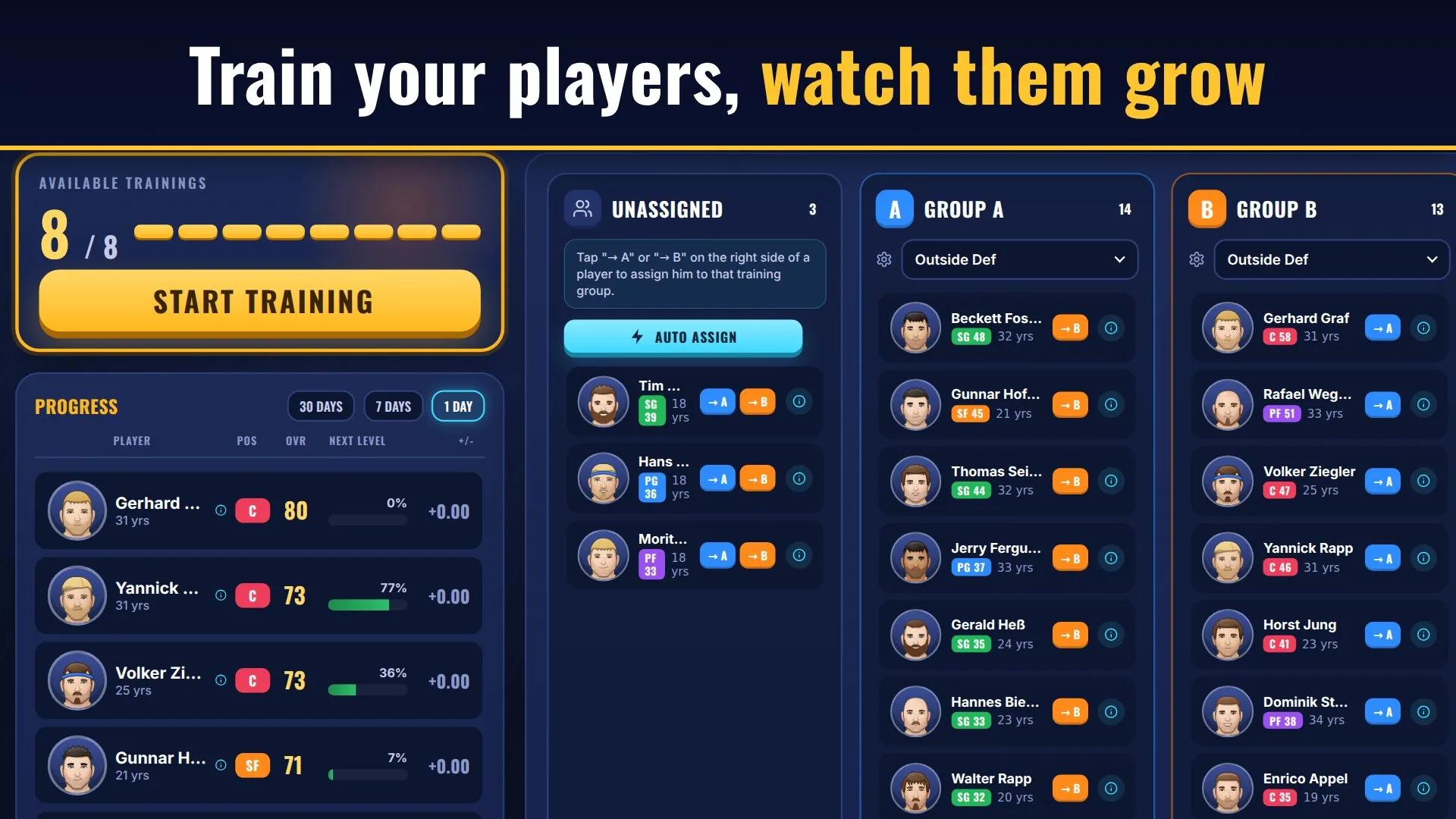 Training in groups: two squads of 14 and 13 players with their own focus, three unassigned, and a counter of eight sessions. The progress column shows each player’s percentage to the next level. Image: Manager Factory / Google Play.
What we could not find: injuries, aging and decline, retirement, morale and chemistry. Stamina and “game shape” suggest a condition system, but how it works is not published.
The front office
Online Basketball Manager is a transfer-market game, not a cap-and-trade one.
The market. The official screenshot titled “Outbid rivals on the transfer market” shows a grid of player cards with rating, position, age, height, star potential, a price (from $3,511,000 to $14,035,000 in the screenshot) and a countdown (from 14 minutes to 1 hour 41 minutes). Each card has a bid field pre-filled one step above the current price and two buttons: Bid and Autobid. So the market is a timed auction between managers, with a proxy-bidding option that bids for you up to a limit. That is the model BuzzerBeater made standard, and it makes the market a competitive space rather than a shop.
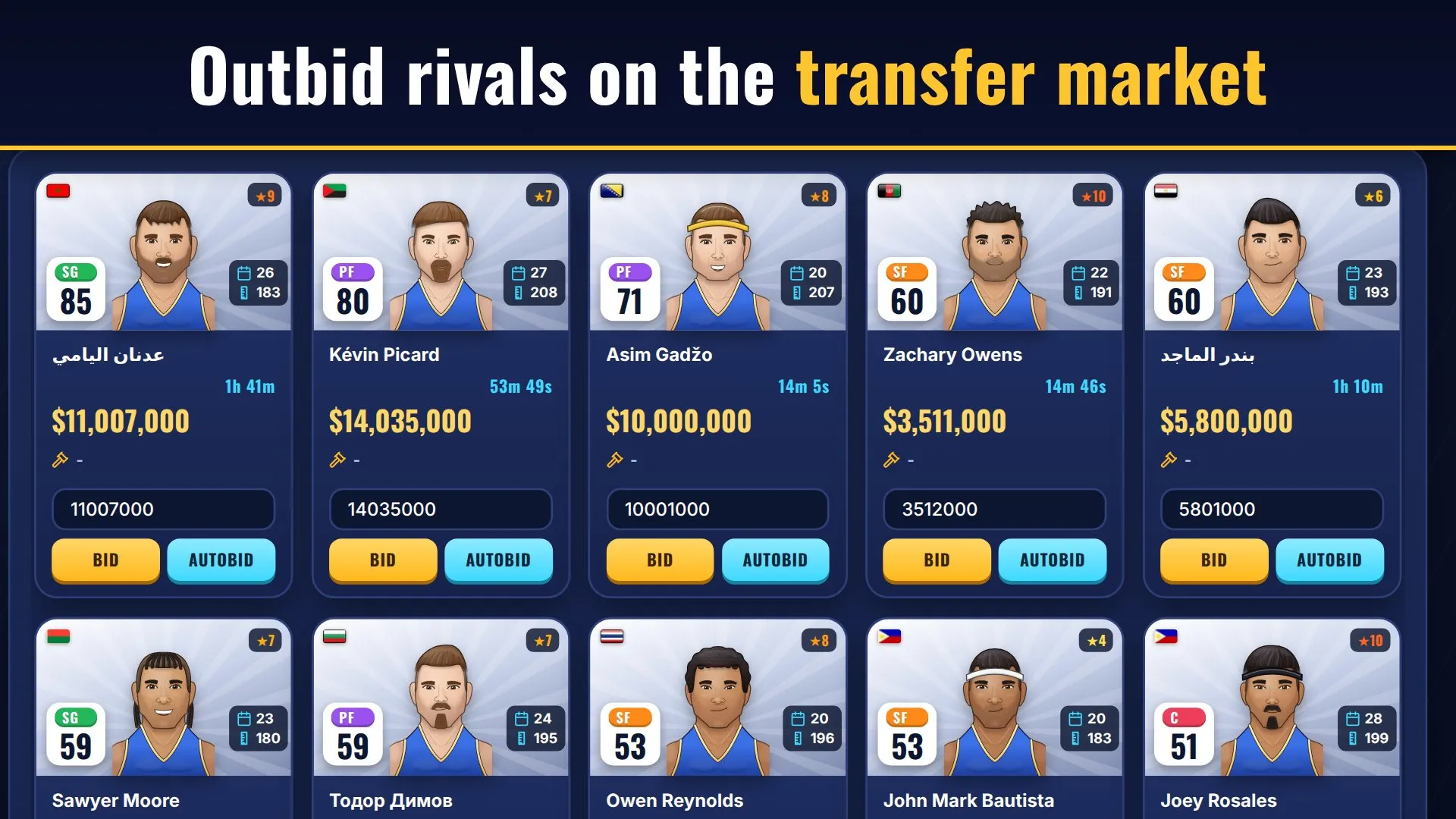 Timed auctions on a shared market: each card shows rating, star potential, age, height, price and time left, with Bid and Autobid. Note the price spread: an 85-rated guard at $11.0M, a 60-rated forward at $3.5M. Image: Manager Factory / Google Play.
Money. The store text says you balance a budget “between salaries, transfers, and investments”, which puts the game in the budget family with BuzzerBeater, BasketVibe and Swish & Dunk. There is no salary cap, no luxury tax and no rookie scale, and none of the NBA’s contract machinery. The developer’s trailer description mentions improving “your arena and training facilities to increase income”, so facilities feed revenue. Sponsors, ticket prices and merchandising are not mentioned anywhere public.
Contracts and trades. The store text promises you can “negotiate deals”, and the trailer description says “negotiate trades”. We saw no trade screen, contract-length option or negotiation interface in any official image, so we can’t describe how it works.
The draft and scouting. The store text says you “participate in the draft to recruit promising young players” and use a scouting system to find “hidden gems”. Draft is a menu entry in the official screenshots. The draft format, the number of rounds and how picks are ordered are not public.
Staff. “Recruit coaching staff and support personnel”, says the store text, with “training bonuses, scouting advantages, and tactical improvements.” Staff is a menu entry. No details.
Owner and board. None mentioned. There is no indication you can be fired.
For a front office, that is thin on rules and thick on activity: lots to do, little to read about how it works.
World and longevity
Competitions. The menu in the official screenshots lists My Team, Training, Tactics, Staff, Transfer Market, Draft, League, Team Cup and Instant Matches. The store text adds league divisions with playoffs and relegation, friendlies and rankings by nation. That is a respectable competition set for an eight-month-old online game.
Instant matches are the newest piece. Version 1.28 on 12 November 2026 brought “new instant match league system”, the only release note on the listing. The official screenshot shows a pool of 10 instant matches, a ranking table where three teams sit at 679th to 681st with three wins each, and a team-strength radar with axes such as Outside Defense and Offensive Flow. With 681 places on the ladder in a marketing image, the instant-match ranking already looks large, although we can’t tell whether those are human teams.
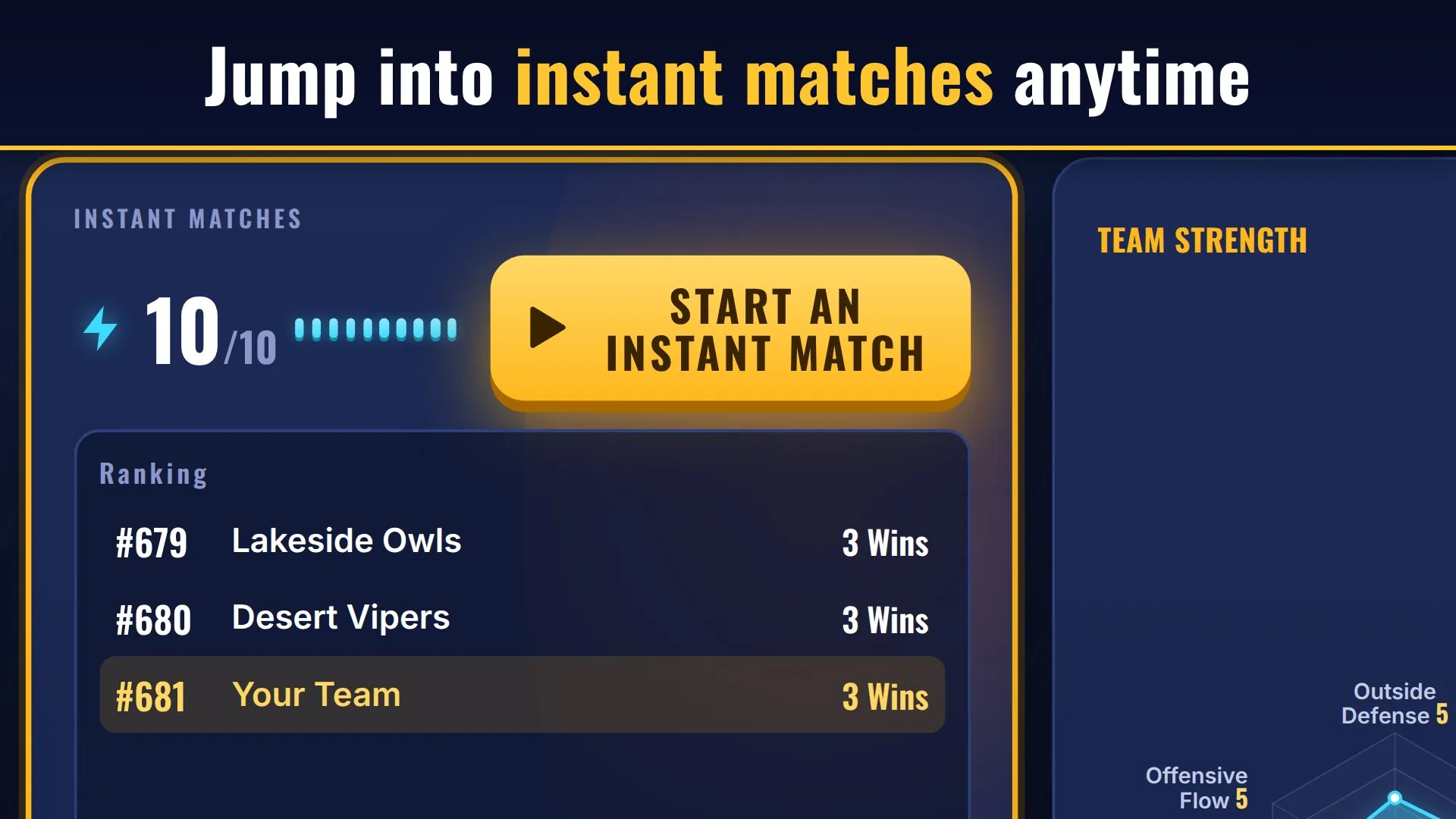 Instant matches run on a pool of ten (shown as 10/10), with a separate ranking. The team-strength radar on the right rates your side on axes like Offensive Flow and Outside Defense. Image: Manager Factory / Google Play.
Licences and data. Everything is fictional: players, teams, faces. No real names, logos or leagues, and therefore no licensing questions.
History, records, editor. None documented. There is no editor or modding, which is normal for an online manager.
Saves. Your team lives on the developer’s servers; there is nothing to save locally.
How long can you play? Online managers live or die by whether the developer stays. Manager Factory’s tennis game is the strongest argument in its favor: a sister title with 100K+ downloads and a 4.7 rating suggests a developer who maintains online games over time. The counter-arguments are the game’s age and the absence of any public roadmap. The site’s own files were updated during our visit (stylesheets stamped 29 October and 14 November 2026, the script bundle 12 November), so it is clearly being worked on right now.
Interface, platforms and performance
Browser. The landing page is modern, fast and responsive. At phone width it stacks into a single column with large Play Now and Login buttons. Switching to Arabic mirrors the entire layout right-to-left, which many larger games still get wrong.
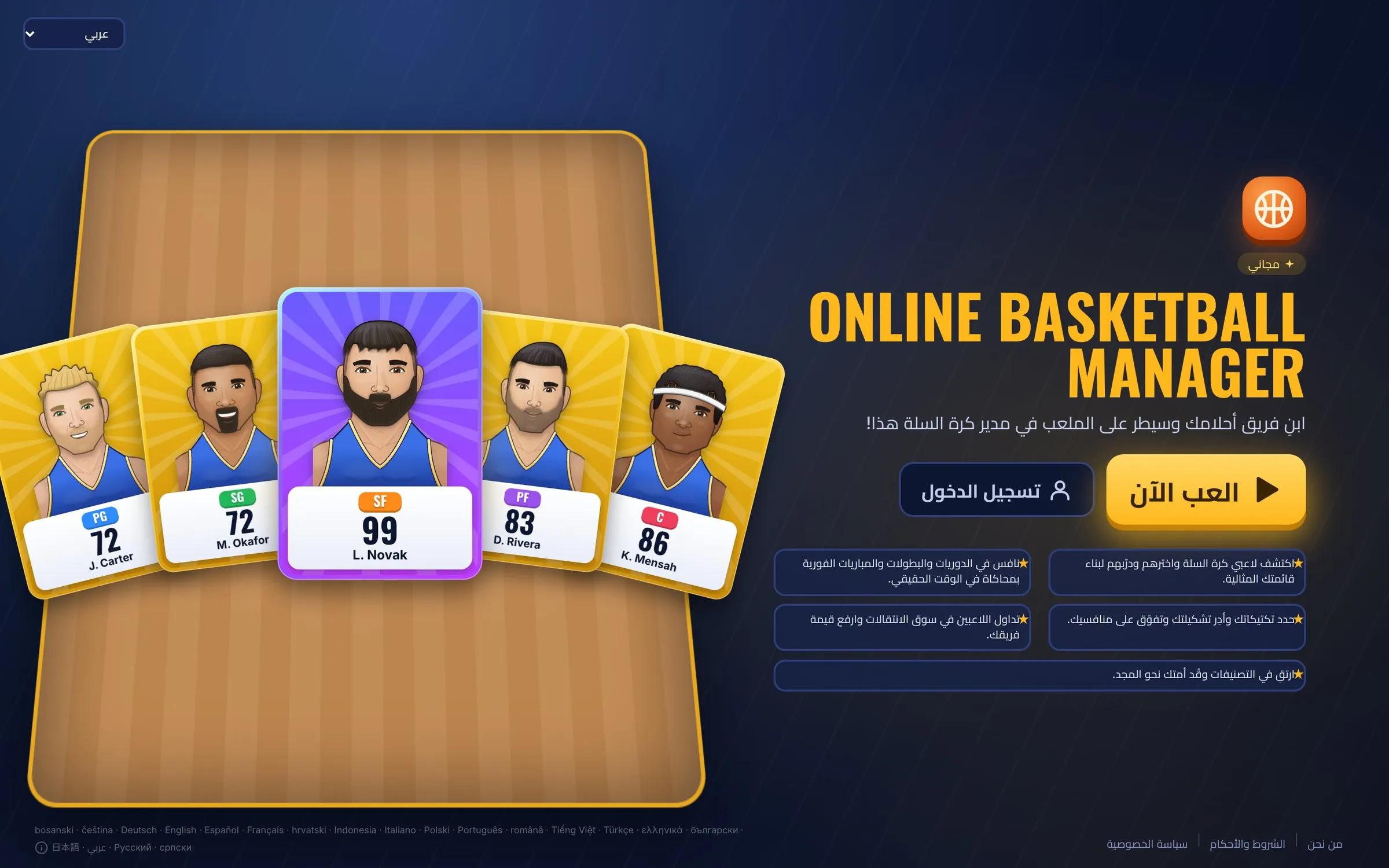 The Arabic landing page mirrors the whole layout: cards on the left, text and buttons on the right. A small detail that says the translations are more than machine-pasted strings. Image: our capture.
Languages. The site’s language menu and its sitemap list twenty languages: Bosnian, Czech, German, English, Spanish, French, Croatian, Indonesian, Italian, Polish, Portuguese, Romanian, Vietnamese, Turkish, Greek, Bulgarian, Russian, Serbian, Arabic and Japanese. The Google Play description says “16+ languages”, which is out of date rather than wrong.
Android. The Google Play app requires Android 7.0 or later and is rated Everyone in the US and PEGI 3 in Europe, with the “Users Interact” flag. The site’s manifest names the Android app as its related application and asks to run in landscape orientation. There is no iOS app: a search of the App Store found nothing from Manager Factory.
Accounts and offline play. You need an account. The sign-up overlay asks only for a player name, a password and a nation; no email field appeared. The privacy policy says email is optional and used for login details, password resets and inactivity notices. There is no offline mode.
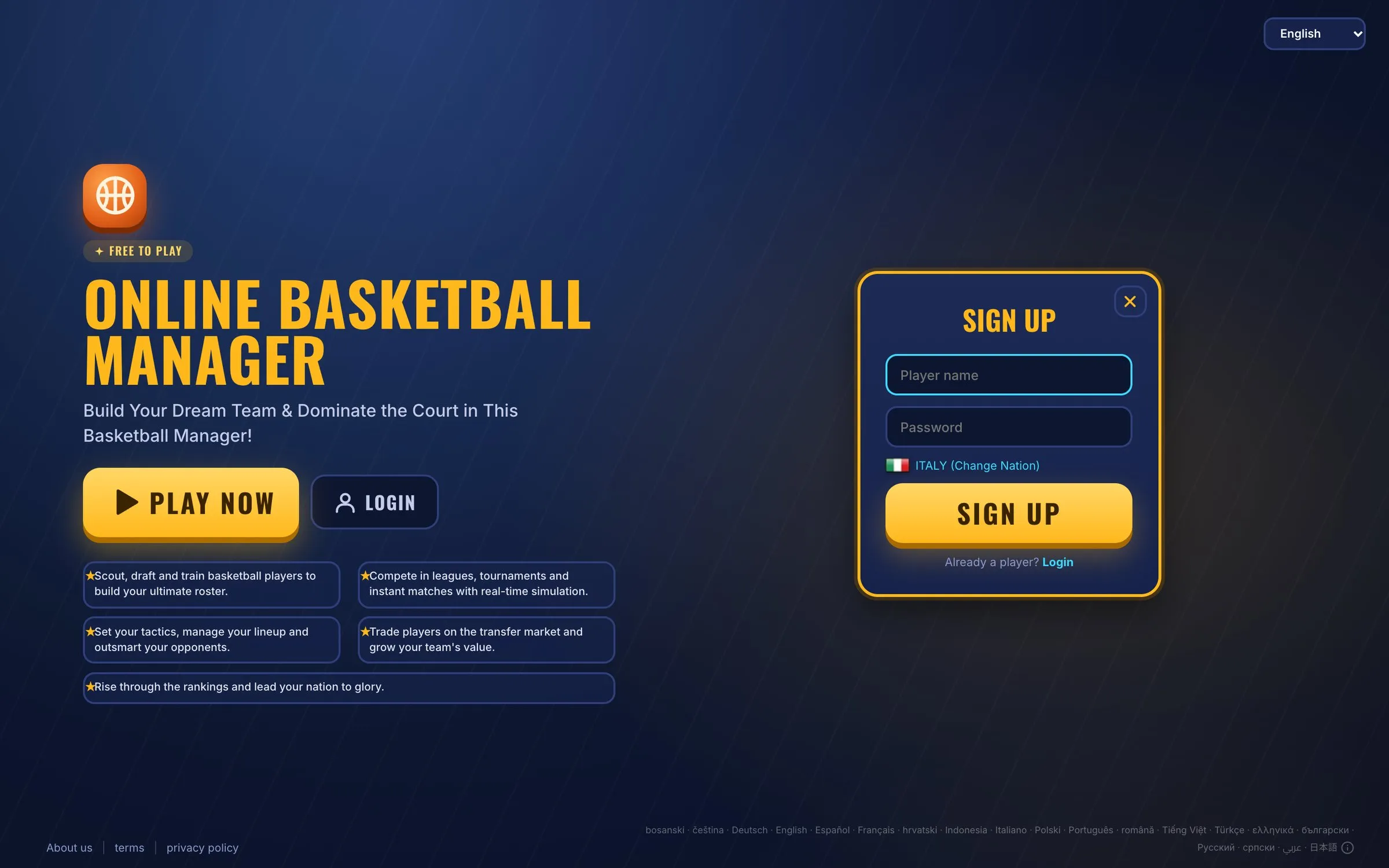 The sign-up overlay, which we opened but did not submit: a name, a password and a nation pre-filled from our location. Quick, but with no email you have little to fall back on if you lose access. Image: our capture.
Performance. We can’t speak to in-game speed. The landing page loaded quickly in our tests.
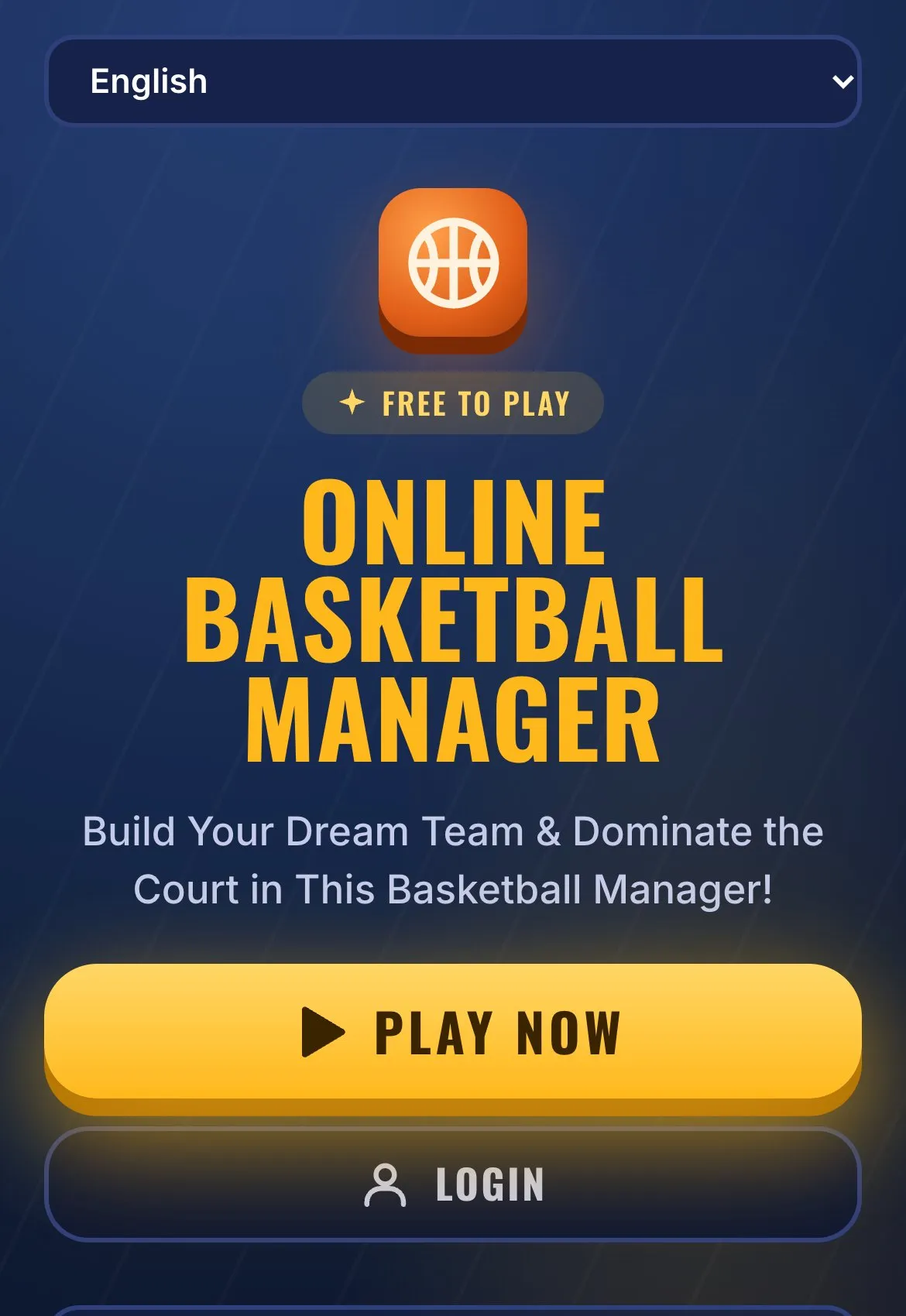 At phone width the landing page becomes a single column with oversized buttons. Image: our capture.
Monetization, line by line
Online Basketball Manager is free to start, in a browser and on Android. Google Play lists in-app purchases but does not declare ads; the sister tennis game declares both. Here is everything public about prices on 14 November 2026:
| Where | What is shown | What it buys |
|---|---|---|
| Browser | Free to play; no price list on the site | Unknown |
| Google Play, United States | In-app purchases, $9.49 per item | Not listed |
| Google Play, United Kingdom | £7.99 if billed through Play | Not listed |
| Google Play, Italy | €9.99 if billed through Play | Not listed |
| Google Play, Philippines | ₱199.00 per item | Not listed |
| Google Play, Nigeria | ₦2,999.00 per item | Not listed |
| Ads | Not declared on Google Play | — |
| Subscription | None visible | — |
Google Play shows one price per storefront, which usually means either a single product or the range collapsing to one value; we can’t tell which. The landing page, store text and screenshots never mention a currency, a premium membership or what money unlocks. One review from June 2026 seems to mention in-game money, but it is too garbled to quote as evidence.
Fairness verdict. We can’t give one, and that is the verdict. In a shared online world, the question that matters is whether money buys players, training or market advantage over other managers. The game shows a counted training pool (8/8) and a counted instant-match pool (10/10), the kind of limits that free-to-play games often let you refill for money. Nothing public says whether this one does. Until Manager Factory publishes what its in-app purchases contain, treat the game as possibly pay-to-win and spend accordingly.
Privacy. The Google Play Data safety page says the app may share device IDs and app interactions with third parties and collects approximate location, encrypts data in transit and allows deletion requests. The site’s privacy policy names Google Analytics and the Google Ads remarketing tag, and the landing page loads Google’s analytics script. The same policy says passwords are “saved md5 coded”. MD5 has been considered unsuitable for storing passwords for many years; if the policy is current, use a password you don’t use anywhere else.
Update history
| Date | What changed | Source |
|---|---|---|
| 24 March 2026 | onlinebasketballmanager.org registered | .org registry WHOIS |
| 29 March 2026 | Android app released on Google Play | Google Play “Released on” |
| April 2026 | First dated store reviews, positive and negative | Google Play reviews |
| 26 August 2026 | Developer replies to ban complaints: multi-account policy | Google Play developer replies |
| 17 October 2026 | Developer refunds a player after a market glitch | Google Play developer reply |
| 29 October 2026 | Site stylesheet updated | Asset version stamp on the landing page |
| 1 November 2026 | Official “First Impressions” trailer on YouTube (85,212 views by 14 November) | YouTube |
| 12 November 2026 | Version 1.28: “new instant match league system”; site scripts updated | Google Play, asset version stamp |
| 14 November 2026 | Main site stylesheet updated on the day of our visit | Asset version stamp |
There is no public changelog and no roadmap. Version 1.28 after eight months suggests frequent small releases on Android, but Google Play shows only the latest note.
What players say
Google Play is the only place we found player opinions. Ratings depend heavily on where you look, because Google Play shows regional averages:
| Storefront | Rating | Reviews counted |
|---|---|---|
| United States | 3.5 | 377 |
| Philippines | 4.4 | 366 (287 five-star, 27 one-star) |
| Nigeria | 4.3 | 366 (231 five-star, 18 one-star) |
| Europe (our session from Italy) | 4.8 | 8 |
The written reviews split into clear clusters.
Positive, mostly short. “Best basketball Manager app for sure and has great potential” (Google Play, 9 November 2026). “Nice Game, keep doing your best to improve it” (9 April 2026, ten people found it helpful). Several others simply say “good game” or “this game is awesome”.
Negative, more specific. “Worst basketball manager I ever played” (5 April 2026, ten helpful votes), from the game’s first week. A review from 10 October 2026 reports that “the transfer market glitched, freezing 7M of my currency” and that nobody answered on Discord; the developer replied a week later: “I already refunded you the amount ;-)”. A review from 25 August 2026 calls the operators “scammers” for banning an account; the developer answered that the “admin only bans if you have multi accounts”. A second player wrote that the only way to reach the admin about a login problem was to open another account, said the second account was his sibling’s, and asked for his main team to be unbanned.
What it adds up to. The players who like it like it a lot, and say so briefly. The players who don’t point at the operation, not the basketball: the market, bans and support. The developer does reply, but with a winking “;-)” that may read as friendly to some and dismissive to others. Nobody, in either direction, talks about the engine or tactics, which suggests most of the player base is casual.
Known issues and bugs
- Transfer-market funds frozen. Reported on 10 October 2026, refunded by the developer on 17 October. We don’t know whether the underlying bug is fixed.
- Bans for multiple accounts, including households. The developer bans multi-accounting. One player says the only way to reach the admin after a login problem was to open another account, and that a ban linked to a sibling’s account cost him his main team. There is no published appeals process.
- No working terms of service. The “terms” link at the bottom of the landing page returned “File not found” during our visit, so the rules of the service are not public.
- A typo in the support address. Google Play lists the support email as admin@onlinebasketballmanger.org, with “manger” instead of “manager”. Use the address in the privacy policy instead.
- Outdated store text. Google Play says “16+ languages”; the site offers twenty.
- Rating scales that don’t match across official screenshots (see the players section).
- Password storage. The privacy policy says passwords are stored MD5-coded.
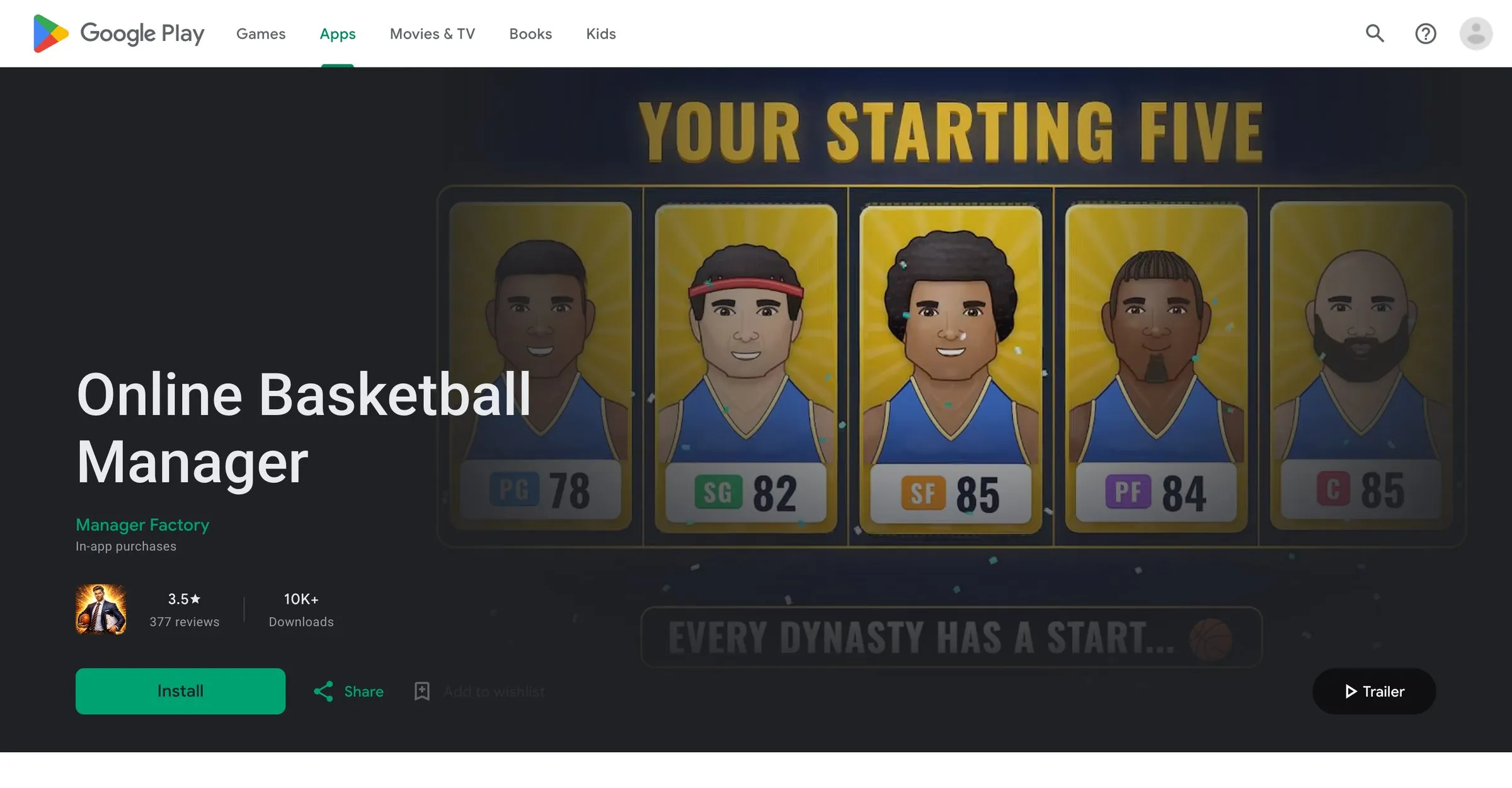 The US Google Play listing on 14 November 2026: 3.5 stars from 377 reviews and 10K+ downloads. In the Philippines and Nigeria the same app shows 4.4 and 4.3. Image: our capture of Google Play.
Tips for your first season
These come from the developer’s own screens and store text and from what players report, not from our own play:
- Check your nation before you sign up. It is pre-filled from your location, and rankings group managers by nation. Use “Change Nation” if it is wrong.
- Never open a second account, even to contact support or for a sibling on the same network. The developer bans multi-accounting, and players report losing their main team.
- Use the shot-mix bar to choose your offense. It shows how Inside, Balanced and Outside change your team’s shot distribution before you commit. Match it to who can actually shoot.
- Try the zones and the press early, in friendlies rather than league games. They are the deepest tactical levers in the game.
- Save game plans as presets. The Load preset menu suggests you can switch between plans quickly; build one for strong opponents and one for weak ones.
- Keep both training groups busy and spend your training sessions. The counter suggests they are limited and recharge; unused sessions are wasted.
- Read potential stars, not just overall. The game pushes teenagers with high star potential and low ratings. They are the long-term value on the market.
- Set Autobid limits you can afford. Auctions run on countdowns, so proxy bidding saves you from watching the clock, and a limit saves your budget. If funds ever freeze, screenshot your bids before contacting support.
- Use a unique password. See the privacy policy note above.
Against the alternatives
| Online Basketball Manager | BuzzerBeater | Swish & Dunk | TopGM Online | BasketVibe | |
|---|---|---|---|---|---|
| Since | 2026 | 2006 | 2026 | 2026 | 2026 |
| Platforms | Browser, Android | Browser, iOS, Android, desktop beta | Browser, iOS, Android | Browser | Browser |
| Price model | Free + in-app purchases | Free + Supporter, ads | Free, nothing for sale | Free + subscription, cosmetics | Free |
| Match view | Live 2D | 2D, text, box score | 2D, box score, text | Live 2D | Text, box score |
| Systems (off./def.) | 3 / 4 | 10 / 7 | 15 / 8 | 5 / 4 | Per-quarter coaching sheet |
| Live coaching | Claimed by developer | No | No | Yes | No |
| Market | Timed auctions | Auctions | Auctions | Negotiation | Auctions |
| Languages | 20 | 34 | 21 | — | 9 |
| Our score | 5.5 | 7.9 | 6.9 | 7.6 | 7.3 |
- BuzzerBeater is what Online Basketball Manager most resembles in structure: fictional players, auctions, divisions. It has twenty years of history, a manual, a forum and far more tactical systems (review).
- TopGM Online is the closest match on its most interesting promise, live coaching, and it delivers it in public with a drawable playbook (review).
- BasketVibe is the pick for depth of coaching per game day, with a sheet that goes far beyond three buttons (review).
- Swish & Dunk (disclosure: developed by our founder) shares the card look and the auction market, with more named systems and nothing for sale (review).
- If you want a single-player game instead, Basketball GM remains the free reference for front-office depth (review).
Where Online Basketball Manager wins is accessibility: big buttons, twenty languages and an Android app that is easy to pick up. Where it loses is everything you would read before committing to a long-term online game.
Our take
I like the instincts behind Online Basketball Manager. Someone in Klaffer understood that zone defenses and a press are what make basketball tactics feel like basketball, that showing the shot mix teaches more than a paragraph of help text, and that a 2D court is enough to make a result feel earned. The card-style presentation is cheerful without being cheap, and an online manager in Arabic, Japanese, Serbian and Vietnamese is a genuine service to players who are usually ignored.
But an online manager is a relationship, not a download. You give it months, sometimes years, and you share a world with other people. For that you need to know the rules, and this game doesn’t publish them. There is no manual, the terms page doesn’t load, the price list is a single number with no contents, and the most specific player reports are about frozen funds and bans. None of that makes it a bad game. It makes it an unproven one, and our score reflects what we could verify rather than what the screenshots promise.
My wish list, in order:
- Publish the rules: a working terms page, a manual for the season calendar, the market, the draft and promotion, and a clear multi-account policy with an appeals route.
- Publish the store: every in-app purchase, its price and exactly what it gives. If nothing buys an on-court advantage, say so loudly.
- Explain the engine: even a page of league averages after a season would let players judge the simulation.
- One rating scale, explained once.
- Modern password storage, and an email option for account recovery.
Who should skip it: simulation purists, anyone who has to share a device or network with another player, and anyone who needs to know what they are buying before they spend. Who should try it: players who want a light, multilingual online manager with real tactical levers, and who are happy to start on the ground floor of a young game.
Sources
Official
- Online Basketball Manager landing page (English), Italian, Arabic and Japanese versions (captured 14 November 2026)
- About us
- Privacy policy
- Terms page (returned “File not found” on 14 November 2026)
- Web-app manifest and sitemap with 20 languages
- Official trailer “Online Basketball Manager – First Impressions” (YouTube, 1 November 2026) and official channel
Stores
- Google Play listing, US storefront: description, version 1.28, release date, in-app purchase price, reviews and developer replies
- Google Play storefronts: Philippines, Nigeria, United Kingdom, Italy
- Google Play Data safety page
- Manager Factory developer page on Google Play
- Online Tennis Manager on Google Play (sister game)
- App Store search API (no Manager Factory app found)
Disambiguation and registry data
- OBM: Online Basketball Manager at playobm.com (a different game) and its App Store listing
- “Online Basketball Manager” listing on NewRPG (older text-based game)
- Online Boxing Manager (same acronym)
- Public Interest Registry WHOIS for onlinebasketballmanager.org (created 24 March 2026)
- Wayback Machine record for onlinebasketballmanager.com (now a parked domain)
Community
- Google Play reviews quoted or described above (April to November 2026), including those dated 5 April, 9 April, 25 August, 10 October and 9 November 2026 and the June 2026 review mentioned under monetization, with developer replies of 26 August and 17 October 2026 (all on the US listing)
Our related reviews
Analysis by category
Match engine
Weight 20%5.0Official screenshots show a live 2D court with player markers and a running score; the developer says results come from a real-time simulation. We found no manual, stat output or developer explanation of how possessions are resolved, and one official player card shows a 108-47 win with 48 minutes for a starter.
Coaching & tactics
Weight 11%6.5Three offenses (balanced, inside, outside), four defenses (man-to-man, 3-2 zone, 2-3 zone, full-court press) and three paces, with saved presets and a team shot-mix bar. Starters plus a backup per position. The developer says you can change formation, rotations and strategy during live games. No playbook or player instructions are shown.
Players & development
Weight 16%6.0Each player has a rating per position, age, height, stamina, game shape, experience, salary, nation and a ten-star potential that scouting reveals. Two training groups with separate focuses and a counted pool of training sessions. The scale is confusing across screens.
Front office & salary cap
Weight 13%5.0A budget split between salaries, transfers and investments, timed auctions with Autobid on a shared market, a draft and staff that give training, scouting and tactical bonuses. No salary cap, no trade negotiation and no documented contract rules.
League & world
Weight 9%5.5Fictional players from many nations, divisions with playoffs and relegation, a Team Cup, instant matches, friendlies, a friend system, mailbox and mentoring. Twenty languages on the site. No editor, no history pages we could verify.
Interface & UX
Weight 9%6.5A clean, modern card interface, fully localized landing page with a mirrored Arabic layout, and a mobile-friendly site. Sign-up asks only for a name, a password and a pre-filled nation. Everything beyond that sits behind the account.
Longevity
Weight 6%5.0The Android app launched on 29 March 2026 and reached version 1.28 on 12 November 2026, with a new instant-match league system. Site files were updated the day we visited. There is no public changelog or roadmap, so long-term plans are unknown.
Business model
Weight 6%6.0Free to play in a browser and on Android, with no ads declared on Google Play. In-app purchases cost $9.49, £7.99 or €9.99 per item depending on the storefront, but what they buy is not published, so we can’t rule out pay-to-win.
Multiplayer ecosystem
Weight 9%5.0A shared world with rankings by manager and nation. Store reviews mention Discord support, a refunded market glitch, and bans for multiple accounts, including a sibling’s. Ratings range from 3.5 (US) to 4.4 (Philippines) where volume is meaningful; Europe’s 4.8 rests on just 8 reviews.
Weighted average of the criteria: 5.6
Features
Game type
- Genre
- Online manager
- You play as
- General manager, Head coach
- Players & teams
- Fictional
Match engine
- Match view
- 2D
- Watch matches live
- Yes
- In-game decisions (timeouts, subs)
- Yes
Coaching & tactics
- Offensive systems
- 3
- Defensive systems
- 4
- Zone defense
- Yes
- Full-court press
- Yes
- Rotations & minutes
- Yes
- Opponent game plan
- Yes
- Team training
- Yes
- Staff (assistants, scouts, medical)
- Yes
Players
- Hidden potential
- Yes
- Progression & aging
- Yes
- Player cards / collection
- Yes
Roster building
- Draft
- Yes
- Scouting (hidden ratings)
- Yes
- Transfer market
- Live auctions
Front office & economy
- Salary rules
- Club budget (European style)
- Club finances
- Yes
- Arena & facilities upgrades
- Yes
League & world
- Promotion & relegation
- Yes
- Domestic cups
- Yes
Online & multiplayer
- Multiplayer type
- Persistent online world
- Market shared with other players
- Yes
- Friendlies vs other players
- Yes
- Global leaderboards
- Yes
Platforms & tech
- Playable offline
- No
- Account required
- Yes
- Languages
- 20
Monetization
- How it makes money
- Premium currency
Frequently asked questions
Is Online Basketball Manager free?
- Yes, Online Basketball Manager is free to play, with optional in-app purchases.
On which platforms can you play Online Basketball Manager?
- Online Basketball Manager is available on browser and Android.
Is Online Basketball Manager multiplayer?
- Yes, Online Basketball Manager is an online multiplayer game: you compete against other human managers.
Does Online Basketball Manager have real players and teams?
- No, Online Basketball Manager uses fictional players and teams.
Does Online Basketball Manager have a salary cap?
- Not a salary cap: Online Basketball Manager uses a club budget, European style.
Can you play Online Basketball Manager offline?
- No, Online Basketball Manager requires an internet connection.
Who develops Online Basketball Manager?
- Online Basketball Manager is developed by Manager Factory (Matthias Rosenthaler).
Is Online Basketball Manager worth playing?
- Manager Factory’s browser and Android manager has the right building blocks: zones and a full-court press, training groups, auctions, divisions with relegation, instant matches. But there is no manual, no visible engine data, a missing terms page and a support record that leans on bans and refunds. (5.5/10)
What are the best alternatives to Online Basketball Manager?
- The best alternatives to Online Basketball Manager are BuzzerBeater (7.9/10), Swish & Dunk (6.9/10), and Hardwood Online College Basketball (7.6/10).