Basketball Legacy Manager 27
A one-person, once-a-year front-office sim that now runs from college recruiting to the super max. The cap sheet is brilliant; the sideline is empty.
Score
The verdict
BBLM27 has one of the richest rulebooks in mobile basketball management: Bird rights, options, no-trade clauses, seven-asset trades, college leagues and history back to 1951. Coaching is thin, the launch was buggy and you buy a new edition every year. Free to try, cheap to own.
The good
- A real NBA-style contract system: Bird exceptions, super max, player and team options, no-trade clauses, front- or back-loaded deals
- Trades with up to three teams and seven assets, pick swaps and protected picks, plus the new trade trees
- College leagues with recruiting, team prestige and academic eligibility feed the draft
- History mode from 1951, now also 1960, 1980 and 2000, with historical salary caps
- Huge league toolkit: minor leagues, promotion and relegation, national teams, editors, community rosters
- Cheap: free on mobile with a $4.99 Pro unlock, $9.99 on Steam
The bad
- Coaching is a starting five, minutes and training slots: no offensive or defensive systems to choose
- A thin, visible attribute model: no free-throw, mid-range or dunk ratings
- Launch-window bugs: broken Pro purchase, empty box scores, stuck injuries, a play-in that would not end
- The free mobile version is time-limited and every Google Play edition lists ads
- A new paid edition every September, with a changelog partly copied from the hockey sister game
Who it’s for
- GMs who love cap mechanics, contract clauses and multi-team trades
- Players who want a deep basketball GM on a phone, offline
- History and college-hoops fans who want to build a world, not just a team
Who should skip it
- Coaches who want playbooks, matchups and in-game adjustments
- Anyone who expects stable software on day one of each edition
- Players who refuse to pay again every year
Most basketball management games pick a lane: the browser sim, the paid PC spreadsheet, the phone game you play on the bus. Basketball Legacy Manager has been quietly trying to be all three, one September at a time. It is made by one developer, Élie Lamoureux, from Laval, Quebec, who also makes the Hockey, Football and Baseball Legacy Manager series. Every year a new numbered edition lands on Steam, iOS and Android, and every year the rulebook gets thicker.
The 2027 edition, BBLM27, came out on September 11, 2026 on Steam and Google Play and on September 12 on the App Store. Its headline feature is small, trade trees, but the full changelog is not: college leagues with recruiting, more history-mode start dates, seven-asset trades, super max contracts and Bird rights that travel with a traded player. On paper this is one of the most complete cap-and-contract simulators you can carry in your pocket. The question this review tries to answer is how much of a basketball game sits around that cap sheet.
The short version
- Play it if you think in cap space, Bird rights and protected picks, and you want that depth on a phone, offline, for the price of a coffee.
- Play it if you like building worlds: 1951 history starts, college conferences, minor leagues, World Cups, promotion and relegation, editors.
- Skip it if you want to coach: there are no offensive or defensive systems, only a starting five, minutes and training.
- Wait a month if you hate bugs: every recent edition has launched rough and been patched hard in its first weeks.
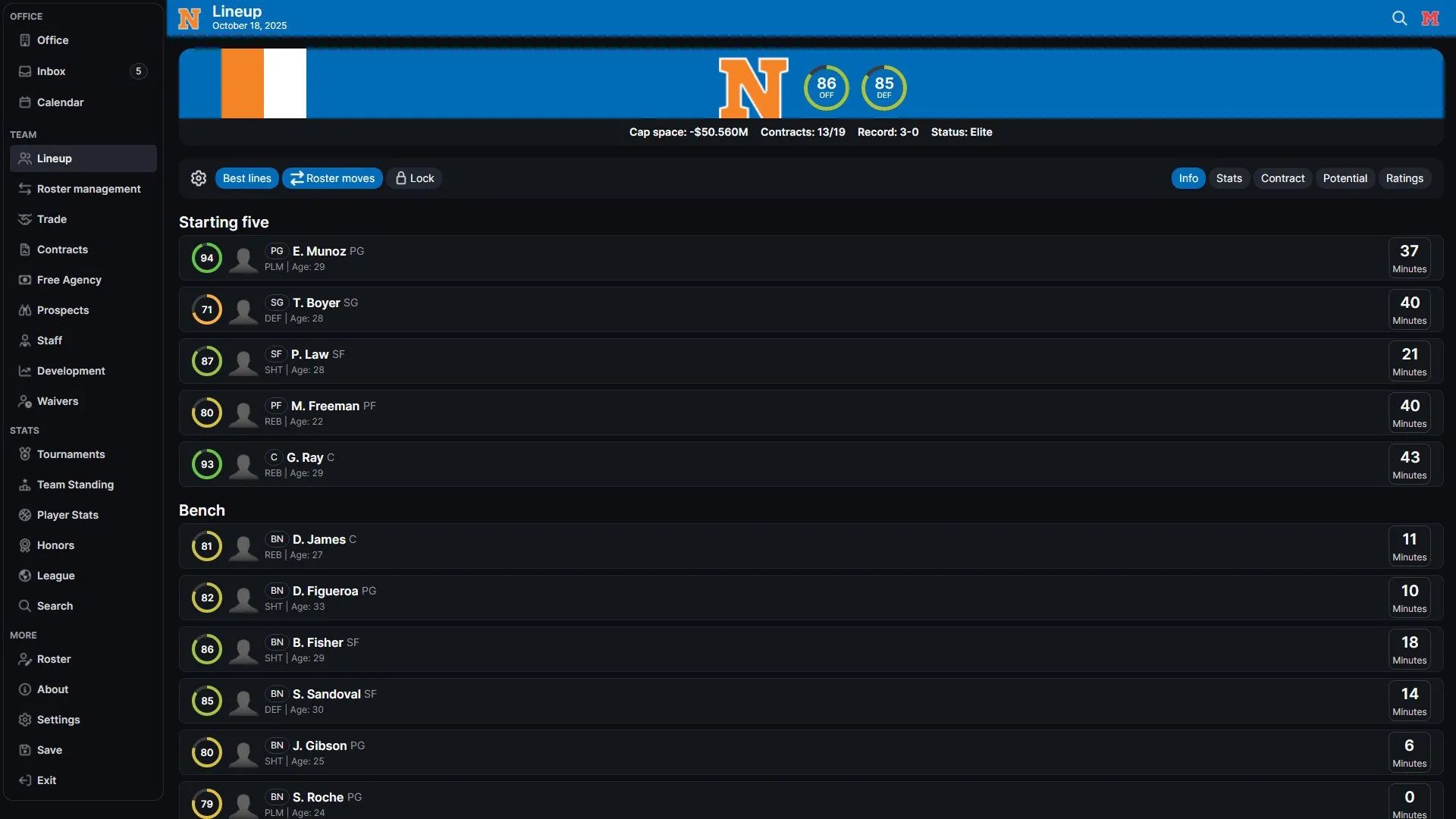
The lineup screen on PC tells you the whole philosophy: an overall rating, a player type (PLM, SHT, DEF, REB) and a minutes box per player, with team offense and defense ratings above. Note the cap space, minus $50.56M with 13 of 19 contracts. This team is a cap problem first and a coaching problem second. Image: Basketball Legacy Manager / Steam store page.
How we researched this review
We did not play Basketball Legacy Manager 27. It is not playable in a browser, there is no web demo, and our rules forbid purchases, account sign-ups and app installs on our test devices, so we could not capture our own footage or run a long simulation. There is no testing block on this page because there was no test.
Instead, we read everything the developer and the stores publish, and we read it closely:
- The Steam pages of BBLM25, BBLM26 and BBLM27, including system requirements and every user review and discussion thread.
- The App Store listing of BBLM27 in eight storefronts (United States, United Kingdom, Canada, Australia, France, Italy, Germany, Philippines), with its in-app purchase list, privacy label and full version history; the BBLM26 App Store reviews.
- The Google Play listings of every edition still online, from BBLM23 to BBLM27, with ratings, download bands and the latest update notes.
- The developer’s full feature reveals for BBLM25, BBLM26 and BBLM27, the hockey edition’s reveals for comparison, the press, buy and creators pages of the Legacy Manager series, and the Patreon page.
- Thirteen official screenshots from Steam and the App Store, which we examined one by one. Every number we quote from a screenshot is visible in it.
What we could not verify: how realistic league-wide statistics are over many seasons, how fast a season simulates on a phone, exactly how many seasons the free mobile version allows in basketball, where the ads that Google Play declares actually appear and whether Pro removes them. We say so wherever it matters. We also found no independent press review of any BBLM edition, and no active Reddit community dedicated to the basketball game. The press section of our sources is thin because the press has not covered it.
A short history of the series
Basketball Legacy Manager is the basketball branch of a family that began with hockey. The series press page describes a single developer who has shipped a new hockey edition “every year since 2019” with “no studio, no publisher, no outside funding”, plus sister series for basketball, football and baseball. On the App Store all of them are published under Élie Lamoureux; on Google Play under the name Hockey Legacy Manager.
The oldest basketball edition still on Google Play is BBLM23, released September 16, 2022. BBLM24 followed on September 12, 2023, BBLM25 on September 12, 2024 on Google Play and September 13, 2024 on Steam, BBLM26 in September 2025 and BBLM27 in September 2026. The rhythm is fixed: a feature reveal in mid-August, a beta for Patreon supporters (BBLM26’s started on August 28, 2025), pre-orders on all three stores, release in the second week of September.
Each edition has had a clear theme:
- BBLM25 brought the Hall of Fame, contract clauses (player options, team options, no-trade clauses), a training system run by your staff and a configurable inbox.
- BBLM26 brought league control, an import draft, career mode with reputation and board satisfaction, tryouts, player specialties, promotion and relegation, Bird exceptions and front- or back-loaded contracts.
- BBLM27 brings trade trees, college leagues, more history-mode starts, minor-league control and a long list of basketball rules: super max, pick swaps, transferable Bird rights, seven-asset trades.
That steady accumulation is the single most important thing to understand about BBLM. It is not a reboot every year. It is the same engine with another layer of rules on top.
A season, step by step
A BBLM career starts with a choice most rivals don’t offer: when. The default roster is set in the present day, but history mode lets you start in 1951 and, new in BBLM27, also in 1960, 1980 or 2000, with the salary cap following historical values. The game rewrites the league around you as you go: schedules change, divisions realign, franchises fold and relocate, and since BBLM27 there is no play-in tournament in history mode before the 2020-21 season.
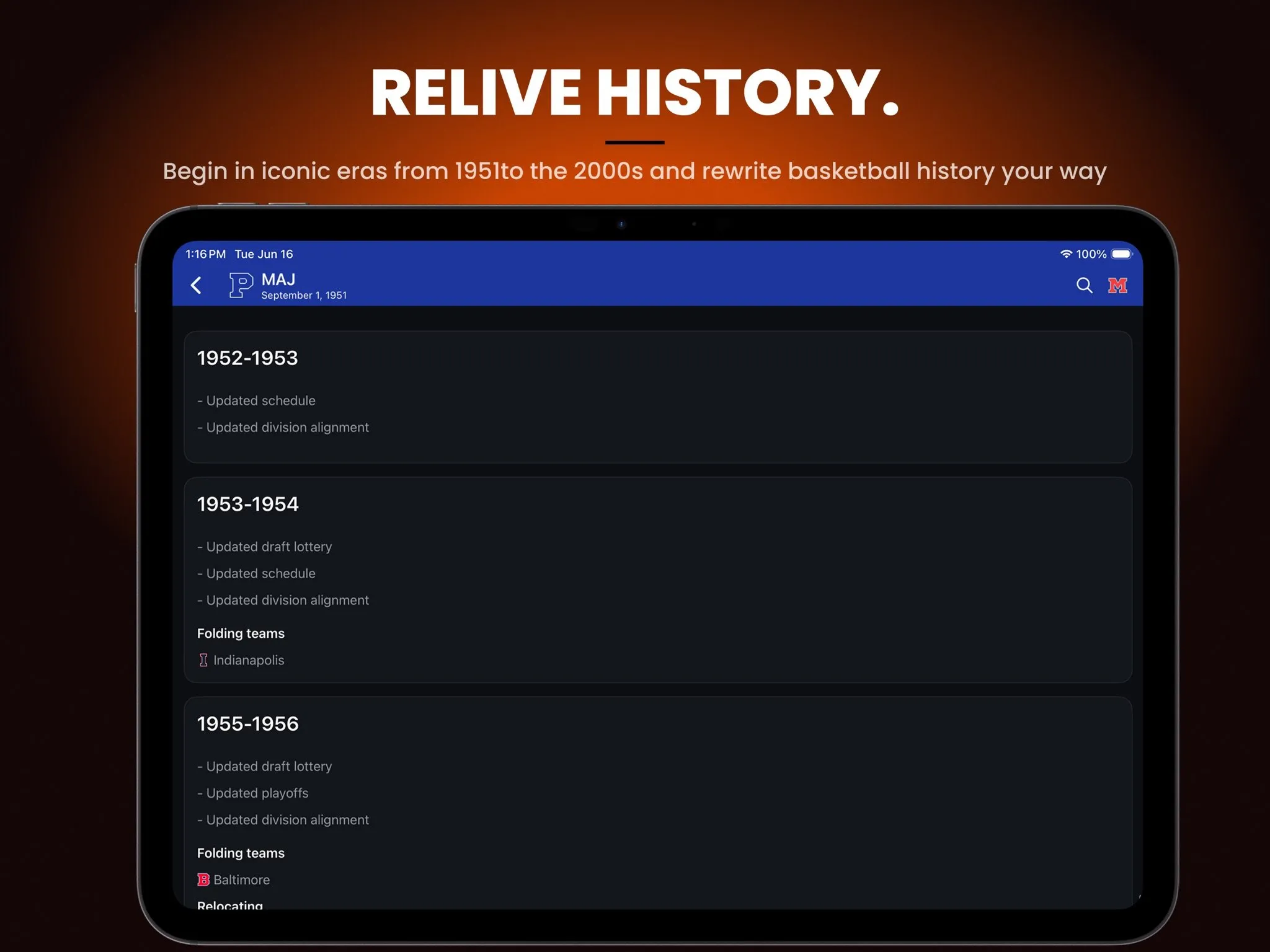 History mode starting September 1, 1951. Each season lists what changes: an updated schedule and division alignment in 1952-53, an updated draft lottery in 1953-54, Indianapolis folding, then Baltimore two years later. This is the league evolving under you, not a static roster with old names. Image: Basketball Legacy Manager / App Store listing.
Before the first game you choose which leagues are active. BBLM27 groups them by continent, lets you switch whole continents on or off, and shows an “Estimated performance” tile with a projected simulation speed and player count. That tile is a quiet admission that a world this big has a cost on a phone.
From there, the year follows the calendar, and the structure the game describes is this:
- Preseason. Sign your draft picks, offer tryouts to free agents (a BBLM26 feature: players on tryouts can be released at any point in preseason or poached by other teams’ offers) and set your lineup.
- Regular season. You simulate a day, a game or a whole month. The inbox fills with trade recaps, injuries, a monthly draft preview that ranks the projected first round and tells you whether the class is below average, average or above average, monthly progression reports and Stars of the Week and Month. Staff train players only during the season.
- Trade deadline. AI teams buy and sell according to their status (Elite, Rebuilding, Retooling). The context tab on mobile switches from Trade to Team Standing at the deadline.
- All-Star Game. Now played in every league, not only the major one.
- Playoffs. Play-in (optional since BBLM27), seven-game series, Finals, playoff MVP. College leagues have their own post-season tournament with brackets.
- Awards and Hall of Fame. You vote. Since BBLM27 you no longer have to cast all your votes and awards can end in a tie.
- Lottery and draft. Draft eligibility, number of rounds and the eligible pool (300 to 750 players, or unlimited; 350 by default) are all configurable.
- Contracts and extensions. The new contract year starts just before the draft. Re-sign your players during the extension period, which in BBLM27 runs in every league at the same time as the major league’s.
- Free agency. A Free Agency Day event, followed by the market. College programs have a Recruitment Day.
- Summer. International tournaments: World Cup and U19 World Cup in July, in divisions with promotion and relegation.
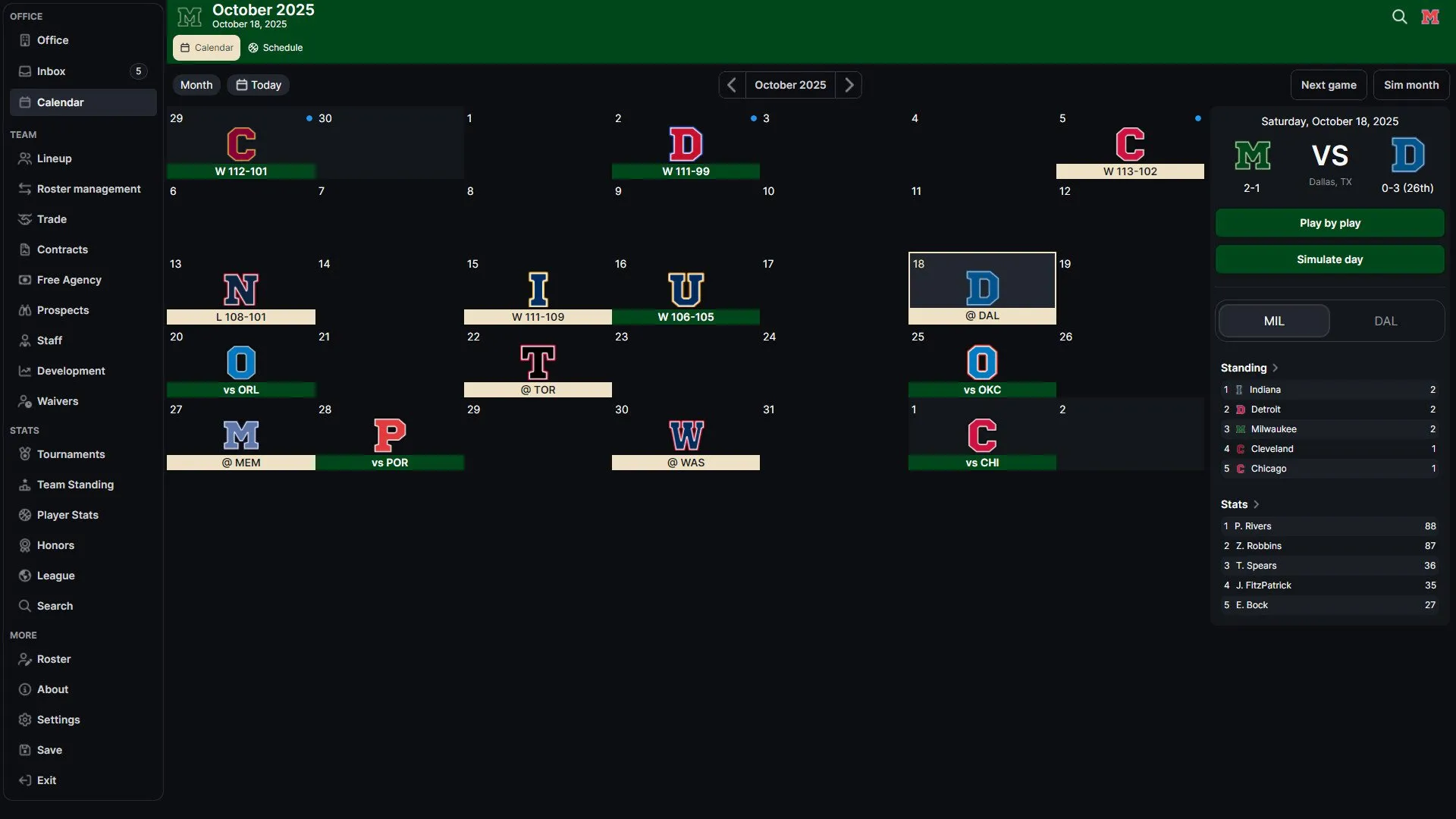 October in Milwaukee: 2-1 after three games, results stamped on the calendar, next opponent Dallas (0-3) with venue, standings and stat leaders in the sidebar. The buttons tell you how the game is meant to be played: “Next game”, “Simulate day”, “Sim month”. Image: Basketball Legacy Manager / Steam store page.
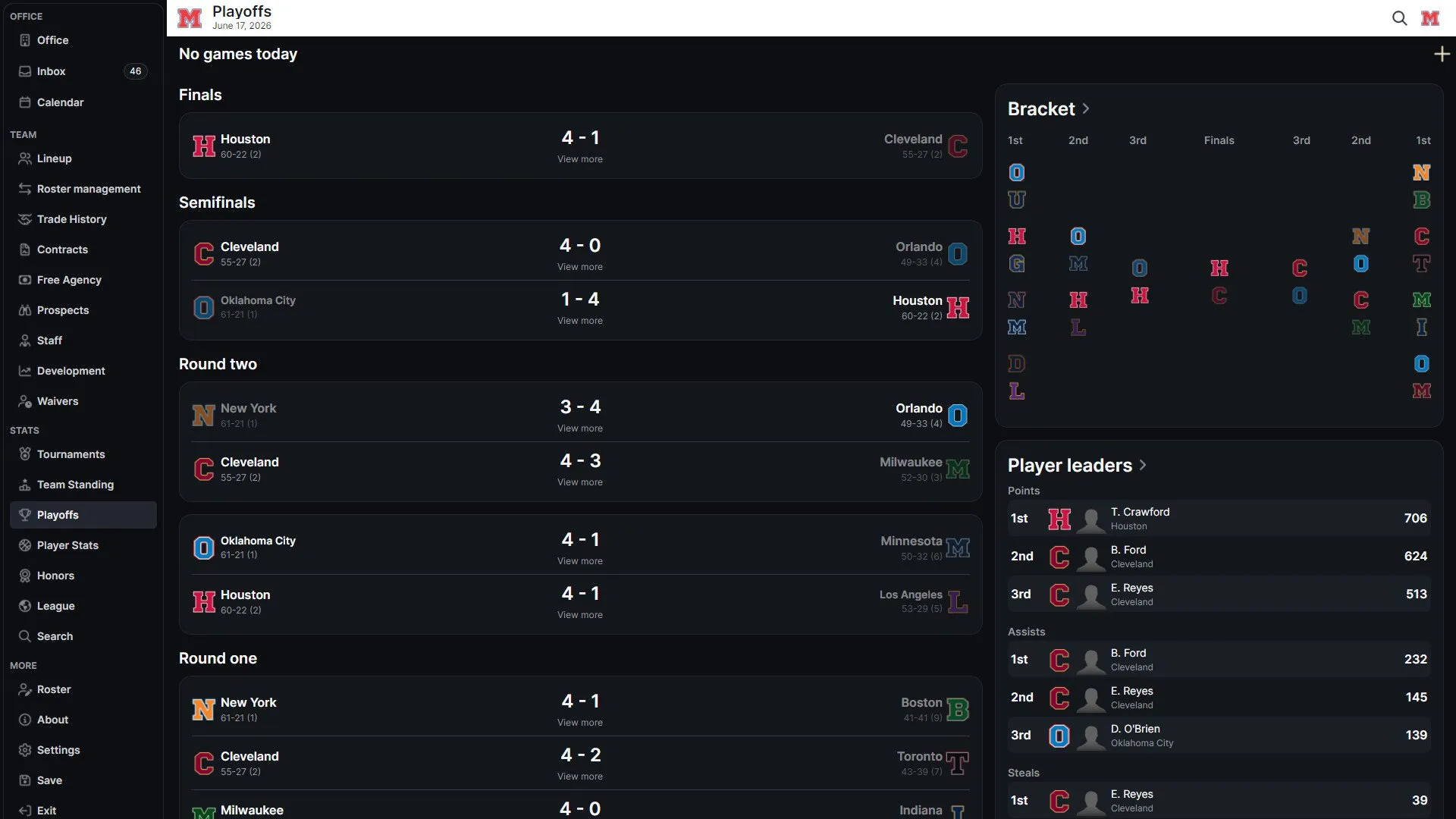 The playoffs page from the official screenshots: Houston (60-22) beat Cleveland 4-1 in the Finals after Cleveland swept Orlando. Playoff leaders sit on the right: Houston’s T. Crawford with 706 points. Note the 46 unread messages in the inbox, a reminder of how much the game talks to you. Image: Basketball Legacy Manager / Steam store page.
The career mode, added in BBLM26 and expanded this year, gives that loop stakes. You have a GM contract, a reputation and board satisfaction. Owners set objectives each season, and you have until free agency to meet them. Reputation decides who will hire you; trading away a player you recently signed lowers it; resigning lowers it too. You can apply to other jobs on a Jobs page, including national teams if your reputation is high enough. BBLM27 lets you start as the GM of a minor-league or college team and climb.
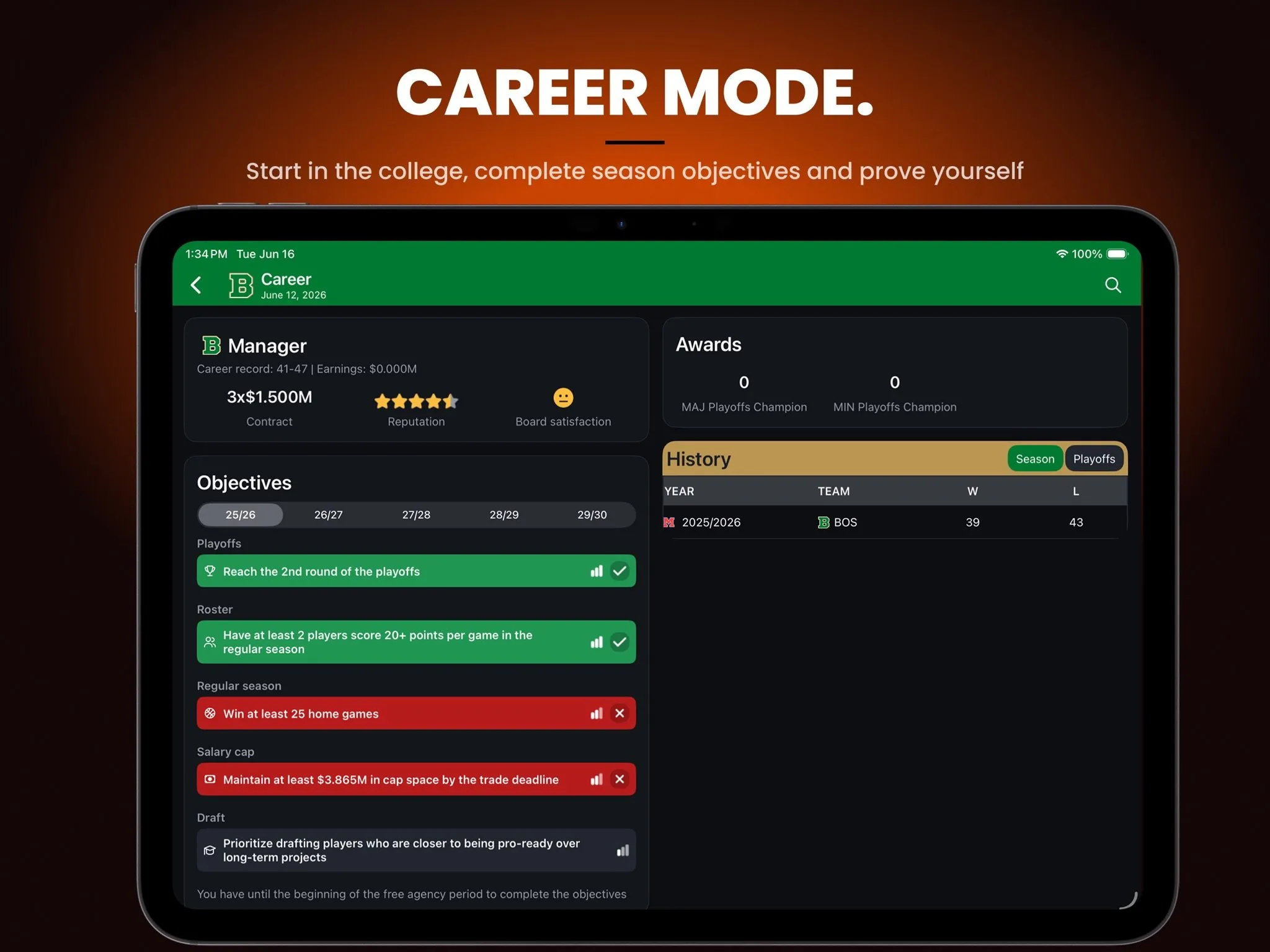 A Boston GM after a 39-43 season: a three-year, $1.5M contract, four and a half stars of reputation and a lukewarm board. Two objectives met (second round, two 20-point scorers), two failed (25 home wins, $3.865M of cap space at the deadline) and a draft directive to favor pro-ready players. Objectives that cross coaching, cap and draft are exactly the right design. Image: Basketball Legacy Manager / App Store listing.
The match engine
BBLM simulates every game of every active league. You can watch your own games live or skip them. The live view, as the official screenshots show it, has a pause button and a “Sim” button, quarter-by-quarter scores, player leaders in points, assists, steals, blocks and rebounds, team stats bars, a scoring timeline you can switch to other stats, a play-by-play feed, and a court map that plots shots for the selected quarter and event type. It is a stat-driven 2D presentation, not animated basketball. You watch numbers move and dots appear on a court.
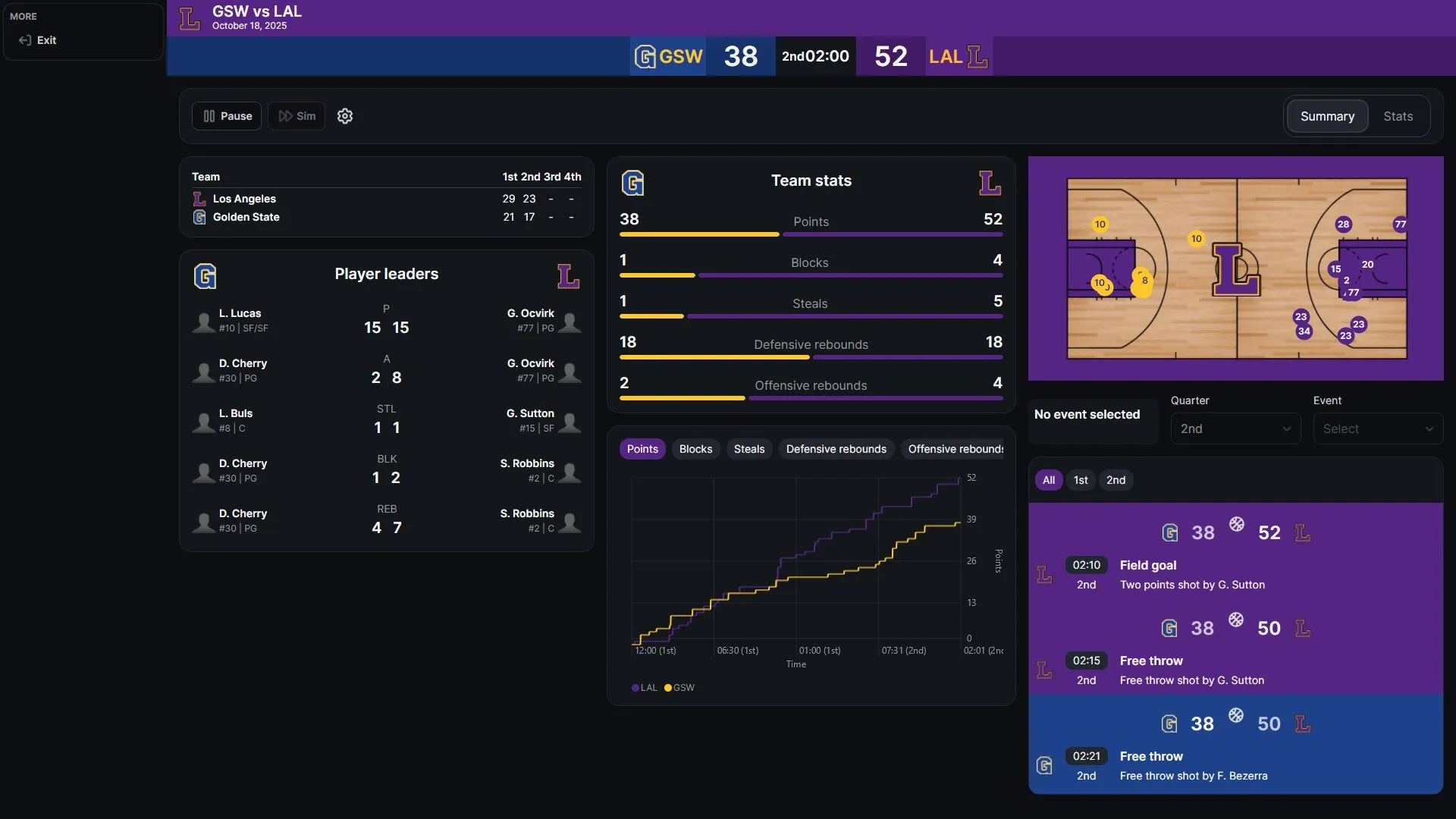 Golden State trails the Lakers 38-52 with two minutes left in the second quarter. The timeline shows the lead opening steadily; the court map shows shots clustered at the rim. The play-by-play is terse (“Two points shot by G. Sutton”, “Free throw shot by…”). You can pause, but there are no tactical buttons to press when you do. Image: Basketball Legacy Manager / Steam store page.
The developer has never published a technical description of how a possession is resolved, so we can’t tell you whether it is possession-by-possession like Basketball GM or something more statistical. What we can document is how the engine has changed:
- Free throws. BBLM27: “On most free throws, players now take two consecutive attempts instead of always one.” The fact that previous editions gave one shot per trip tells you how abstract the old model was.
- Scoring and minutes. The 27.1.14 App Store update (September 27) lists “Improved player scoring for more realistic results”, “Improved minutes distribution” and “Increased injury rates”. The November 12 Google Play update adds “Improved scoring realism”.
- Ratings generation. BBLM27 increased the attribute diversity of generated players and raised draftable players’ overalls; 27.1.14 fixed “players gaining up to 20 overall points in a single season”.
- Stats. BBLM26 added true shooting percentage; BBLM27 rescaled Game Score from 0 to 10 with a color scale and tuned the formula again in 27.2.1.
- Fatigue and injuries. BBLM26 made players “more at risk of injury when playing more than 35 minutes in a game”.
The players’ verdict on realism is mixed. A Google Play reviewer in November 2026 wrote that “most players defense is higher than their offense” and that attributes look alike outside superstars. On BBLM26, a reviewer argued that bench scoring was too low and that Sixth Man of the Year was “unwinnable” because starters won it, and asked for block numbers closer to real elite rim protectors. An App Store reviewer in October 2025 reported 4th-quarter field goals that didn’t count toward the score. Those are the reports of people who care about basketball looking like basketball, and they line up with the changelog: the engine is being tuned edition by edition, and the tuning is still visible.
Our read: the engine is plausible enough to support a GM game, coarse enough that a coach would notice, and honest about being a work in progress. We would like the developer to publish league-average benchmarks against the NBA the way some rivals do. Without them, nobody outside the studio can say how close it gets.
Coaching and tactics
This is the shortest section, because there is the least to describe. Everything we could document comes down to four tools:
- Lineup and minutes. A starting five, a bench order and a minutes figure per player, with a “Best lines” button that builds it for you and a “Lock” to stop the AI from touching it. The 27.2.1 update adds a salary cap warning to the lineup page during the playoffs.
- Player types. Each player has a type that shapes his role: playmaker, shooter, slasher (added in BBLM26), defender, rebounder. Types count toward the overall rating, and staff can retrain a player into a new type.
- Training. Since BBLM25 your head of player development has two training slots and can train anyone in the organization; head coaches and assistants have one slot each for their own team. A training can add a secondary position, change the player type or raise one rating by a point. Each player also has a development focus: balanced, offense or defense, or a specific attribute group.
- Staff. Head coaches, assistants, a head of player development and up to six scouts. BBLM27 lets you fire all staff at once, raises the staff salary cap each season, and even lets you disable staff entirely.
What is missing, compared with the best in the genre, is everything that happens after the ball goes up. We found no offensive systems, no defensive schemes, no zone or press, no pace setting, no play-calling, no matchups or player instructions, and no in-game adjustments in any edition’s feature list or screenshot. Draft Day Sports gives you a game plan; Pro Basketball Manager gives you tactics on a 3D court; even Hoop Land lets you play the game yourself. BBLM gives you a minutes column.
To be fair, this is a choice shared by the genre’s most celebrated front-office sim, Basketball GM. But Basketball GM at least hides lineup synergies under the hood. Nothing in BBLM’s documentation suggests anything similar. If you came for coaching, this is the dealbreaker.
Players and ratings
The official PC profile of Mladen Tadic, a 6-foot-11, 284-pound Serbian center drafted 41st by Denver in 2014 (the same slot in which Denver took Nikola Jokić in the real 2014 draft), is the best window we have into the player model.
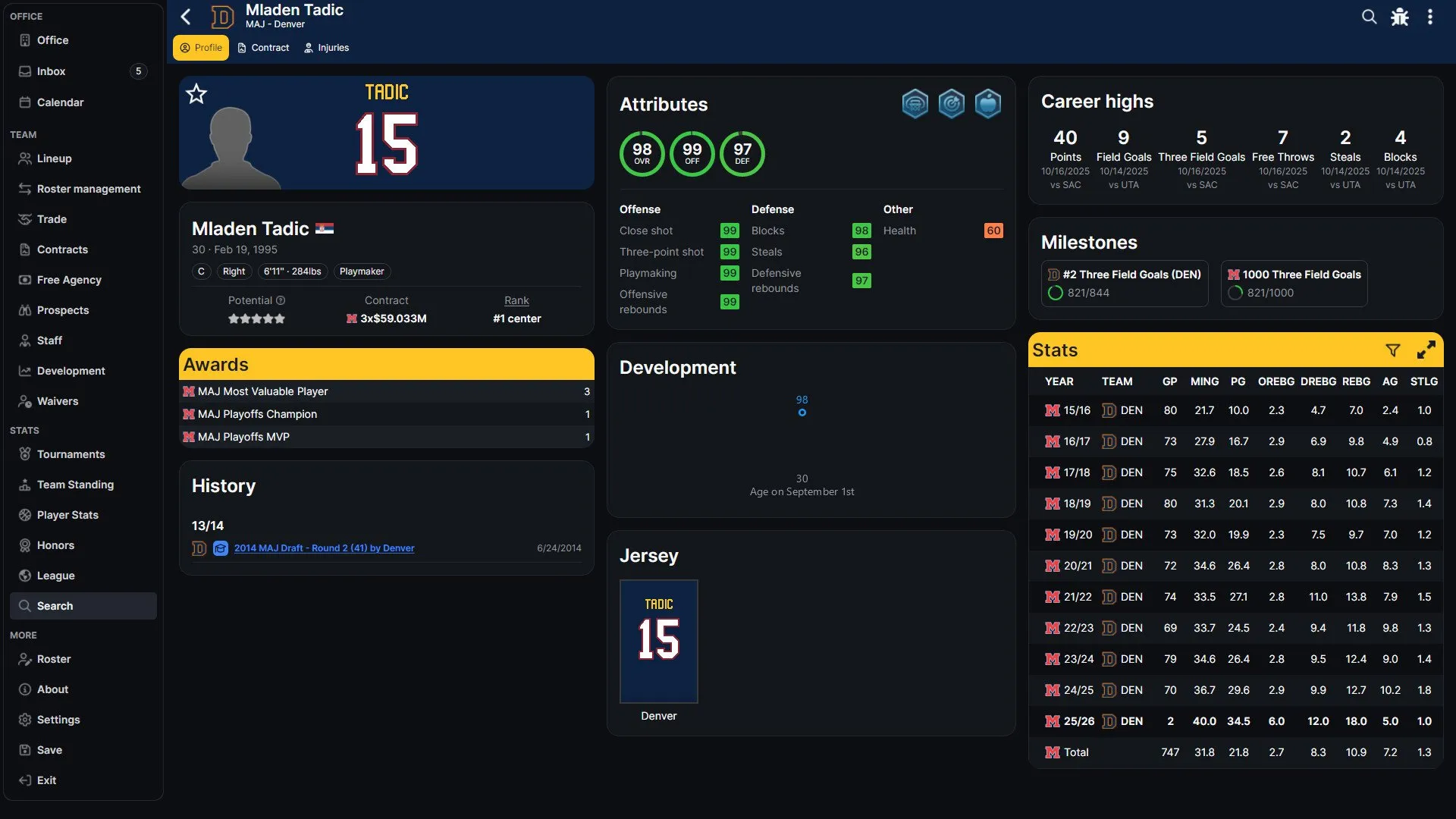 Mladen Tadic: three MVPs, a title and a Finals MVP, 98 overall (99 offense, 97 defense) on a $59.033M deal. Eight ratings are visible: close shot, three-point shot, playmaking and offensive rebounds; blocks, steals and defensive rebounds; and health. Three specialty badges sit top right. Real city, altered name. Image: Basketball Legacy Manager / Steam store page.
- Attributes. Eight visible ratings, grouped as offense, defense and other, plus an overall, an offense rating and a defense rating. There are no separate free-throw, mid-range, dunk, post or IQ ratings; a BBLM26 reviewer asked specifically for “freethrow ratings and dunk ratings” and a mid-range rating.
- Player types and specialties. BBLM26 added specialties, up to three active per star: Clean Sweep and Glass Crasher for rebounding, Finisher, Sharpshooter, Visionary, No Fly Zone, Shield, Thief, Iron Man (far lower injury risk) and Playoffs Performer. They raise a player’s value and can be turned off.
- Potential. Shown in stars and, according to the developer’s own bug fix (“Fixed hidden potentials being visible in Free Agency”, 27.1.14), partly hidden. BBLM26 added settings to change the overall range for each potential level and to set the regression age by position.
- Development. A trend indicator (very slow to outstanding) driven by league strength, games played, playoff games and injuries. A slow trend can lower a player’s ceiling. The monthly progression mail is now ordered by overall.
- Injuries. Health is a visible rating, injuries were made more frequent in September, and the Iron Man specialty exists to fight them.
- Morale and chemistry. We found no documented morale or chemistry system. Players do have a signing “interest” (visible as “High” in the negotiation screenshot), motivation colors (customizable since BBLM27) and, new this year, a childhood team that raises interest in signing there.
Scouting runs on tiers: you assign scouts to prospects, and in BBLM27 a scout who reaches tier 5 on a player automatically moves on, with a “Scout top available” button to automate assignments. Prospect pages can now show stats and injury history.
The data question is answered by the same profile. Teams use real cities and abbreviations (Denver, LAL, GSW, OKC), while players carry altered names. No store page claims a league or players’ association licence. One Google Play reviewer who has played “since bblm24” admits “the names bother me a bit”. The answer is in the community: rosters made by players can be downloaded in the game, the name and face editor works inside a career, and BBLM27 adds face-pack import. A Steam discussion opened in November 2026 is titled simply “Realname mods”.
The front office
This is the part of the game that made us sit up. Over three editions the developer has built a contract system that mirrors the NBA’s collective bargaining agreement more closely than most mobile games even try to.
The cap. A soft cap with exceptions. BBLM26 added Full Bird, Early Bird and Non-Bird exceptions; BBLM27 makes Bird rights transfer when a player is traded, as they generally do in the NBA, and adds super max exceptions. Rookie scale contracts exist and are front-loaded. In the off-season you can go up to 10% over the cap while negotiating. You can set next season’s cap yourself, or disable the cap mid-career, with no way back for that save. We found no documented luxury tax, so we don’t claim one.
Contracts. Since BBLM25: player options, team options and no-trade clauses. A clause has a price: offering a no-trade clause to a player who didn’t ask for one lowers his asking salary, while refusing one he wants raises it. BBLM26 added front- and back-loading, replaced the salary slider with a text field and added a projected cap footer for future seasons. BBLM27 adds a contract-status-at-expiry indicator, improves how options affect a player’s interest and lets you edit maximum contract length during a career. Buyouts exist and have a dedicated period.
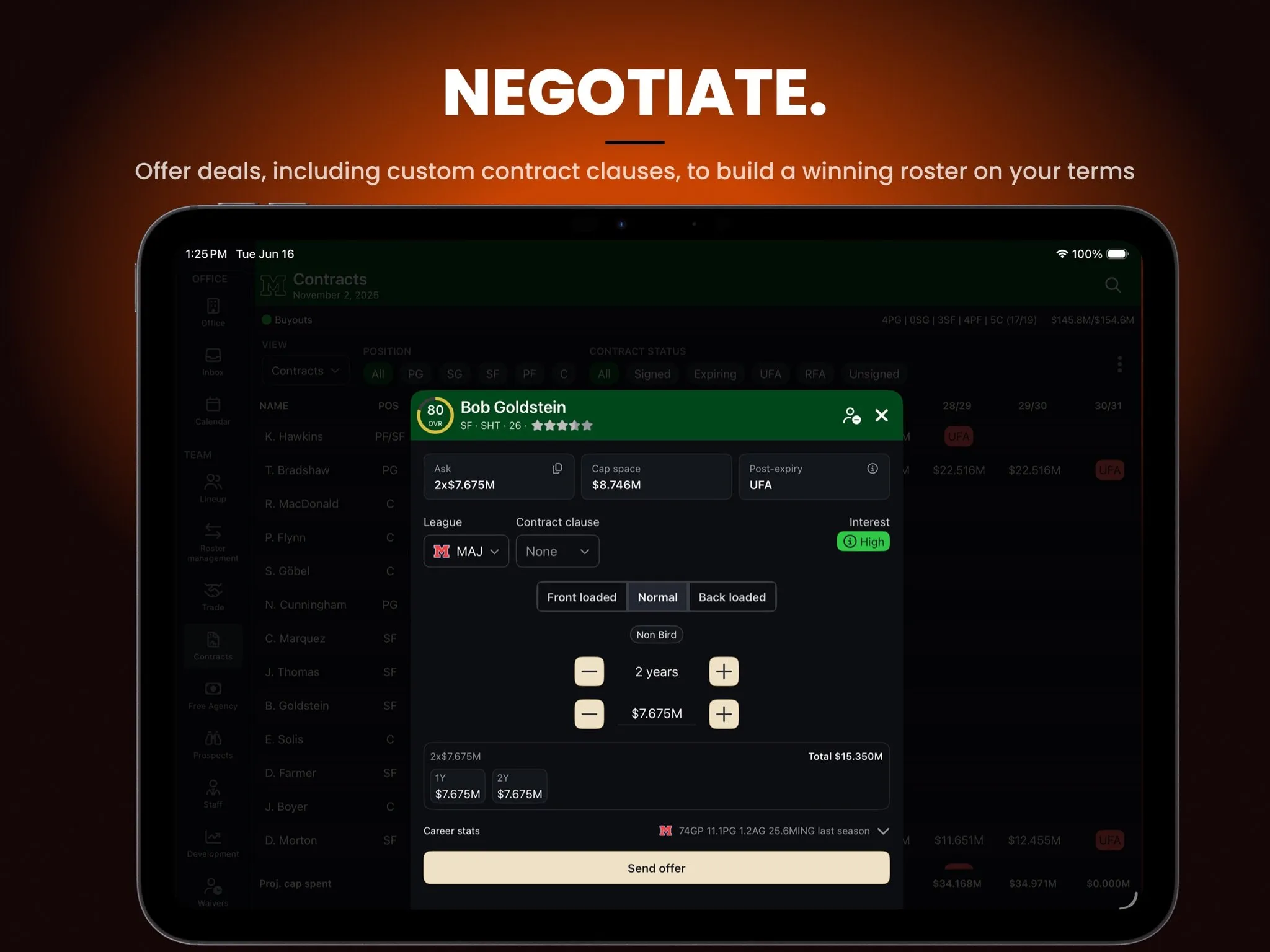 Negotiating with Bob Goldstein, an 80-overall shooter: he asks two years at $7.675M, you have $8.746M of cap space, he becomes an unrestricted free agent at expiry, and his interest is high. Clause selector, contract shape (front-loaded, normal, back-loaded), a Non-Bird tag and free entry of years and salary. This is a real negotiation screen, not a menu of fixed offers. Image: Basketball Legacy Manager / App Store listing.
Trades. Three-team trades since BBLM25, up to seven assets per side since BBLM27, conditional picks with protections and now pick swaps. The trade AI has rules you can read:
- Since BBLM26, AI teams can reject value-fair offers that don’t fit their situation. A contender won’t act as a salary-retention middleman or take a bad contract; a rebuilder won’t give up first-round picks or take bad money. Both will do it for an overpayment.
- Since BBLM27, non-contending teams are more reluctant to take first-round picks three or more years out, which closes the classic exploit of dumping distant picks on bad teams.
- “Find trade” and “Auto complete” let the AI propose or balance a deal; BBLM26 stopped Find Trade from proposing deals that break the cap.
- You can ask a player to waive his no-trade clause, and players with clauses on rebuilding teams are more willing to lift them to join contenders.
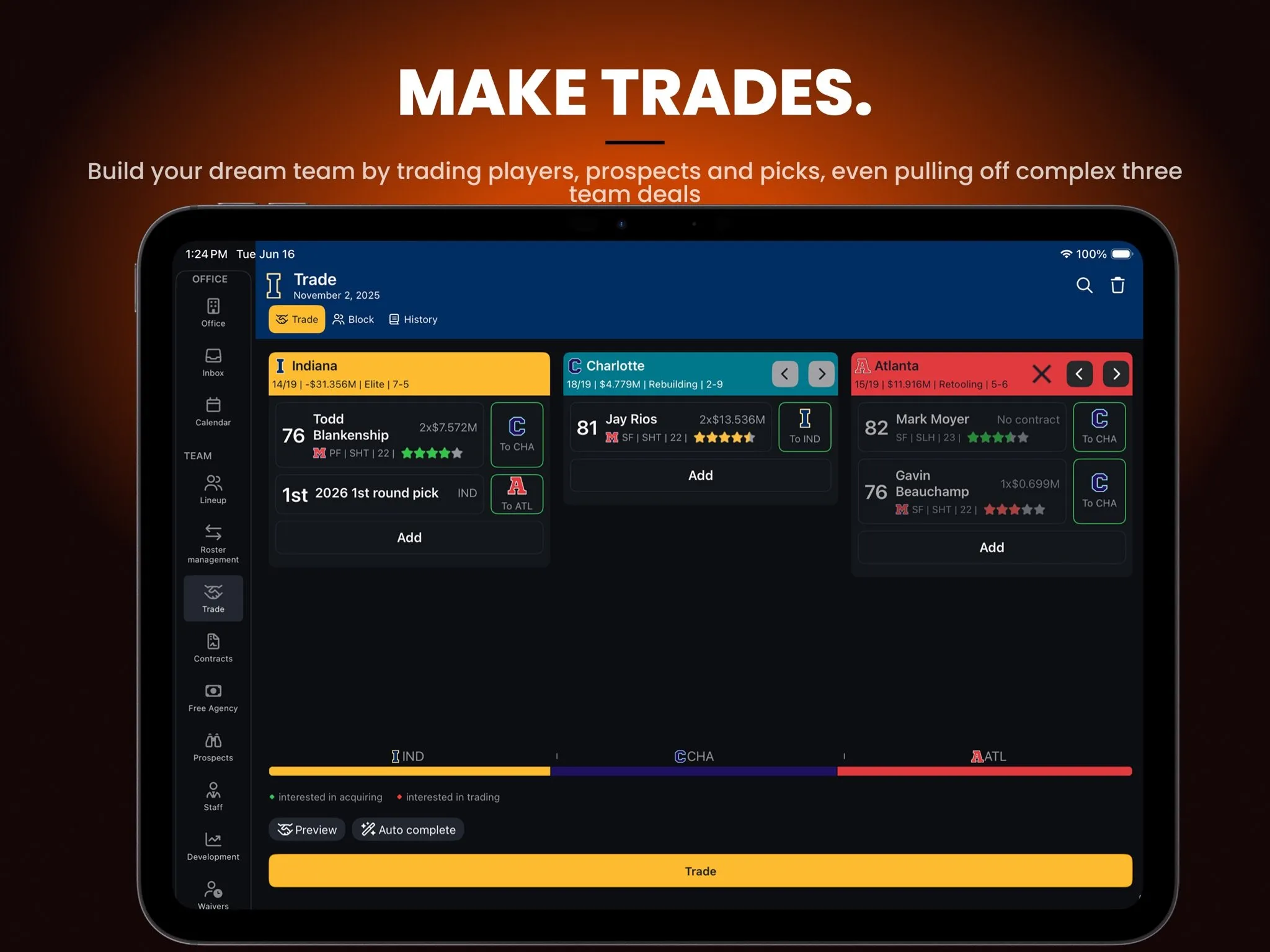 A three-team trade with readable logic: Indiana (Elite, $31.4M over the cap) sends Todd Blankenship to Charlotte and its 2026 first to Atlanta; Charlotte (Rebuilding) sends Jay Rios to Indiana; Atlanta (Retooling) sends two players to Charlotte. The bars at the bottom show each team’s interest. Image: Basketball Legacy Manager / App Store listing.
Is the trade AI any good? The best evidence we found is from players. One App Store reviewer of BBLM26 called “the depth, trade logic, etc…” “the best on the market”. Another complained that “the no trade clause ruins major trades I try to make”, which is a sign that clauses have teeth. A BBLM25 Steam reviewer questioned how trade value is set. And the developer’s own 27.2.1 notes fix “AI teams making unauthorized trades during the trade deadline”. Reasonable, with rough edges.
The new trade trees are the emotional payoff of all that. Pick any traded player and the game draws the full lineage: who came back, where those assets went next, and on through every season. The hockey edition’s reveal frames it as answering “what happened to the assets involved in a big trade made 5 years ago?”. It is the barbershop argument about who won a blockbuster, rendered as a diagram for your own league. The 27.1.14 update had to fix trade trees “displaying incorrect trades”, so early users saw some wrong branches.
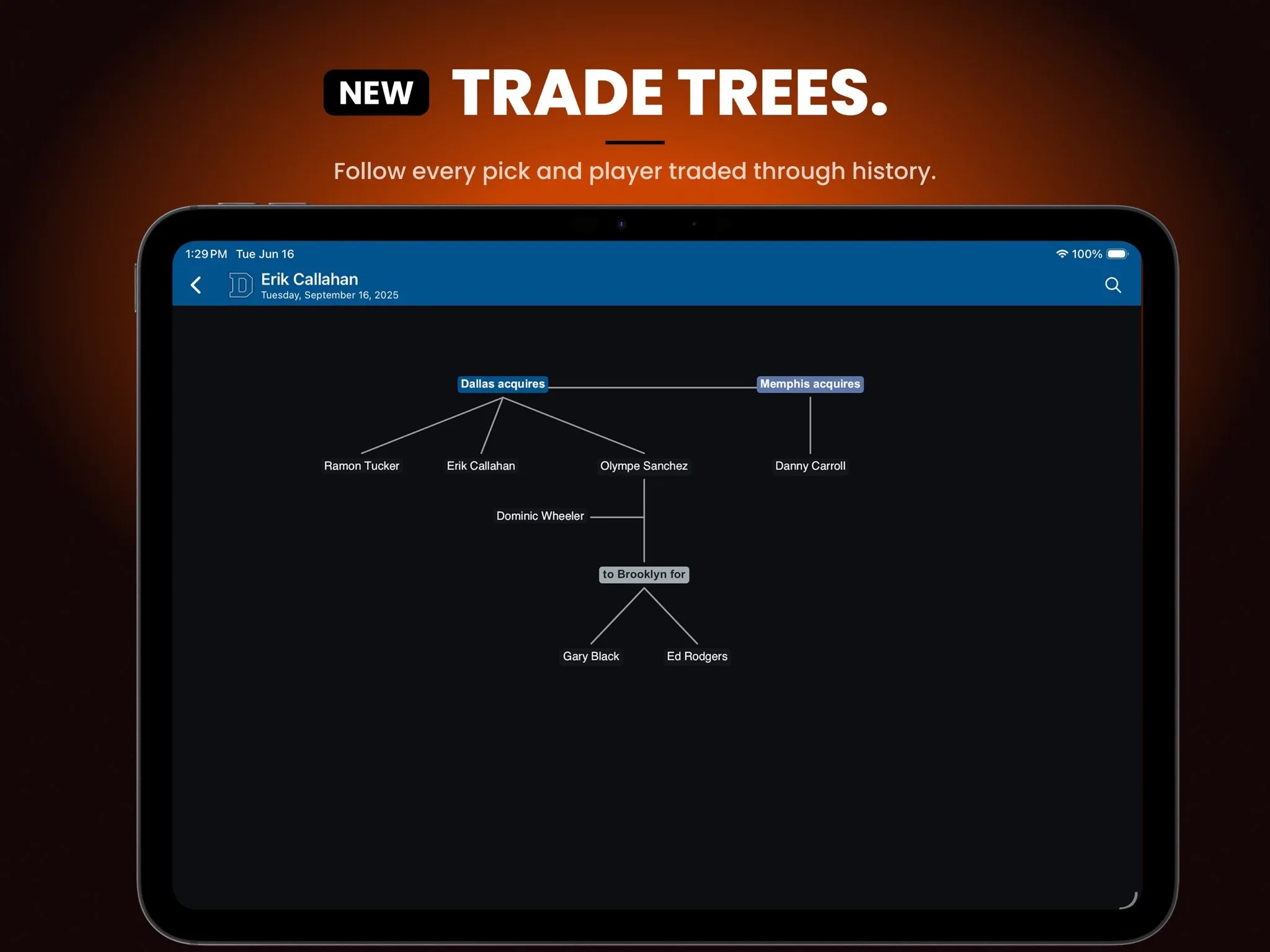 The trade tree of Erik Callahan: Dallas acquires him with two teammates, Memphis gets Danny Carroll, and one of the pieces is later flipped to Brooklyn for two more players. Simple to read, and the kind of screen that makes you rethink a deal five seasons later. Image: Basketball Legacy Manager / App Store listing.
Draft and free agency. A draft lottery in every top-level league that has a draft, configurable rounds, untradeable rounds and eligibility years; protected picks with their conditions shown on the lottery page; an import draft for players assigned to lower leagues. Free agency has its own day, filters by age and nationality since BBLM27, and lets you send offers straight from a player’s profile. Waivers exist with claims from the inbox.
Owner and finances. Career mode adds owner objectives, board satisfaction and firing. We found no documented ticket pricing, revenue, budgets or facilities. The money in BBLM is cap money, not club money.
The college game, new in BBLM27
The big 2027 addition deserves its own section. The default roster now includes ten college conferences (ACC, American, Atlantic 10, Big 12, Big Ten, Big East, Mountain West, Missouri Valley, SEC, West Coast) and 43 new college teams, and you can create your own with a new “Academic” league type.
- Academic contracts. Players who commit receive a contract with no salary, lasting as long as the league’s maximum contract length, labelled Freshman to Senior. They lose eligibility once it expires, if they are released, or beyond a configurable age if they played elsewhere.
- Prestige and recruiting. Each program has a prestige rating from 0 to 99 that drives recruiting, changes with results and is visible on team pages and rankings. A Recruitment Day mirrors Free Agency Day.
- Leaving early. Players can leave school before their commitment ends for a better opportunity, and a pro team that drafts a committed player can sign him away.
- A national view. Each country page gets a College tab with every academic league, a prestige ranking of all programs, a player ranking and a weekly poll with movement.
- Post-season tournaments. College leagues get a tournament featuring conference playoff winners, with brackets, leaders, host team, past winners and a simple editor for name, logo and color.
For anyone who has wanted to follow a prospect from campus to the lottery, this is a genuinely distinctive system. It is also new, and the patches show it: 27.1.15 fixed tournament seeding and tournaments not completing, 27.2.1 fixed college career-mode objectives and tuned college player generation to reflect prestige, and the latest App Store notes fix college players not receiving academic contracts at all.
World and longevity
If the sideline is thin, the world around it is huge.
- Leagues on leagues. A major league, minor affiliates (which you can now run, trade from, sign free agents for and start a career in), college conferences and custom leagues of up to 80 teams. BBLM27 lets you force any league to run an active AI for trades, coach firings, scouting and training.
- Structure. League control lets you take over any top-level league and change its rules: promotion and relegation between divisions, play-in on or off, number of draft rounds, draft eligibility, underage players, maximum seasons per league, the point system, the date of the last game.
- International basketball. World Cups and U19 World Cups in divisions with promotion and relegation (the App Store screenshots promise 30 national teams), a women’s World Cup when a women’s league is active, and the chance to run a national team in career mode.
- Memory. Hall of Fame voting, retired jerseys with an in-game editor, captains, records and, in BBLM27, a long list of new rankings: worst champions, biggest playoff upsets, best non-playoff teams, best undrafted players, the best player taken at every pick, “cup of coffee” players with exactly one game.
- Tools. Commissioner mode, expansion drafts (now in any league), fantasy drafts including in history mode, player, team and league editors, a roster tool to force retirements by age, overall and potential, historical logos that switch by season, and downloadable community rosters.
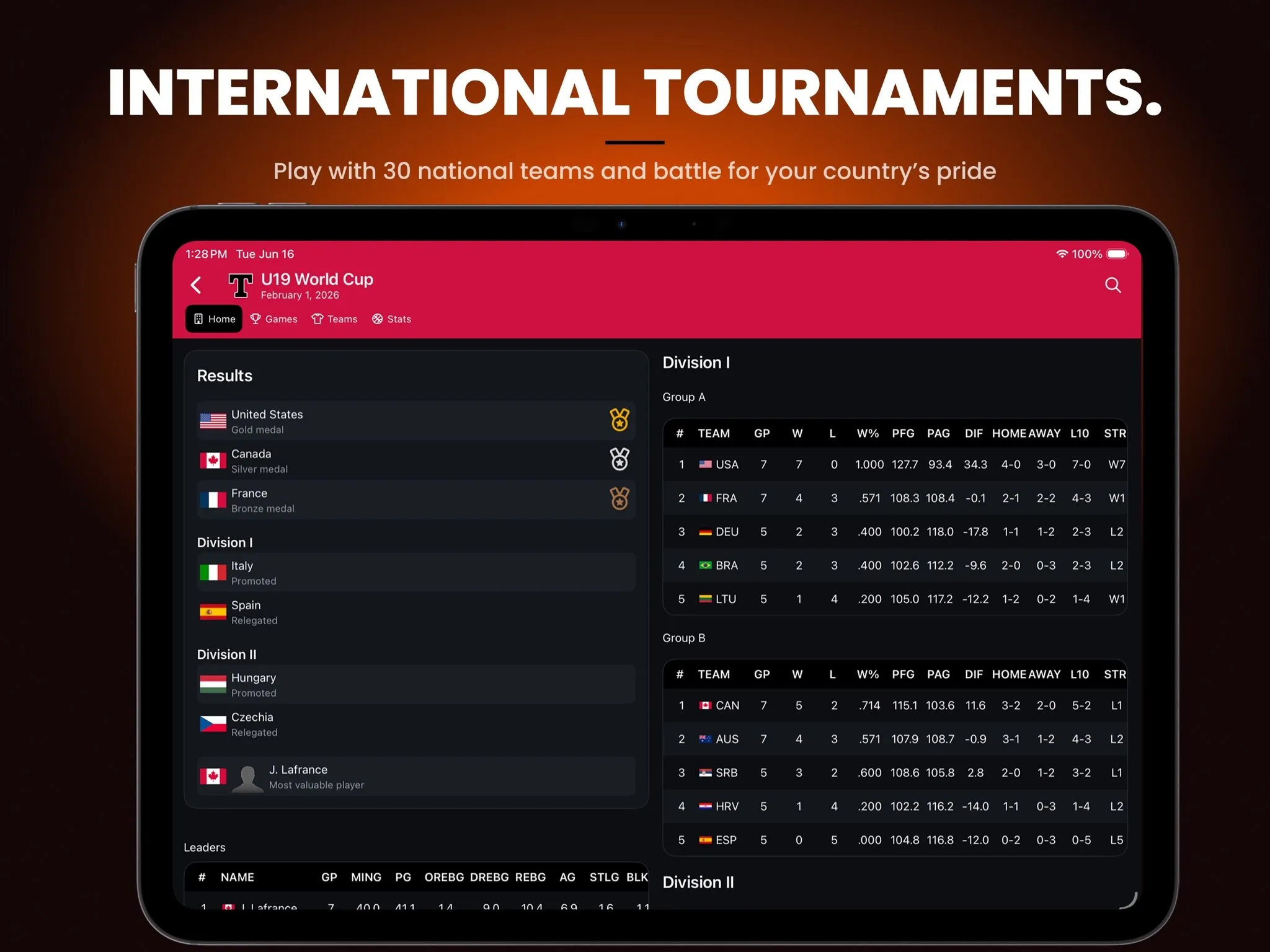 The U19 World Cup: USA gold, Canada silver, France bronze; Italy promoted and Spain relegated in Division I; full group tables with points for and against, home and away records and streaks. International basketball as a living layer, not a menu. Image: Basketball Legacy Manager / App Store listing.
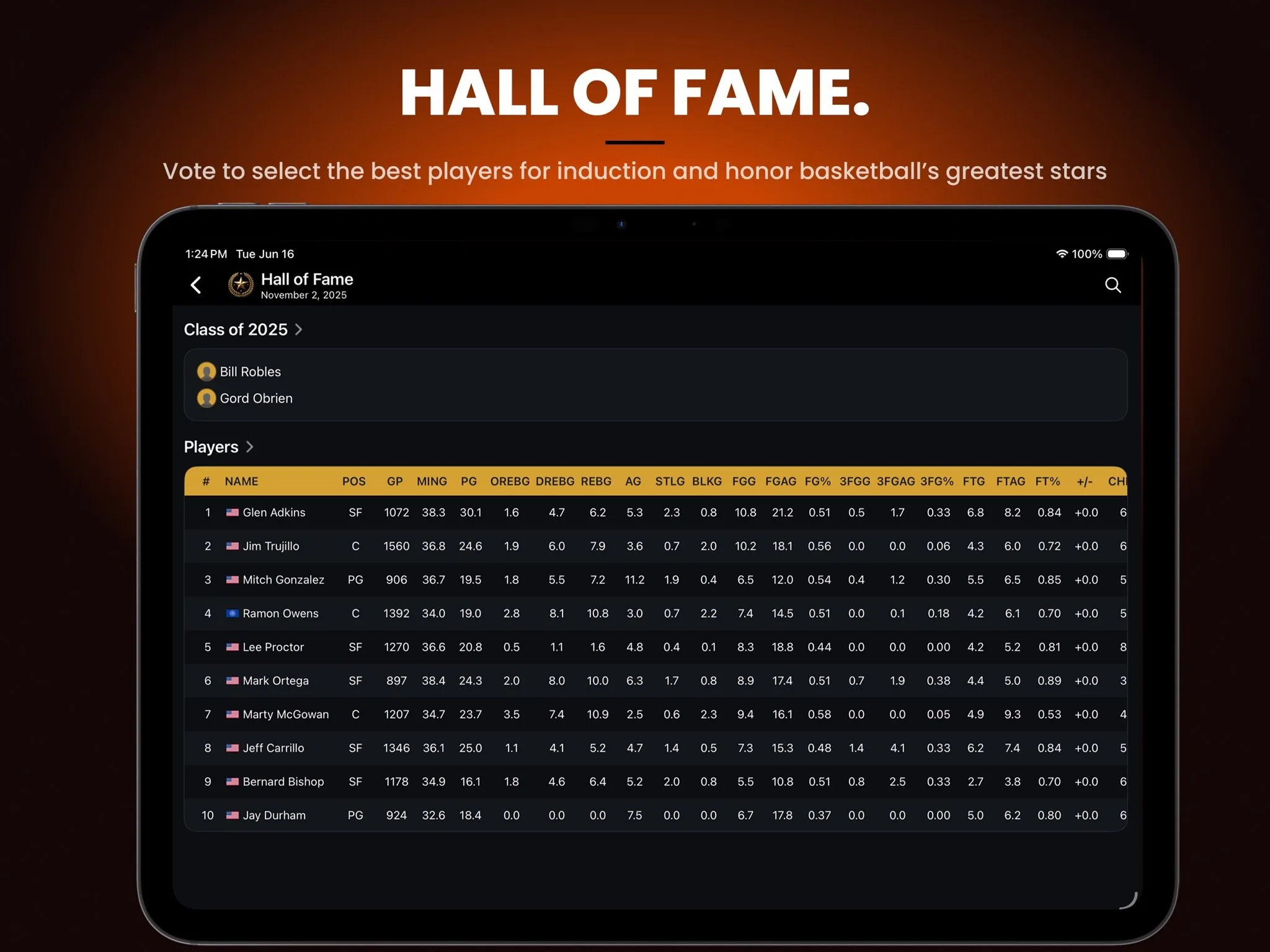 The Hall of Fame, class of 2025, with a sortable career table: games, minutes, points, rebounds, assists and shooting splits. You vote on inductees each off-season, and since BBLM27 you can choose how many go in each year. Image: Basketball Legacy Manager / App Store listing.
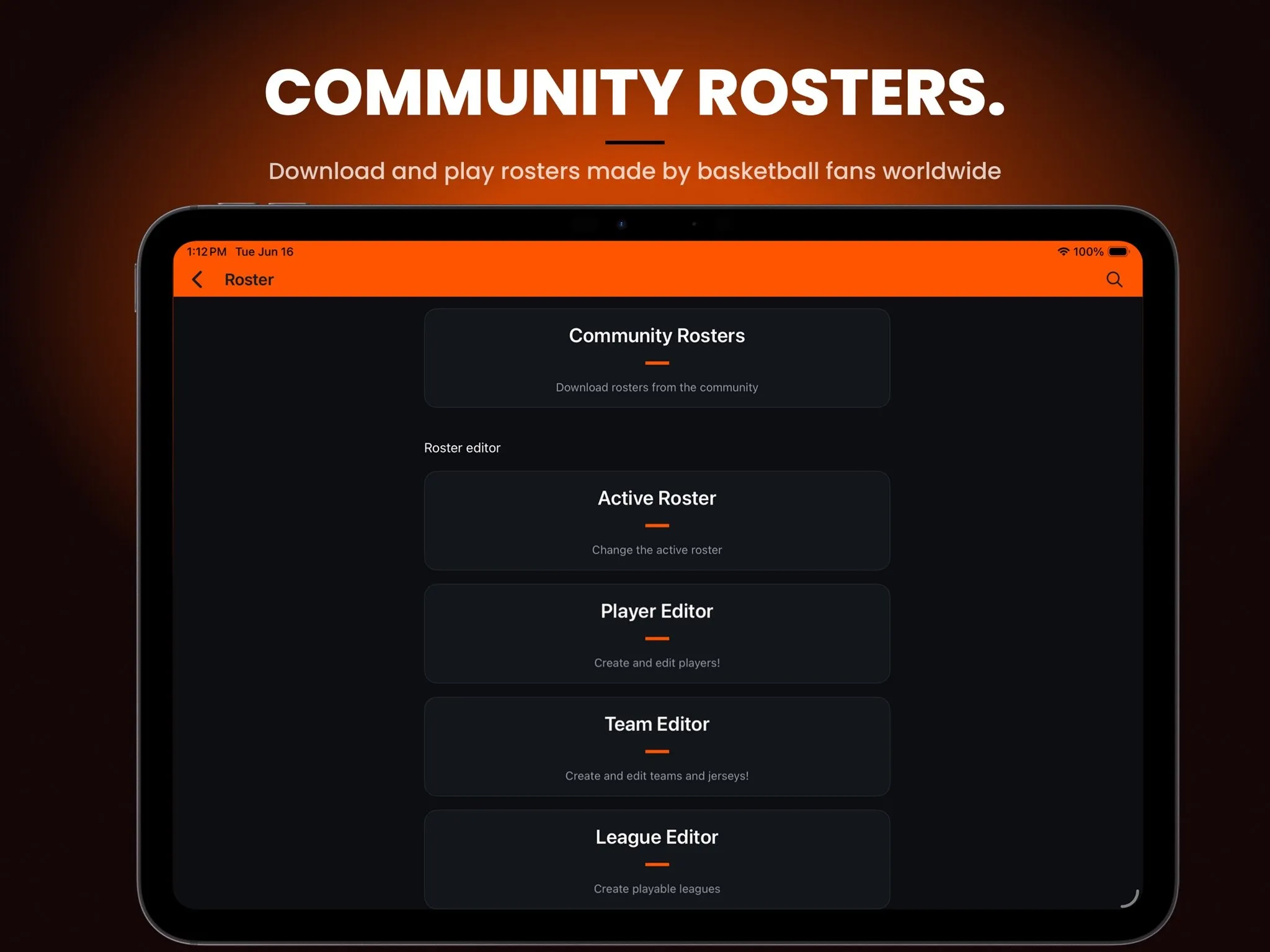 The roster menu: download community rosters, change the active roster, or edit players, teams and leagues yourself. In a game with altered player names, this screen is how real rosters arrive. Image: Basketball Legacy Manager / App Store listing.
Longevity. The store copy promises you can manage “for decades or even centuries” with “no forced end date”. Several BBLM27 settings exist to keep long saves light: a save performance option (faster saves or smaller files), a cap on how many games each player’s log keeps, an option to disable birthplace features for speed, and automatic retirement of unused free agents under 75 overall.
The longevity problem is structural, not technical. Each edition is a separate app and a separate Steam product. BBLM26 could convert BBLM25 rosters, and the 27 notes mention careers transferred from PC to mobile, but nothing we read promises that a career carries from one numbered edition to the next. Your dynasty belongs to this September’s game.
Interface, platforms and performance
The interface is the same across platforms: a dark theme, team-colored headers, a sidebar grouped into Office, Team, Stats and More on larger screens. It is clean and consistent, and dense. The phone navigation was rebuilt in BBLM27 around five tabs: Office, Calendar, Lineup, a context tab that changes with the season (Trade until the deadline, then Team Standing, Playoffs and Contracts) and Menu. The old sidebar can be restored in settings. The search bar runs quick commands: typing “/silent” turns on the auto-simulation preset.
| Platform | Price | Requirements and notes |
|---|---|---|
| Steam (Windows) | $9.99 / €10.25 | Windows 10/11 64-bit, 4 GB RAM, 2 GB storage; Family Sharing |
| Steam (macOS) | same purchase | Apple Silicon only, 4 GB RAM, 2 GB storage |
| iOS / iPadOS | Free + IAP | iOS 13 or later, 307.8 MB; also on Apple Silicon Macs and Vision Pro; Game Center |
| Android | Free + IAP | 1K+ downloads as of November 2026; listing declares ads |
Store data checked on November 14, 2026.
- Offline. The mobile listings promise play “anytime, anywhere – no internet connection required”.
- Languages. English only on Steam. The App Store listing does not declare languages; the hockey series has added French, but we found no sign of it for basketball.
- Accessibility. BBLM26 added a font scaling option for larger text. Desktop gets keyboard shortcuts (F1 to F10), the mouse back button, shift-click multi-select and CSV export of tables with Ctrl+E.
- Speed. The developer measured BBLM25 at 44% faster full-season simulation on PC and 60% faster on mobile than the previous edition. The BBLM27 notes claim a 50% faster Android season, but the sentence compares HLM27 and HLM26, the hockey games. We could not time a basketball season ourselves.
- Cloud and cross-save. There is no account. We found no cloud sync; the 27 notes mention careers transferred from PC to mobile, which implies a manual transfer rather than automatic sync.
One recurring frustration is documentation. The BBLM27 feature reveal is clearly adapted from the hockey edition’s list: it still mentions faceoff training, hat-trick stats, “the rink section” and Top-6-forward potential labels. BBLM25’s list mentions goaltender records and a “Hitting” attribute focus; BBLM26’s mentions goal animations. Most items are generic to the shared engine and clearly apply, and each list has a dedicated basketball section. But a buyer reading those pages can’t always tell what is basketball and what is copy-paste.
Monetization, line by line
| Product | Price (US) | What it buys |
|---|---|---|
| BBLM27 on Steam | $9.99 (€10.25) | Full game on Windows and macOS, one purchase, no DLC listed |
| BBLM27 on iOS / Android | Free | The game with limited seasons; Google Play declares ads |
| BBLM27 Pro | $4.99 | Unlocks long careers (“decades and even centuries”) |
| BBLM27 Pro + Donation | $5.99 | Pro plus a tip to the developer |
| BBLM27 Pro + Large Donation | $7.99 | Pro plus a larger tip |
| BBLM27 Pro + Generous Donation | $11.99 | Pro plus the largest tip |
| Patreon | from €1 a month | Supports the developer; past editions gave Patreon members early beta access |
App Store in-app purchase list and Steam price as of November 14, 2026. The donation tiers add nothing beyond Pro according to their names; the store does not describe them further.
A few observations. The free mobile tier is a trial, not a game: the store copy ties long careers to Pro, a BBLM26 reviewer wrote that “without Pro, you only can play a few seasons”, and a BBLM27 reviewer asks the developer to “increase the free seasons”. For hockey the developer states seven free seasons; we found no equivalent statement for basketball. Every Google Play edition from BBLM23 to BBLM27 is labelled “Contains ads”, and the iOS privacy label lists identifiers used for third-party advertising. We could not check whether Pro removes ads.
There is no pay-to-win, no loot box, no energy, no currency. The real cost is the cycle: a new edition every September, each a new purchase. At $4.99 on a phone or $9.99 on PC that is hard to call greedy, and it is a fraction of what paid PC rivals cost. But it means early adopters effectively fund the beta, and anyone who wants the newest rules pays again each year.
Fairness verdict: fair. Cheap, clearly priced, no gameplay advantages for sale. We would like ads gone for Pro buyers (stated explicitly) and a longer free trial.
Update history
| Date | Version | What changed |
|---|---|---|
| Sep 16, 2022 | BBLM23 | Oldest edition still on Google Play |
| Sep 12, 2023 | BBLM24 | Next annual edition (Google Play) |
| Sep 12–13, 2024 | BBLM25 | Earliest basketball edition on Steam; Hall of Fame, player/team options and no-trade clauses, staff training, configurable inbox, faster sim |
| Sep 2025 | BBLM26 | League control, career mode, tryouts, specialties, promotion and relegation, Bird exceptions, contract loading, women’s leagues |
| Aug 15, 2026 | Reveal | BBLM27 feature list published |
| Sep 11–12, 2026 | 27.1.8–27.1.10 | Launch on Steam, Google Play and App Store; roster update |
| Sep 15–17, 2026 | 27.1.11–27.1.13 | Bug fixes; Pro purchase fixed by Sep 16 |
| Sep 27, 2026 | 27.1.14 | Scoring realism, minutes distribution, injury rates; trade-tree, All-Star and scouting fixes |
| Sep 30, 2026 | 27.1.15 | Simulation freeze, tournament seeding, Find Trade for minor leagues |
| Oct 1, 2026 | 27.2.0 | Lineup page crash fix |
| Oct 5, 2026 | 27.2.1 | Editable max contract length, playoff cap warning, college tuning, Game Score tuning, AI deadline trades fix |
| Nov 12, 2026 | Google Play update | Scoring realism, scout and trading-block fixes, fantasy draft and history-mode salary fixes |
Sources: Google Play listings, Steam, the App Store version history and the developer’s feature reveals. Steam lists BBLM26 on September 17, 2025; the developer announced it for September 13.
There is no public roadmap beyond the annual cycle. Judging by the pattern of the last three years, the BBLM28 reveal should arrive in mid-August 2027.
What players say
Ratings are good but not spectacular, and the reviews are honest about why.
| Store | BBLM27 | BBLM26 |
|---|---|---|
| App Store (US) | 4.0 from 29 ratings | 4.6 from 110 ratings |
| App Store (Canada) | 4.8 from 9 ratings | — |
| Google Play | 4.4 from 58 reviews, 1K+ downloads | 4.2 from 302 reviews, 10K+ downloads |
| Steam | 1 review, positive (too few for a score) | 1 review (too few for a score) |
Checked November 14, 2026. Other App Store storefronts (UK, Australia, France, Italy, Philippines) have one or two ratings each.
The positive cluster: depth and loyalty. Many reviewers are repeat buyers. On Google Play one says “I love this series, it is very addicting in a good way” and claims almost 300 hours in the 2026 basketball and football editions combined (September 15, 2026). On the App Store a BBLM26 player called the trade logic “the best on the market”, and another said they had played the last two editions and planned to buy the next. On Steam, a 2024 BBLM25 reviewer called it “a quicker, easier alternative to other basketball GM games”.
The negative cluster: launches and bugs. On September 13, 2026, an App Store reviewer wrote: “Pro upgrade isn’t working. Bugs throughout app.” The developer answered on September 16 that it had been fixed. Others reported box scores “showing zeros” (September 17) and injury times not changing as they simmed (September 23). The same pattern hit BBLM26: “This game is currently unplayable until they fix critical bugs” (September 15, 2025), followed by a developer reply the next day.
The monetization cluster. “Most of the fun stuff is stuck behind a paywall,” wrote a fan “since bblm24” on Google Play (September 13, 2026). A November App Store review calls it amazing but regrets having to pay “5 bucks for it to be actually fun”.
The realism cluster. “Most players defense is higher than their offense,” complained a BBLM26 player who prefers the previous edition (Google Play, November 10, 2026). The lone BBLM27 Steam review recommends the game but asks for team stats and team and league history (October 2026).
The developer. Across stores the developer answers quickly, usually within a day or two, and asks players to send their save from the About page to reproduce bugs. That responsiveness is the reason many reviewers stay.
Known issues and bugs
All of these are sourced to store reviews or official patch notes; we could not reproduce any of them.
- Fixed in BBLM27 patches: Pro purchase not working at launch; empty box scores; trade trees showing wrong trades; players gaining up to 20 overall in one season; hidden potentials visible in free agency; players on both All-Star teams; post-season tournaments not completing and wrong seeding; simulation freezes around the All-Star Game; a crash on the lineup page; AI teams making unauthorized deadline trades; a crash on launch on older devices.
- Reported by players, status unclear: injury times not counting down and minutes changes that can’t be confirmed after an injury (App Store, September 23); a play-in that would not advance and a season with no champion (Google Play, September 15); flat ratings with defense above offense (Google Play, November 10).
- Recurring across editions: BBLM26 had a draft-skip bug at launch, crashes, slow loading of single days and a draft lottery players wanted fixed (App Store, 2025-2026). Expect the first weeks of any edition to be rough.
Tips for your first season
- Decide on Pro before you get attached. The free mobile version limits how many seasons you can play. If you want a dynasty, buy Pro (or the Steam version) before you sink hours into a save.
- Choose your era deliberately. 1951 gives you a tiny league that grows; 1980 or 2000 give you modern rules with historical caps. In history mode there is no play-in before 2020-21.
- Mind the minutes. Start from “Best lines”, then adjust. Since BBLM26 players logging more than 35 minutes a night carry more injury risk, and injury rates went up in September 2026.
- Fill every training slot. Your head of player development trains two players, each coach one. Trainings run only during the season, and only developing players are eligible. Pick development focuses for your young core.
- Use your six scouts. “Scout top available” fills assignments, and BBLM27 moves a scout on automatically once a prospect hits tier 5. Watch the monthly draft preview for class quality.
- Spend clauses like money. Offering a no-trade clause to a player who didn’t ask for one lowers his price; refusing one he wants raises it. Options now affect signing interest too.
- Read the team status before trading. Contenders won’t take bad contracts or retain salary as middlemen; rebuilders won’t give up firsts. Overpay if you must, and don’t expect bad teams to want picks three years out. Let “Auto complete” suggest the missing piece.
- Plan the off-season cap. You can go 10% over the cap while negotiating in the off-season, and every league now has an extension period. Bird rights follow players you trade for.
- Tame the inbox. Each message type can be Silenced, sent to the Inbox or Notified. Silencing the noise, or typing “/silent” in search for the auto-simulation preset, makes long sims faster.
- Report bugs with your save. The developer asks players to send their career from the About page. It is the fastest way to get a fix.
Against the alternatives
| Basketball Legacy Manager 27 | Basketball GM | Hoop Land | Draft Day Sports: Pro Basketball 27 | Astonishing Basketball Manager | |
|---|---|---|---|---|---|
| Platforms | iOS, Android, Windows, macOS | Browser, Android | iOS, Android, Windows, macOS | Windows | iOS, Android, Windows |
| Price model | Free + $4.99 Pro / $9.99 Steam | Free with ads | Free + IAP | Paid | Free + IAP and subscription |
| Player data | Real cities, altered names | Real players (unlicensed) or random | Fictional | Fictional | — |
| Match view | Box score, play-by-play, shot map | Box score, text | Playable 2D | 2D, text, box score | Box score |
| Trades | Advanced (3 teams, 7 assets) | Basic (2 teams) | Basic | Advanced | Basic |
| Cap model | Soft cap with exceptions | Soft cap with tax | — | Soft cap | Budget |
| Our score | 7.0 | 9.0 | 7.8 | 8.2 | 6.7 |
Comparison drawn from our own reviews of each game.
- Basketball GM is free in a browser, with deeper ratings, real-player history back to 1947 and a similarly hands-off sideline. It has nothing like BBLM’s college system, contract clauses or multi-team trades, and BBLM has a native app with offline play (review).
- Hoop Land lets you actually play the games you manage, in retro 2D, with college and pro leagues and a lighter front office (review).
- Draft Day Sports: Pro Basketball 27 is the paid Windows text sim, with stronger game-day coaching and comparable trade depth (review).
- Astonishing Basketball Manager is the other big mobile management game, with a budget instead of a cap and a monetization model we found far less fair (review).
- Pro Basketball Manager 2027 is the licensed European club sim with a 3D engine (review).
- BuzzerBeater and Swish & Dunk are online managers where your rivals are real people (BuzzerBeater, Swish & Dunk; disclosure: Swish & Dunk is developed by our founder).
Our take
Basketball Legacy Manager 27 is a cap nerd’s game wearing a mobile app’s clothes. Bird rights that follow a player in a trade, super max exceptions, no-trade clauses you can ask a player to waive, protected picks and pick swaps, a college pipeline with prestige and early departures: this is the stuff basketball fans argue about online every off-season, and BBLM lets you live it on a phone, offline, for five dollars. For one developer working on four sports at once, the ambition is remarkable, and the way the rules stack up year after year is the strongest argument for the annual model.
What holds it back is everything between the tip-off and the final buzzer. Eight visible ratings and a minutes column are not enough to make a playoff series feel coached, and the player feedback about flat ratings suggests the engine hasn’t caught up with the rulebook. Add a September launch buggy enough to break the Pro purchase, and a changelog that still talks about faceoffs, and you get a game whose best version arrives about a month after release.
Our wish list for BBLM28:
- A basic tactical layer: pace, a handful of offensive and defensive identities, a zone, and a timeout button in the live view.
- A richer attribute set: free throws, mid-range, finishing, post play, defensive IQ.
- Published league-average benchmarks against the NBA, so we can judge the engine.
- A basketball-only changelog, written for basketball.
- Career transfer from one edition to the next, so a dynasty survives September.
- A clear statement that Pro removes ads, and more free seasons.
Who should skip it: coaches, anyone who wants licensed names out of the box, and anyone who can’t stand early-access-style bugs every autumn. Everyone else: wait for the first big patch, buy Pro, and start your dynasty in 1951.
Sources
Official (developer)
- Basketball Legacy Manager official website (redirects to the Legacy Manager series site)
- BBLM27 feature reveal (August 15, 2026)
- BBLM26 feature reveal (August 15, 2025)
- BBLM25 feature reveal (August 17, 2024)
- HLM27 feature reveal, for comparison with the shared changelog
- HLM27 feature reveal: trade trees
- HLM27 feature reveal: college leagues
- Legacy Manager press page and fact sheet
- Legacy Manager buy page
- Legacy Manager creators page
- Hockey Legacy Manager on Patreon
Stores
- Steam: Basketball Legacy Manager 27
- Steam: Basketball Legacy Manager 26
- Steam: Basketball Legacy Manager 25
- Steam reviews: BBLM27
- Steam reviews: BBLM25
- App Store (US): Basketball Legacy Manager 27 (in-app purchases, version history, privacy label, reviews)
- App Store (Canada): Basketball Legacy Manager 27
- App Store (UK): Basketball Legacy Manager 27
- App Store: Basketball Legacy Manager 26 and its reviews
- App Store: Basketball Legacy Manager 25
- Google Play: Basketball Legacy Manager 27
- Google Play: Basketball Legacy Manager 26
- Google Play: Basketball Legacy Manager 25
- Google Play: Basketball Legacy Manager 24
- Google Play: Basketball Legacy Manager 23
Community
- Steam discussions: Basketball Legacy Manager 27 (including the “Realname mods” thread, November 2026)
- Steam discussion “BBLM” in the Hockey Legacy Manager 25 forum, with developer replies (December 2024)
Data and reference
- Basketball-Reference: 2014 NBA Draft (pick 41, Denver)
- Hoops Rumors glossary: Bird rights
Press: we found no independent press review of any Basketball Legacy Manager edition as of November 14, 2026.
Analysis by category
Match engine
Weight 22%6.5Games are simulated with a live view, play-by-play, a scoring timeline and a court map of every shot, but we could not measure league realism ourselves. Players flag flat ratings and odd awards; September and November patches tuned scoring, minutes and injury rates.
Coaching & tactics
Weight 12%5.5You pick a starting five, set minutes per player and assign training slots to coaches and development staff. Official materials show no offensive or defensive systems, no pace and no play-calling. That is a GM game’s coaching, not a coach’s.
Players & development
Weight 18%7.5Draft with lottery, six scouts and tier-based scouting, hidden potential, player types and up to three star specialties, development focus and a college recruiting layer driven by team prestige. The visible attribute set is small: eight ratings on the profile we examined.
Front office & salary cap
Weight 14%8.0The strongest part of the game. Soft cap with Full, Early and Non-Bird exceptions, super max, rookie scale, player and team options, no-trade clauses, buyouts, front- and back-loaded deals, three-team trades with up to seven assets, pick swaps and protected picks.
League & world
Weight 10%8.5Start in 1951 or, new this year, 1960, 1980 or 2000 with historical caps. Minor and college leagues, promotion and relegation, World Cups, Hall of Fame, expansion, fantasy draft, commissioner mode, full editors and community rosters.
Interface & UX
Weight 10%6.5A clean, consistent dark UI on PC, tablet and phone, with a redesigned five-tab mobile navigation this year. Dense, English only, and players have called earlier PC menus clunky; the shared changelog with the hockey game makes it hard to know what applies to basketball.
Longevity
Weight 7%7.0No forced end date, decades of history and frequent patches (ten App Store builds between September 10 and October 5). But each edition is a new app: your league lives in this year’s game, and next September the cycle restarts.
Business model
Weight 7%7.0Steam: $9.99, no DLC. Mobile: free with a time limit, Pro at $4.99 (optional donation tiers up to $11.99). Google Play lists ads and the iOS privacy label declares third-party advertising. Fair money for the depth, but it is a yearly purchase.
Weighted average of the criteria: 7.0
Features
Game type
- Genre
- Management simulation
- You play as
- General manager
- Players & teams
- Real (unlicensed)
- League structure
- NBA-style (draft, playoffs), College, International, Historical seasons, Custom leagues
- Rules
- NBA (48 min), Customizable
Match engine
- Match view
- Box score, Text play-by-play
- Watch matches live
- Yes
- Instant simulation
- Yes
- Advanced stats (PER, TS%, +/-)
- Yes
- Shot charts
- Yes
- Fouls & foul trouble
- Yes
Coaching & tactics
- Rotations & minutes
- Yes
- Individual training plans
- Yes
- Staff (assistants, scouts, medical)
- Yes
Players
- Ratings per player
- 8
- Hidden potential
- Yes
- Progression & aging
- Yes
- Injuries
- Yes
- Retirements & Hall of Fame
- Yes
Roster building
- Draft
- Yes
- Draft lottery
- Yes
- Trading draft picks
- Yes
- Scouting (hidden ratings)
- Yes
- Development league / affiliate
- Yes
- Player loans
- Yes
- Free agency
- Yes
- Contract negotiation
- Yes
- Trades
- Advanced (multi-team, future picks)
- Waivers / releases
- Yes
Front office & economy
- Salary rules
- Soft cap (NBA style)
- Cap exceptions (Bird rights, MLE)
- Yes
- Rookie scale contracts
- Yes
- Player / team options
- Yes
- Buyouts & release clauses
- Yes
- Owner / board goals
- Yes
- You can be fired
- Yes
- Job offers from other clubs
- Yes
League & world
- Promotion & relegation
- Yes
- Domestic cups
- Yes
- National teams
- Yes
- All-Star game
- Yes
- Season awards
- Yes
- League history & records
- Yes
- In-game editor
- Yes
- Fantasy draft
- Yes
- Expansion & relocation
- Yes
- Commissioner / god mode
- Yes
Platforms & tech
- Playable offline
- Yes
- Account required
- No
- Languages
- 1
- Data export (CSV / JSON)
- Yes
Monetization
- How it makes money
- Ads, Premium currency
Frequently asked questions
Is Basketball Legacy Manager 27 free?
- Yes, Basketball Legacy Manager 27 is free to play, with optional in-app purchases.
On which platforms can you play Basketball Legacy Manager 27?
- Basketball Legacy Manager 27 is available on iOS, Android, Windows, and macOS.
Is Basketball Legacy Manager 27 multiplayer?
- No, Basketball Legacy Manager 27 is a single player game: you play against the computer.
Does Basketball Legacy Manager 27 have real players and teams?
- Basketball Legacy Manager 27 includes real players, without an official license. You can also create or import custom leagues and rosters.
Does Basketball Legacy Manager 27 have a salary cap?
- Yes, Basketball Legacy Manager 27 has a soft salary cap, NBA style: teams can exceed it under specific rules.
Can you play Basketball Legacy Manager 27 offline?
- Yes, Basketball Legacy Manager 27 can be played offline.
Who develops Basketball Legacy Manager 27?
- Basketball Legacy Manager 27 is developed by Élie Lamoureux.
Is Basketball Legacy Manager 27 worth playing?
- BBLM27 has one of the richest rulebooks in mobile basketball management: Bird rights, options, no-trade clauses, seven-asset trades, college leagues and history back to 1951. Coaching is thin, the launch was buggy and you buy a new edition every year. Free to try, cheap to own. (7.0/10)
What are the best alternatives to Basketball Legacy Manager 27?
- The best alternatives to Basketball Legacy Manager 27 are Hoop Land (7.8/10), Astonishing Basketball Manager (6.7/10), and Basketball GM (9.0/10).