College Basketball Manager
A one-person Early Access sim that understands modern college hoops — recruiting pitches, NIL budgets, the portal — better than most studio-made games.
Score
The verdict
The most college-specific coaching sim we have seen: a 14-row recruiting pitch system, real NIL and revenue-sharing budgets, a deep gameplan and minute-by-minute rotations. It is still Early Access, Windows-only and rough around the edges, but at $9.99 it is the college hoops manager to watch.
The good
- Recruiting is the game: graded pitches, recruit knowledge, scouting fog and real bidding wars
- Modern college economics: NIL contracts, revenue sharing, boosters, TV deals and tournament units
- Coaching depth rare in the genre: two offenses, two defenses plus a press, ten sliders and a 20-period matrix rotation
- Transfer portal with motives: players leave for minutes, money or a losing program
- A pressure-cooker career: athletic director approval, firings, job offers and Dream Jobs
- $9.99, no in-app purchases, a free demo and Steam Workshop mods
The bad
- Early Access balance: core systems such as in-game development were broken until July 2026
- Windows only, English only, small fonts that players struggle to read
- Many school names are fictionalized; real names and logos depend on community mods
- Conference realignment, rivalries and facility upgrades are still on the to-do list
- Support lives on Discord; Steam forum questions often go unanswered
- No Steam announcement since the Workshop update of 30 July 2026
Who it’s for
- College basketball fans who live for signing day more than for the Finals
- Coaches who want to set pace, help defense and exact rotations, not just a depth chart
- Players who enjoy building a low-major into a tournament team over many seasons
Who should skip it
- Mac, Linux, console or mobile players
- Anyone who needs a finished, fully balanced game today
- Pro-style GMs looking for trades, a salary cap and a draft
College basketball is a different sport to manage. There is no salary cap to game, no trade deadline and no draft lottery. Your roster turns over every spring, your best player can walk into the transfer portal for a few more minutes, and your job depends on an athletic director who wants wins, attendance and a balanced budget. College Basketball Manager is built around exactly those pressures. It is a text-based sim from Lunacien, which is to say one developer, Aaron, who spent four years of spare time on it and released it in Steam Early Access on 17 March 2026.
What makes it different is how current it is. This is not a game frozen in the era of scholarships and nothing else: it models NIL contracts and revenue sharing, a transfer portal driven by players’ reasons for leaving, international recruits, the NET and its quadrants, and boosters with their own agendas. On paper, it is the most college-specific basketball management game we have looked at — and, because it is one person’s Early Access project, also one of the most openly unfinished.
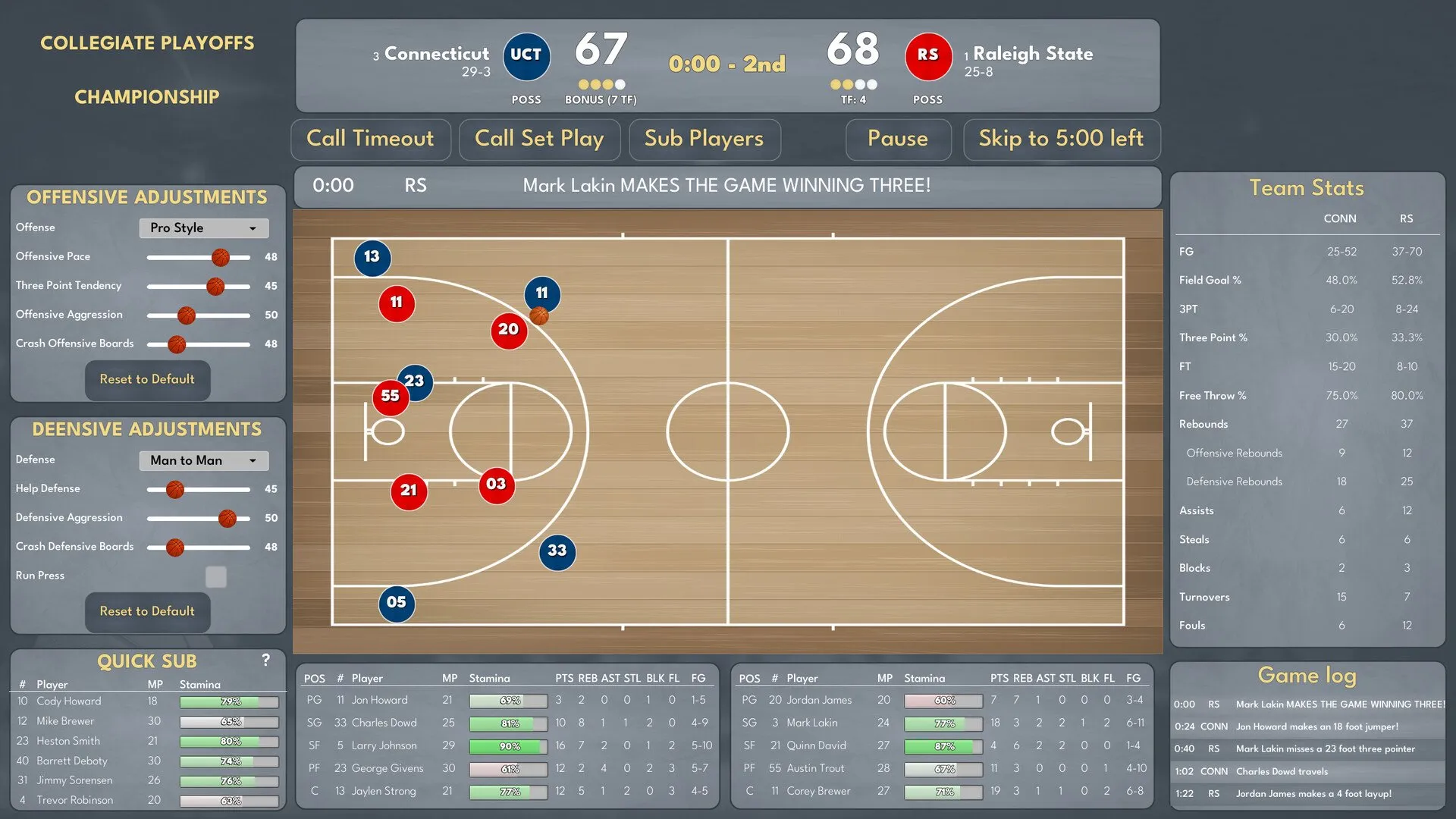
A national championship decided on the last shot: No. 1 Raleigh State beats No. 3 Connecticut 68-67. The screen shows the whole live toolkit — tendency sliders you can move mid-game, Call Timeout, Call Set Play and Sub Players, stamina bars and a play-by-play log. Image: Lunacien / Steam store page.
The short version
- Play it if you care more about signing day, the portal and building a mid-major than about trades and cap sheets, and you are on Windows.
- Play it if you like real coaching control: two offenses, two defenses plus a press, ten tendency sliders and a minute-by-minute rotation grid.
- Wait if you need a finished, balanced game: the patch notes show core numbers still being corrected in July 2026, and the last Steam update is from 30 July.
- Skip it if you play on Mac, Linux, mobile or console, need large fonts, or want real school names and logos without modding.
How we researched this review
We did not play College Basketball Manager, and we won’t pretend otherwise. It is a paid Windows game, the free demo is a Windows install too, and we do not buy or install software for reviews. There is no browser version, public league page or online manual we could capture. This review is built on what we could read and see:
- the Steam store page, its Early Access FAQ, system requirements and achievement count;
- every announcement and patch note the developer has posted on Steam, from the store-page reveal in May 2024 to the Steam Workshop update of 30 July 2026 — fourteen posts in all, which we read line by line;
- the seventeen official screenshots on the store page, which we studied screen by screen;
- GM Games’ listing, the 2024 announcement press release and Metacritic’s (empty) page;
- the 16 Steam user reviews we could load from the store’s review pages (Steam counts 20 in total), and 26 threads on the game’s Steam forum;
- the Steam pages of the two closest competitors, and NCAA and press sources for the real-world rules the game models.
Every image is an official screenshot from the Steam page, cropped to remove window chrome and debug text, and every caption says so. Some come from earlier builds, so in-game dates jump from 2022 to 2116. Where something can only be judged by playing — how the engine behaves over ten seasons, how fair the recruiting AI is, how fast a season simulates — we say so. Our scores weigh documented systems against what players report, and we flag what we could not verify.
A season, step by step
College Basketball Manager is a Legacy game: you create a coach and take a job. The store page pitches two ways in — start small and aim for the top, or take over the school you have always cheered for — and either way, the athletic director (AD) is your boss. From the official screens, the patch notes and the player reviews, a season breaks down like this.
1. The offseason handover. Players declare for the pro draft, enter the transfer portal or graduate, and AI teams cut down to 15 players (since May 2026 they prefer cutting walk-ons and end-of-bench upperclassmen). You see each player’s draft odds; since July, seniors with no realistic chance show “No Chance” rather than “Automatic”. A May fix made projected-undrafted underclassmen more likely to stay in school.
2. Staff and budget. You hire assistants within a staff budget, and new positions need the AD’s approval, which since March depends on how much room is in the budget and on the program’s overall finances. Since June, promotions within your own staff take effect immediately.
3. Building the schedule. In the preseason you fill the non-conference calendar by signing game contracts: home-and-home series, neutral-site games, or a non-conference tournament. One long-time player describes scheduling “money games” against powerhouse schools “just to keep the program financially afloat.”
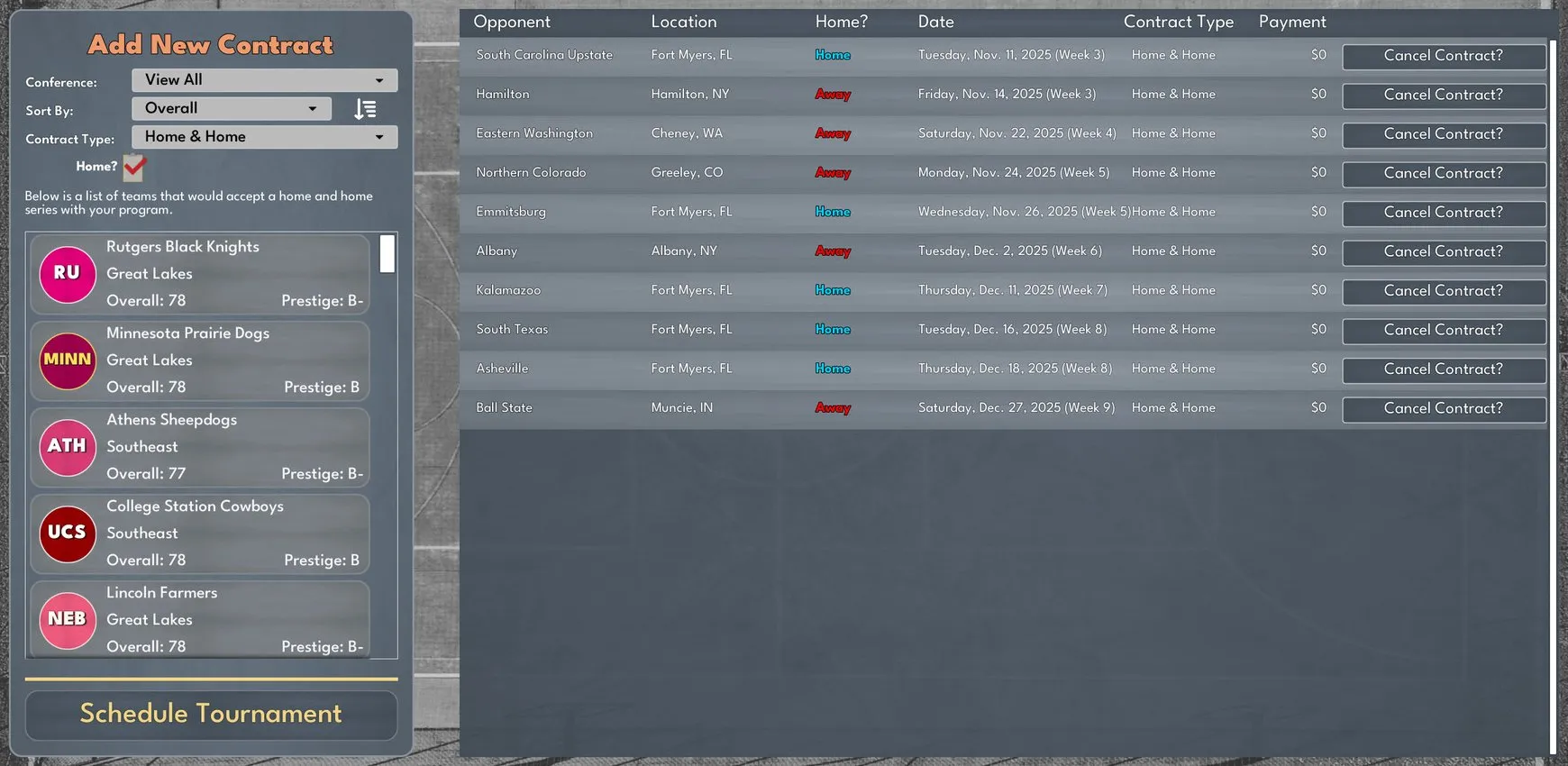 Building a non-conference slate for the Florida Gulf Hawks: ten home-and-home contracts at $0, and a list of teams that would accept one, each with overall rating and prestige grade. A March patch fixed a bug where home-and-home games could earn you money. Image: Lunacien / Steam store page.
4. The gameplan and the rotation. You set offense and defense, sliders, usage and a rotation (see the coaching section below), and save them as templates.
5. Weekly loop. Each week has a practice plan (up to 20 hours in the regular season), recruiting actions paid from a weekly budget and the coaching staff’s time, and games. A checklist flags events: a coaching vacancy to fill, a staff member joining, a possible job opening, a player whose contract expectations just jumped.
6. Conference play and the conference tournament. Practice plans automatically switch to a tournament-week template for the conference tournament.
7. Selection and the national tournament. A 64-team bracket in four regions, the “Collegiate Playoffs”, with automatic and at-large bids. A May patch fixed an at-large selection that overweighted preseason polls.
8. Year-end review. The AD grades you on winning, program development and finances; boosters update their happiness; fan support decays (since March, missing the tournament costs a point of fan rating and a title is worth eight). Coach of the Year awards and runs to the Sweet 16 or deeper raise your reputation. Then job openings appear, and the cycle restarts.
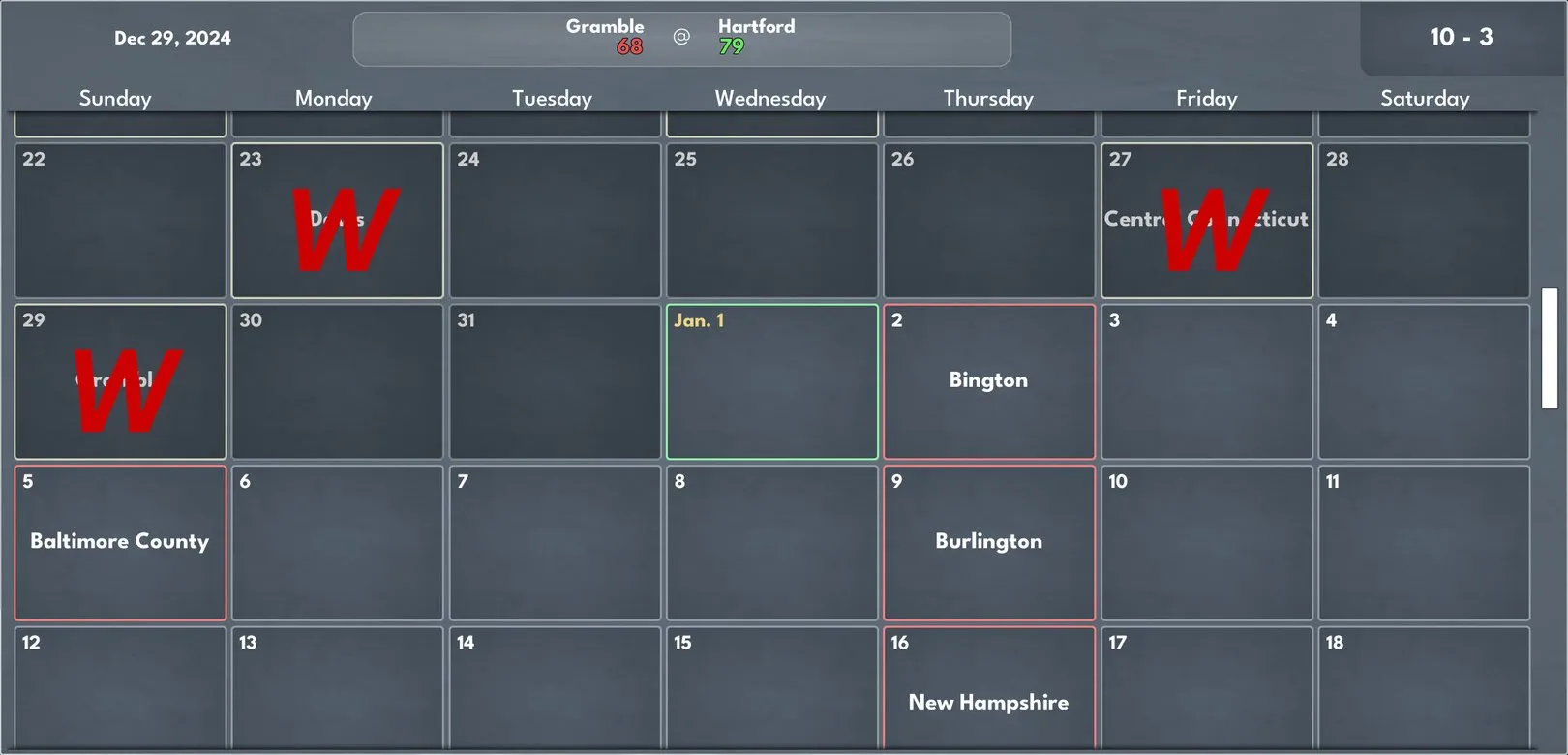 The calendar view: Hartford at 10-3 after beating Gramble 79-68, with conference games against Bington, Baltimore County, Burlington and New Hampshire ahead. The names show the game’s approach to licensing: real places, sometimes lightly altered. This and the 21-0 team overview below are separate official screenshots from different saves or seasons. Image: Lunacien / Steam store page.
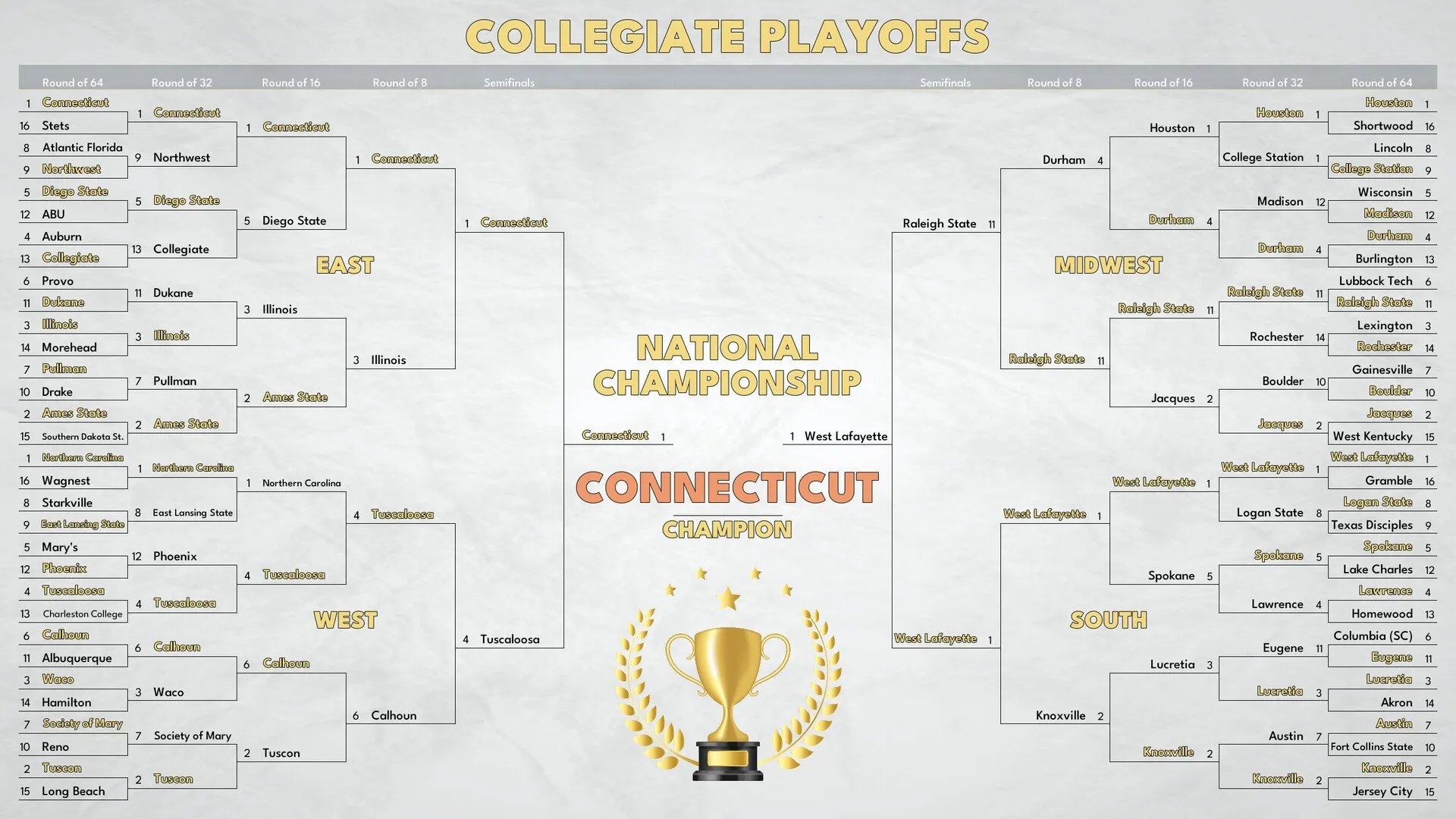 The “Collegiate Playoffs”: 64 teams, four regions, seeds 1 to 16. In this bracket the 11-seed Raleigh State reaches the semifinals and top seed Connecticut wins it all. A July patch fixed byes for fields that are not a power of two, which suggests tournament sizes can vary. Image: Lunacien / Steam store page.
The match engine
How results are calculated. College Basketball Manager is a text-first, possession-level simulation. The official live-game screen shows a running play-by-play log (“Mark Lakin MAKES THE GAME WINNING THREE!”), a 2D half-court with numbered dots for the ten players, live team stats and per-player box scores with minutes, stamina and fouls. After the game you get a full box score and a play-by-play tab.
What you can do live. The live screen has buttons for Call Timeout, Call Set Play, Sub Players, Pause and “Skip to 5:00 left”, plus offensive and defensive adjustment panels: choose a different offense or defense, move pace, three-point tendency, aggression, crashing the boards and help defense, or switch the press on. A Quick Sub panel lists bench players with their stamina. Since May, foul-trouble settings decide when players sit automatically.
What the preview tells you. The game preview screen is the most college-literate screen in the genre. It compares the two teams’ schemes, ranks every tendency nationally (pace in possessions per game, free-throw attempts, three-point attempts, offensive rebounds, fouls, opponents’ two- and three-point percentages), and adds NET rank, offensive, defensive and net efficiency, strength of schedule and records in Quadrants 1 to 4. In the real NCAA, the NET is “the primary sorting tool” for selection, and Quadrant 1 means home games against the NET top 30, neutral-site games against the top 50 and road games against the top 75. The game shows the same structure; we could not verify that it uses the same ranges.
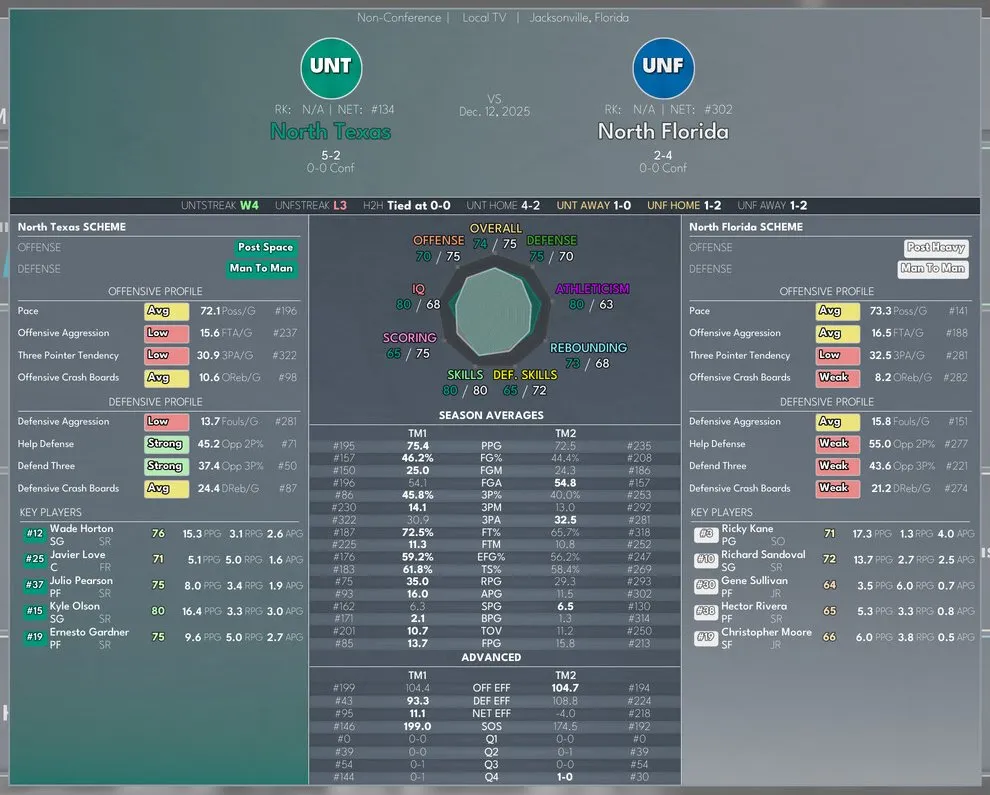 North Texas (NET #134, Post Space offense, man-to-man) against North Florida (#302, Post Heavy). Every tendency carries a national rank — North Texas is #322 in three-point attempts — and the bottom block lists efficiency, SOS and quadrant records. Image: Lunacien / Steam store page.
Realism evidence. No player or outlet has published a statistical audit of the engine, and we could not run one. The two official box scores give only a glimpse: a 68-67 title game in which Connecticut shot 48% and lost the rebounding battle 37-27, and a season opener in which Kennasa State scored just 52 points on 35.1% shooting. Both sit within the range of real college scores, which proves little.
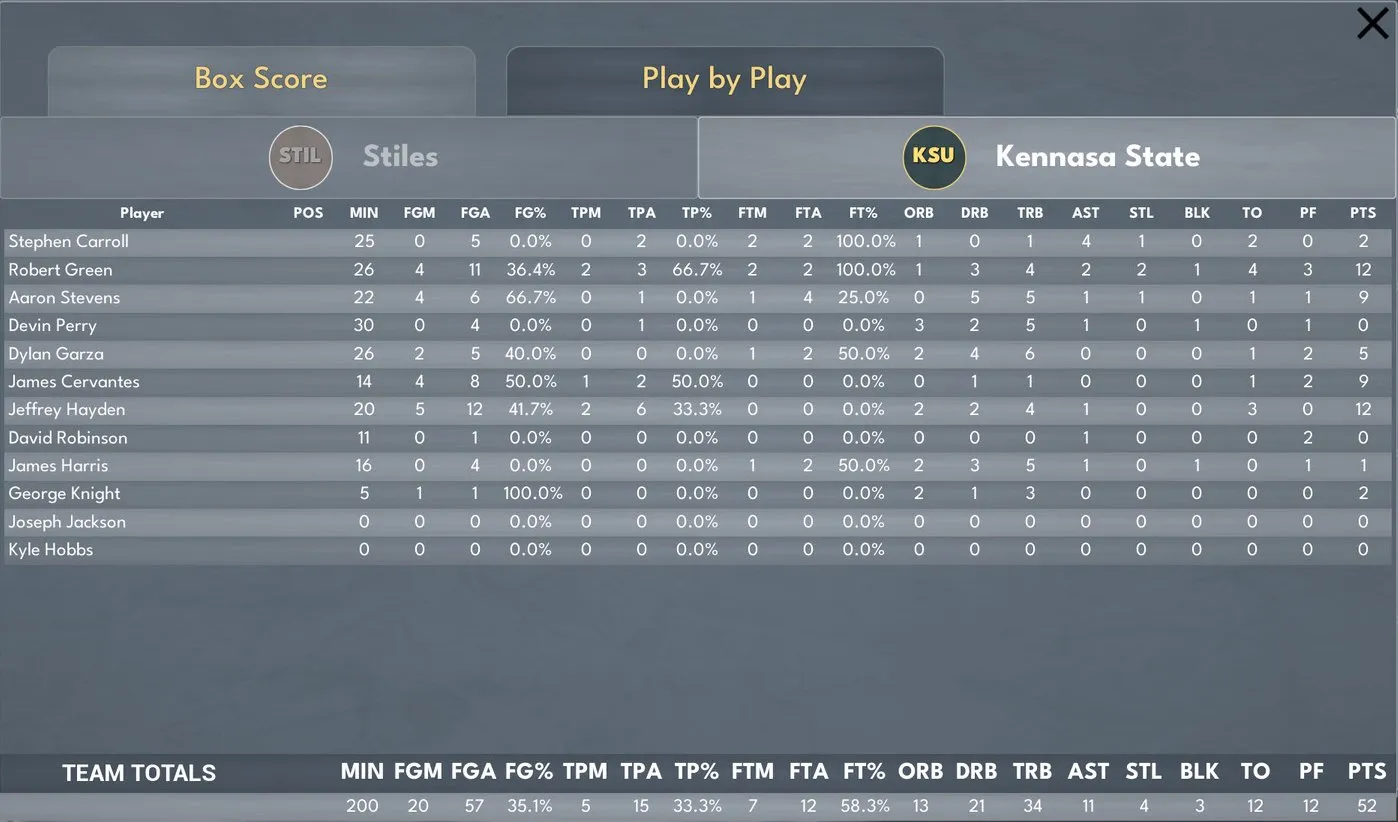 Kennasa State’s opener: 52 points, 20-for-57 from the field, 5-for-15 from three, 12 turnovers, ten players used. It is a classic box score; plus-minus is not shown. Image: Lunacien / Steam store page.
What the patch notes reveal. They are where the engine’s state is most visible, and they are admirably candid. In March, close and mid-range shooting ratings had been applied to the wrong shots. In May, game-to-game fatigue was not accumulating at all, three-point percentages were cut across the board and elite shooters were toned down. In July the developer added a distance-based ceiling on two-point accuracy because mid-range shots had been “nearly automatic for elite scorers”, and fixed help defense, wrong foul rates, low-aggression teams that didn’t slow down, man-to-man matchup assignments being discarded, and missed and-one free throws being counted as made. Four coaching skills “almost never worked”, and — the most significant — players had been getting no development from playing in games.
Known engine complaints. On the forum, players reported fouls “kind of out of control” (April), a free-throw display bug (March, during the demo), and asked for more variety in the play-by-play (“hook shots, jump hooks, runners”). Several report that the 2D court shows no player dots at all (see Known issues).
Our view. The engine’s design is strong: possession-level, driven by ten tendencies, with live intervention. Its calibration is the open question. None of this is unusual for Early Access, and the speed of the fixes is reassuring, but nobody — us included — can yet say how believable a ten-season save is. That is why the engine scores a 7.0, well below the coaching layer that drives it.
Coaching and tactics
This is College Basketball Manager’s best argument. Most basketball management games give coaches a depth chart and a slider or two; this one gives you a gameplan worth studying.
Systems. You pick a primary and a secondary offense and a primary and a secondary defense, plus a press. The official screenshots show offensive systems and practice sets called Pro Style, Off Ball Movement, Post Space, Post Heavy, Drive Kick and Zone Attack; defenses including Man to Man, Two Three Zone and a 2-3 Matchup Zone; and presses including Fullcourt Man to Man and Press Two Two One. A player review mentions a motion offense, and the patch notes mention a spread-offense coach skill. We could not find a complete list, so our feature sheet leaves the count blank.
Tendencies. Ten sliders from 0 to 100: on offense, crashing the boards, pace, pace consistency, three-point tendency and aggression; on defense, crashing the defensive boards, help defense, a hedge-screen threshold, defending the three-point line and aggression.
Situations. Six sub-menus: Usage, Late Game Situations, Timeouts, Double Teams, Intentional Fouling and Pressing. Plans can be saved as templates.
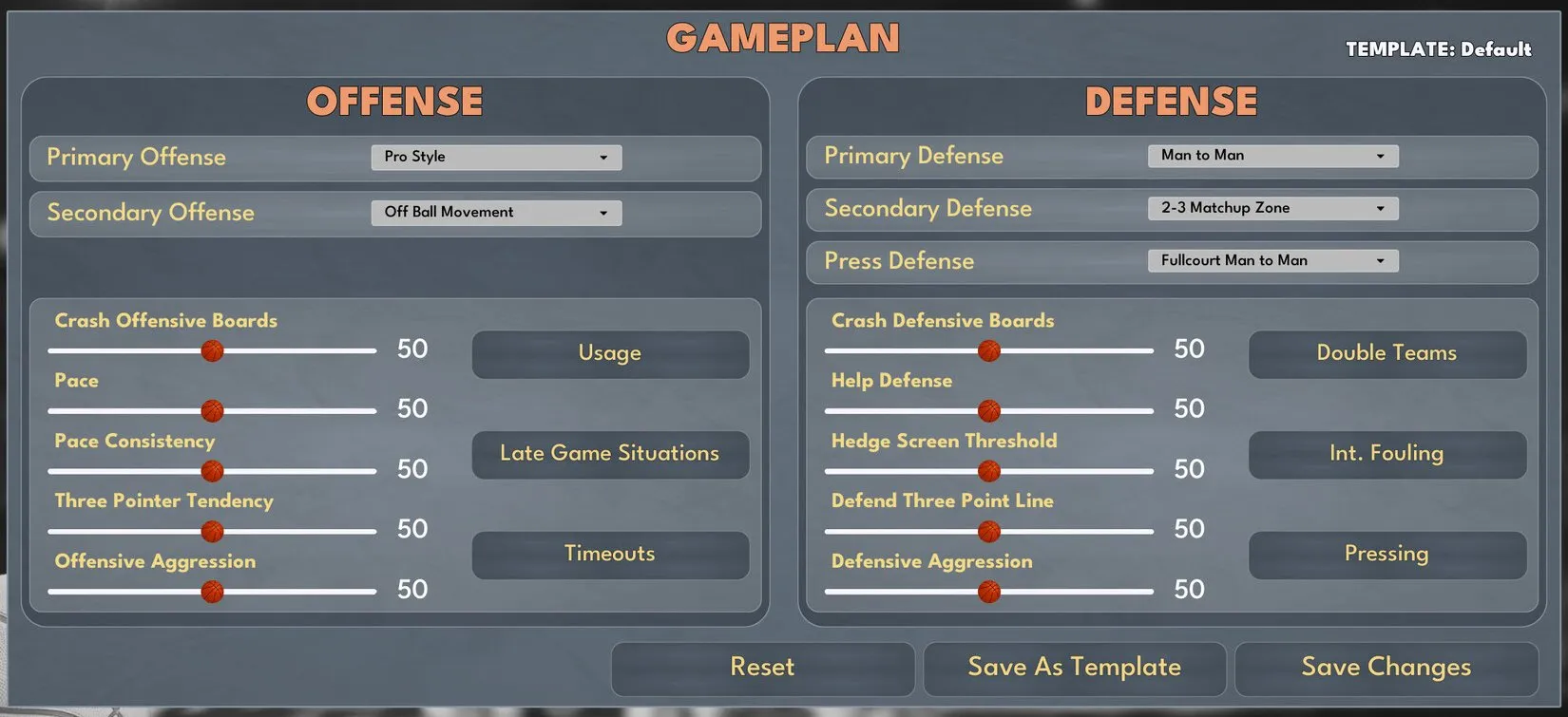 The gameplan: Pro Style with Off Ball Movement as the secondary offense, man-to-man with a 2-3 matchup zone as the secondary defense, a full-court man press, ten sliders at 50 and six sub-menus. Image: Lunacien / Steam store page.
Usage and roles. The Usage Gameplan sets a desired usage per player, next to his offensive and defensive ratings and all his attributes. Since May players can have separate offensive and defensive positions, and since July they start with preset ones. One long-time player still asked in July whether you can set an individual player’s shot mix (for example, a guard who mostly shoots threes inside a low-three-point offense); we found no evidence that you can.
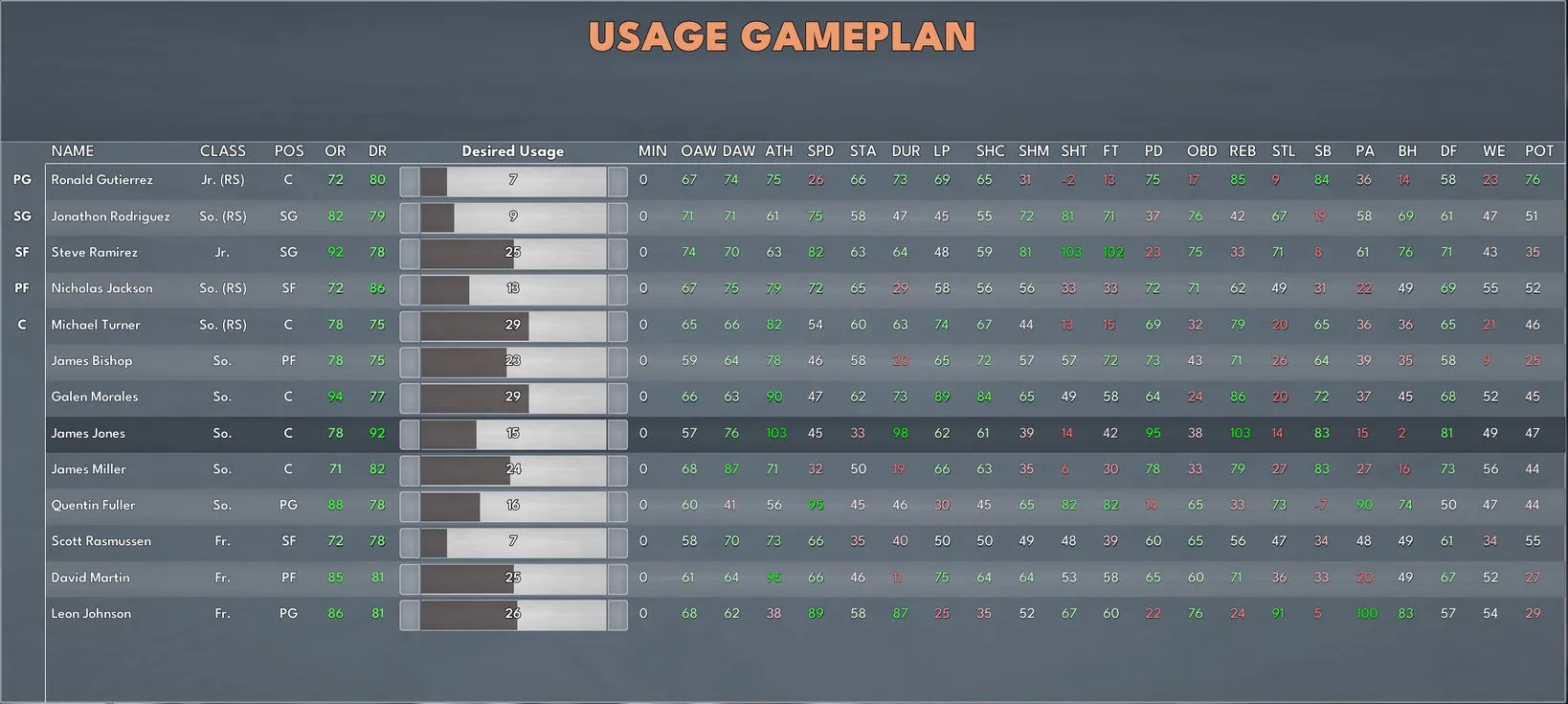 The Usage Gameplan for Hartford in the year 2116: desired usage from 7 to 29 per player, next to every rating. Ratings can pass 100 — Steve Ramirez shoots 103 from three and 102 from the line, James Jones has 103 athleticism and rebounding. Image: Lunacien / Steam store page.
Rotations. You can use a classic rotation with minutes per player, or the matrix rotation added in May 2026. It splits the game into twenty two-minute periods and lets you paint exactly who plays which position in each, with sub-out and sub-in foul thresholds, allowed positions per player and buttons for Copy 1H→2H, Regenerate and Ask Assistant. It is the kind of control college coaches actually have, and almost no management game offers it. Since June your custom matrix starts at tip-off instead of the first dead ball.
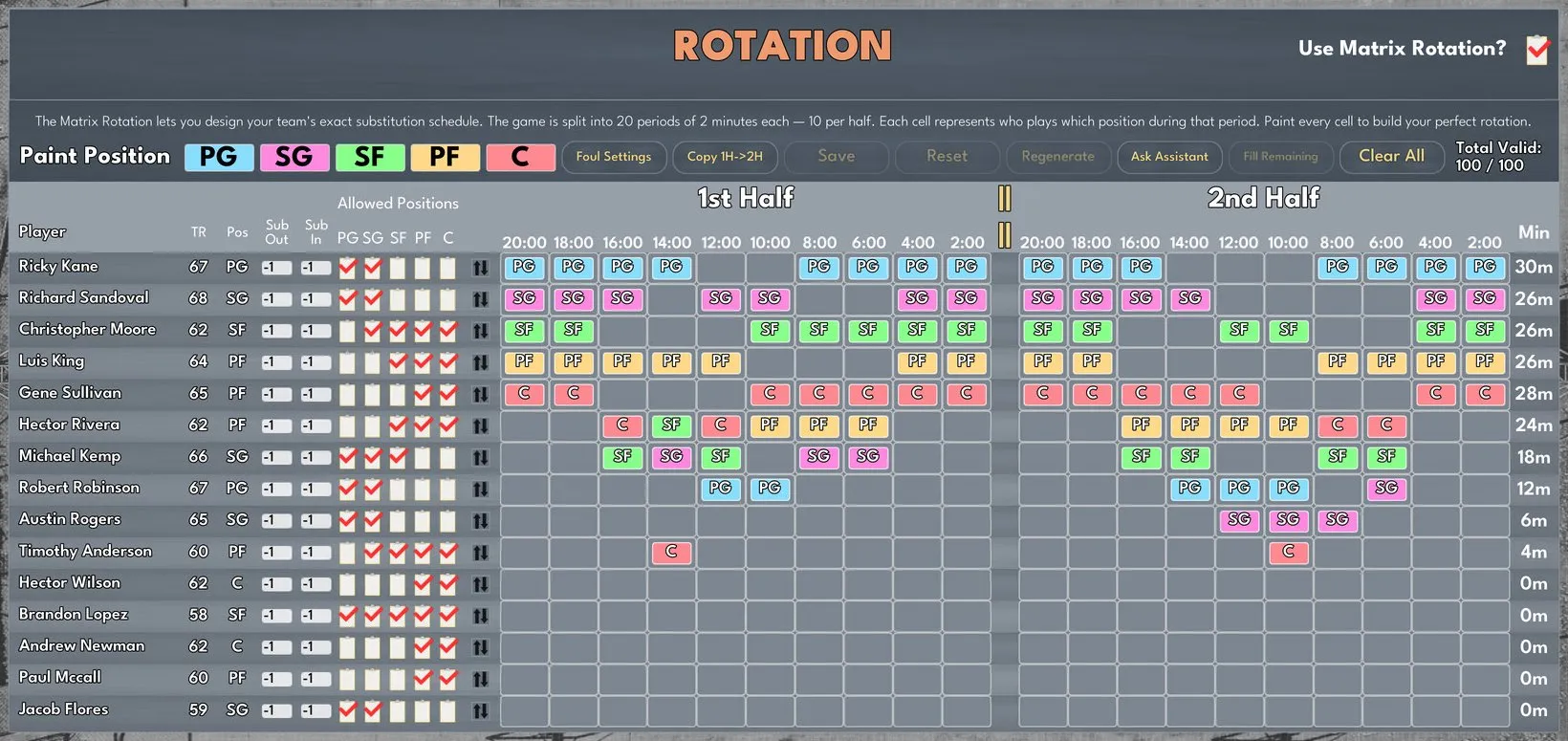 The matrix rotation: 20 periods, five positions, 100 of 100 slots filled. Ricky Kane plays 30 minutes at point guard, five players never leave the bench, and each player has allowed positions and foul-trouble sub thresholds. Image: Lunacien / Steam store page.
Practice. Each week you split practice hours between offensive and defensive sets, game prep, film, conditioning, strength and agility, and skill development. The screen states a maximum of 20 hours during the regular season, which mirrors the NCAA’s real in-season limit of four hours a day and 20 a week on countable athletic activities. Since June players can follow individual practice templates, and practising the sets you use matters: player development data is tracked per offensive and defensive set. A July fix made overworked weeks (heavy practice plus several games) cause ratings to decay, as intended, rather than improve.
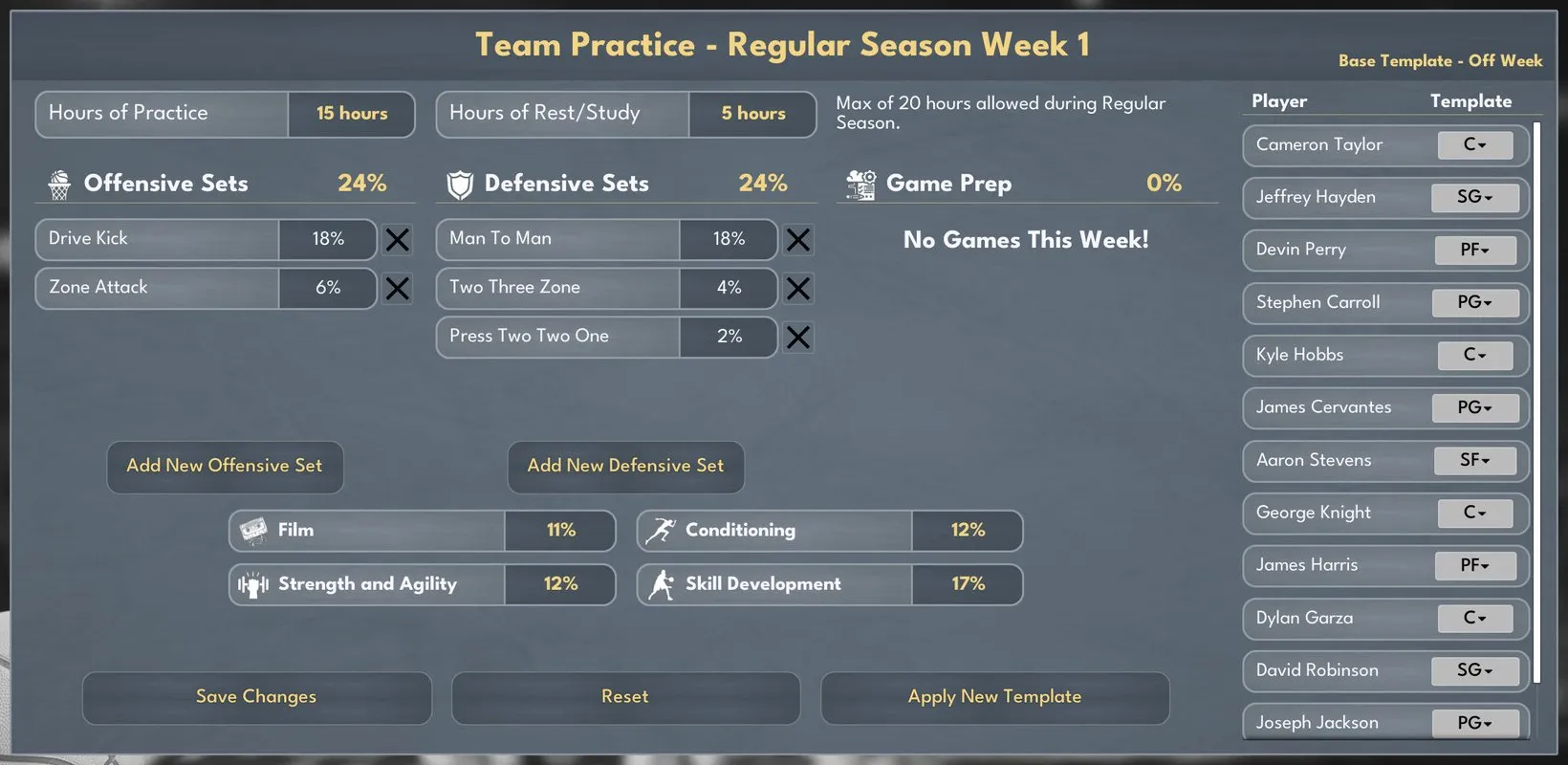 Week 1 for Kennasa State: 15 hours of practice and 5 of rest and study under the 20-hour cap, with 24% each on offensive and defensive sets, and a per-player template column on the right. Image: Lunacien / Steam store page.
Staff and the coach. You level up your own coach through skills, and you hire a staff whose roles have an “actual mechanical impact in-game”, as a March patch put it when it rewrote their tooltips. Skills named in the patch notes include Potential Reacher (up to about 10% faster development), the Potential, Work Ethic, Personality and Rating Unlockers, recruiting skills and a spread-offense skill. A “dysfunctional staff” penalty exists. The AI coaches adapt too: since May they revisit their rotations every four weeks and adjust their gameplans mid-season based on results.
What’s missing compared with the genre’s best. You choose named systems; there is no tool to design your own plays. Individual instructions are limited to usage and positions, with no documented shot-selection or defensive-assignment controls beyond double teams. We found no opponent-specific scouting report. And the in-game presentation is a 2D dot view, not the playable court of Hoop Land or the full 2D game of Draft Day Sports.
Players and ratings
The attribute model. The official recruit screen shows 21 ratings in six groups:
| Group | Ratings |
|---|---|
| IQ | Offensive Awareness, Defensive Awareness |
| Physical | Athleticism, Speed, Stamina, Durability |
| Scoring | Low Post, Shooting Close, Shooting Mid, Shooting Three, Free Throw |
| Defense | Post Defense, On Ball Defense, Rebounding, Stealing, Shot Blocking |
| Skills | Passing, Ball Handling, Drawing Fouls |
| Intangibles | Work Ethic, Potential |
The patch notes speak of “all 20 play-type ratings”; we could not tell which of the 21 they leave out. Players also carry an overall rating by position, offensive and defensive ratings (OR and DR), star ratings, and a rating in each offensive and defensive system they know: a July fix stopped recruits arriving with a Pro Style rating of 150 because the same familiar offense had been rolled twice.
Progression. Players develop through practice, through minutes played (which grow stamina and all 20 play-type ratings since the July fix), and through coaching skills. Work ethic drives development, and since March personalities set hard limits on it: a driven player can’t have terrible work ethic, a complacent one can’t have great work ethic. Redshirting exists, with the real limit on games played enforced since May.
Personalities and morale. Personalities named in the notes include Volatile, Competitive, Perfectionist, Driven, Confident, Complacent and Loyal, each with “a distinct mechanical fingerprint” since May. Satisfaction has five axes: contract, playing time, individual success, team success and, since May, School Fit — built from the grades of whatever the player cared about during recruiting, so a player who came for academics stays content even when minutes are tight. Since July, low morale slightly hurts on-court performance.
Chemistry. Added in May: the game tracks the minutes every pair of teammates spends together, builds career-long bonds that persist if they reunite at another school, and feeds assist, turnover and defense rates as well as team chemistry ratings. A 70-hour reviewer singled it out: chemistry “adds a flavor to how you build rotations.”
Scouting fog. Recruit ratings are question marks until scouted. Transfers are revealed by familiarity tier: players from your conference or schedule are better known than nationally known ones, and unknown transfers are mostly hidden. Your coaches’ scouting ability affects all tiers.
Injuries. Players have a Durability rating, but we found no documentation of the injury system itself, so we leave it out of the feature sheet.
Recruiting: the heart of the game
If College Basketball Manager has a heart, it is the recruiting board. The store page says it is built on thirteen “pitches”, each graded from A to F for your school. The official screenshot of a recruit already shows fourteen rows, and later patch notes refer to a separate grade for contract incentives, so the count has clearly grown during development. The fourteen in the screenshot are Feeling Wanted, Playing Time, Proximity to Home, Prestige, Conference Prestige, Coaching, Championship Contender, TV Exposure, Pro Potential, Academic Prestige, Stadium Atmosphere, Program Tradition, Campus Lifestyle and Athletic Facilities.
- Every recruit weighs pitches differently. Next to each grade, the game shows how important that pitch is to the player and how much he knows about your school. A recruit who barely knows you can’t be impressed by your strengths, so calls, tape and visits are partly about teaching him who you are.
- Ratings are hidden until you scout. Watching tape or calling a high-school or travel coach reveals ratings a few at a time. You can also buy national or regional reports. Since July they are deliberately less accurate, and buying several unlocks a “consensus” view.
- Time and money are the currencies. A 2024 development newsletter described a 40-hour coaching week shared between games, practice and recruiting, with each action assigned to a specific coach. Since July, flights scale with distance.
- The battle is visible. A tab ranks every school after the same player, with interest, weekly change, offers and visits used. Since June, “School Fit”, “Max Interest” and head-to-head “Lead” scores can be sorted on the board.
- Money talks — for some. Since July, 4- and 5-star recruits weight Pro Potential and Contract Incentives much more heavily; offers are graded against the recruit’s own asking price, partial offers count for something, and outbidding a rival gives a capped bonus. Recruits also lower their asking price more slowly as the season goes on.
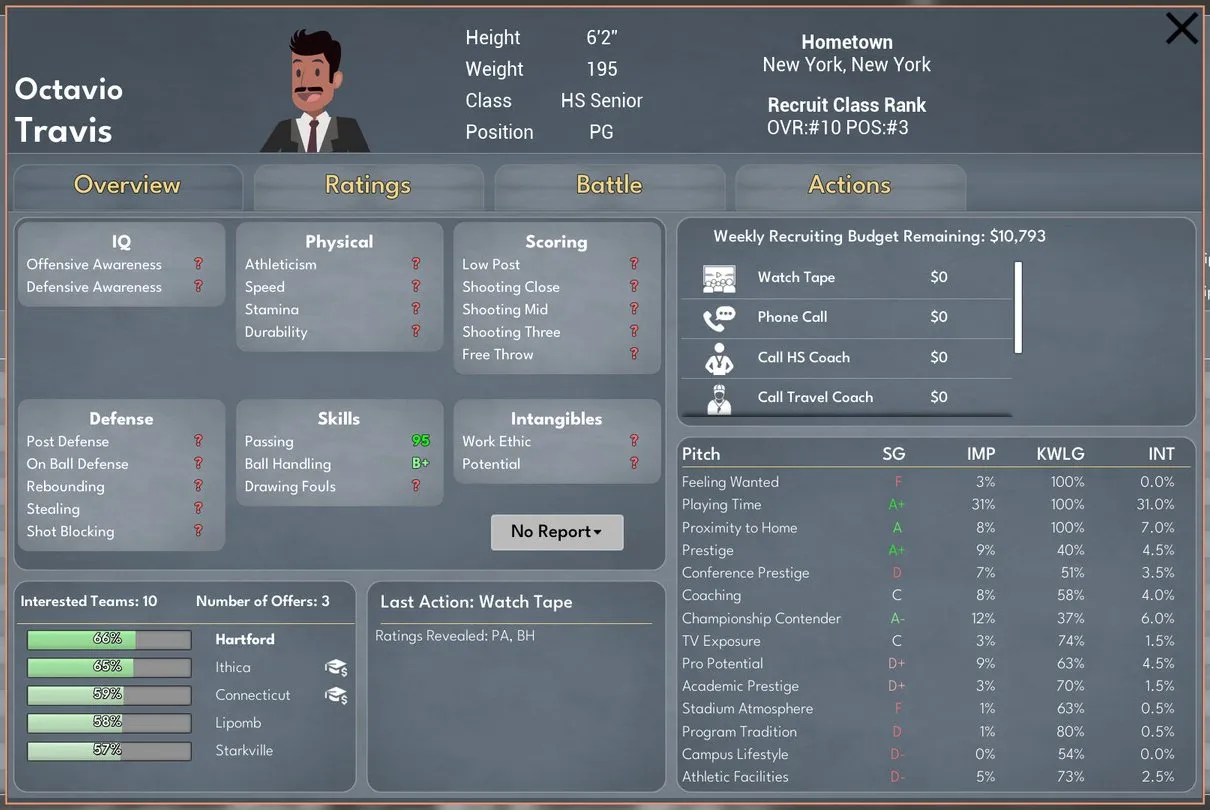 A top-10 point guard with only Passing (95) and Ball Handling (B+) scouted. Playing Time matters most to him (31%) and Hartford grades A+ there, while Feeling Wanted is graded F. The weekly recruiting budget is $10,793; watching tape and phone calls cost nothing from it. Image: Lunacien / Steam store page.
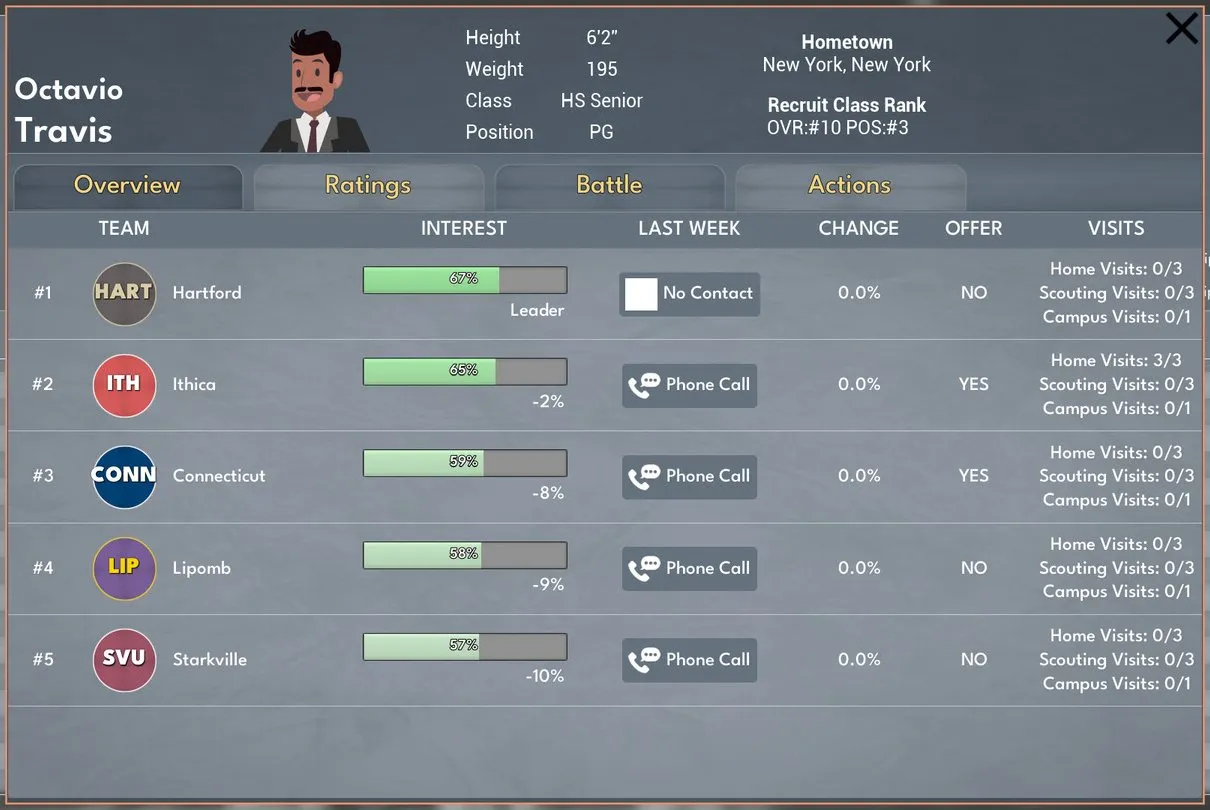 The battle for Octavio Travis: Hartford leads at 67% without an offer, while Ithica (65%, all three home visits used) and Connecticut have already offered. Visits are rationed: three home, three scouting, one campus. Image: Lunacien / Steam store page.
Who you can recruit. High-school seniors, junior college players and transfers, and since May international recruits from 22 countries — about 7% of each class — who can’t be watched in person. Since June, Canadian and Mexican recruits care about distance from home, while overseas ones don’t. Transfer portal players weight the pitch matching their reason for leaving: someone who transferred for minutes weighs playing time more heavily. Service academies and Ivy League schools can only sign incoming freshmen, can’t offer contract money and can’t redshirt players. Since June, being the first school to offer gives an interest bonus.
The portal. Players enter it when they are unhappy, and the developer has tuned it repeatedly: low-overall players became less likely to enter (May), upperclassmen and loyal personalities “stickier” (May), entries more frequent and more driven by minutes and money (June), and centers less overrepresented (July). A tracker shows how players who left your program perform for up to five years.
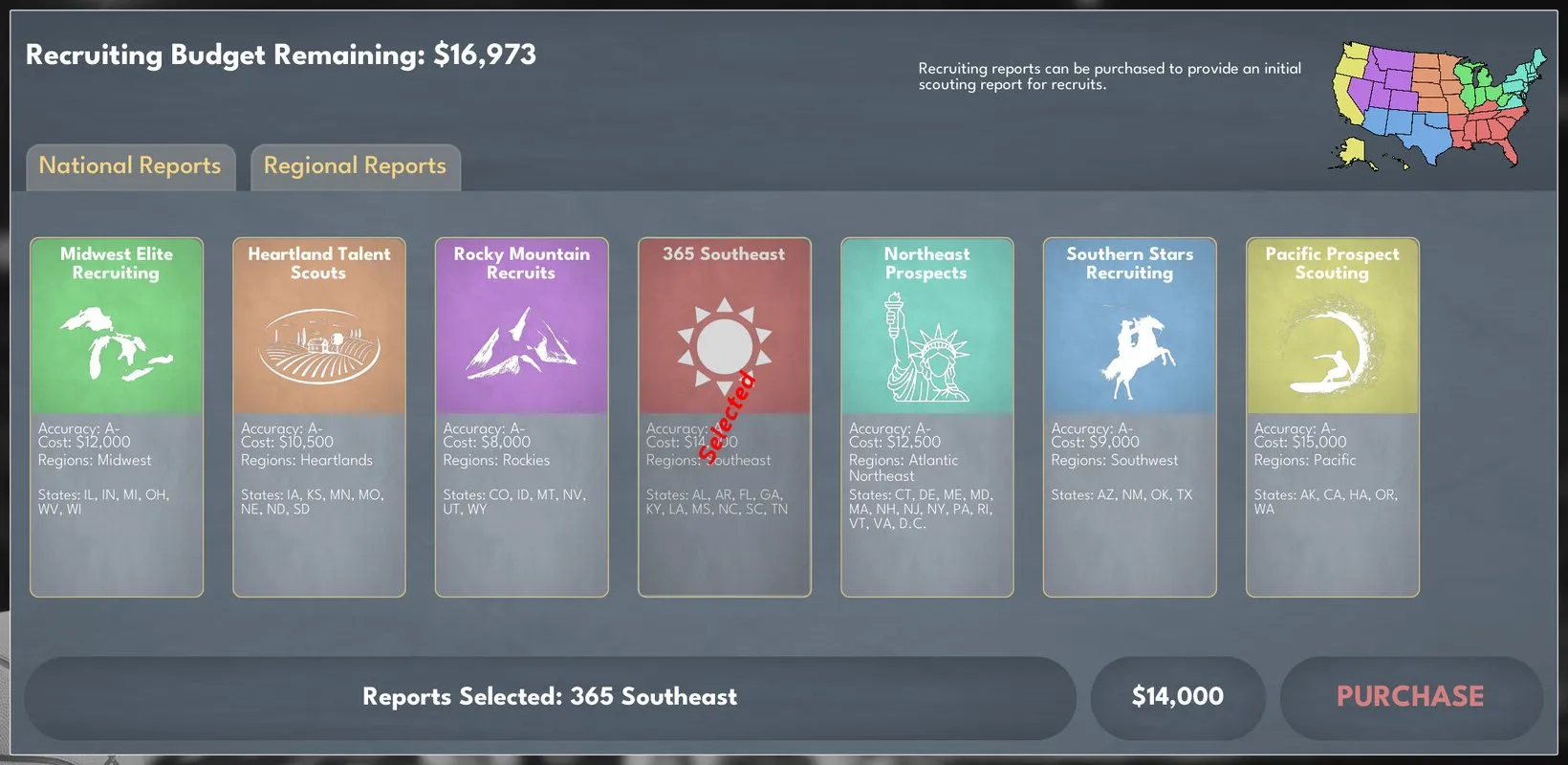 Regional scouting services, from $8,000 for Rocky Mountain Recruits to $15,000 for Pacific Prospect Scouting, each covering a set of states. Kennasa State has $16,973 left in its recruiting budget. Image: Lunacien / Steam store page.
There is an honest caveat. Several players found balance problems early on, most famously a flood of five-star centers. One thread from May claimed “easily 90% of 5 star recruits are consistently centers.” The July update rebalanced recruit generation by position and toned down big men late in long saves. Another thread (April) complained that a team losing two point guards still got an F for playing time when recruiting one; in July the developer fixed a playing-time grade that was “locked in at first contact” and departed players still counting as depth. We can’t confirm the result; we can say the developer took both seriously.
The front office, college edition
College Basketball Manager has no professional front office, by design: no trades, no salary cap or luxury tax, no rookie scale, no draft for you to run. Players declare for the pros, and the game tracks their pro careers and a pro Big Board (since May less biased toward athletic big men), but your levers are scholarships, money and minutes. What replaces the cap sheet is a set of budgets.
Scholarships and roster size. A scholarship breakdown by class and position sits on the team page; rosters top out at 15, with walk-ons filling gaps. A June fix stopped teams accumulating more than 15 players.
NIL and revenue sharing. According to GM Games’ listing, programs that opt into revenue sharing distribute NIL money across the roster, with budgets scaled to prestige and football revenue, and the AI can adjust contracts during the season if you let it. The patch notes add a chance for a program in surplus to opt in (March), the ability to raise an offer (May), a contract budget capped at the school’s revenue-sharing limit (June) and contract morale that scales with performance and development (July). In the real world, the House v. NCAA settlement allowed schools to share up to $20.5 million with athletes in 2025-26. The screenshots we saw show no dollar cap, so we can’t say how closely the game tracks that figure.
The athletic director. Each AD has a personality and Finance, Negotiation and Public Relations ratings. Your approval with him covers winning (weighted since May by your historical win percentage at the school) and program development (fixed in June after it was stuck near zero, and again in July when it cratered), while budget health decides whether he approves new staff positions. One early reviewer went 7-22 “for like three seasons in a row” without being fired; a July fix for coach approval resetting twice each offseason, which had led to “teams under-firing their coaches”, likely addresses that.
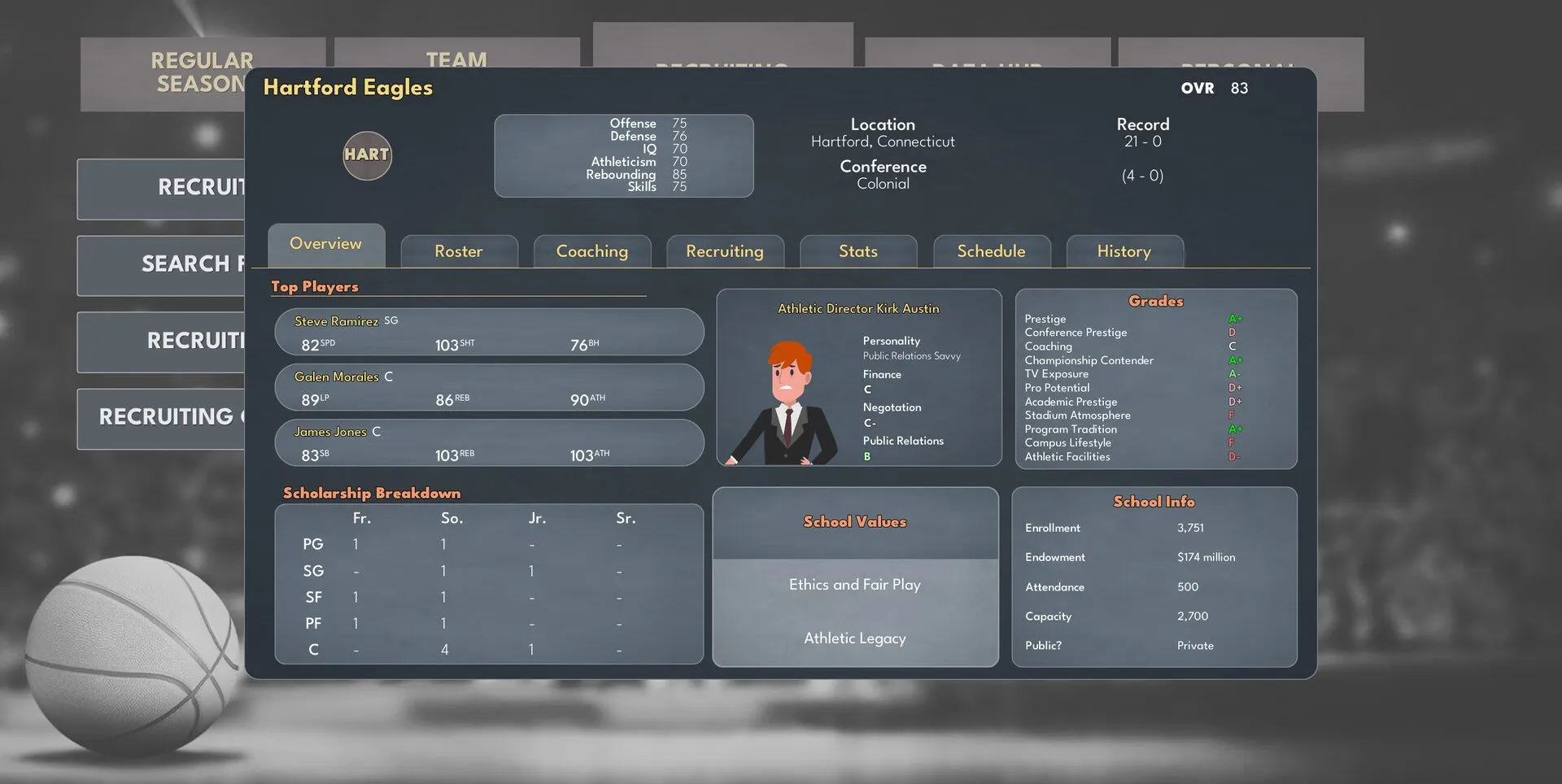 The Hartford Eagles at 21-0: an 83 overall, an athletic director with C finance and C- negotiation skills, a roster of mostly freshmen and sophomores, a private school with 3,751 students, a $174 million endowment and a 2,700-seat arena. Program Tradition is A+, Athletic Facilities D-. A separate official screenshot from the 10-3 calendar above, so the records don’t match. Image: Lunacien / Steam store page.
The job market. Elite CPU coaches can be hired by pro teams (May), opening jobs at top programs; unemployed coaches retire over time (June); you can star “Dream Jobs” to be alerted when they open; and since July hiring schools weigh results far more than tenure.
The money side lives in a Finances screen with six tabs:
| Revenue or cost line | What the game models (official screens and patch notes) |
|---|---|
| Tickets | Game and season ticket prices with a recommended range and projected sales; fan support split into hardcore, casual and fair-weather fans |
| TV deal | Annual value, value per team, years remaining, national and regional TV value, a dedicated streaming platform; since March the TV curve favors Power 5 conferences |
| Tournament units | Postseason money paid through the conference; since July, no ticket revenue for neutral-site playoff games |
| Boosters | Donors with expected donations, patience, difficulty and three priorities each |
| Game contracts | Home-and-home series and paid road games |
| Budgets | Contracts (NIL), recruiting and staff, program subsidy and deficit forgiveness; surpluses grow the budgets |
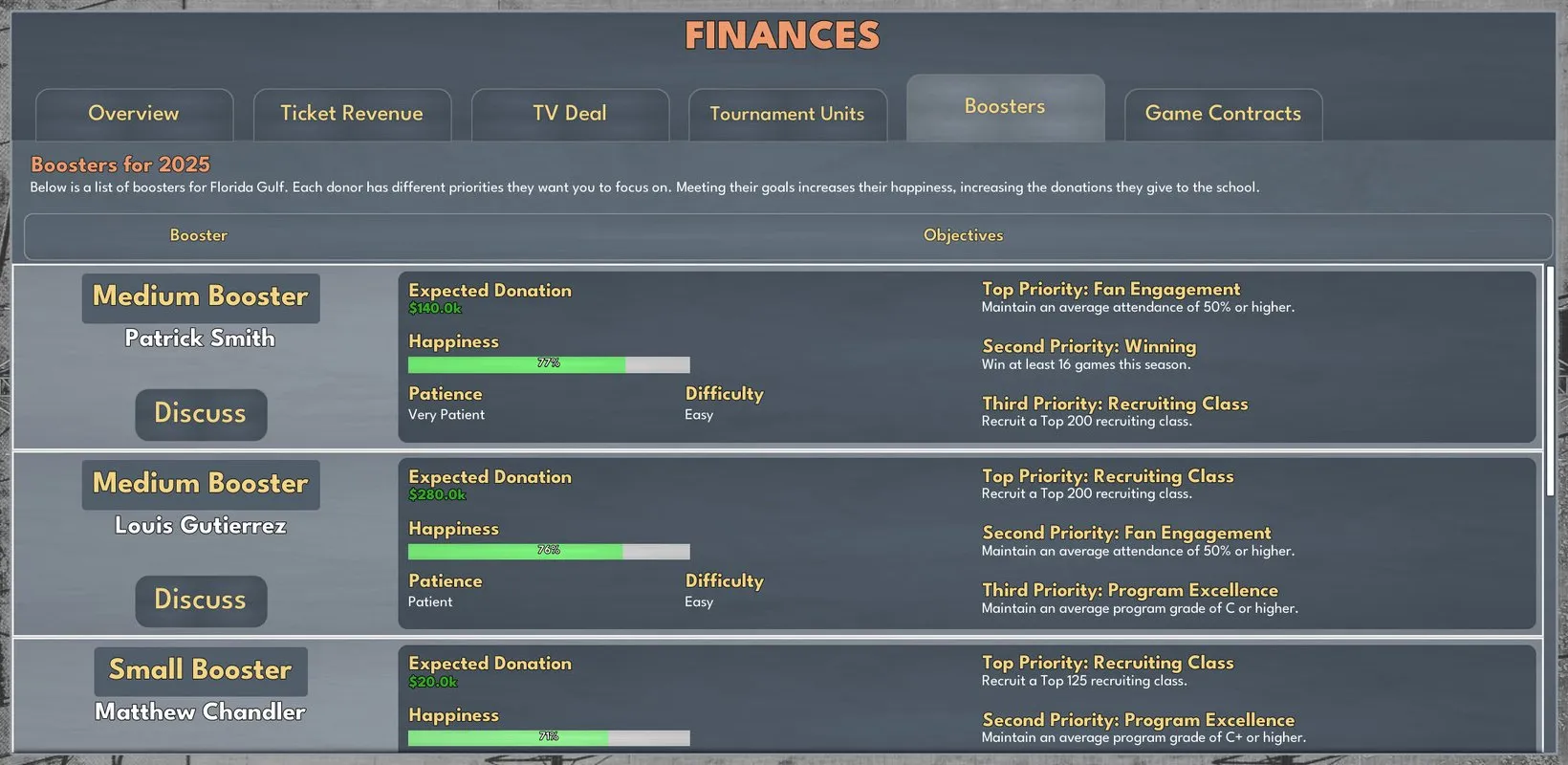 Florida Gulf’s boosters: Patrick Smith ($140k expected) wants 50% attendance first and 16 wins second; Louis Gutierrez ($280k) wants a top-200 recruiting class first. Keeping them happy keeps the donations coming. Image: Lunacien / Steam store page.
Our view. For a college game, this is the right front office: the constraints are budgets, people and expectations rather than a cap. The AD and booster layer gives losing a cost beyond the standings, and the TV and tournament-unit tabs make conference membership matter financially. What it can’t offer, by definition, is the trade-market chess of a pro sim.
World and longevity
Leagues and competitions. Division I-style conferences (the screenshots show the Colonial, Great Lakes and Southeast), conference tournaments, non-conference tournaments and the 64-team Collegiate Playoffs. We could not find the number of schools or conferences documented anywhere.
Licences. None. School names are real places, sometimes lightly altered — Connecticut and Illinois appear as is, but you also meet “Kennasa State”, “Ithica”, “Lipomb” and “Bington”. One player was pleased to find his Vermont Catamounts “represented (Burlington Wildcats)”. Player portraits are generic cartoons; one forum thread complained that “a 18 year old college freshman looks just like a age 50 plus balding coach.”
History and records. The store page promises team and league histories, past results, awards, coaching careers and records. Patch notes add five-year transfer tracking, percentage records that require minimum attempts (June), national award voting adjusted for strength of schedule (June), a corrected Most Improved Player and All-American teams by earned position (July), and player stats viewable past the year 2050 (May). One official screenshot is dated 2116.
Editor and modding. Since May you can load custom conference files to get accurate conference names; since 30 July 2026 mods install through the Steam Workshop, including “Universe” mods that bundle a whole set of mods. The underlying data are Excel files plus a mod_info.json file, which the game can generate. Players tag the game Moddable on Steam. Since June you can export all kinds of data from the Legacy menu.
Saves and long careers. Steam’s system requirements warn that disk space “depends on number of saves and length of simulation.” A May patch added a warning if save files are not writable. Save-related fixes include a “rare save-corruption bug” when taking a new job (June) and a season skipped by rapid clicks (July).
Longevity verdict. The design supports decades-long careers, and the developer has fixed the issues that break them as they surfaced. But the game is in Early Access, the developer hoped for “just a year” there, and as of 14 November 2026 the most recent Steam announcement is 107 days old. That isn’t abandonment — the gap between the demo and launch was much longer — but it is worth knowing before you buy.
Interface, platforms and performance
- Platforms. Windows only. Minimum specs: Windows 10, a Ryzen 3200G or equivalent, 4 GB of RAM, a Radeon RX 550-class GPU with 4 GB, DirectX 11 and 5 GB of storage. No macOS, Linux, console or mobile version is announced.
- Engine. Two official screenshots carry the window title “College Basketball Manager Preview [NetMode: Standalone 0] (64-bit/PC D3D SM5)”, the format Unreal Engine uses when running a game from its editor. That suggests, but does not prove, an Unreal-based game, which would explain the GPU requirement for a text sim.
- Languages. English only.
- Steam features. 45 Steam achievements (from Win a Game! to Undefeated Regular Season and Giant Killer), Family Sharing and Steam Workshop. The store page does not list Steam Cloud or controller support.
- Speed. We could not measure simulation speed, and no player has documented it.
- Accessibility. The most common interface complaint is readability. One 84-hour reviewer wrote that “the font is so small that I have trouble reading it at times”; forum threads ask for a larger font (“my eyes”, April) and a different color scheme (December 2025). We found no font-size option in the patch notes.
- Learning curve. Players consistently praise tooltips and the in-game guide. One 70-hour reviewer: “the game does a terrific job explaining concepts without overwhelming the player.” Since launch the recruiting screens gained rating filters, batch actions (“Call All”, “Watch All Tape”, May 2026), fit and interest sorts, a space-bar hotkey and a quick-action bar.
- Offline. As a single-player Steam game with no documented account requirement it should play offline, but we could not verify it, so we leave it out of the feature sheet.
Monetization, line by line
| Item | Price (US Steam, 14 Nov 2026) | What it gets you |
|---|---|---|
| College Basketball Manager (Early Access) | $9.99 | The full game; the developer says Early Access “will be discounted compared to the final release” |
| Demo | Free | A limited build first released for a Steam fest in April 2025; a forum post in March 2026 noted a “big difference” between the old demo and the Early Access build |
| DLC | None | No DLC is listed on the store page |
| In-app purchases, ads, subscriptions | None | Nothing is sold inside the game |
| Steam Workshop mods | Free | Community conference, team and universe mods |
| Steam Family Sharing | Included | Listed among the store page’s features |
Fairness verdict. Clean. You pay once and get everything; recruiting reports and staff are bought with in-game budget money, not real money. The only caveat is that the full-release price will be higher, so today’s $9.99 is the cheapest the base game is planned to be — and you are paying for a game that is still changing.
Update history and roadmap
| Date | Version | What changed |
|---|---|---|
| 21 May 2024 | — | Store page live and announcement press release |
| 2 Jul 2024 | Alpha | Closed playtest of a demo build (one season, no team switching) |
| 9 Apr 2025 | Demo | Public demo for Steam’s “Sport-acular” fest |
| 17 Mar 2026 | 0.7.x | Early Access launch at $9.99 |
| 18 Mar 2026 | 0.7.8 | Schedule and interface bug fixes |
| 25 Mar 2026 | 0.7.10 | Recruit rating filters, finance overview, fan support and TV money rebalance, close/mid shooting fix, satisfaction rebalance |
| 26 Mar 2026 | 0.7.11 | Recruiting crash fixes |
| 1 May 2026 | — | Matrix rotation, foul-trouble settings, new game preview, conference modding, international recruits, team chemistry, Dream Jobs, smarter AI rotations and gameplans, fatigue fix |
| 13–14 May 2026 | — | School Fit satisfaction, lower three-point percentages, draft declaration fix, portal rebalance, hotfix |
| 4 Jun 2026 | 0.7.16 | Data export, fit and interest scores, per-player practice templates, conference and national stat views, portal and recruit-generation rebalance |
| 6 Jun 2026 | 0.7.17–0.7.18 | Sorting, save-corruption fix, award voting by strength of schedule, recruiting board fixes |
| 30 Jul 2026 | — | Steam Workshop and Universe mods, plus a long balance pass: development from games, coaching skills, foul rates, help defense, center balance, recruiting money grades, coaching reputation and hiring |
Roadmap. The Early Access FAQ lists conference realignment, rivalries and Steam Workshop support (now delivered). The launch post adds athletic facility buildout, conference invites and coach recruiting networks. The developer hoped to spend “just a year” in Early Access, which would mean leaving around March 2027. No public roadmap gives dates.
What players say
As of 14 November 2026, all 20 Steam user reviews are positive, all written during Early Access; Metacritic lists no critic or user reviews. It is a small sample, but a consistent one.
What they love.
- Depth: a 21.5-hour reviewer (21 March) wrote that its “depth of mechanics blows out every other college basketball sim” and compared it to Football Manager (review).
- Comparisons with classics: “Awesome and scratches the sports GM itch as much as OOTP for me” (50 hours, 30 March, review); a 23.9-hour player called himself “a college basketball dork” who loved College Hoops 2K8 (review).
- The low-major grind: “an extreme challenge to take a bottom feeder team to the Big Dance in 5 years” (70 hours, 20 May, review).
- The developer: “Implements reasonable suggestions within a day or two” (23 hours, 25 March, review).
What they temper.
- “Not as in depth as Football Manager or Out of the Park Baseball, but for a first entry and being early access…” (22.6 hours, 17 March, review).
- Presentation: “it’s kind of bland right now at points” (23.9 hours, 30 March); another reviewer wants “more dynamic or unique cosmetics” (10 May, review).
- Readability: “the font is so small that I have trouble reading it at times” (84 hours, 8 July, review).
- Career pressure, early on: a player went 7-22 for three seasons and wasn’t fired (18 hours, 5 April, review).
There are no negative Steam reviews to quote, so the critical voice lives on the forum, covered next.
Known issues and bugs
All from the Steam forum and the developer’s own patch notes; status as of 14 November 2026.
| Issue | Reported | Status |
|---|---|---|
| No player dots on the 2D court during games | Thread from 6 Apr 2026, replies until 19 Oct | Open; a player answered it is a known bug |
| Can’t substitute when a player fouls out | Mar 2026 (demo) | Fixed in 0.7.10 (25 Mar) |
| Can’t make subs in some games | 18 Mar and 4 Jun 2026 | No fix confirmed in the notes |
| Fouls “out of control” | 10 Apr 2026 | Foul rates fixed on 30 Jul |
| Too many five-star centers | 22 May 2026 | Rebalanced on 30 Jul |
| Playing-time grade wrong in recruiting | 8 Apr 2026 | Fixed on 30 Jul |
| All jersey numbers 0 | 17 May 2026 | Fixed in 0.7.16 (4 Jun) |
| A whole season skipped after “advance to next season” | 4 Jul 2026 | Fixed on 30 Jul |
| Freeze after redshirting a player | Feb 2026 (demo) | Redshirt rules changed in May; the freeze is not mentioned |
| Portraits look the same for players and coaches | Mar and May 2026 | Portrait files shrunk in May; variety still requested |
| Unanswered forum questions | 22 Apr 2026 | Support is on Discord, linked from the store page |
On that last point, one player wrote in April: “I see a lot of questions asked and nothing has responses.” In October another advised: “talk about this over on the discord you will get a much faster answer.”
Tips for your first season
- Read the in-game guide first. Reviewers consistently cite it; one says it helps “learn what types of players they need, for example, for their motion offense.”
- Use batch actions to build knowledge. “Call All” and “Watch All Tape” (added in May) raise what recruits know about you and reveal ratings across your whole board in one click.
- Offer early. Since June, the first school to offer a recruit gets an interest bonus.
- Check the asking price before you offer. Since July the recruit popup shows his expected contract and a tooltip with the grade each offer would earn; partial offers still count.
- Buy reports where you recruit. Regional reports are cheaper than covering the country ($8,000 to $15,000 in the official screenshot), and since July several reports combine into a more accurate consensus.
- Recruit for fit, not just stars. Players who joined for the pitches they care about stay happy through School Fit, and the board can now be sorted by fit and interest.
- Mind the minutes. Players expect playing time — volatile and competitive personalities more so; high-pace teams lower expectations; low morale now hurts performance.
- Schedule for money at a small school. As one 70-hour player describes it, money games against powerhouses keep a low-major afloat, at the cost of some ugly losses.
- Set foul-trouble rules. Sub-out and sub-in thresholds save you from losing starters early.
- Install a Universe mod if names bother you. Since July, Workshop mods load when you start a Legacy, and community conference files can restore accurate names.
Against the alternatives
College Basketball Manager is one of two games we have reviewed built entirely around college basketball; the other, WhatIfSports’ browser-based Hoops Dynasty, is an online subscription game where you recruit against other humans. The closest single-player commercial rival, Wolverine Studios’ Draft Day Sports: College Basketball 2026, is a separate $39.99 Windows product we have not reviewed; its store page also promises NIL strategy and the transfer portal. Campus Legends College Basketball ($4.99, Early Access) offers 192 teams, or up to 384 in custom leagues. Among the games we have reviewed:
| College Basketball Manager | Hoop Land | Draft Day Sports: Pro Basketball 27 | Basketball GM | |
|---|---|---|---|---|
| Focus | College head coach | College and pro sandbox | NBA-style GM and coach | NBA-style GM |
| College features | Full: recruiting pitches, NIL, portal, AD, boosters | Campus Mode (beta since Oct 2026) | Link to the college game | None |
| Engine | Text and 2D dots, possession-level | Playable, 2D | 2D and text | Text, possession-level |
| Coaching depth | Very high | Low | High | Low |
| Platforms | Windows | iOS, Android, Windows, macOS | Windows | Browser, Android |
| Price model | $9.99 one-off | Free with a $4.99 unlock on mobile; $14.99 on Steam | $39.99 | Free with ads; optional subscription |
| Multiplayer | No | Same-device only | No | No |
| Our score | 7.7 | 7.8 | 8.2 | 9.0 |
- Hoops Dynasty is the online alternative: real schools, Divisions I to III and a recruiting war against other people, in a browser and on a subscription (review).
- Hoop Land is the friendlier, broader package: you can play the games yourself, and its Campus Mode is a lighter college GM game inside a college-to-pro universe (review).
- Draft Day Sports: Pro Basketball is Wolverine’s professional sim, with the cap sheet and trade market college hoops lacks (review).
- Basketball GM is the free, browser-based front-office benchmark; it can run custom leagues but has no recruiting (review).
- Pro Basketball Manager is the licensed European club and national-team alternative (review).
- BuzzerBeater and Swish & Dunk are online leagues against real managers (BuzzerBeater, Swish & Dunk; disclosure: Swish & Dunk is developed by our founder).
If what you love about basketball is March, signing day and a coach on the hot seat, College Basketball Manager is the single-player game built entirely for that.
Our take
College Basketball Manager gets the most important thing right: it understands that college basketball is a recruiting and retention game first and a tactics game second, and it builds both layers with real care. The pitch system, the NIL budgets, the portal motives, the athletic director and the boosters are not decorations. They are the levers a modern college coach actually pulls. Add the matrix rotation and the gameplan, and you have a coaching sim deeper than most professional ones, for ten dollars.
What impresses us most is the specificity. Service academies that can’t pay players. International recruits who don’t care how far away home is, unless home is in Canada or Mexico. Fans who drift between hardcore and fair-weather. A game preview built around NET and quadrants. These are details you only put in a game if you watch a lot of college basketball, and they add up to a world that feels right.
It is also exactly what its label says: Early Access from one developer. The patch history shows a game whose core numbers were still being corrected four months after launch, the 2D court can go blank, the fonts are small, the portraits are generic and many school names are fictionalized. Our 7.7 is a score for what is documented today — an excellent coaching and recruiting design (9.0 and 8.5) held back by an engine still being calibrated (7.0) and a rough interface (6.5) — not a forecast.
Our wish list. The developer’s own roadmap first: conference realignment, rivalries and facility upgrades. Then a font-size option and a fix for the court view. A published balance check, even a simple table of league averages per season, so players can trust long saves. Individual shot tendencies. Better portraits. And a Mac version, so more of the people who fill out brackets every March can try it.
Who should skip it. Anyone who wants to run an NBA franchise, anyone off Windows, and anyone who will be frustrated by a game whose rules change with each patch. Everyone else who loves college hoops should at least try the demo — and keep an eye on the next update.
Sources
Official (Lunacien on Steam)
- Steam store page, Early Access FAQ and system requirements
- Free demo
- All announcements and patch notes
- Store page live (21 May 2024)
- Alpha newsletter and closed playtest (2 Jul 2024)
- Sport-acular Steam Fest demo (9 Apr 2025)
- Early Access release (17 Mar 2026)
- 0.7.8 (18 Mar 2026), 0.7.10 (25 Mar), 0.7.11 (26 Mar)
- Matrix rotation, international recruits, chemistry (1 May 2026)
- Bugfix and balance update (13 May), hotfix (14 May)
- 0.7.16 (4 Jun 2026), 0.7.17 (6 Jun), 0.7.18 hotfix (6 Jun)
- Steam Workshop update (30 Jul 2026)
Stores
- Steam user reviews for College Basketball Manager
- Draft Day Sports: College Basketball 2026 on Steam
- Campus Legends College Basketball on Steam
Press and specialist sites
- Games Press announcement (May 2024)
- Game Developer press release (May 2024)
- GM Games listing
- Metacritic
Community (Steam forum threads)
- No graphics on the court, Can’t make subs, Foul trouble, Fouling, Free throws, Play by play
- So many centers, Recruiting playing time, Prestige, Bug: redshirting
- Game skipped a year, All player numbers 0, Player pictures, Player portraits
- Larger font option, Change the color scheme, Demo, Mod for current NCAA teams, Current teams and schools, Great game – initial thoughts
Data and real-world rules
Analysis by category
Match engine
Weight 22%7.0A possession-level text sim with a 2D court view, play-by-play, box scores and college metrics such as NET and quadrant records. Promising, but still being tuned: patches in 2026 corrected swapped close and mid-range ratings, three-point rates, foul rates, help defense and missing game-to-game fatigue.
Coaching & tactics
Weight 12%9.0The standout. Primary and secondary offense, man, zone and press defenses, ten tendency sliders, per-player usage, double teams and intentional fouling, a 20-period matrix rotation with foul-trouble rules, and practice plans that respect a 20-hour week. In-game you can call timeouts, set plays and subs.
Players & development
Weight 18%8.5Recruiting runs on graded pitches weighted by each recruit’s priorities and his knowledge of your school, with ratings hidden until you scout or buy reports. High school, JUCO, international and portal players, personalities, chemistry and a five-axis satisfaction model all feed back into who stays.
Front office & salary cap
Weight 14%8.0No salary cap, but budgets everywhere: NIL contracts within a revenue-sharing limit, recruiting and staff budgets, new staff positions that need the athletic director’s approval, ticket prices, TV deals, tournament units and boosters with their own goals. Scheduling money games is a real financial decision.
League & world
Weight 10%7.0A 64-team national tournament with regions, conference tournaments, awards, records and coaching careers. Many school names are fictionalized, conferences can be renamed by mods, and realignment and rivalries are not in yet.
Interface & UX
Weight 10%6.5Dense, tooltip-heavy screens with an in-game guide that players praise, plus a long list of recruiting filters and sorts added since launch. Fonts are small and a long-standing bug can hide the player dots on the 2D court.
Longevity
Weight 7%7.0Legacy Mode careers stretch across decades, and the developer posted ten updates and hotfixes between launch and July 2026, fixing crashes, save corruption and a skipped-season bug. It is still Early Access, with a stated target of about a year.
Business model
Weight 7%8.5$9.99 on Steam with no DLC or in-app purchases and a free demo. The developer says Early Access is discounted compared with the final release.
Weighted average of the criteria: 7.7
Features
Game type
- Genre
- Management simulation
- You play as
- Head coach
- Players & teams
- Fictional
- League structure
- College
Match engine
- Simulation model
- Possession by possession
- Match view
- Box score, Text play-by-play, 2D
- Watch matches live
- Yes
- In-game decisions (timeouts, subs)
- Yes
- Advanced stats (PER, TS%, +/-)
- Yes
- Fatigue
- Yes
- Fouls & foul trouble
- Yes
Coaching & tactics
- Zone defense
- Yes
- Full-court press
- Yes
- Rotations & minutes
- Yes
- Individual player instructions
- Yes
- Opponent game plan
- Yes
- Team training
- Yes
- Individual training plans
- Yes
- Staff (assistants, scouts, medical)
- Yes
Players
- Ratings per player
- 21
- Hidden potential
- Yes
- Progression & aging
- Yes
- Personalities & traits
- Yes
- Morale & playing-time demands
- Yes
- Team chemistry
- Yes
Roster building
- Scouting (hidden ratings)
- Yes
- Contract negotiation
- Yes
- Trades
- None
Front office & economy
- Salary rules
- Club budget (European style)
- Club finances
- Yes
- Ticket pricing
- Yes
- Arena & facilities upgrades
- No
- Owner / board goals
- Yes
- You can be fired
- Yes
- Job offers from other clubs
- Yes
- Fan satisfaction & attendance
- Yes
League & world
- Season awards
- Yes
- League history & records
- Yes
- Mods / roster import
- Yes
Platforms & tech
- Languages
- 1
- Tutorial / onboarding
- Yes
- Data export (CSV / JSON)
- Yes
Monetization
- How it makes money
- Nothing: no ads, no purchases
Frequently asked questions
Is College Basketball Manager free?
- No, College Basketball Manager is a paid game.
On which platforms can you play College Basketball Manager?
- College Basketball Manager is available on Windows.
Is College Basketball Manager multiplayer?
- No, College Basketball Manager is a single player game: you play against the computer.
Does College Basketball Manager have real players and teams?
- No, College Basketball Manager uses fictional players and teams.
Does College Basketball Manager have a salary cap?
- Not a salary cap: College Basketball Manager uses a club budget, European style.
Who develops College Basketball Manager?
- College Basketball Manager is developed by Lunacien.
Is College Basketball Manager worth playing?
- The most college-specific coaching sim we have seen: a 14-row recruiting pitch system, real NIL and revenue-sharing budgets, a deep gameplan and minute-by-minute rotations. It is still Early Access, Windows-only and rough around the edges, but at $9.99 it is the college hoops manager to watch. (7.7/10)
What are the best alternatives to College Basketball Manager?
- The best alternatives to College Basketball Manager are Basketball GM (9.0/10), Draft Day Sports: Pro Basketball 27 (8.2/10), and NBA 2K27 – MyNBA (8.2/10).